How to Exceed Your Sales Quota, and Recover When You’re Behind
A practical perspective for connecting this idea to your revenue team’s next move.
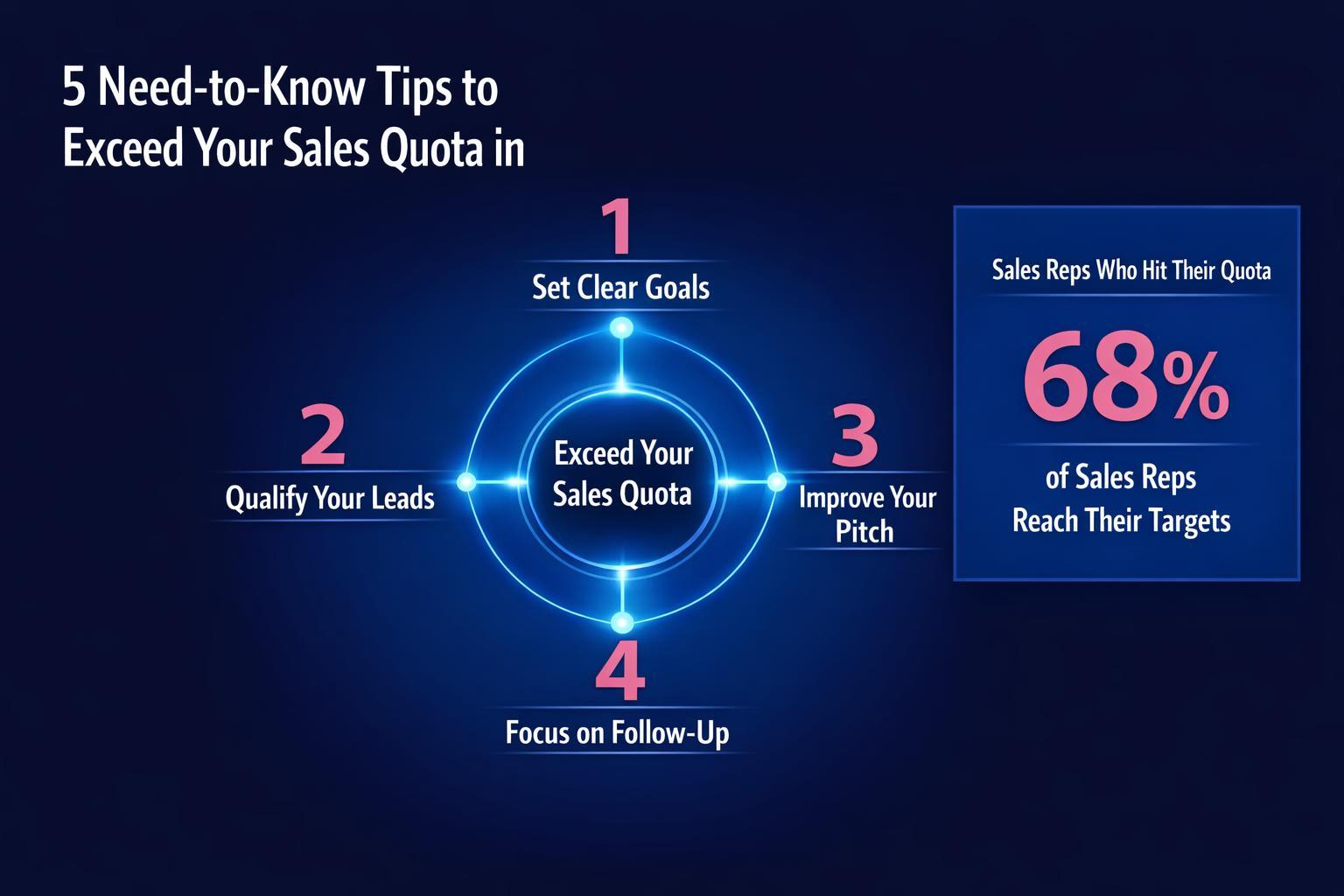
To exceed your sales quota, work backwards from the number: calculate the gap, build enough qualified pipeline to cover it at your real win rate, spend time only on deals with buyer engagement, reach the whole buying committee, and agree a dated plan with the buyer so deals close on time instead of slipping.
Exceeding quota puts you in a minority, so the method matters more than effort. This guide covers the quota math, five moves for sellers and the managers who coach them, a recovery plan for when you are behind, and what sales leaders can change so more of the team gets over the line. It applies to any quarter or fiscal year; the dated third-party research it cites was published between February 2023 and June 2026, and Revspire’s own benchmarks cover October 2025 to September 2026.
Last updated: 16 October 2026
What percentage of sales reps hit quota?
Fewer than half, in most recent studies. In The Bridge Group’s AE Models, Motions & Metrics report (June 2026), a survey of 158 B2B companies run in the first half of 2026, 48% of account executives were at quota, down from 51% in 2024. Studies built on other data land lower still, because each one measures something different:
Source (date)
What it measured
Finding
The Bridge Group, AE Models, Motions & Metrics (June 2026)
Survey of sales, RevOps and finance leaders at 158 B2B companies, Q1-Q2 2026
48% of reps at quota, down from 51% in 2024
Ebsta, 2025 GTM Benchmarks (April 2025)
$48 billion of pipeline data plus a survey of 2,000 CROs
78% of sellers missed quota in 2025, up from 69% in 2024
Everstage, Sales Quota Attainment Benchmarks 2026 (undated page)
Commission data on 25,112 quota carriers in 80+ countries
Median AE attainment 61.7%; 77.2% of AEs missed quota
Ebsta and Pavilion, 2023 B2B Sales Benchmark Report (February 2023)
3.2 million opportunities at 364 companies, 2022 data
29% of salespeople made quota by Q4 2022
A leader survey, CRM pipeline data and commission records will never agree exactly, but they point the same way. Two details matter more than the headline. First, attainment is concentrated: in Ebsta’s 2024 B2B Sales Benchmarks H1 update (July 2024), 16% of reps contributed 83% of revenue. Second, quotas are rising faster than pay. The Bridge Group’s 2026 report puts the median AE quota at $960K and the quota-to-OTE ratio at 4.6x, up from 4.2x in 2024, and says more companies now sit in the 0-30% attainment range.
How do you calculate quota attainment and your gap to quota?
Quota attainment is closed-won bookings credited to you in the period divided by your quota for the period, times 100. A rep who closes $210K against a $240K quarterly quota is at 87.5%. To plan for exceeding quota, you need three more numbers:
- Gap to target = your target (quota, or quota plus the overachievement you are aiming for) minus closed-won to date.
- Pipeline needed = gap divided by your win rate on qualified deals. Use your own trailing four-quarter rate, not a company average.
- Closeable pipeline = qualified pipeline that can realistically close before the period ends, judged against your normal sales cycle, not against the close dates in the CRM.
Worked example: what it takes to finish at 120%
The figures below are hypothetical. The quota is a quarter of the Bridge Group’s $960K median annual AE quota, and the 30% win rate sits inside the 30-35% range in the Revspire B2B SaaS win rate and sales cycle benchmark (about 40 B2B companies, closed deals from October 2025 to September 2026), where win rates ran from 35% on $10k-$20k deals to 30% above $100k.
Step
Calculation
Result
Quarterly quota
$960K annual ÷ 4
$240K
Target (120% of quota)
$240K × 1.2
$288K
Closed-won by week 6 of 13
From the CRM
$90K
Gap to target
$288K − $90K
$198K
Pipeline needed at a 30% win rate
$198K ÷ 0.30
$660K
Qualified pipeline that can close in the 7 weeks left
From deal review, not CRM close dates
$450K
Shortfall
$660K − $450K
$210K of closeable pipeline
The constraint is time, not activity. Seven weeks is 49 days, and in the same Revspire benchmark the median won deal of $10k-$50k closed 45 days after the opportunity was created, and above $50k it took 90 days. Many net-new opportunities created in week 6 will close next quarter: a median $10k-$50k deal uses almost all of the time left, and larger deals need about twice as long. So the $210K has to come from raising the win rate on deals you already have, moving them faster, expansion with existing customers, and short-cycle deals. Net-new prospecting this week is next quarter’s number. For how coverage ratios work across stages and segments, see the pipeline coverage ratio guide.
How do you exceed your sales quota? Five moves
Each move below works for an individual seller and for a manager running deal reviews, and each has a leading indicator you can check weekly while there is still time to act.
Move
What it fixes
Leading indicator to check weekly
1. Plan backwards and run on leading indicators
Finding out at quarter end
Qualified pipeline created against plan; stage-to-stage conversion
2. Qualify harder and clear out stalled deals
Time spent on deals that will not close
Deals open longer than twice your median cycle; days since the buyer last engaged
3. Multithread the buying group early
Single-threaded deals that stall when one contact goes quiet
Distinct buyer stakeholders engaged per deal
4. Make it easy to buy with a mutual action plan
Slips in security review, legal and procurement
Buyer-owned milestones completed on time
5. Protect selling time and practise the conversations you lose
Admin load; lost objections
Hours spent selling; practice scores on closing and status quo objections
1. Plan backwards from the number and run the week on leading indicators
Revenue and closed deals are lagging indicators: by the time they move, the quarter is decided. Run your week on the numbers that move first: qualified opportunities created, conversion from first meeting to qualified opportunity, the number of buyer stakeholders engaged on each deal, whether the buyer has opened the proposal, and whether every deal has a next step with a date the buyer agreed to.
Turn the gap into weekly targets. In the example above, with a $30K average deal, the $210K shortfall is about seven more closeable opportunities, or the same value in larger and faster deals.
Keep the CRM current, because your plan is only as good as the data under it. In Ebsta’s H1 2024 benchmarks (July 2024), opportunities updated weekly were 17% more likely to close won. In Salesforce’s State of Sales announcement (3 February 2026), based on 4,050 sales professionals surveyed in August and September 2025, 79% of high performers said they prioritise data hygiene, against 54% of underperformers.
2. Qualify harder and clear out stalled deals
When you are short, the instinct is to add leads to the top of the funnel. Usually the leak is in the middle: deals that entered the pipeline and stopped. Old deals rarely come back. In the Ebsta and Pavilion 2023 benchmark report (February 2023), opportunities open for more than twice the average sales cycle had just a 3% chance of closing. Slipped deals lose ground fast too: Ebsta’s H1 2024 update found win rates dropped 34% when a deal slipped one to four weeks past its close date, and a further 67% when it slipped more than a month. Buyer silence is the third signal. In the Revspire digital sales room benchmark (about 40 B2B companies, October 2025 to September 2026), once a deal room went 20 days without a buyer view, the win rate fell below half the overall rate.
Use those signals as starting rules, then tune them to your own data. Move a deal out of commit when it is open longer than twice your median won cycle, its close date has moved twice, or the buyer has not engaged in 20 days. Send stalled deals a short, honest note that makes it easy to say “not now”, and spend the time you get back on deals that are moving.
Where a deal stalls tells you what to fix:
- Stalls after discovery: the pain is not urgent or you are talking to the wrong person. Requalify with a framework such as MEDDIC or MEDDPICC.
- Stalls during evaluation: there are no agreed decision criteria, so every competitor looks the same. Write the criteria down with the champion.
- Stalls at proposal: the business case is weak or the economic buyer has not seen it. Rebuild the case with the buyer’s own numbers.
- Stalls in legal, security or procurement: nobody on the buyer’s side owns the step. Get a name and a date for each one (see move 4).
3. Multithread the buying group early
One enthusiastic contact is not a deal. Forrester’s State of Business Buying, 2026 (21 January 2026) reports that a typical buying decision now includes 13 internal stakeholders and nine external influencers, and that procurement professionals are decision-makers in 53% of buying cycles. Timing matters as much as reach: Ebsta’s H1 2024 update found win rates were 42% lower when the C-suite was engaged late.
Practical multithreading means listing the roles on every deal above your average size (economic buyer, champion, finance, security, legal, procurement, main users), marking who you have actually spoken to, and asking the champion for the missing introductions before the proposal. Give the champion a one-page summary of the problem, business case and next steps, written for the person who was not on the call. In the Revspire digital sales room benchmark, rooms engaged 15 unique buyer stakeholders against one to five on deals without a room, and 80% of rooms gained a new viewer after the first share.
4. Make it easy to buy: agree a mutual action plan
Most sellers manage their own sales process; fewer manage the buyer’s buying process, which is where deals actually stall. Buying is hard work for the customer. Gartner’s customer confidence research (undated page, checked 16 October 2026) says 77% of B2B buyers described their latest purchase as very complex or difficult, and links information that helps customers move forward to a 2.8x change in the likelihood of an easy purchase and a 3x change in the likelihood of a high-value, low-regret deal.
A mutual action plan turns “we will get back to you” into dated steps both sides own: evaluation, business case sign-off, security review, legal, procurement, signature and kickoff. In the Revspire mutual action plan benchmark (about 40 B2B companies, October 2025 to September 2026), deals with a plan were won 35% of the time against 28% without one, and deals above $50k closed in a median of 85 days against 120. These are observed patterns, not proof the plan caused the result; teams that write plans may also qualify harder. The same data shows the common weakness: buyers owned only 20% of plan milestones. Give every buyer-side step a named owner at the customer and a date, and agree them on a call rather than by email.
Two more ways to reduce effort for the buyer:
- One link, not ten attachments. Put the proposal, the plan, security documents and references in one shared place. Near signature, lead with the proposal and the implementation plan: in the Revspire deal room data, they drew 80% of buyer views in the 14 days before a won deal closed.
- A business case the buyer can edit. Let the champion put their own volumes and costs into your ROI model. A case built on their numbers survives the finance review; one built on yours often does not.
In Revspire Digital Sales Rooms, the mutual action plan, stakeholder map and shared content sit in one branded room, with an owner and due date on each milestone and engagement analytics that show which stakeholders opened what.
5. Protect selling time and practise the conversations you lose
Selling time is scarce. The Salesforce State of Sales announcement (February 2026) found the average seller spends 40% of their time selling. AI can give some of the rest back, if it replaces work rather than adding tools. A Gartner survey of 1,026 B2B sellers (press release, 16 September 2024) found sellers who effectively partner with AI tools were 3.7 times more likely to meet quota; it also found 50% of sellers felt overwhelmed by the amount of technology their job needs, and overwhelmed sellers were 45% less likely to attain quota. Use AI for account research, call summaries and first drafts, and drop any tool that adds a login without removing a task.
Then practise the moments where deals are lost. In the Revspire sales skills gap benchmark (more than 2,000 scored AI role-plays across 20 B2B companies, October 2025 to September 2026), reps scored 4.4 out of 5 on product knowledge but 3.0 on closing and 3.2 on objection handling. The hardest objection was the status quo (“our current process works fine”) at 2.9. Prepare a status quo answer that covers the cost of the current process, the risk of waiting and a small first step, and rehearse it until it is natural. After every loss, record whether the “no” was about price, fit or timing; over a quarter, that log tells you what to practise next.
What should you do when you’re behind on quota?
Being behind is common and usually recoverable if you change what you do, not just how much of it. Start by re-running the gap math with honest numbers, then sort every open deal into three groups: commit (a dated path to signature that the buyer has confirmed), upside (qualified and engaged, but a step is unconfirmed) and stalled (no buyer engagement, a moving close date, or open far past your normal cycle). Tell your manager the real gap early, with the plan attached; asking for an executive sponsor or a solutions engineer in week 5 is far more useful than in week 12.
What to do next depends on how much of the quarter is left:
Time left
Focus
Do
Stop
9-13 weeks
Build pipeline that can still close
Requalify every early-stage deal; prospect where your cycles are shortest; ask existing customers about expansion and referrals
Counting pipeline that cannot close inside your normal cycle
4-8 weeks
Move the deals you have
Agree a mutual action plan on every commit and upside deal; get the economic buyer on a call; confirm security, legal and procurement owners and dates
Making net-new top-of-funnel activity the main plan
0-3 weeks
Close deals with a signature path
Confirm the signer, the paperwork and the purchase order process; put the final proposal and implementation plan in one place; send a clear note to stalled deals
Discounting without getting something back; moving unengaged deals into commit
In every phase, spend your best hours on commit and upside deals, not the ones that make you most anxious, and start next quarter’s pipeline now: the deals that would save this quarter had to be created weeks ago.
How can sales leaders help more reps exceed quota?
Individual effort cannot fix a plan that does not add up. For a VP Sales, CRO, RevOps or enablement leader, the levers are:
- Read the distribution, not the team total. A team at 100% can hide a few reps at 180% and half the team below 50%. Track the share of reps above 100%, between 50% and 100%, and below 50% each quarter.
- Check that quota fits the territory. With the Bridge Group reporting a 4.6x quota-to-OTE ratio in 2026, test each quota against the pipeline the territory can produce at your real win rate before you assign it.
- Ramp new hires on purpose. The Bridge Group’s 2026 report puts average AE ramp time at 6.2 months, the highest in its study history. Use a ramped quota schedule and readiness checks rather than full quota from month one; the sales ramp time glossary entry covers how to measure it.
- Inspect deals on buyer evidence. In weekly reviews, ask for stakeholders engaged, mutual action plan milestones and days since the buyer last engaged, not just the close date and stage.
- Coach each rep on their lowest-scoring skill. Team-wide training on product knowledge rarely moves attainment when the gap is in closing or objection handling.
Next step: download the free mutual action plan template and agree one with the buyer on each of your three largest open deals this week.
Want reps to see what each deal pays? Tools that calculate commissions and show reps their earnings are compared in our guide to the best sales commission software.
Frequently asked questions
What percentage of sales reps hit quota?
Fewer than half in recent studies. The Bridge Group’s June 2026 AE report found 48% of reps at quota, down from 51% in 2024, and Ebsta’s April 2025 benchmarks reported that 78% of sellers missed quota. Everstage’s commission data, on an undated page, puts median AE attainment at 61.7%.
How do you calculate quota attainment?
Divide the closed-won bookings credited to a rep in the period by their quota for the same period, then multiply by 100. A rep who books $210K against a $240K quota is at 87.5%. Use the bookings definition your compensation plan uses, so attainment and commission reports match.
How much pipeline do you need to hit quota?
Divide your remaining gap by your win rate on qualified deals: at a 30% win rate, a $150K gap needs $500K of pipeline, or about 3.3x coverage. Count only pipeline that can close inside your normal sales cycle before the period ends, not every deal with a close date in the quarter.
How do you get back on track when you are behind on your sales target?
Re-run the gap math, sort deals into commit, upside and stalled, and spend your time on the first two. With four to eight weeks left, put a mutual action plan on every serious deal and confirm the buyer-side owners for security, legal and procurement. Tell your manager early and start next quarter’s pipeline at the same time.
Why do most sales reps miss quota?
The research points to several pressures rather than one proven cause: quotas rising faster than pay (a 4.6x quota-to-OTE ratio in the Bridge Group’s 2026 report), longer ramp times, larger buying groups (13 internal stakeholders in Forrester’s 2026 study) and limited selling time (40% of a seller’s week, per Salesforce’s 2026 survey). Deals that slip or stall also become much less likely to close.
Sources
- AE Models, Motions & Metrics: 2026 Research Report, The Bridge Group (Matt Bertuzzi), 22 June 2026. Accessed 16 October 2026.
- Ebsta unveils 2025 GTM Benchmarks Report, Ebsta (Amy Cook), 22 April 2025. Accessed 16 October 2026.
- 2024 B2B Sales Benchmarks: H1 Update, Ebsta, July 2024. Accessed 16 October 2026.
- 2023 B2B Sales Benchmark Report, Ebsta and Pavilion, February 2023 (2022 data). Accessed 16 October 2026.
- Sales Quota Attainment Benchmarks 2026, Everstage, undated. Accessed 16 October 2026.
- Forrester’s 2026 Buyer Insights: GenAI Is Upending B2B Buying As Leaders Face Mounting Pressure To Justify Every Dollar Spent (press release on The State Of Business Buying, 2026), Forrester, 21 January 2026. Accessed 16 October 2026.
- Customer Confidence (Sales Insights), Gartner, undated. Accessed 16 October 2026.
- Gartner Sales Survey Reveals Sellers Who Partner with AI Are 3.7x More Likely to Meet Quota, Gartner, 16 September 2024. Accessed 16 October 2026.
- The Productivity Gap: New Survey Shows 9 in 10 Sellers Are Betting on AI and Agents To Help (State of Sales report announcement), Salesforce, 3 February 2026. Accessed 16 October 2026.