Pipeline Coverage Ratio: Formula, Targets and Pipeline Analytics
A practical perspective for connecting this idea to your revenue team’s next move.
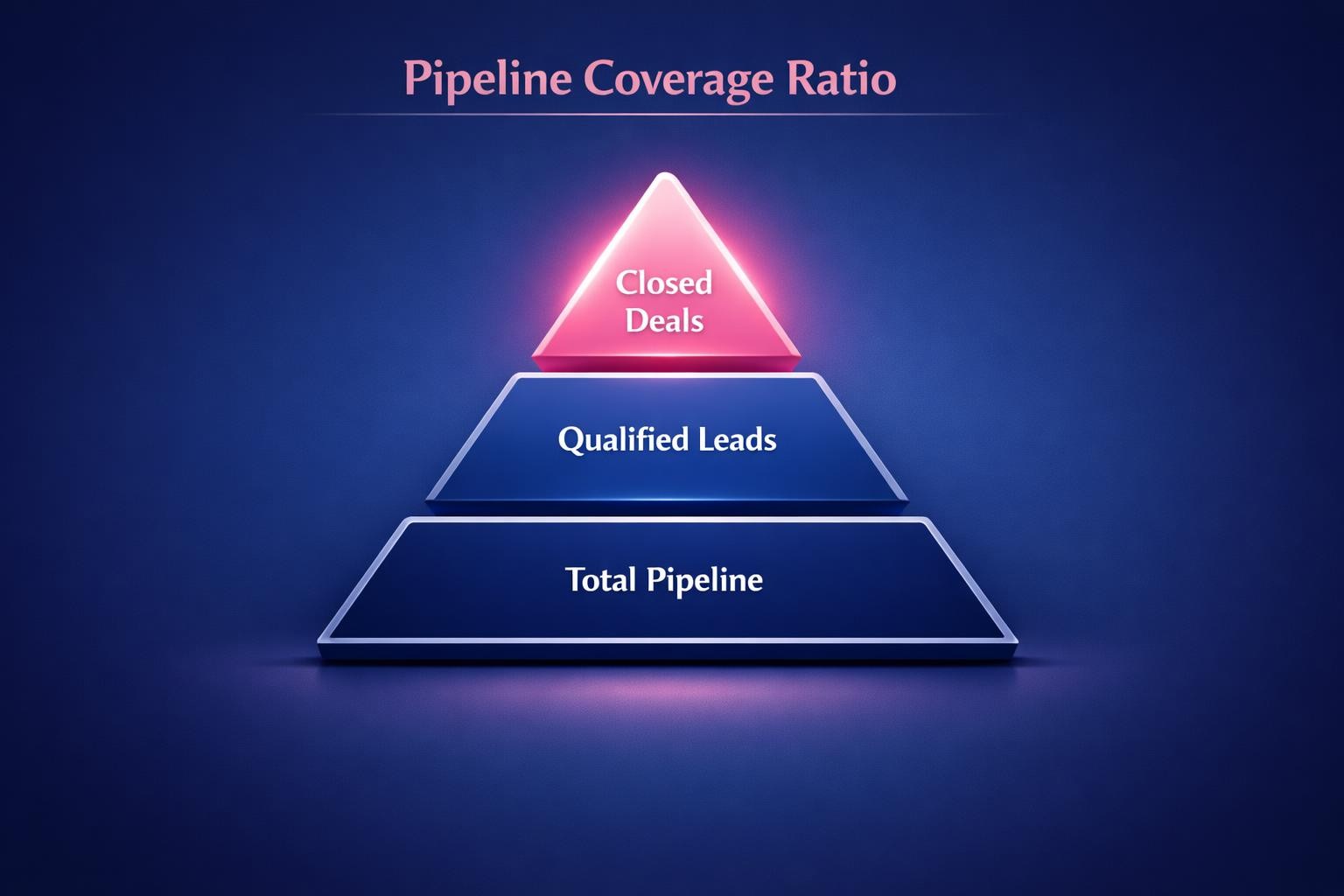
Pipeline coverage ratio is the value of open, qualified pipeline closing in a period divided by the revenue still needed to reach that period’s target. $3 million of pipeline against $1 million of quota left is 3x coverage. The right ratio is the inverse of your own win rate, so 3x is a rule of thumb, not a law.
This guide gives the pipeline coverage formula, a worked example, how to set target ratios by stage, and why 3x only fits some teams. It then covers pipeline analytics more broadly: the metrics that tell you whether the pipeline behind the ratio is real, including conversion by stage, velocity, aging and slippage.
Last updated: 17 October 2026
What is pipeline coverage ratio?
Pipeline coverage ratio (also called pipeline coverage or pipeline-to-quota ratio) compares the pipeline you could close in a period with the revenue you still need in that period. It answers one question: do we have enough open deals to hit the number if they convert at our usual rate?
Three rules make the ratio meaningful:
- Match the period. Count only opportunities with a close date inside the period you are measuring, usually the current or next quarter.
- Count qualified pipeline only. Use the stages your team treats as real opportunities, and exclude closed-won and closed-lost deals.
- Measure against what is left. Halfway through a quarter, divide by the target minus what has already closed (the “to-go” number), not by the full quota.
Pipeline coverage ratio formula
The formula is:
Pipeline coverage ratio = open qualified pipeline with a close date in the period ÷ (revenue target for the period − closed-won revenue to date)
The coverage you need is the inverse of the share of that pipeline you normally win:
Required coverage = 1 ÷ historical win rate on pipeline of this type and timing
Worked example
An illustrative team has a $2.0 million target for the quarter and has closed $0.5 million so far, so $1.5 million is still to go. Open qualified pipeline with a close date this quarter is $4.2 million. Coverage is $4.2 million ÷ $1.5 million = 2.8x.
If this team historically wins 30% of in-quarter pipeline, it needs 1 ÷ 0.30 = 3.3x. At 30%, $4.2 million is expected to produce $1.26 million, about $240,000 short. To close the gap at the same win rate, it needs roughly $800,000 more qualified pipeline that can still close this quarter ($240,000 ÷ 0.30), or a better win rate on what it has. The stage-weighted view below gives a more precise answer.
Historical win rate on period pipeline
Coverage needed to hit target
20%
5.0x
25%
4.0x
30%
3.3x
33%
3.0x
35%
2.9x
40%
2.5x
50%
2.0x
Required pipeline coverage = 1 ÷ win rate. Use your own win rate for pipeline of the same segment, deal size and timing.
What is a good pipeline coverage ratio?
A good pipeline coverage ratio is the one your own conversion data says you need: a win rate between 20% and 50% puts it between 5x and 2x. The familiar 3x target is what you get from a win rate of about 33%. Storm Ventures’ model makes the point directly: 3x coverage works with a 33% close rate on 90-day deals, and across its range of cycle lengths and close rates the required ratio ran from 0.83x to 15x (Storm Ventures, 14 September 2016).
For a reference point, Revspire customer data shows win rates of 35% on $10k-$20k deals, 33% on $20k-$100k deals and 30% above $100k (Revspire win rate and sales cycle benchmark). By the formula above, that implies coverage of roughly 2.9x, 3.0x and 3.3x. That is our arithmetic, not a published coverage benchmark, and it uses all closed deals rather than in-quarter pipeline, so treat it as a sanity check.
Why 3x is a rule of thumb, not a law
Dave Kellogg argues that once managers enforce a 3x target, pipelines reach 3x whether or not the deals will close, and the ratio stops predicting anything. He calls it “a giant self-fulfilling prophecy” and recommends deriving coverage targets from historical conversion, per rep, region or product, and tracking coverage of the to-go number through the quarter. His example: a rep who usually closes 40% of pipeline needs only 2.5x (Kellblog, 19 April 2013).
Your required ratio rises when:
- win rates are lower, for example on large or highly competitive deals;
- the sales cycle is long relative to the period, so pipeline created this quarter cannot close in it;
- close dates slip often, so some “in-period” pipeline will land next period;
- a few large deals make up most of the pipeline, so one loss moves the whole number;
- pipeline quality is weak. Ebsta found only 18% of 2024 pipeline matched the seller’s ideal customer profile, and that win rates increase 3.1x when opportunities match it (Ebsta, 2024 B2B Sales Benchmarks: H1 Update, July 2024).
Pipeline coverage by stage: how to set target ratios
A single coverage number treats a first meeting and a contract in redlines as equal. Stage-based coverage fixes that. Calculate, from your last four to six quarters, the share of pipeline in each stage that went on to close in the same period. The required coverage for pipeline sitting in that stage is 1 divided by that rate.
Stage
Example stage-to-close rate
Coverage needed if all pipeline sat in this stage
Example pipeline
Expected revenue
Discovery
10%
10x
$1.2M
$120k
Evaluation
25%
4x
$1.4M
$350k
Proposal
50%
2x
$1.0M
$500k
Negotiation
75%
1.3x
$0.6M
$450k
Total
$4.2M
$1.42M
Illustrative stage conversion rates. Replace them with your own history, by segment.
In the example, the same $4.2 million of pipeline is expected to produce $1.42 million against $1.5 million to go: a stage-weighted coverage of 0.95x, about $80,000 short. That is a smaller gap than the flat 30% estimate suggested, because a large share of the pipeline is already at proposal or negotiation. The aim for stage-weighted coverage is at least 1.0x, with a buffer if your slip rate is high.
Coverage targets also change through the quarter. At the start, you need enough early-stage pipeline to feed later stages; by the last month, only late-stage pipeline can still close. Track the to-go ratio weekly and compare it with the same week in previous quarters, rather than holding one target for 13 weeks.
Common pipeline coverage mistakes
- Counting deals with stale or past close dates as current pipeline.
- Mixing new business, expansion and renewals in one ratio; they convert very differently.
- Pulling next quarter’s pipeline into this quarter’s ratio to make it look healthy.
- Dividing by the full quota after part of it has already closed.
- Setting one company-wide target when segments, products and deal sizes convert at different rates.
Pipeline analytics: the metrics behind the ratio
Pipeline analytics is the practice of measuring how deals enter, move through and leave the pipeline, so leaders can tell whether it will produce the revenue the coverage ratio implies. Coverage tells you how much pipeline you have; the other metrics tell you whether it is real. The table lists the ones worth tracking every week.
Metric
How to calculate it
Warning sign
Pipeline coverage
In-period qualified pipeline ÷ revenue still to go
Below your required ratio, or rising while win rate falls
Stage conversion
Deals that reach the next stage ÷ deals that entered the stage
A sharp drop at one stage compared with previous quarters
Pipeline velocity
(Opportunities × win rate × average deal size) ÷ average cycle length in days
Falling while pipeline volume rises
Pipeline aging
Days in current stage compared with the median for that stage
Many deals well past the stage median
Slippage
Deals whose close date moved out ÷ deals forecast to close in the period
The same deals slipping two quarters running
Pipeline creation
New qualified pipeline added per week, by source
Next quarter’s coverage building more slowly than usual
Win rate by segment
Closed-won ÷ (closed-won + closed-lost), by deal size and segment
Coverage targets based on a win rate that no longer holds
Core pipeline analytics metrics and their warning signs.
Conversion by stage
Stage conversion is the input to stage-based coverage and the quickest way to find where deals leak. Break it down by rep, segment and deal size: a team average can hide one stage where a single segment loses most of its deals. Our guide to pipeline-to-close conversion goes further.
Pipeline velocity
Velocity combines volume, win rate, deal size and cycle length into revenue per day. For an illustrative team, 40 opportunities at a 30% win rate, a $35,000 average deal and a 70-day cycle produce 40 × 0.30 × $35,000 ÷ 70 = $6,000 a day. It is the best single check on whether added pipeline is helping: if volume rises and velocity does not, the new deals are not converting. The deal velocity metrics guide covers each lever.
Pipeline aging
A deal that has sat in one stage far longer than usual is less likely to close. Ebsta reports win rates are 203% higher when deals close within the “golden period” of historical stage benchmarks (Ebsta, July 2024). Buyer silence is an earlier sign than a stage date: in Revspire customer data, after 20 days without a buyer view in the deal room, the win rate fell below half the overall rate (Revspire digital sales room benchmark). A practical starting rule is to review any deal that has spent more than one and a half times the stage median in its stage.
Slippage
Slipped deals inflate coverage: they count this quarter, then again next quarter. Ebsta reports win rates decline by 83% when deals slip, and by 34% when the slip is one to four weeks past the close date (Ebsta, July 2024). Clari Labs puts the average company’s revenue loss from breakdowns in the revenue process at 14.9% (Clari via Business Wire, 10 April 2024); that is a vendor figure, but it shows why slippage deserves its own line in the review. Count a deal’s slips, and discount pipeline that has slipped more than once when you calculate coverage.
Data quality
Every metric here depends on clean close dates, stages and amounts. In a Gartner survey, fewer than half of sales leaders and sellers (45%) were highly confident that their organisation forecasts accurately, and 47% of respondents rated their organisation’s data as high quality (Gartner, 12 February 2020). See the pipeline hygiene guide for the rules that keep those fields honest.
How to run a weekly pipeline coverage and analytics review
- Name an owner. One leader, often in RevOps, owns stage definitions, the coverage calculation and the dashboard, so the numbers mean the same thing every week.
- Set targets from history. Pull the last four to six quarters, calculate win rate and stage conversion by segment, and set required coverage from them. Revisit each quarter.
- Review coverage first, then quality. Start with to-go coverage by team, then look at aging, slippage and stage conversion to see whether the pipeline behind it is real.
- Inspect live deals, not activity counts. For each outlier deal, ask what the next buyer-owned step is, who owns it and when it is due. Flag deals with only one active buyer contact as at risk, whatever the forecast category says.
- Act on gaps early. If coverage for next quarter is short, the fix is pipeline creation now, by source and segment, not a discount in the last week.
- Close the loop every 90 days. Compare forecast with actuals, update conversion rates, and feed win-loss findings into qualification and stage criteria.
Buyer engagement data makes several of these steps easier. Revspire’s Digital Sales Rooms include real-time buyer engagement analytics and mutual action plans with owners and due dates, which give the review an early signal before a close date moves.
Frequently asked questions
What is a good pipeline coverage ratio?
The one your own win rate implies: required coverage is 1 divided by the share of in-period pipeline you usually win. A team that wins 33% needs about 3x; one that wins 25% needs 4x; one that wins 40% needs 2.5x.
How do you calculate pipeline coverage ratio?
Add up open, qualified pipeline with a close date in the period, then divide it by the period’s target minus closed-won revenue to date. For example, $4.2 million of pipeline against $1.5 million still to go is 2.8x coverage.
Is 3x pipeline coverage enough?
Only if you win about a third of your in-period pipeline. With lower win rates, long cycles or frequent slippage you need more; with high win rates, mostly late-stage pipeline or very reliable close dates, less can be enough.
What is pipeline coverage by stage?
It weights pipeline by how likely each stage is to close in the period, using your historical stage-to-close rates. Multiply pipeline in each stage by its rate, add the results and divide by the revenue still to go; aim for at least 1.0x.
What is pipeline analytics?
Pipeline analytics is measuring how deals enter, move through and leave the pipeline, using metrics such as coverage, stage conversion, velocity, aging and slippage. It tells leaders whether the pipeline behind the coverage ratio is likely to turn into revenue.
What are the most important pipeline metrics?
Track coverage, stage conversion, pipeline velocity, pipeline aging, slippage, new pipeline creation and win rate by segment. Review them weekly by team and segment, and set targets from your own history rather than generic benchmarks.
Sources
- GTM Metric #1: Will I make the quarter? Do we have enough pipeline coverage?, Tae Hea Nahm, Storm Ventures, 14 September 2016; accessed 17 October 2026.
- The Self-Fulfilling 3x Pipeline Coverage Prophecy, Dave Kellogg, Kellblog, 19 April 2013; accessed 17 October 2026.
- 2024 B2B Sales Benchmarks: H1 Update, Ebsta, July 2024; accessed 17 October 2026.
- Clari is First Revenue Platform Provider to Surpass $4 Trillion in Revenue Under Management, Clari via Business Wire, 10 April 2024; accessed 17 October 2026.
- Gartner Says Less Than 50% of Sales Leaders and Sellers Have High Confidence in Forecasting Accuracy, Gartner, 12 February 2020; accessed 17 October 2026.
- Revspire research (aggregated Revspire customer data, October 2025 to September 2026): win rate and sales cycle benchmark and digital sales room benchmark; accessed 17 October 2026.