Revspire blog
Buyer Journey Stages: A Practical B2B Revenue Guide
Learn how to audit buyer journey stages, define ownership, track meaningful indicators, reduce execution risks, and improve a B2B revenue process.
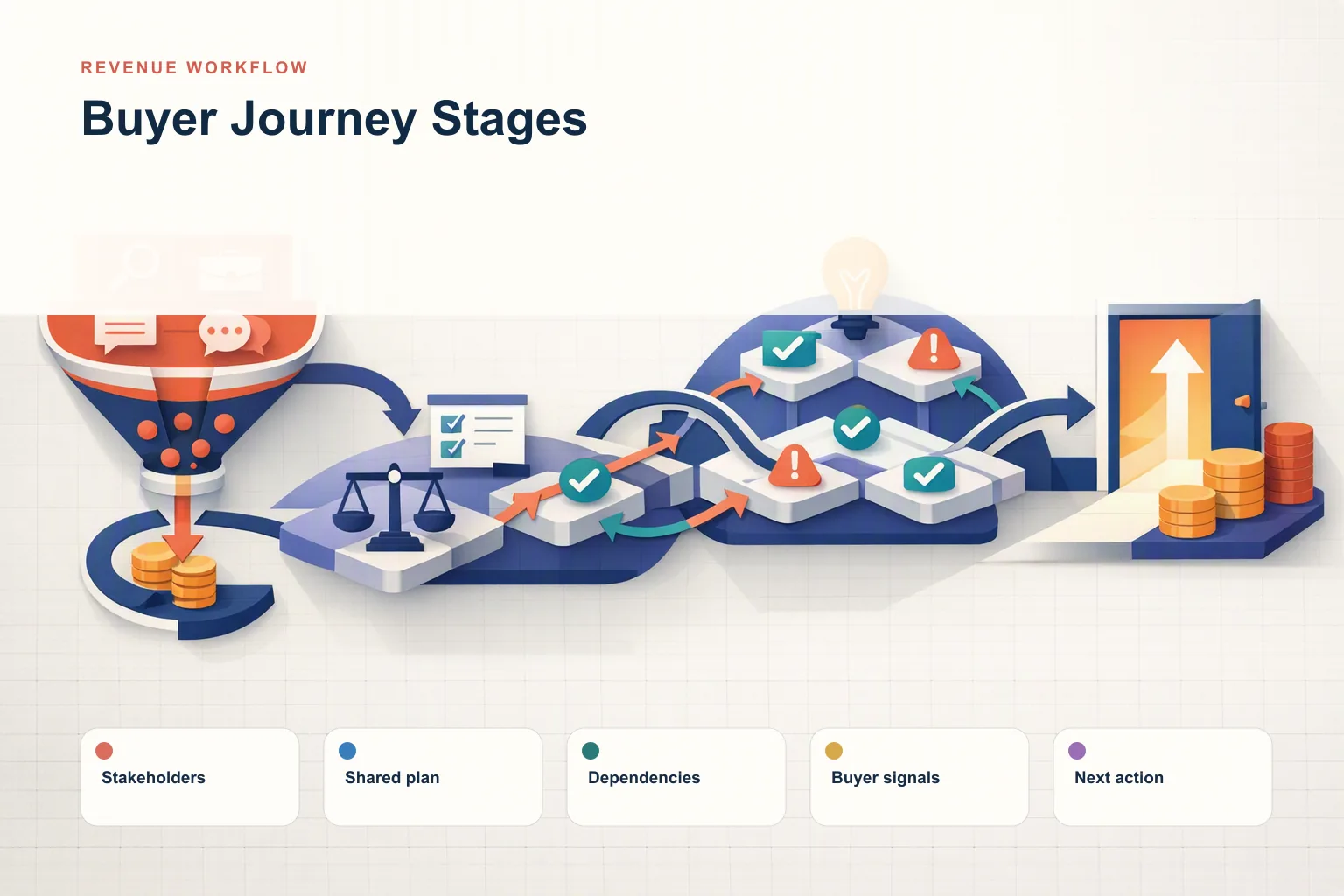
Buyer Journey Stages can be managed as an ongoing system rather than a one-time event. This guide brings together an audit, operating model, measurement approach, common risks, and feedback practices for B2B revenue teams.
Start with an audit
Before you can improve Buyer Journey Stages, you need an honest baseline. Review recent opportunities against the current stages and identify where deals enter the pipeline, stall, or are lost. Break the review down by rep, segment, and deal size to expose specific patterns.
Use the assessment to prioritize two or three improvements. Give each improvement a clear owner, a measurable goal, and a defined review cadence.
Audit the current journey before defining improvements.
Build a clear operating model
An operating model should answer what actions should happen, at what stage, and who is accountable. Document stage milestones, progression criteria, expected actions, and ownership. Use a shared vocabulary across the revenue team.
Keep the model practical enough to teach, reinforce, and use in pipeline reviews. Treat it as a living process that can be updated when win-loss reviews reveal new information.
Define what good looks like
Write down what excellent execution looks like at each stage. Documenting the standard makes it possible to coach, measure, and improve the process systematically.
Use meaningful indicators
Connect stage measurement to revenue outcomes rather than relying only on activity counts. Leading indicators might include stakeholder engagement rates, content consumption, mutual action plan progression, or deal velocity at each stage. Lagging indicators can include win rates, cycle times, and average deal sizes.
Review the indicators regularly and connect them to deal-level coaching. When the data and the prevailing narrative disagree, investigate the discrepancy.
A buyer journey system can connect ownership, process, technology, data, and measurement.
Address common execution risks
- Treating the work as a temporary project: Assign ongoing ownership and include the process in the operating cadence.
- Relying only on intuition: Review portfolio and deal-level data before changing the process.
- Single-threading a relationship: Map stakeholders, assign coverage, and track engagement across the buying group.
- Confusing activity with progress: Measure outcomes, not activities.
- Failing to learn from losses: Use structured reviews and update playbooks with the findings.
Common risks include temporary ownership, intuition-only decisions, single-threaded relationships, activity-based measurement, and missed loss reviews.
Make the process part of the operating cadence
- Define excellent execution and stage criteria in writing.
- Instrument each stage with leading indicators.
- Review buyer journey health during the weekly pipeline cadence.
- Use live opportunities for deal-level coaching.
- Capture win-loss intelligence systematically.
- Align technology to support the process.
- Create feedback loops that update metrics, playbooks, and training.
Three-part explainer: Set the standard, Embed the practice, and Scale what works.
Turn outcomes into feedback
Every won and lost deal contains insights about what works and what does not in your approach to Buyer Journey Stages. Capture those insights through structured win-loss reviews, post-deal interviews, and CRM analysis. Feed the findings into stage criteria, playbooks, coaching, and training.
The objective is a repeatable process that helps the revenue team distinguish seller activity from buyer progress and refine its approach over time.
Use technology to support the process
The technology layer for Buyer Journey Stages should reduce friction, not add it. The supplied sources describe Revspire Buyer Intelligence as a way to surface deal-level signals and make next actions visible in deal rooms.
Three-part explainer: Expose the hidden cost, Build the business case, and Start where it matters.
Evaluate the next step
Review the current process, select a small number of improvements, and assign ownership before expanding the operating model.