Revspire blog
Why the Modern B2B Buyer Journey Matters in B2B Sales
A practical guide to auditing and improving the modern B2B buyer journey with clear ownership, useful metrics, coaching, and structured feedback loops.
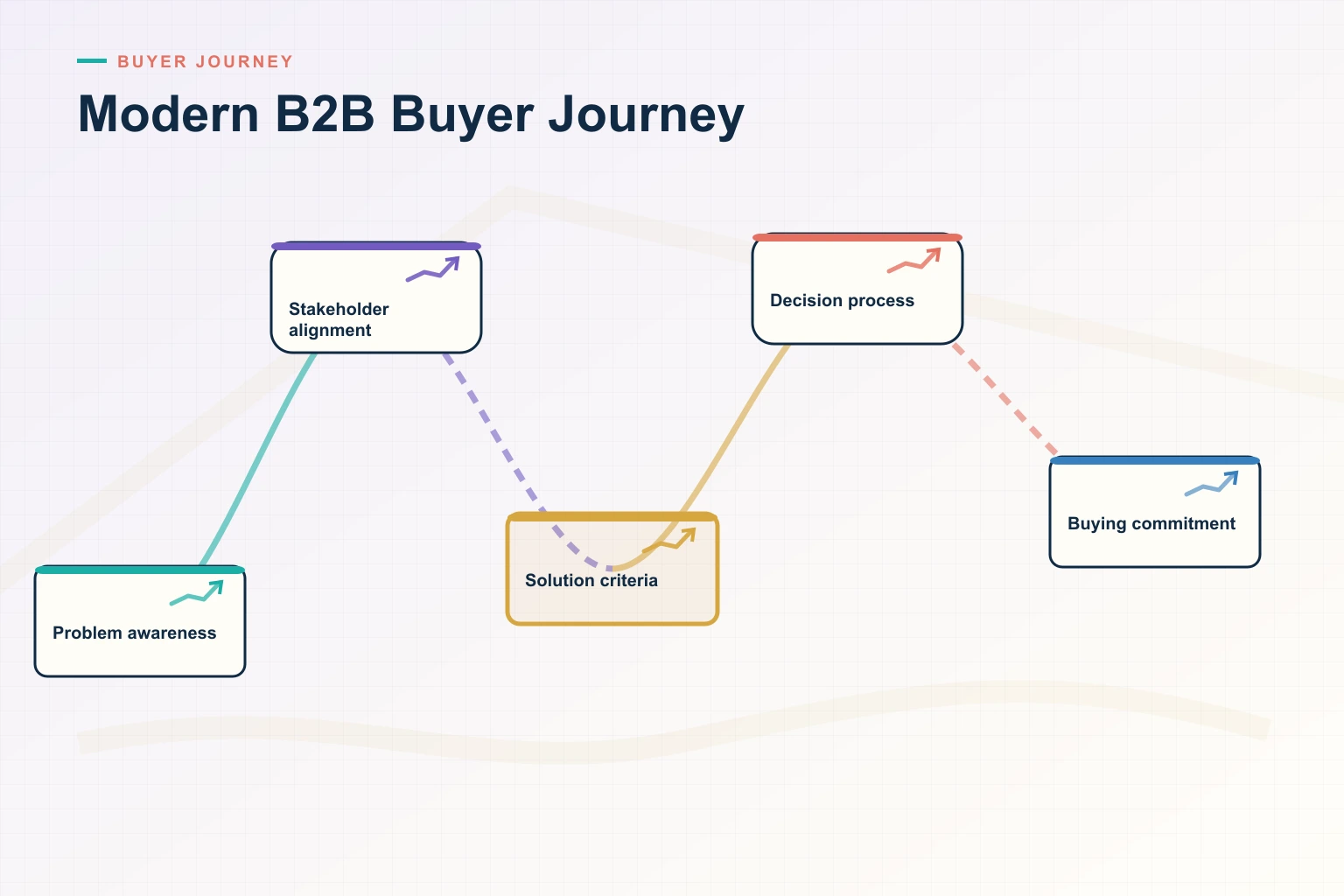
A modern B2B buyer journey should be managed as an ongoing operational discipline rather than as a project with a start and end date.
Where Buyer-Journey Problems Affect Revenue
Poor buyer-journey management can allow unsuitable opportunities into the pipeline, leave qualified deals stalled, and expose late-stage deals to procurement surprises, unstated objections, or stakeholder concerns. A structured approach can surface these problems earlier.
The source articles link Revspire Buyer Intelligence to the deal-room page.
Three-part explainer: Expose the hidden cost, Build the business case, and Start where it matters.
The Business Case Described by the Canonical Source
The canonical source associates systematic improvement in the buyer journey with faster ramp times for new representatives, higher average deal sizes, lower customer acquisition costs, and improved forecast accuracy. These are directional outcomes reported by that source, not proof that the buyer journey has greater leverage than every other B2B sales investment.
The buying-experience dimension
When a product is differentiated but not unique, the canonical source presents the buyer journey as a competitive variable. It describes a buying experience that builds trust, reduces perceived risk, and helps buyers feel confident.
The talent dimension
The canonical source also states that a strong buyer-journey approach can create an environment where representatives develop faster and stay longer.
Audit the Current Journey
Start with an honest audit. Review the last six months of opportunity data by journey stage, representative, segment, and deal size. Identify where opportunities leave the process and why.
Compare what the data says with what the internal narrative says. Then prioritize two or three specific improvements, giving each one a clear owner, a measurable goal, and a 90-day review cadence.
Build the Operating Model
Document what actions should happen, at what stage, and who is accountable. Keep the model simple enough for the team to follow consistently.
Assign a leader who is accountable for outcomes, sets goals, defines metrics, and ensures the approach evolves as market conditions change.
Use embedded workflows and manager reinforcement to surface the expected action at the right moment. Include a standing buyer-journey health review in the weekly cadence, and use live opportunities for deal-specific coaching.
Three-part explainer: Define the system, Operationalize the workflow, and Measure the impact.
Measure Progress, Not Activity
Measure outcomes, not activities. Relevant indicators described by the sources include stage conversion, time in stage, deal velocity, buyer engagement quality, stakeholder coverage, mutual action plan progression, win rate, cycle time, and average deal size.
Leading indicators can help teams intervene before final outcomes are known. Lagging indicators such as win rate, cycle time, and average deal size help confirm whether the approach is working. Build a dashboard that shows both. Review it weekly.
When activity is high but outcomes are poor, investigate what is happening inside the deal instead of requesting more activity.
Avoid Common Execution Mistakes
Treating improvement as a temporary project
Assign permanent ownership, establish standing reviews, define metrics, and set quarterly improvement goals.
Single-threading stakeholder relationships
Map the buying committee, assign stakeholder coverage, and track engagement with each stakeholder. Flag deals with only one active contact as high risk.
Confusing activity with progress
Prioritize stage progression, buyer engagement quality, and stakeholder coverage over raw activity totals.
Failing to learn from losses
Use structured reviews to identify the buyer-journey breakdowns that contributed to significant losses. Document the findings and feed them back into playbooks, coaching, and strategy.
Seven Practices for Continuous Improvement
- Set a shared standard: document what excellent execution looks like at every stage.
- Instrument each stage: monitor leading indicators that can reveal risk before final outcomes are known.
- Create a weekly cadence: discuss buyer-journey health and what needs to change.
- Coach live deals: diagnose execution gaps through current opportunities.
- Capture win-loss intelligence: combine post-deal interviews, CRM data analysis, and structured reviews.
- Align the technology stack: reduce friction and unnecessary manual intervention.
- Maintain feedback loops: review metrics, update playbooks, and incorporate buyer feedback.
Three-part explainer: Set the standard, Embed the practice, and Scale what works.
Turn the Audit Into a 90-Day Plan
Prioritize two or three improvements from the audit, assign each one an owner and measurable goal, and review the results after 90 days. Incorporate what the team learns into its playbooks and operating cadence.