CPQ ROI and Business Case: A Practical Guide for Revenue Teams
A practical perspective for connecting this idea to your revenue team’s next move.
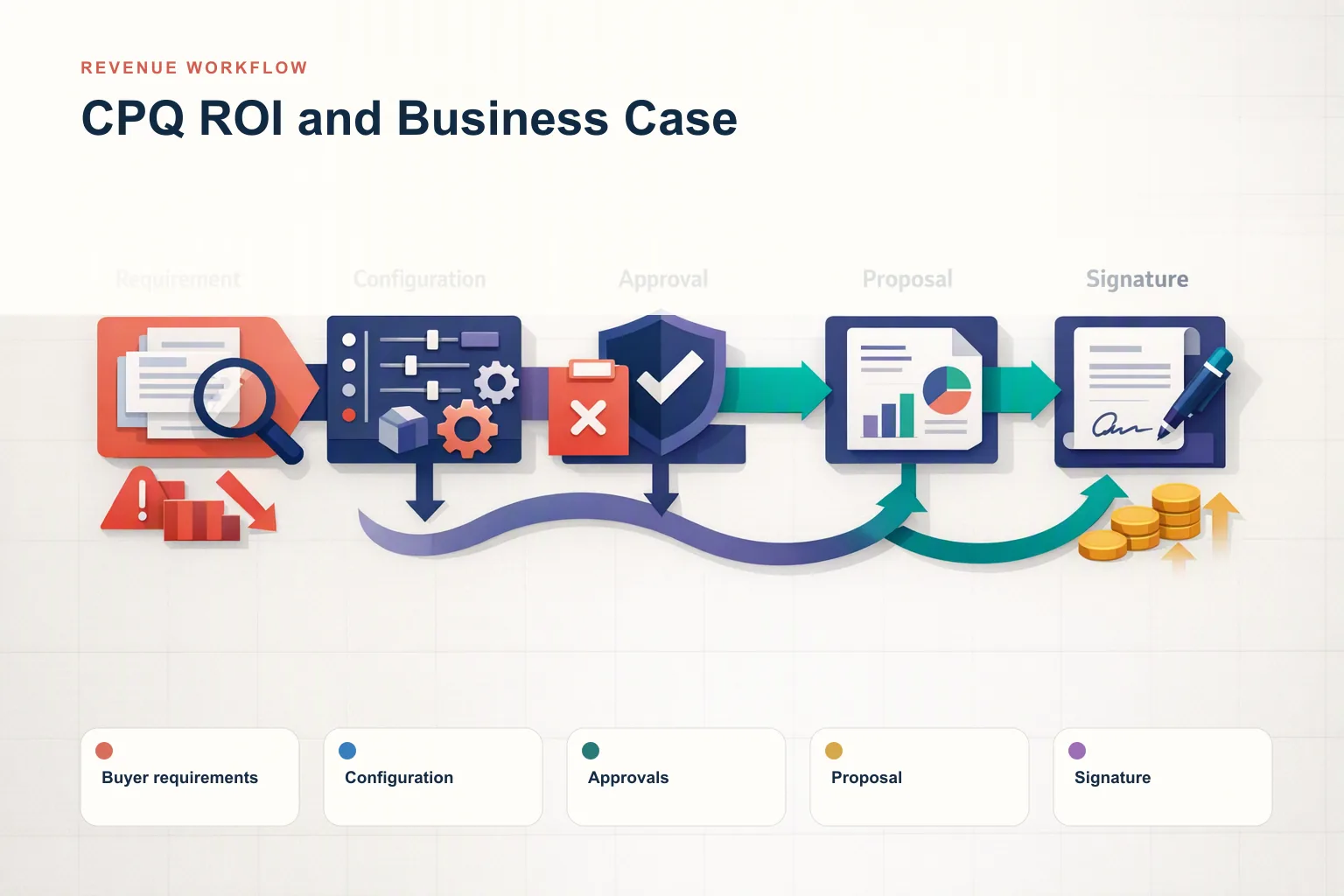
This guide presents a source-defined framework for reviewing CPQ ROI and business-case execution. Revenue teams can use it to examine ownership, stage criteria, measurements, stakeholder coverage, deal-specific coaching, and feedback loops. Each recommendation should be evaluated against the organization’s own data and operating context.
When the process is inconsistent, weak opportunities can consume capacity, qualified deals can stall, and late-stage concerns can emerge after the team has limited room to respond. A structured review can help leaders examine those risks throughout the revenue cycle.
Where to Review Potential Revenue Leakage
The source framework organizes potential revenue leakage into three review points. First, examine whether early-stage opportunities that should not enter the pipeline are consuming representative capacity or distorting the forecast. Second, review qualified opportunities for unclear stage criteria or missing evidence. Third, examine late-stage opportunities for procurement surprises, unstated objections, or stakeholder concerns that could have been addressed earlier.
Reviewing these points as part of a repeatable process can give managers a clearer basis for deciding where coaching, stakeholder engagement, or qualification work may be needed.
Platform reference: Revspire CPQ.
Three-part explainer: Expose the hidden cost, Build the business case, and Start where it matters.
Build a Repeatable Operating System
Assign explicit ownership
The source framework recommends assigning explicit strategy ownership for the CPQ ROI and business-case process. A designated leader can set goals, define measurements, maintain the operating model, and coordinate changes as the team learns.
Ownership can continue beyond the initial rollout. Standing reviews, defined measurements, and quarterly improvement goals can keep the work connected to the broader revenue process.
Document the process and stage criteria
As a process recommendation, document what good CPQ ROI business-case execution looks like at each stage and identify who is accountable.
An operating model for CPQ ROI and Business Case answers three questions: what actions should happen, at what stage, and who is accountable. Keep the model simple enough for representatives and managers to use consistently.
Embed the process in the weekly cadence
Consider making CPQ ROI and business-case health a standing part of pipeline calls. Instead of relying on a general status update, review what changed, what evidence is missing, which stakeholder needs attention, and what action should happen during the next seven days.
Three-part explainer: Define the system, Operationalize the workflow, and Measure the impact.
A Three-Step Improvement Framework
Step one: Audit the current state
Before you can improve CPQ ROI and Business Case, you need an honest baseline. Review the last six months of opportunity data and map where deals advance, stall, or leave the pipeline. Break the findings down by representative, segment, deal size, stage, and stated loss reason.
Compare the data with the internal narrative. Use the review to identify recurring structural problems rather than allowing one recent or memorable opportunity to determine the response.
Step two: Build the operating model
For each stage, document the action that should happen and the person who is accountable. Connect the model to the team’s daily workflow so expectations are visible during active opportunities.
Step three: Measure leading and lagging indicators
Lagging indicators can include win rate, cycle time, average deal size, and quota attainment. Candidate leading indicators can include stakeholder engagement, content consumption, mutual action plan progression, stage velocity, and stakeholder coverage.
Build a dashboard that shows both. Review it weekly. Tie it directly to coaching conversations and territory reviews. Activity counts alone should not be treated as proof that an opportunity is progressing.
Three-part explainer: Audit the current state, Build the operating model, and Measure and improve.
Seven Practices to Consider
- Define excellent execution. Establish documented criteria and a shared vocabulary for each stage.
- Instrument the stages. Track indicators that may reveal risk before the final revenue result is known.
- Create a weekly operating rhythm. Review evidence, risk, ownership, and next actions.
- Coach live opportunities. Use active deals to identify specific execution gaps and work through them in context.
- Capture win-loss intelligence. Use post-deal interviews, CRM analysis, and structured reviews to identify recurring lessons.
- Align technology with the process. Evaluate whether tools reduce administrative friction and support the documented workflow.
- Create feedback loops. Review results against goals, update playbooks, and incorporate buyer feedback into future execution.
Seven practices for building and scaling a consistent CPQ ROI and business-case process.
Five Process Risks to Review
Treating the work as a one-time initiative
A rollout can lose focus without permanent ownership, recurring reviews, defined measurements, and improvement goals. Consider treating the work as an ongoing operating discipline rather than a project with a fixed end date.
Relying on intuition instead of portfolio data
Define three to five leading indicators and review them each week. When the data conflicts with the prevailing narrative, investigate the discrepancy instead of defaulting to the most recent deal.
Building the relationship around one contact
To reduce reliance on a single stakeholder, map the buying committee, assign stakeholder coverage, and flag opportunities with only one active contact for additional review.
Confusing activity with progress
When evaluating CPQ ROI business-case sales, do not assume that high email, call, or task volume demonstrates forward momentum. Examine stage progression, engagement quality, and stakeholder breadth as part of the review.
Failing to learn from losses
Implement a structured loss review process. Document relevant execution breakdowns, update the playbook, and use the findings in coaching so lessons from one opportunity can inform future work.
Strategic and execution risks to examine in a CPQ ROI and business-case process.
Consider the Buying and Talent Experience
Alongside pipeline measurements, examine how the business-case process affects the buying experience. Clear milestones, stakeholder coverage, and documented evidence can help the team identify where a buyer may need additional information or where perceived risk remains unresolved.
Also review how the operating model supports representative onboarding and development. A documented process, shared vocabulary, live-deal coaching, and accessible win-loss lessons can give new and experienced team members a common framework for execution.
These competitive and talent dimensions should be evaluated with the organization’s own data. The frozen sources do not provide independent evidence for comparative performance, retention, or hiring outcomes.
Where to Start
Start with an honest audit. Select two or three specific improvements, give each one a clear owner and measurable goal, and review progress after 90 days. Consider expanding the model after the initial process is being used consistently.
The intended operating model is a continuous system in which opportunity evidence informs coaching, coaching informs execution, and win-loss findings refine the playbook.