Revspire blog
CPQ vs. Manual Quoting: Costs, Automation, and a Practical Framework
Compare manual intervention with CPQ-oriented automation and build a practical framework for ownership, metrics, coaching, and continuous improvement.
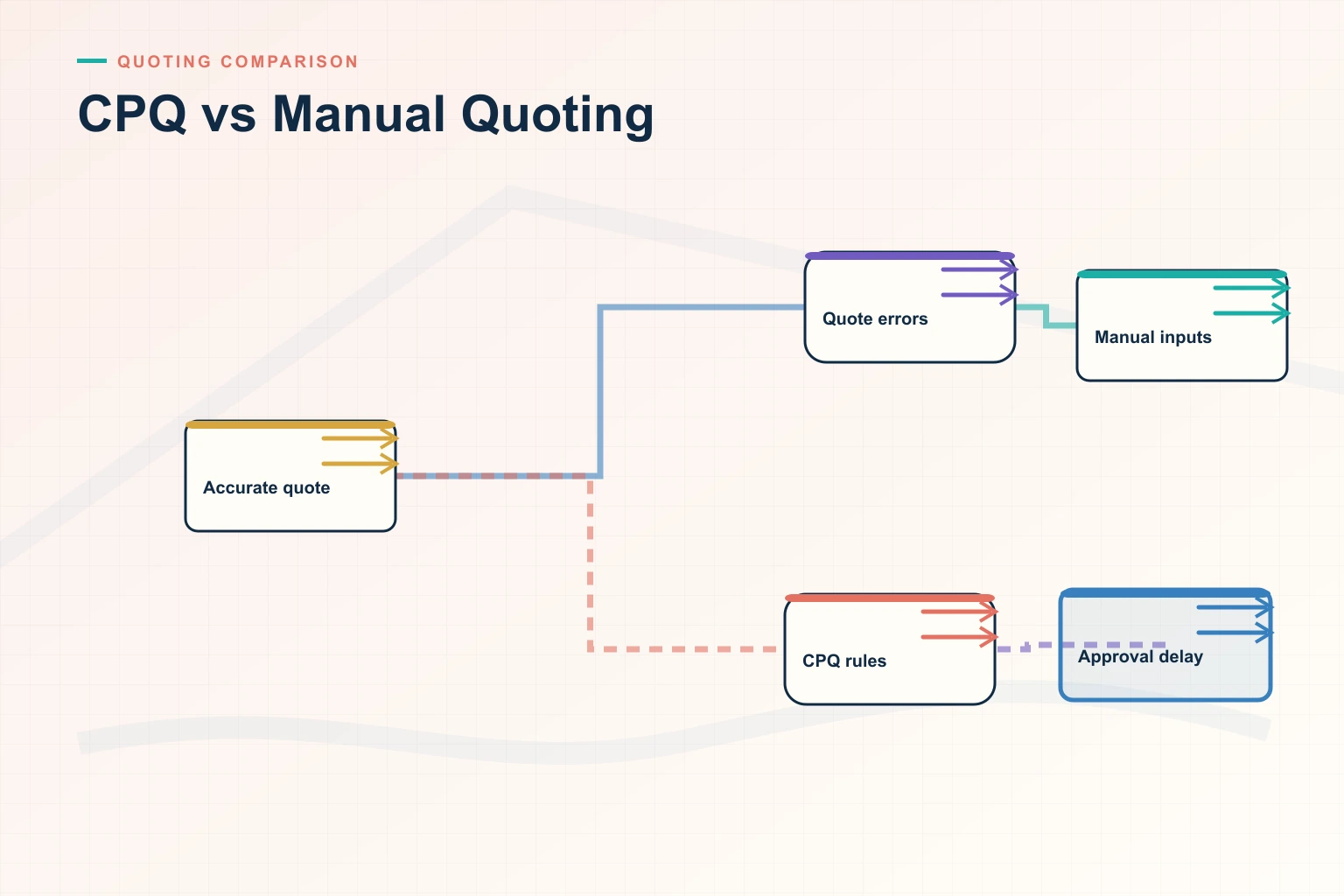
The supplied sources frame CPQ versus manual quoting as an operational decision involving process friction, data flow, ownership, measurement, and the buying experience. They do not establish that CPQ is universally the highest-leverage B2B sales investment, so this guide makes no such ranking.
What the supplied comparison supports
The sources associate manual intervention with operational overhead. They describe a technology layer intended to reduce friction and allow data to flow automatically between systems such as a CRM, engagement platform, and deal room. This supports a focused comparison between workflows that require repeated manual handling and workflows designed to automate data movement.
- Manual workflow: requires manual intervention to move or update information across tools.
- CPQ-oriented workflow: uses technology intended to reduce friction and support automatic data flow between connected systems.
- Operating discipline: the source framework calls for documented workflows, clear ownership, measurement, coaching, and recurring review.
Product reference: Revspire CPQ.
Three-part explainer: Expose the hidden cost, Build the business case, and Start where it matters.
Why quoting operations matter
The canonical source says the cost of weak quoting practices may emerge gradually through lower win rates, longer deals, and uncertain forecast calls. It identifies three places where revenue leakage may occur: unsuitable early-stage deals consuming rep capacity, qualified deals stalling mid-cycle, and late-stage deals being lost to process failures.
The same source says buyers consider how easy and confident the buying experience makes them feel. These are source-stated reasons for examining quoting operations; the frozen material does not independently validate the outcomes or compare quoting investment with every other sales initiative.
The qualified business case
The canonical source associates systematic improvement with faster ramp times for new reps, higher average deal sizes, lower customer-acquisition costs, and improved forecast accuracy. These are claims made by that source, not independently verified results in the frozen evidence.
It also presents a talent thesis: organizations that take the process seriously may attract strong revenue professionals, help them develop faster, and retain them longer. The source calls the resulting pattern a talent flywheel. Because no independent recruiting or retention evidence is supplied, this remains a qualified account of the source’s position.
Audit the current process
Pull the last six months of deal data. Map each opportunity against the stages of the process and identify where deals are falling out and why. Document what actions should happen at each stage and who is accountable.
Use the assessment to prioritize two or three specific improvements. Give each improvement a clear owner and measurable goal, then use a 90-day review cadence before building from the results.
Document ownership, workflows, and technology
The source framework recommends documenting, teaching, and enforcing the process through embedded workflows, manager reinforcement, and appropriate technology. It also says technology should serve the process rather than define it.
Evaluate whether each tool makes execution easier and more consistent or adds friction. Where the connected systems support it, allow data to flow without manual intervention rather than requiring repeated updates.
Measure and improve execution
The sources recommend connecting measurement to revenue outcomes instead of relying on activity counts alone. Suggested measures include conversion rates, time in stage, win rates, cycle times, average deal sizes, and relevant leading indicators.
- Define what good execution looks like at each stage.
- Assign ownership for outcomes and the review cadence.
- Build a dashboard with leading and lagging indicators and review it weekly.
- Use deal-specific coaching to identify execution gaps in live opportunities.
- Capture findings through post-deal analysis and structured win-loss reviews, then update playbooks.
- Review metrics against targets and solicit buyer feedback quarterly.
Three-part explainer: Set the standard, Embed the practice, and Scale what works.
Correct common operating mistakes
- Treating improvement as a one-time initiative: assign a permanent owner and establish standing reviews, defined metrics, and quarterly improvement goals.
- Relying on intuition alone: define three to five leading indicators, track them weekly, and investigate discrepancies between the data and internal assumptions.
- Confusing activity with progress: measure outcomes and investigate deals where activity is high but progress is poor.
- Failing to learn from losses: conduct structured reviews after significant losses, document the findings, and update playbooks.
Start with a focused plan
Choose two or three improvements from the audit, assign an owner, define a measurable goal for each one, and review progress after 90 days.