How to Research Prospects Without Being Creepy: 12 Tips and Call Prep
A practical perspective for connecting this idea to your revenue team’s next move.
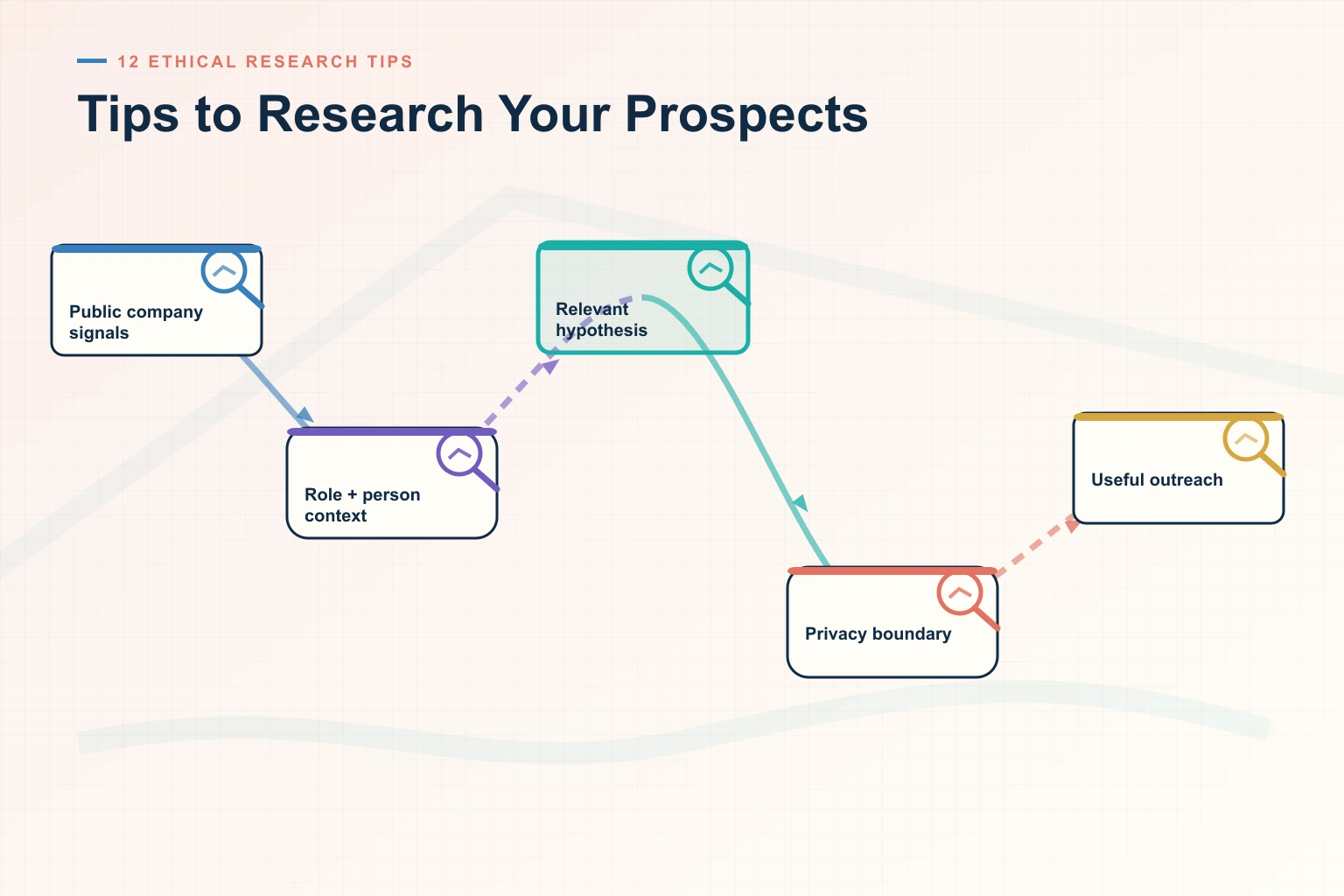
To research prospects without being creepy, use public, professional information about the company and the person’s role, turn it into a hypothesis about what they need, and mention only what they would reasonably expect a stranger to know. Prospect research should explain why you are reaching out now, not show how much you found.
This guide sets out where the line sits between thorough and intrusive, the privacy rules that apply, 12 practical research tips, examples of creepy and relevant openers, and a checklist for preparing before the sales conversation starts. It reflects practice and guidance current to October 2026.
Last updated: 17 October 2026
What is prospect research, and why does it matter?
Prospect research is the work of learning enough about an account and the people in it to start a relevant conversation: what the company is trying to do, what has changed recently, who is involved in a decision like yours, and what each person is responsible for. Its output is not a dossier. It is a short hypothesis you can test: “because this changed, you are probably dealing with that, and here is how others handled it.”
It matters because buyers arrive prepared. In 6sense’s 2025 B2B Buyer Experience Report (nearly 4,000 buyers surveyed), buyers initiated 79% of engagements with sellers and made first contact 61% of the way through their buying process, and 94% had already ranked their shortlist before speaking to any vendor. A buyer who has done that much homework on you expects you to have done some on them.
Research also has to cover more than one person. Forrester’s 2026 buyer insights release (21 January 2026) says the typical buying decision includes 13 internal stakeholders and nine external influencers, so the person you email first is rarely the only one you need to understand.
Where is the line between thorough and creepy?
Research becomes creepy when you use information the prospect would not expect a stranger to have, or would not expect to see used in a sales message. A simple test: if the prospect asked “how did you know that?”, would your honest answer make them more comfortable or less?
Over-personalisation can also backfire commercially. A Gartner survey of 1,464 B2B buyers and consumers (published 3 June 2025, fielded November and December 2024) found that personalisation created negative experiences for 53% of customers, and that those customers were 3.2 times more likely to regret a purchase. Gartner’s advice is to ask customers to share their preferences and context directly rather than inferring them. In sales, that means using research to ask a better question, not to show off what you know.
Category
Examples
How to use it
Fine to use
Company website, press releases, annual reports, job postings, product pages, funding news; the person’s current role, published articles, talks, podcasts and posts on professional topics
Reference it openly as the reason for your message
Use with care
Forum threads, employee reviews, earlier roles, mutual connections, a post the person wrote some time ago
Use for background and themes; do not quote it back to them
Off limits
Personal social accounts, family, home location, photos, health, politics, religion; anything behind a login you have no right to use; scraped or purchased data of unclear origin
Do not collect it, store it or mention it
Privacy rules that apply to prospect research
If you research and contact people in the UK or the EU, data protection law applies to the notes you keep about them, even when the information was public. This is general guidance, not legal advice; check your approach with your own counsel. The UK Information Commissioner’s Office sets out the main points:
- Have a lawful basis. Most B2B prospecting relies on legitimate interests, which the ICO says can apply to direct marketing only where the electronic marketing rules (PECR) do not require consent. The ICO’s legitimate interests guidance (last updated 23 March 2026) describes a three-part test: a legitimate purpose, processing that is necessary for it, and a balance against the person’s interests. The person’s reasonable expectations are central to that balance, and the right to object to direct marketing is absolute, so if someone asks you to stop, you stop.
- Tell people where you got their data. When you collect personal data from somewhere other than the person, the ICO’s checklist of information you must supply says to provide privacy information within a reasonable period (at most one month), and no later than your first communication if you use the data to contact them. The list of what to supply includes the source of the data. A link to your privacy notice in the first email is the usual way to do this.
- Keep only what you need. Notes about the person’s role and priorities are proportionate. A file on their personal life is not.
Platform terms
Read a platform’s terms before using any automation on it. Professional networks generally restrict scraping, bots and browser extensions that copy profile data in bulk, and breaking those rules can cost you your account. Research by reading, not by harvesting.
12 tips to research your prospects
The first six tips cover the account, the next four the person, and the last two turn research into something you can use.
Research the company
- Start with what the company says about itself. Read the homepage, product pages and recent blog posts to learn how it describes its customers and goals. For public companies, the annual report states priorities, risks and investment plans in the company’s own words.
- Check recent news and press releases. Funding rounds, acquisitions, launches, new markets and leadership changes are the triggers that create a reason to buy; layoffs and restructuring change priorities, so check for them too. Our guide to signal-based selling explains which signals are worth acting on.
- Read the job postings. Open roles show where a company is investing, which tools it uses and which problems it is staffing up to solve. A posting for a “sales enablement manager to build our content library” tells you more than most press releases.
- Look at funding and growth data. Company databases such as Crunchbase show funding stage, investors and headcount trends. A company that has just raised and is hiring sellers has different problems from one that is cutting costs.
- Identify the systems they run. Job ads, integration pages and technographic data show the CRM and tools in use, so you can say early whether you fit their stack.
- See how the market describes them. Competitors’ announcements, analyst coverage and industry press show the pressures the company faces. Forums and employee review sites can add useful context about themes, but treat them as background: never quote an employee review or a forum complaint back to a prospect.
Research the person
- Understand their current role. Their profile shows title, remit, team and tenure. Someone new in a role is often looking for early wins; someone several years in may own the process you would replace.
- Find what they have said in public, on purpose. Articles, conference talks, webinars, podcast interviews and posts on professional topics show what they care about in their own words. These are the safest things to reference, because the person chose to publish them.
- Use shared context honestly. A mutual connection is better used to ask for an introduction than as a name to drop. Shared communities or events are fine to mention if you were genuinely there.
- Place them in the buying group. Work out who else is likely to be involved: their manager, the budget owner, IT, security, procurement. Our guide to the types of B2B decision-makers explains how each one evaluates a purchase.
Turn research into a reason to talk
- Write a one-sentence hypothesis. For example: “You opened two new regions this year, so your new sellers are probably learning the product while also learning the territory.” The hypothesis is what you test in the conversation; it is not a claim about their business.
- Time-box it and record it. Match the effort to the stakes: a quick pass for a first email, more for a first meeting, a full account plan for a strategic account. Put what you learn in the CRM so nobody repeats it, and stop when you have a credible reason to reach out.
Creepy vs relevant: examples of research in an opening line
The same research can produce a relevant opener or an uncomfortable one. The difference is whether you connect it to the person’s work, and whether they would expect you to know it.
Creepy
Relevant
Why the second works
“Looks like you had a great holiday in Lisbon last week.”
“I saw you opened a Lisbon office this quarter.”
Company news, published on purpose, tied to a business change
“I noticed your employees complain about your CRM on review sites.”
“Teams that add a region often find their CRM set-up lags behind. Is that on your list?”
Asks instead of accusing; no private source to explain
“I’ve been following everything you post.”
“Your talk on onboarding new sellers made a point I hear often: ramp depends on finding the right material fast.”
References a public, professional talk and engages with the idea
“Congratulations on your new baby!”
“Congratulations on the new role. What’s top of your list for the first quarter?”
A professional milestone, and an open question
“I see you’ve viewed our pricing page three times.”
“Teams at your stage often ask how pricing scales as they grow. Happy to walk through it.”
Uses the signal to time the message without revealing the tracking
How to prepare before the sales conversation starts
Before any sales conversation, master two things: who you are talking to, and what you want the conversation to achieve. Research covers the first. The second needs a written objective, a short agenda, a few hypotheses with the questions that test them, and the proof you might need, all ready before the call.
Know who you are talking to
- Confirm the attendees and their roles. Check the invite and ask your contact who else is joining and why. A surprise attendee from finance or IT changes the conversation you should have.
- Re-read the account history. Previous emails, call notes, what was promised and by whom. Nothing loses trust faster than asking a question the buyer has already answered.
- Refresh the trigger. Check for news since your last contact. A reorganisation or new leader since the last call may change the priority.
Know what you want from the conversation
- Write the objective and the next step you will propose. “Learn about their process” is not an objective. “Agree a technical review with their IT lead before the end of the month” is.
- Prepare hypotheses and questions. Write two or three hypotheses about the buyer’s problems and the questions that would test each. Gong’s analysis of more than 519,000 B2B sales calls (first published 18 June 2017, updated 4 March 2026) found success peaked at 11 to 14 targeted questions per discovery call, and that top performers spread their questions through the conversation rather than front-loading them. The data is old but the lesson holds: plan your questions, but don’t interrogate. Our list of sales discovery questions is a starting point.
- Send a short agenda in advance. Three lines are enough: what you will cover, what you would like to learn, and the decision you hope to reach. Invite the buyer to add to it. A short video introduction and a one-page summary sent with the agenda tell the buyer who they will meet and why.
- Plan a direct opening. In the first minute, state why you asked for the meeting, the value you think you can offer tied to the news you found, and check the buyer agrees before going further. For example: “You opened two new regions this year. I’d like to understand how you’re onboarding sellers there and share what we’ve seen work. Does that match what you wanted from today?”
- Have your proof ready. Pick one or two relevant case studies and a one-page summary before the call, not during it. In Revspire’s seller search and AI assistant benchmark, 28% of seller searches ended with no result opened, so the case study you plan to “find quickly” mid-call may not turn up.
- Anticipate two or three objections. Timing, price and “we already have something” come up in most first calls. Our objection handling guides cover how to respond to each.
Pre-call checklist
Item
Ready when
Attendees
You know each person’s role and why they are joining
Account history
You can summarise previous conversations in two sentences
Trigger
You can say why this matters to them now
Objective
One outcome and one proposed next step, written down
Hypotheses and questions
Two or three hypotheses, each with the questions that test it
Agenda
Sent in advance, with space for the buyer to add
Opening
Purpose, value tied to their news, and a check that they agree
Proof
One or two relevant case studies and a one-pager, open in a tab
Objections
Your answer to the two or three most likely ones
Logistics
Meeting link, time zone and any demo environment checked
Once the call is booked, qualification starts. Our guide to sales qualification covers what to test in that first conversation.
Can you use AI for prospect research?
Yes, with three checks. AI assistants are good at summarising a company’s public material quickly: annual reports, news, product pages and published interviews. They are not reliable on their own.
- Verify every fact you plan to use. An AI summary can mix up companies, people and dates. Check anything you will put in a message against the original source.
- Keep personal data out of unapproved tools. Use only the AI tools your company has approved, and do not paste personal information about prospects into consumer chatbots.
- Do not ask AI to infer personal traits. Asking a model to guess someone’s personality, politics or personal circumstances from their posts is exactly the kind of use people would not expect, and it fails the reasonable expectations test above.
Evaluating the rest of your sales stack? Our roundup of the best B2B sales tools and software compares the main tool categories side by side.
Frequently asked questions
How do you research a prospect before a cold call?
Check three things: the company’s recent news and priorities, the person’s current role and remit, and one trigger that gives you a reason to call now. Write a one-sentence hypothesis linking the trigger to a likely problem, and open the call by testing it. Keep everything you reference public and professional.
How long should prospect research take?
Match the time to the stakes. A first email needs enough to write one relevant sentence; a first meeting needs the account history, attendees and a few hypotheses; a strategic account needs a full account plan. Stop researching once you have a credible reason to reach out, and record what you found so nobody repeats it.
Is prospect research legal under GDPR?
Researching business contacts can be lawful under GDPR and UK GDPR, usually on the basis of legitimate interests, if the processing is necessary, proportionate and within what the person would reasonably expect. You must give people privacy information, including where you got their data, within one month and no later than your first communication, and stop if they object. Take legal advice for your specific situation.
What should you avoid when researching prospects?
Avoid personal social accounts, family, location, health, politics and religion, and never use scraped or purchased data of unclear origin. Do not quote employee reviews or forum complaints back to a prospect. If you would be uncomfortable explaining how you found something, do not use it.
How do you prepare for a sales call?
Confirm who is attending and their roles, re-read the account history, write the objective and the next step you will propose, and prepare two or three hypotheses with the questions that test them. Send a short agenda in advance and have one or two relevant case studies ready before the call starts.
Good research covers the whole buying group, not just your first contact. Map each person’s role and influence with our stakeholder map template.
Sources
External pages were accessed on 17 October 2026.
- 2025 B2B Buyer Experience Report, 6sense, 2025 (no exact date on page). Accessed 17 October 2026.
- Forrester’s 2026 Buyer Insights: GenAI Is Upending B2B Buying As Leaders Face Mounting Pressure To Justify Every Dollar Spent, Forrester, 21 January 2026. Accessed 17 October 2026.
- Gartner Survey Reveals Personalization Can Triple the Likelihood of Customer Regret at Key Journey Points, Gartner, 3 June 2025. Accessed 17 October 2026.
- Legitimate interests, Information Commissioner’s Office (UK), last updated 23 March 2026. Accessed 17 October 2026.
- What information you must supply under the GDPR, Information Commissioner’s Office (UK), no date shown on page. Accessed 17 October 2026.
- Data Driven Tips to Mastering Sales Discovery Calls, Gong Labs (Chris Orlob), first published 18 June 2017, updated 4 March 2026. Accessed 17 October 2026.
- Seller search and AI assistant benchmark, Revspire, 2026 (aggregated customer data, 12 months). Figures checked against Revspire’s benchmark data on 17 October 2026.