Revspire blog
At-Risk Pipeline Identification: 7 Strategies the Top Revenue Teams Use in 2026
Seven source-grounded practices for defining, reviewing, measuring, and improving at-risk pipeline identification in B2B revenue teams.
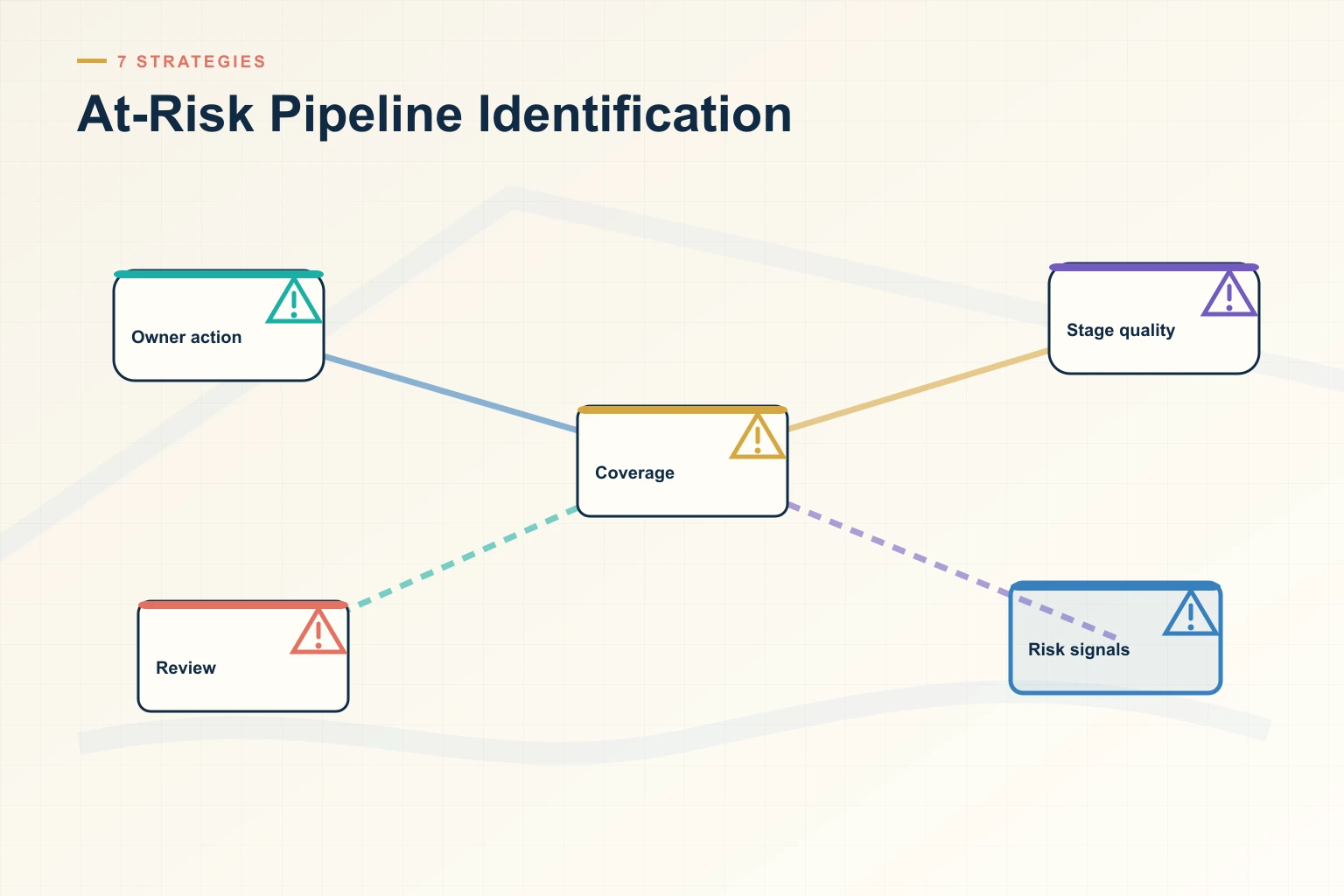
The seven strategies below cover standards, indicators, review, auditing, stakeholder coverage, technology, and feedback.
1. Define the standard and ownership
Define what good looks like: clear milestones, documented criteria, and a shared vocabulary across the team. Document this explicitly.
Someone on the leadership team is accountable for the outcomes, not just the activities.
2. Instrument each stage with indicators
For At-Risk Pipeline Identification, leading indicators might include stakeholder engagement rates, content consumption, mutual action plan progression, or deal velocity at each stage.
Three-part explainer: Audit the current state, Build the operating model, and Measure and improve.
3. Add review and coaching to the cadence
Build a standing review of At-Risk Pipeline Identification health into the weekly rhythm as a structured conversation about what needs to change.
Use deal-specific coaching by reviewing live opportunities with each rep and working through the fix in real time.
4. Audit the current state and build the operating model
Start with an honest audit. Where is At-Risk Pipeline Identification working well today? Where is it breaking down? What does the data say versus what the narrative says?
An operating model for At-Risk Pipeline Identification answers three questions: what actions should happen, at what stage, and who is accountable.
5. Review stakeholder coverage and progress
Map every stakeholder in the buying committee, assign coverage, and track engagement with each one.
High activity levels in at risk pipeline identification B2B can mask a complete absence of forward momentum.
6. Align technology and data with the process
Technology should serve the at risk pipeline identification B2B process, not define it. The related deal-room resource is Revspire Pipeline Analytics.
Data should flow automatically between systems — CRM, engagement platform, deal room — so that leaders always have a current, accurate view of what is happening across the portfolio.
7. Capture win-loss intelligence and maintain feedback loops
Capture win-loss intelligence through post-deal interviews, CRM data analysis, and structured win-loss reviews, then feed the findings into playbooks, training, and strategy.
Feedback loops can include reviewing At-Risk Pipeline Identification metrics quarterly against targets, updating playbooks when you learn something new, and soliciting feedback from buyers on their experience.
Three-part explainer: Set the standard, Embed the practice, and Scale what works.