B2B Lead Generation: How to Generate Quality Leads
A practical perspective for connecting this idea to your revenue team’s next move.
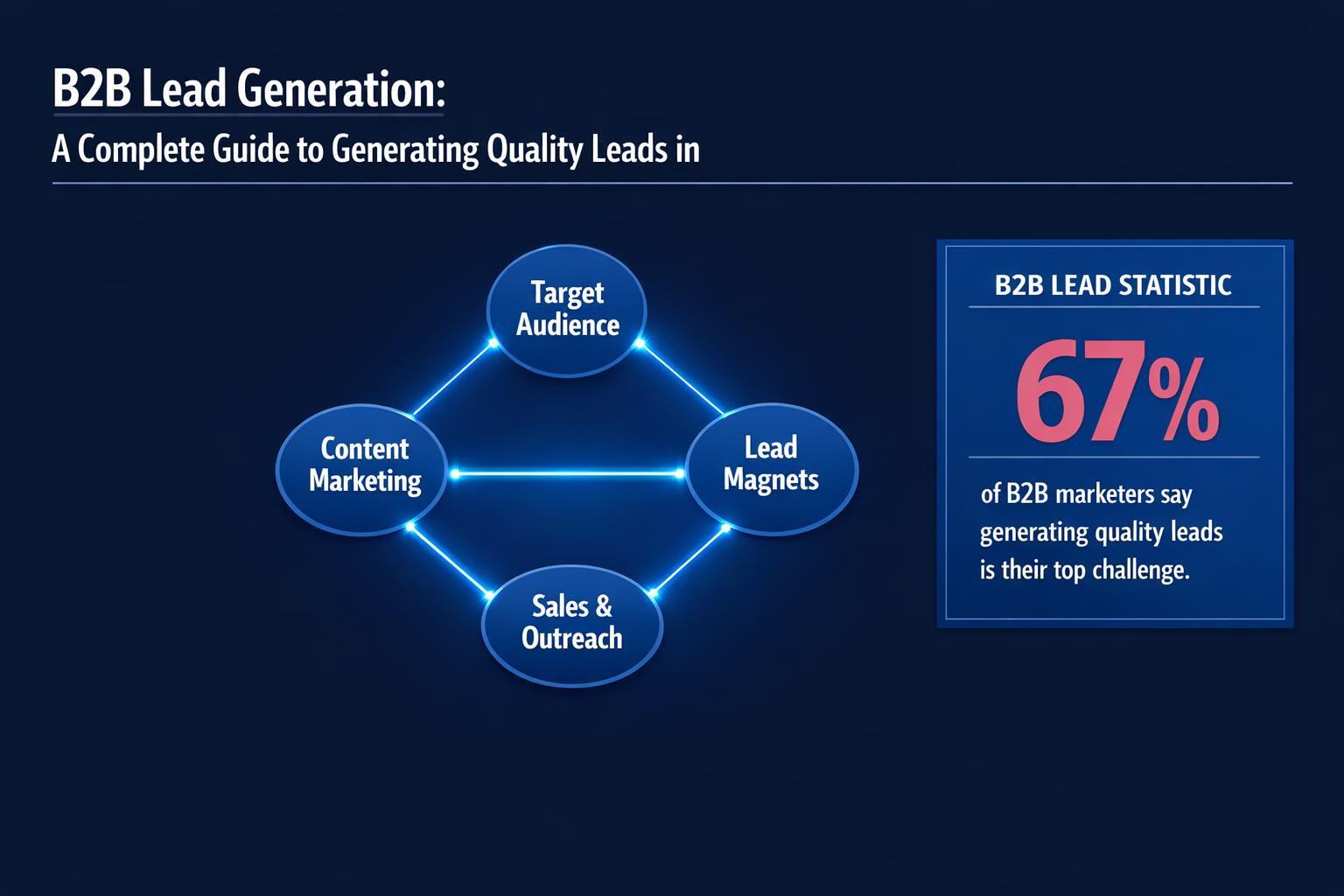
B2B lead generation is the work of finding companies that fit your ideal customer profile, earning their attention and turning that interest into conversations sales can qualify. A quality lead is an account that fits, has a reason to buy now and includes a person who can move the decision forward.
This guide covers how business buyers find vendors today, the lead stages from IQL to SQL, eight lead generation strategies (seven of them involve no cold outreach), the metrics that show lead quality, and a worked example that sizes lead volume from a revenue target. It reflects research and practice current to October 2026.
Last updated: 17 October 2026
What is B2B lead generation?
B2B lead generation covers every activity that brings a new, relevant company into your funnel: content and search, referrals, partners, events, communities, paid media and outbound prospecting. A lead is a person or account that has shown interest, or that you have identified as a strong fit and started a conversation with.
It differs from consumer lead generation in three ways:
- A group buys, not a person. The contact who downloads a guide is rarely the one who signs, so a lead has to lead to the rest of the buying group.
- Decisions take longer and need more proof. Finance, IT and procurement get involved, and each wants evidence the change is worth the effort.
- Fit matters more than volume. A short list of well-chosen accounts beats a long list of form fills that sales will ignore.
Lead generation, demand generation and pipeline generation
Demand generation builds awareness and preference, including among buyers who are not yet looking. Lead generation captures identifiable interest from people and accounts. Pipeline generation turns that interest into qualified opportunities with a value attached. Our guide to early-stage pipeline generation picks up where this one ends.
How do B2B buyers find vendors now?
Recent research points the same way: buyers do most of the work alone, decide early and reach out on their own terms.
- Buyers start the conversation. In the 6sense 2025 Buyer Experience Report (just under 4,000 respondents), buyers initiated 79% of engagements with sellers, against 82% in prior years, and first contact came at 61% of the buying journey.
- The shortlist is set early. The same report found buyers chose a vendor from their Day One shortlist 95% of the time.
- AI assistants shape that shortlist. G2’s Answer Economy research (15 April 2026; 1,076 B2B software buyers surveyed in March 2026) found 51% start research in an AI chatbot more often than in Google, up from 29% in G2’s 2025 report. AI chatbots were the top source influencing shortlists, ahead of review sites, analyst firms and vendor websites.
- Peers are trusted more than vendors. A SurveyMonkey and Reddit study (10 March 2026; 1,202 US decision-makers) found 73% trust peer insights, against 55% for vendor websites, 46% for review sites and 39% for AI chatbots.
- Many people decide. Forrester’s State of Business Buying, 2026 (press release, 21 January 2026) says the typical buying decision includes 13 internal stakeholders and nine external influencers.
So much of lead generation happens before anyone fills in a form: you need to be on the shortlist, in the AI answer and in the peer recommendation. A lead is one person but the deal is a group, so the job is not done until you reach more of it. And when a buyer does raise a hand, they have already researched you, so respond quickly and with substance.
What makes a B2B lead a quality lead?
A quality lead passes four tests. Use them as the shared definition between marketing and sales, and record the evidence for each in the CRM.
- Fit. The account matches your ideal customer profile: industry, size, region, systems and, above all, the problem you solve. “Mid-market SaaS” is a category; “B2B software companies with 300 to 2,000 employees, a field sales team and Salesforce” is a profile. Our ICP definition guide shows how to build one.
- Timing. There is a reason to act now. Gartner research (Help B2B Buyers Navigate Change Management for Complex Purchases, 9 January 2024) notes that nearly all B2B purchases are made amid organizational change, so look for the change: a new leader, a funding round, an acquisition, a reorganisation, a new regulation.
- Access. Your contact is inside the buying group and can introduce you to others, not only a researcher collecting vendor names.
- Engagement. The interest is two-way: a reply, a booked call, a question, a forwarded page. An email open or a single page view is a signal, not a lead.
Fit without timing is common. Research by Peter Weinberg and Jon Lombardo of the LinkedIn B2B Institute with Professor John Dawes of the Ehrenberg-Bass Institute, described in Marketing Week (2 September 2021), puts the share of B2B buyers in market at any one time at only about 5%. A well-fitting account that is not buying yet belongs in nurture, not in a sales sequence.
Lead-quality checklist
- Does the account meet the must-have ICP criteria?
- Can you name, in one sentence, the trigger that makes this relevant now?
- Do you know the contact’s role in the decision?
- Has the contact done something two-way?
- Do you know at least one other person at the account who will be involved?
What are the stages of a B2B lead?
Most B2B teams move leads through four or five stages. Names vary; what matters is that each stage has an owner and an exit rule.
Stage
What it means
Typical evidence
Owner
Moves on when
Information qualified lead (IQL)
A known contact at an account that may fit
Downloaded a guide, subscribed, attended a webinar
Marketing
Fit is confirmed and engagement repeats
Marketing qualified lead (MQL)
A fitting contact whose behaviour suggests active interest
Pricing or comparison page visits, repeat sessions
Marketing
Sales agrees to work it
Sales accepted lead (SAL)
Sales has reviewed and accepted the lead
Rep confirms fit and that a conversation is worth having
SDR or AE
A first conversation confirms a problem and interest
Sales qualified lead (SQL)
A lead sales believes could become a deal
A problem, a sponsor or route to one, a reason to act
AE
It meets your opportunity criteria
Opportunity
A deal with a value and a close date in the CRM
Agreed next steps, more stakeholders involved
AE
Won, lost or disqualified
Common B2B lead stages. Product-led companies often add a product qualified lead (PQL): a trial or free user whose usage signals buying intent.
Should you replace MQLs with buying groups?
Forrester has long argued that B2B teams should stop counting MQLs and track buying groups and opportunities instead; a Forrester analyst blog describes the shift as moving “from wild idea to reality”, with most companies now asking when and how, not whether, to leave MQLs behind. One engaged contact rarely reflects a purchase; several engaged people at the same account are a far stronger signal. You can apply this without rebuilding your funnel: score accounts as well as contacts, count engaged contacts per account, and treat a lone MQL as a prompt to find the rest of the group.
B2B lead generation strategies compared
The table compares eight strategies. Seven do not rely on cold outreach; the eighth, signal-led outbound, is cold outreach with a reason. Time to results is a judgement, not a benchmark.
Strategy
Best for
Quality signal to watch
Time to first results
Main cost
Referrals and customer advocacy
Any team with happy customers
Introductions that arrive with context
Fast once you ask
Customer goodwill, a simple process
Partner-sourced leads
Products sold alongside consultancies, resellers or platforms
Registered deals with a named sponsor
Months to build the partnership
Partner enablement time, margin or fees
Re-engaging known contacts
Teams with closed-lost, churned or dormant contacts
Replies to a specific update
Fast
Rep time
Content and AI-answer visibility
Categories buyers research before talking to sales
Visits to pricing, comparison and decision pages
Slow (months)
Writing and subject-matter time
Peer communities and review sites
Categories where buyers compare options with peers
Questions and mentions from fitting accounts
Slow to medium
Time, review collection
Social selling with a value hook
AEs and SDRs with a clear point of view
Replies and requests for the asset
Weeks
Rep time, one good asset
Events and webinars
Complex products that benefit from conversation
Follow-up meetings booked within days
Fast after the event
Event spend, follow-up discipline
Signal-led outbound
Teams with a tight ICP and good data
Replies that confirm the trigger
Weeks
Data, tools and SDR time
Eight B2B lead generation strategies. Pick two or three that match your deal size and sales motion rather than running all eight at once.
How do you generate B2B leads without cold outreach?
These seven approaches rely on being useful, being recommended or following up on existing interest. Each works better with one shareable asset: a page the recipient can forward, which shows you who read it.
1. Ask for referrals, and make them easy to pass on
Ask at a moment of proven value, such as go-live, renewal or a business review that showed a result. Make the ask specific (“Who else in your network runs a field sales team on Salesforce?”) and give the customer something to forward: a short page stating the problem you solved, what changed and how to book a conversation. Buyers do pass well-built pages on. In Revspire’s digital sales room benchmark (about 40 companies, October 2025 to September 2026), 80% of deal rooms gained a new viewer after the first share. Those were rooms on active deals, not referral campaigns, and the figure shows a pattern rather than a cause, but the behaviour is the same. A digital sales room shows which stakeholders opened it and what they read, so you know when a referral has landed.
2. Build partner-sourced leads
Consultancies, resellers, technology partners and marketplaces already talk to your buyers. Choose a few partners whose customers match your ICP, agree how leads are registered and credited, and give partners approved content they can use without asking you. Judge partner deals on the same criteria as your own, so volume does not hide poor fit.
3. Re-engage the contacts you already have
Closed-lost deals, champions who changed jobs, past trial users and event attendees are warmer than any purchased list. Replace “just checking in” with something new: an updated business case, a customer story from their industry, or a product change that addresses why they said no. Since only a small share of buyers is in market at any time, last year’s “not now” may be this year’s yes.
4. Publish content buyers and AI assistants quote
Answer what buyers ask before they talk to sales: comparisons, pricing models, how to evaluate options and how to build the business case. Specific answers with definitions, tables and sourced figures are what AI assistants and peers repeat. G2’s 2026 research found citations from software review sites were the top trust signal in AI answers, so keep your review profiles current. For prospects you already know, gather your best pieces into one resource page per persona instead of sending single attachments.
5. Be the trusted source in peer communities
Peer insights were the most trusted source in the SurveyMonkey and Reddit study. Join the communities your buyers use, answer questions in full, and offer a deeper write-up when a question deserves one: the answer, the evidence and an outside source that backs it. Leads that come from being the person buyers ask arrive with trust attached.
6. Network with a value hook, not a meeting request
On LinkedIn, offer something useful (a benchmark, a template, a checklist) instead of asking for a demo, and comment with substance on posts from people at target accounts before you message them. Treat requests for the asset and thoughtful replies as the signal, and follow up with a question about their situation, not a calendar link.
7. Turn events and webinars into follow-up
Build one follow-up page per event with the session recap, slides, a one-page overview and a booking link, and put a QR code that opens it on your booth or final slide. Follow up within days with a note that refers to what you discussed. Speed matters: a Harvard Business Review study (March 2011) by James Oldroyd, Kristina McElheran and David Elkington concluded that, with online leads, “most companies are not responding nearly fast enough”.
How do you make outbound produce quality leads?
Outbound works when it has a reason. Cognism’s Cold Calling Report 2026, which analysed more than 200,000 calls from 2025, puts the industry-average cold call success rate at 2.7% (the report does not define a success). Give every call and email a reason:
- Start from the trigger. A new executive, a funding round, hiring in the team you serve, a technology change or a visit to your pricing page. Name it in the first line.
- Write one play per trigger. A new CRO gets a different message from a company that just bought a competing product.
- Offer something useful. A relevant benchmark or short assessment earns more replies than a meeting request.
- Multi-thread early. Reach two or three roles at the account, not only the most senior one.
- Disqualify fast. A clear “not now” is useful data; move the account to nurture with a reason code.
How do you build a B2B lead list?
To build a B2B lead list, turn your ideal customer profile into filters, choose accounts before people, add the three to five roles per account likely to be involved, take contacts only from sources you can verify and lawfully use, check every address before the first send, and keep the list clean with one shared suppression list and a refresh date on every record.
1. Turn the ICP into filters
Filter
Example
Why it matters
Firmographic
B2B software, 300 to 2,000 employees, UK and North America
Fit with the problem you solve
Technographic
Runs Salesforce or HubSpot
Integration fit, shorter evaluation
Trigger
New sales leader in the last 90 days; hiring account executives
A reason to act now
Exclusion
Customers, open opportunities, partners, competitors, anyone who has objected
Prevents embarrassing and unlawful sends
Example filters; replace them with your own profile.
2. Pick accounts, then people
Rank accounts on fit and timing first, then add contacts by role: the person who owns the problem, their manager, and the finance, IT or operations roles that usually join. One contact per account produces single-threaded deals.
3. Use sources you can defend
- Your CRM: closed-lost deals, dormant opportunities and past champions at new companies. Cheapest and warmest.
- First-party engagement: event and webinar registrants, content downloads, company-level website visits.
- Prospecting databases: broad coverage. Ask each provider how records are collected and how often they are re-verified.
- Public sources: company websites, press releases and job postings, best for triggers and titles.
- Bought lists: the riskiest. The European Commission says a company using a third-party list must “demonstrate that the data was obtained in compliance” with the GDPR (European Commission, undated).
4. Verify before the first send
- Run every address through email verification and drop invalid results.
- Check titles and companies on a sample against public profiles; our tips on researching prospects without being creepy help here.
- Deduplicate against the CRM and apply the exclusion filters.
- Send a small batch first and watch bounces and complaints. Google asks senders to keep the spam rate in Postmaster Tools below 0.10%, never reach 0.30%, and suggests automatically unsubscribing recipients who have multiple bounced messages (Google, Email sender guidelines, accessed 17 October 2026).
5. Check the rules where your recipients are
Rule
What it means for a B2B lead list
CAN-SPAM (US)
“The law makes no exception for business-to-business email.” Use accurate headers and subject lines, identify the message as an ad, include a valid postal address and a working opt-out, and honour opt-outs within 10 business days. You stay liable if an agency sends for you, and penalties reach $53,088 per email (FTC, CAN-SPAM Act: A Compliance Guide for Business, August 2023, edited January 2024).
GDPR (EU)
A named person’s work email, such as name.surname@company.com, is personal data (European Commission, undated). Third-party lists are usually processed on legitimate interests; tell people you hold their data at the latest in your first message, follow the ePrivacy rules for email, and stop as soon as someone objects (European Commission on third-party data and objections, undated).
UK PECR and UK GDPR
Corporate subscribers such as companies can be emailed without consent if you identify yourself and offer an opt-out, but sole traders and some partnerships need consent or a soft opt-in. Where an address identifies a person, UK GDPR applies: a lawful basis, privacy information (no later than one month after you obtain the data if it came from another source), and an absolute right to object. If you buy a list, you must tell people you obtained their data (ICO, updated 22 May 2025; the ICO notes the guidance is under review after the Data (Use and Access) Act).
A summary, not legal advice. Check with counsel for each country you email.
6. Keep the list clean
- One suppression list shared by every sending tool: unsubscribes, objections, hard bounces, customers and competitors.
- A source and date on every contact, so you can answer “where did you get my details?” and re-verify anything older than about 90 days before a campaign.
- Retire contacts who never respond after a full sequence instead of re-mailing them every quarter.
- Judge the list by meetings and pipeline per 100 contacts, not by its size.
How to build a B2B lead generation process
- Define the ICP and the buying group: firmographics, the problem, the triggers and the roles usually involved.
- Agree the stages and the service level: what makes an MQL, SAL and SQL, who owns each, and how fast sales follows up.
- Choose two or three strategies that match deal size and motion: referrals, partners and events for complex enterprise deals; content and signal-led outbound for a broad mid-market.
- Build one useful asset per strategy: a forwardable referral page, an event follow-up page, a benchmark for social selling.
- Route and respond: send each lead to the right owner automatically, and reply with something specific to what the buyer did.
- Qualify and recycle: apply the four quality tests, return leads that are not ready to nurture with a reason, and set a date to try again.
- Measure by source, to revenue: judge each strategy by the opportunities and revenue it creates, not by lead count.
- Feed back what you learn: review won and lost deals by source each quarter, and update the ICP, triggers and messages.
Which B2B lead generation metrics should you track?
Metric
How to calculate
What it tells you
Lead-to-SQL rate by source
SQLs ÷ leads, per strategy
Which strategies produce leads sales wants
SQL-to-opportunity rate
Opportunities ÷ SQLs
Whether qualification criteria are realistic
Win rate by source
Won ÷ (won + lost), per strategy
Which strategies bring buyers who actually buy
Time to first response
First meaningful reply minus lead creation time
Whether hand-raisers are left to cool
Engaged contacts per account
Distinct people with two-way engagement
Whether a lead is becoming a buying group
Cost per opportunity by source
Programme and people cost ÷ opportunities
Where the next dollar should go
Pipeline and revenue by source
Opportunity value and won value, per strategy
The measure that settles budget debates
Core lead generation metrics. Track them per strategy so a high-volume, low-quality source cannot hide inside a blended average.
Worked example: how many leads do you need?
Work backwards from revenue. Suppose a team needs $1,000,000 in new annual recurring revenue from new customers next half-year, at an average deal size of $25,000.
- Deals needed: $1,000,000 ÷ $25,000 = 40 won deals.
- Opportunities needed: Revspire’s win rate and sales cycle benchmark observed a 33% win rate on $20,000 to $100,000 deals (about 40 companies, October 2025 to September 2026). At that rate, 40 ÷ 0.33 = about 122 opportunities.
- SQLs needed: assuming 60% of SQLs become opportunities, 122 ÷ 0.6 = about 204 SQLs.
- Leads needed: assuming 20% of leads become SQLs, 204 ÷ 0.2 = 1,020 leads.
The 60% and 20% are illustrative; use your own rates by source. Timing matters too: the same benchmark found the median won deal of $10,000 to $50,000 closed 45 days after the opportunity was created, so opportunities created in the last six weeks of the half will mostly close in the next one. Then compare sources: if referrals convert to SQL at several times the rate of content downloads in your data, a few more referrals can replace hundreds of form fills.
What tools do you need for B2B lead generation?
Buy tools for the strategies you chose, not the other way round. The usual categories are a CRM, data and enrichment, intent and website visitor identification, forms and marketing automation, sales engagement, scheduling and routing, and content sharing or digital sales rooms that show who engaged. For named products in each category, see our list of lead generation tools.
Evaluating the rest of your sales stack? Our roundup of the best B2B sales tools and software compares the main tool categories side by side.
Frequently asked questions
What is the difference between an MQL and an SQL?
A marketing qualified lead (MQL) is a contact whose fit and behaviour, such as pricing page visits, suggest interest. A sales qualified lead (SQL) is a lead sales has spoken to and believes could become a deal, because there is a problem, a reason to act and a route to a decision-maker. Many teams add a sales accepted lead (SAL) stage between them.
What are the best B2B lead generation strategies?
It depends on deal size and how your buyers research. For complex B2B deals, referrals, partners, events and re-engaging known contacts usually bring the highest-quality leads, while content and signal-led outbound add reach. Pick two or three and judge them by pipeline and revenue, not lead count.
How do you generate leads without cold calling?
Ask customers for referrals at moments of proven value, build partner-sourced leads, re-engage closed-lost and dormant contacts with something new, publish content buyers and AI assistants quote, answer questions in peer communities, offer a useful asset on LinkedIn instead of a meeting request, and follow up on events within days.
How do you measure lead quality?
Check each lead for ICP fit, a reason to buy now, access to someone in the buying group, and two-way engagement. Then measure by outcome: lead-to-SQL rate, win rate and revenue by source. A source with fewer leads but a higher win rate is usually the better investment.
What is the difference between lead generation and demand generation?
Demand generation creates awareness and preference among buyers, including the majority who are not yet in market. Lead generation captures identifiable interest from specific people and accounts so sales can follow up. Most B2B teams need both.
Leads become deals when you reach the rest of the buying group. Map who decides, who influences and who signs with our stakeholder map template.
Is it legal to buy a B2B email list?
Buying a list does not transfer the compliance work to the seller. In the EU you must be able to show the data was obtained lawfully, tell people you hold it by your first message, follow the ePrivacy rules for email and stop if they object; in the UK, emailing sole traders without consent or a soft opt-in breaches PECR. In the US, CAN-SPAM applies to business email and you stay liable for messages sent on your behalf.
Sources
All pages were accessed on 16 October 2026 unless noted.
- 2025 B2B Buyer Experience Report, 6sense, 2025 (no exact date on page). Accessed 16 October 2026.
- In the Answer Economy, Don’t Win the Click: Win the Answer, G2 (Tim Sanders), 15 April 2026. Accessed 16 October 2026.
- SurveyMonkey and Reddit: The hidden B2B journey, SurveyMonkey, 10 March 2026. Accessed 16 October 2026.
- Forrester’s 2026 Buyer Insights: GenAI Is Upending B2B Buying, Forrester, 21 January 2026. Accessed 16 October 2026.
- The “Goodbye MQL” Transformation Accelerates, Forrester blog, date not shown on page. Accessed 16 October 2026.
- Help B2B Buyers Navigate Change Management for Complex Purchases (research summary), Gartner, 9 January 2024. Accessed 17 October 2026.
- The 95-5 rule, Marketing Week (Peter Weinberg and Jon Lombardo), 2 September 2021. Accessed 16 October 2026.
- Cold Calling Report 2026, Cognism (with WHAM), 2026, analysing 2025 call data. Accessed 16 October 2026.
- The Short Life of Online Sales Leads, Harvard Business Review (James B. Oldroyd, Kristina McElheran, David Elkington), March 2011. Accessed 16 October 2026.
- Digital sales room benchmark, Revspire, 2026 (customer data, October 2025 to September 2026). Figures checked against Revspire’s benchmark data on 16 October 2026.
- B2B SaaS win rate and sales cycle benchmark, Revspire, 2026 (customer data, October 2025 to September 2026). Accessed 16 October 2026.
- CAN-SPAM Act: A Compliance Guide for Business, US Federal Trade Commission, August 2023 (edited January 2024). Accessed 17 October 2026.
- Can data received from a third party be used for marketing?, European Commission, undated. Accessed 17 October 2026.
- Do the data protection rules apply to data about a company?, European Commission, undated. Accessed 17 October 2026.
- What happens if someone objects to my company processing their personal data?, European Commission, undated. Accessed 17 October 2026.
- Business-to-business marketing, Information Commissioner’s Office, updated 22 May 2025 (under review after the Data (Use and Access) Act). Accessed 17 October 2026.
- Email sender guidelines, Google (Gmail Help), undated (requirements effective 1 February 2024). Accessed 17 October 2026.