Revspire blog
The Biggest B2B Content Consumption Mistakes Costing Your Team Deals in 2026
Correct B2B content consumption mistakes involving ownership, buyer data, stakeholder coverage, coaching, measurement, and win-loss learning.
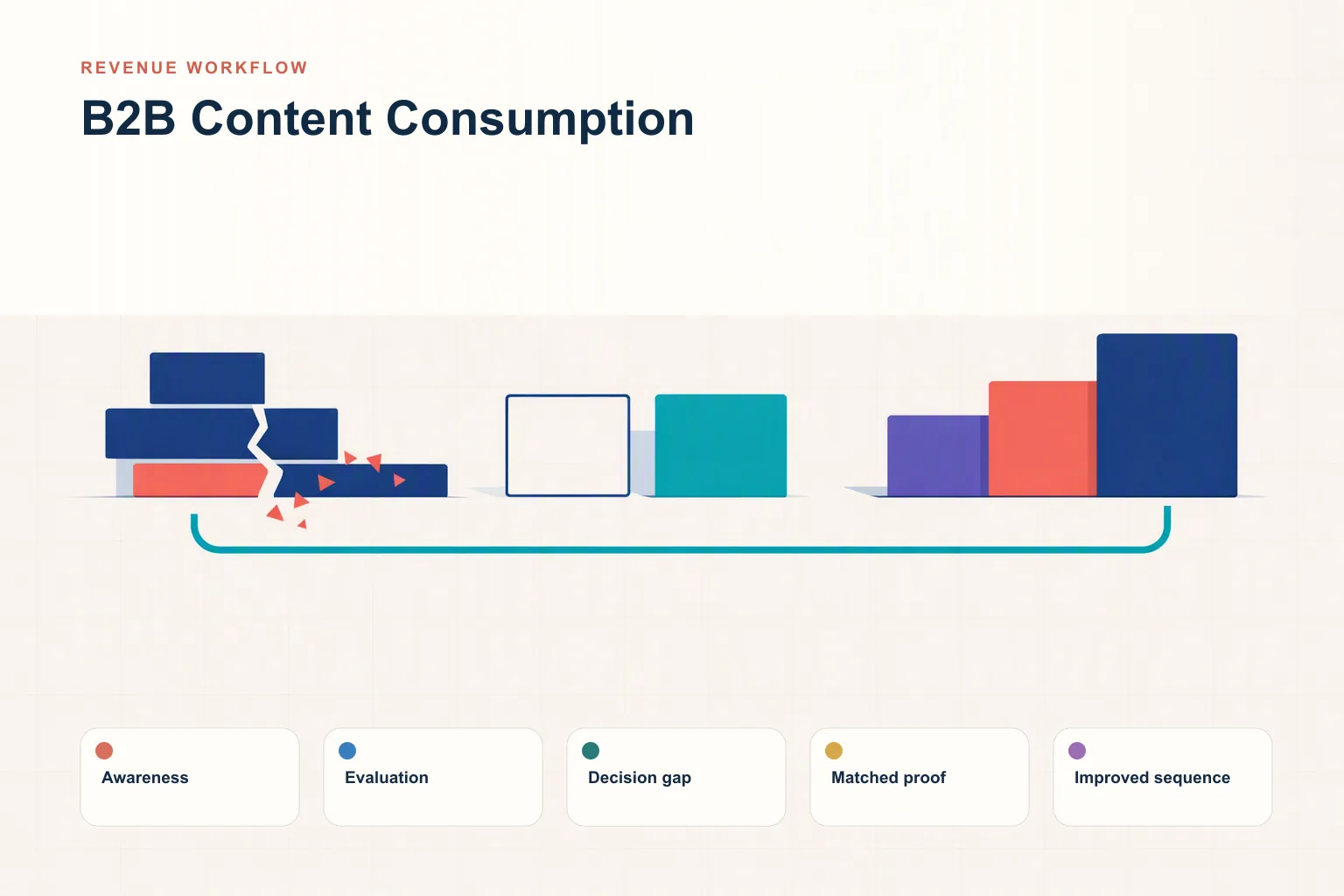
B2B revenue teams can avoid recurring content-consumption problems by treating the buyer journey as a continuous operating discipline supported by clear ownership, relevant data, deal-level coaching, and structured learning.
Strategic mistakes
Mistake 1: Treating B2B content consumption as a one-time initiative
Treating B2B Content Consumption as a one-time initiative causes the process to drift when daily pipeline pressure takes over. A durable approach requires permanent ownership, standing reviews, defined metrics, and quarterly improvement goals.
The fix: Assign an accountable leader, document the operating model, and keep the playbook current as the team learns from deal outcomes.
Mistake 2: Relying on intuition instead of data
Recent or memorable opportunities can distort a leader’s view of the wider portfolio. Define three to five leading indicators, review them with revenue outcomes, and investigate discrepancies between the data and the prevailing narrative.
Revspire Buyer Intelligence solves this by surfacing deal-level data that gives leaders an objective view of B2B Content Consumption performance across every opportunity.
Execution mistakes
Three-part explainer: Detect missing proof, Supply the right asset, and Improve the sequence.
Mistake 3: Single-threading the relationship
Building an opportunity around one stakeholder creates a fragile deal. If that contact disengages, changes roles, or leaves the company, the team may have no established path to the rest of the buying group.
The fix: Map every relevant stakeholder, assign coverage, and track engagement with each person. Treat a deal with only one active contact as high risk.
Mistake 4: Confusing activity with progress
Email volume, call counts, and completed tasks can appear healthy while an opportunity remains stationary. Measure outcomes, not activities. Track stage progression velocity, buyer engagement quality, stakeholder coverage breadth, and time in stage.
Mistake 5: Using generic training instead of deal-level coaching
Deal-specific coaching uses live opportunities to identify where execution is breaking down and to work through the fix in context. Make content-consumption health a standing part of weekly pipeline conversations.
Learning and scaling mistakes
Mistake 6: Failing to learn systematically from wins and losses
Every won and lost deal contains insights about what works and what does not. Capture those insights through post-deal interviews, CRM analysis, and structured reviews, then feed the findings into playbooks, coaching, and strategy.
Mistake 7: Letting technology define the process
Technology should serve the B2B content consumption buyer journey process, not define it. Evaluate whether each tool reduces friction, supports the required behavior, and allows useful information to move between systems without unnecessary manual updates.
Data should flow automatically between systems — CRM, engagement platform, deal room — so that leaders always have a current, accurate view of what is happening across the portfolio.
A practical improvement framework
Before you can improve B2B Content Consumption, you need an honest baseline. Review the previous six months of opportunities by rep, segment, deal size, and stage, then identify where deals fall out and why.
Select the two or three structural problems that appear to have the greatest effect on revenue outcomes. Deploy them with a clear owner, a measurable goal, and a 90-day review cadence.
Connect measurement to revenue outcomes. Review conversion rates at each stage, time-in-stage benchmarks, and the relationship between specific behaviors and win rates. Revisit the metrics and win-loss findings quarterly, then update the playbook.
Take the next step
Fixing these patterns requires process, data, coaching, and technology to work together. See how Revspire helps B2B revenue teams eliminate these patterns.