Digital Sales Room Examples: 6 Example Rooms by Deal Type
A practical perspective for connecting this idea to your revenue team’s next move.
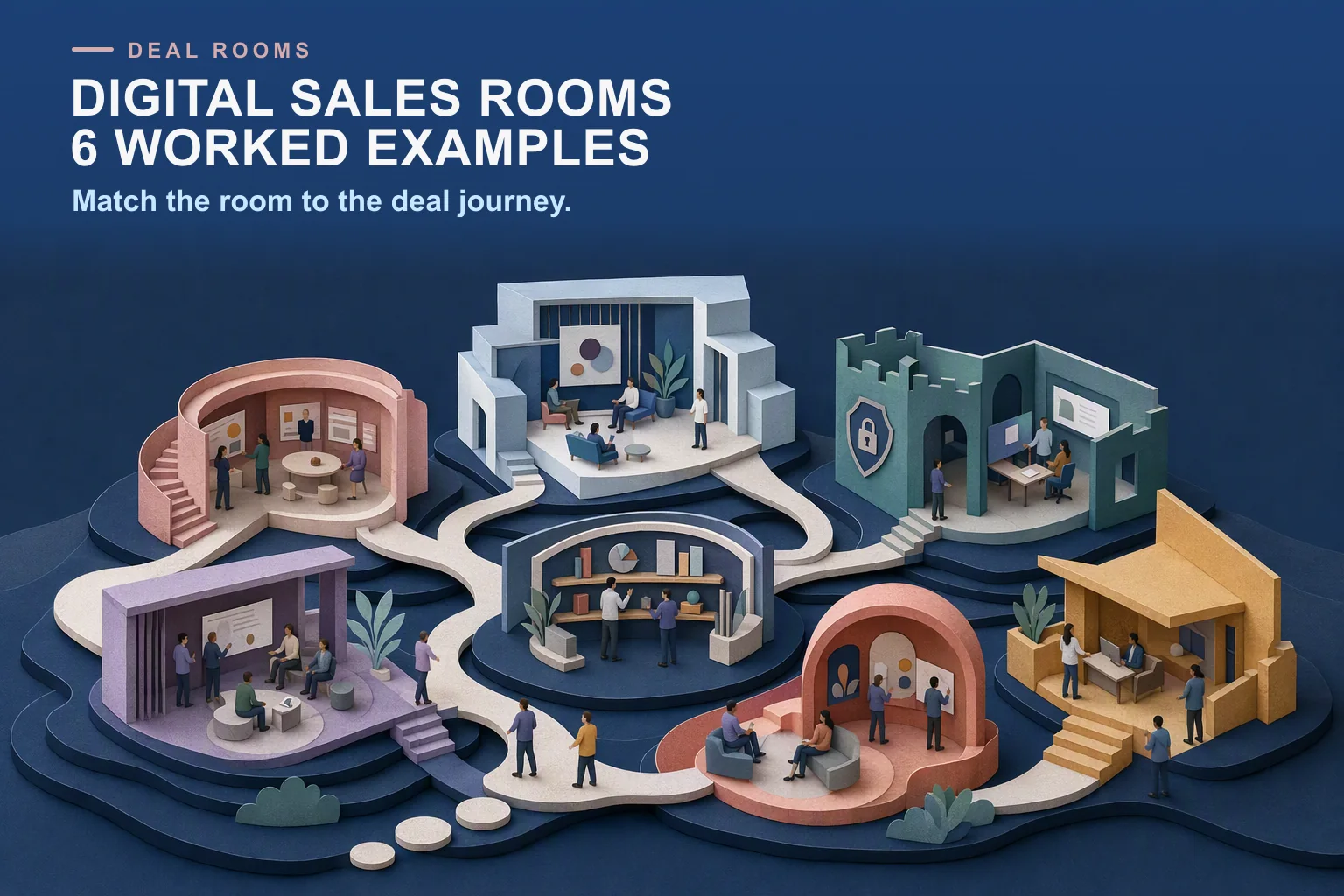
Digital sales room examples are easiest to learn from when they are tied to a deal type. Below are six example rooms: mid-market new business, an enterprise deal with a security review, a proof-of-concept, a renewal and expansion, a partner-sourced deal and a post-signature onboarding room. Each shows the sections, content, mutual action plan and who on the buyer side engages.
Every company in these examples is fictional. They are composites of how sales rooms are commonly structured, not records of real deals. At the end we summarise how three vendors lay out their own published templates, and the mistakes that make a room go unused.
Last updated: 27 October 2026
Disclosure: Revspire publishes this guide and sells digital sales room software. The examples are vendor-neutral and can be built in most deal room tools, or in a shared document if you have none.
What is a digital sales room, in one paragraph?
A digital sales room is one secure, branded page or workspace for a single deal, where the seller and the buying group share content, agree next steps and see progress. It matters because buyers spend most of their time away from sellers. Gartner’s B2B buying journey research (undated page, accessed 27 October 2026) says a typical buying group for a complex solution involves six to 10 decision makers, and that buyers spend only 17% of their buying time meeting potential suppliers. The room is what those six to 10 people read when you are not in the meeting.
The six example rooms at a glance
Example
Deal type
Main sections
Who engages most
1. Fernhill Analytics to Ostara Retail
Mid-market new business
Welcome video, recap, proposal, case study, mutual action plan
Champion, finance lead
2. Quillstone Security to Halvard Bank
Enterprise with security review
Executive summary, security pack, legal folder, business case, MAP
CISO team, procurement, legal
3. Tarnwick Data to Mereford Logistics
Proof of concept
Success criteria, test plan, environment access, daily notes, exit review
Technical lead, IT admin
4. Brindle Payroll and Coastmere Clinics
Renewal and expansion
Value review, usage summary, expansion options, renewal paper, MAP
Economic buyer, new department head
5. Varrow Cloud via partner Arcwold Consulting
Partner-sourced
Joint intro, partner services scope, combined pricing, shared MAP
Buyer champion, partner lead
6. Pellam Field Service to Kestrelby Utilities
Post-signature onboarding
Kickoff, implementation plan, training, support contacts
Project manager, admins, end users
All companies are fictional.
Example 1: Mid-market new business room
The deal: Fernhill Analytics sells reporting software to Ostara Retail, a 600-person retailer. Buying group of four: the head of merchandising (champion), the CFO’s deputy, an IT manager and an operations director. Target close in 45 days.
- Welcome: a 90-second video from the account executive naming each stakeholder and what the room is for.
- What we heard: a short recap of discovery in Ostara’s own words: three reporting problems and the cost of each, as the champion described it.
- Proposal: one page with two pricing options and what changes between them.
- Proof: one case study from a retailer of similar size, and a two-minute product clip of the report the champion asked about.
- Mutual action plan: six steps from “Demo for operations director” to “Signature”, each with an owner on both sides and a date.
Who engages and what to watch: the champion opens the room first. The useful signal is when the CFO’s deputy opens the proposal page, because that usually means the champion has started selling internally. If the operations director never opens the room, the account executive asks the champion for a 20-minute introduction rather than sending another email.
Example 2: Enterprise deal with a security review
The deal: Quillstone Security sells a data protection product to Halvard Bank. Twelve people are involved, including a CISO delegate, two security analysts, procurement, legal and a business sponsor. Security review is the longest step.
- Executive summary: a one-page business case for the sponsor, with the risk being addressed and the decision timeline.
- Security pack: architecture overview, completed standard questionnaire, data-flow diagram, penetration test summary and a named security contact. Access is limited to the security team.
- Legal folder: master agreement, data processing addendum and a redline log.
- Business case: the cost model the sponsor will take to the investment committee.
- Mutual action plan: separate tracks for security, legal and procurement, joined at a single “Investment committee” milestone.
Who engages and what to watch: the security analysts spend the most time in the room, often weeks before anyone else. If the security pack is opened but questions stop arriving, the seller asks the security contact whether anything is blocking. Separate sections with different access keep sensitive documents away from people who do not need them.
Example 3: Proof-of-concept room
The deal: Tarnwick Data runs a three-week proof of concept with Mereford Logistics. The buyer’s technical lead owns the evaluation; an IT admin sets up access.
- Success criteria: four measurable criteria agreed in writing, for example “Load last quarter’s shipment data in under two hours”.
- Test plan: each test with an owner, a date and a pass or fail column.
- Environment access: setup guide, credentials process and a support channel.
- Daily notes: short updates from the sales engineer so the business sponsor can follow progress without joining calls.
- Exit review: a meeting booked for the last day, where both sides mark each criterion met or not met.
Who engages and what to watch: the technical lead and the admin. The risk in proof-of-concept rooms is scope creep, so any new test the buyer asks for is added as a dated line with an owner, not absorbed silently.
Example 4: Renewal and expansion room
The deal: Brindle Payroll renews Coastmere Clinics, a healthcare group, and proposes adding a second department.
- Value review: what Coastmere set out to achieve last year and what happened, in figures from Coastmere’s own reports.
- Usage summary: adoption by site, with the two sites that lag named honestly.
- Expansion options: two packages for the new department with a one-page comparison.
- Renewal paper: order form and any changed terms highlighted.
- Mutual action plan: renewal steps first, expansion steps second, so the renewal does not wait on the expansion decision.
Who engages and what to watch: the economic buyer and the head of the new department. If the new department head reads the expansion page several times but the economic buyer does not, the customer success manager asks for a joint meeting before the renewal date.
Example 5: Partner-sourced deal room
The deal: Arcwold Consulting, an implementation partner, brings Varrow Cloud into a deal at a manufacturing company. The buyer sees two vendors and wants one plan.
- Joint introduction: who does what between Varrow and Arcwold.
- Services scope: Arcwold’s implementation statement of work.
- Combined pricing: software and services on one page, with which company invoices which part.
- Shared mutual action plan: owners from three companies: buyer, vendor and partner.
Who engages and what to watch: the partner lead often updates the plan more than the vendor. Agree upfront who owns the room, and give the partner access only to the sections they need. Revspire, for example, extends deal rooms to partner companies through its Partner Portal, with company-level access controls.
Example 6: Post-signature onboarding room
The deal: Pellam Field Service has just signed Kestrelby Utilities. The sales room becomes the onboarding room, so nothing agreed during the sale gets lost.
- Kickoff: agenda, attendees and the success criteria carried over from the sales room.
- Implementation plan: phases with dates and owners.
- Training: sessions by role, with recordings.
- Support contacts: who to call for what.
Who engages and what to watch: the buyer’s project manager and admins. The handoff works when the customer success manager is added to the room before signature and the sales promises are written down there, not in someone’s inbox.
How vendors lay out their published templates
Several vendors publish their own room templates, which are a useful check on your structure:
- Dock publishes a digital sales room template (accessed 27 October 2026) with eight sections: Summary (with a mutual action plan checklist), Product Overview, Business Case, Sales Pilot Plan, Case Studies, Pricing Proposal with a sample order form, Competitor Comparison and Customer Success.
- GetAccept ‘s digital sales room examples article (updated 9 October 2026) walks through a room for TechFlow, which it describes as an imaginary company, and covers internal uses such as HR onboarding and finance guidelines.
- Aligned describes its digital sales room template as a “mini-site” where buying teams can self-serve, with a wider template library after sign-up.
The common pattern: a summary, the business case, proof, pricing and a mutual action plan. Where they differ is in how much of the evaluation (pilots, competitor comparisons) they put in the buyer’s view.
What separates a room buyers use from one they ignore
- It is written for the buyer, not the seller. Section titles use the buyer’s words: “Your security review”, not “Security collateral”.
- It has a mutual action plan. Without dated next steps, a room is a file share. Our mutual action plan template gives a starting structure.
- It is short. Five to eight sections, each with a clear reason to exist. Old decks stay out.
- Each stakeholder has a page. Finance, security and the user team each find their part in one click. A stakeholder map helps you decide which pages to build.
- The champion can forward it. Gartner’s March 2026 survey of 646 B2B buyers found that 67% prefer a rep-free experience. A room the champion can share without you in the meeting fits that preference.
- Someone reads the engagement data. Views by stakeholder are only useful if the seller acts on them. Our guide to deal room analytics covers which signals to act on.
How to build your first room from these examples
- Pick the example closest to your next deal.
- Copy its sections and delete any you cannot fill with something specific to this buyer.
- Write the “What we heard” summary first. If you cannot write it, you are not ready to send a room.
- Draft the mutual action plan with dates, then agree it with your champion on a call.
- Send the room after a meeting, not instead of one, and check who opened what two days later.
Revspire’s Digital Sales Rooms include branded rooms, mutual action plans with owners and due dates, AI content recommendations by deal stage and stakeholder role, AI stakeholder mapping and real-time engagement analytics. To compare tools, see our digital sales room software guide.
Frequently asked questions
What should a digital sales room include?
At minimum: a short summary of the buyer’s problem, the proposal, proof such as a case study, a mutual action plan with owners and dates, and contacts. Add a security, legal or pilot section when the deal needs it.
What are common digital sales room use cases?
New business deals, enterprise deals with security and legal reviews, proofs of concept, renewals and expansions, partner-sourced deals, and onboarding after signature. Some teams also use rooms internally, for example for employee onboarding.
How many sections should a sales room have?
Usually five to eight. Each section should answer a question a specific stakeholder will ask. If a section exists only because the content was available, remove it.
Is a deal room the same as a digital sales room?
In B2B sales, yes: deal room, sales room, digital sales room and virtual sales room describe the same idea. A virtual data room used in mergers and acquisitions is different: it is built for due diligence document review.
Can I build a digital sales room without software?
You can approximate one with a shared document that links to files and holds a mutual action plan. You lose access control by section, per-stakeholder engagement data and a single link that always shows the current version.
Related: digital sales room template, mutual action plan examples and digital sales room vs email and PDFs.
Sources
- The B2B Buying Journey, Gartner, undated, accessed 27 October 2026
- Gartner Sales Survey Finds 67% of B2B Buyers Prefer a Rep-Free Experience, Gartner, 9 March 2026, accessed 27 October 2026
- Digital Sales Room Template, Dock Labs, undated, accessed 27 October 2026
- Digital sales room examples, GetAccept, updated 9 October 2026, accessed 27 October 2026
- Digital Sales Room Template, Aligned, undated, accessed 27 October 2026