Mutual Action Plan Examples: 4 Complete Plans by Deal Type
A practical perspective for connecting this idea to your revenue team’s next move.
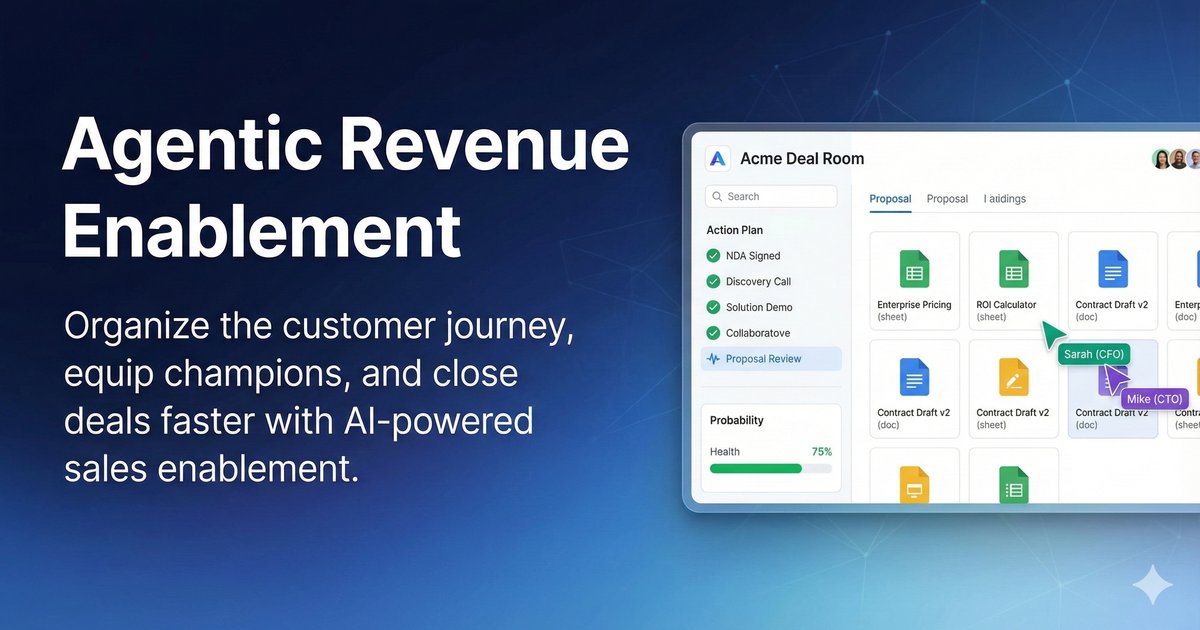
A mutual action plan example is most useful when it matches your deal type. Below are four complete examples: a mid-market SaaS deal, an enterprise deal with a security review, a renewal with expansion and a partner-sourced deal. Each lists the steps, the buyer and seller owner for each step, the timing and what “done” means.
The companies are fictional, and the timings are illustrative; adjust them to your own sales cycle. If you want a blank version to fill in, start from our mutual action plan template.
Last updated: 27 October 2026
Disclosure: Revspire publishes this guide and sells digital sales room software that includes mutual action plans. The examples work in any tool, including a shared spreadsheet.
What goes into a mutual action plan?
A mutual action plan (MAP) is a shared, dated list of the steps buyer and seller agree to take to reach a decision. Every example below uses the same six fields:
Field
What it holds
Why it matters
Step
A verb and an outcome: “Security review completed”
Makes the step checkable
Buyer owner
A named person on the buyer side
Most delays happen on the buyer side
Seller owner
A named person on your side
Shows what you owe the buyer
Timing
A date or week
Lets both sides see slippage early
Exit criterion
What “done” means
Stops steps being marked done too early
Status
Not started, in progress, done, at risk
Gives the champion a quick internal update
The fields used in every example below.
The steps usually follow how buyers decide. Gartner’s B2B buying journey research (undated page, accessed 27 October 2026) names six buying jobs: problem identification, solution exploration, requirements building, supplier selection, validation and consensus creation. It also says a typical buying group for a complex solution has six to 10 decision makers. A good MAP has at least one step for validation and one for consensus, with the people who own them named.
The plan also has to work when you are not in the room. Gartner’s March 2026 survey of 646 B2B buyers found that 67% prefer a rep-free experience. A written plan with buyer-side owners lets the champion move steps forward between meetings.
Example 1: Mid-market SaaS new business (about 6 weeks)
Deal: Ashgrove Software sells scheduling software to Pellowmere Dental Group, a 400-person practice group. Buying group: operations director (champion), finance manager, IT lead and the regional managers’ representative.
Step
Buyer owner
Seller owner
Timing
Exit criterion
Agree goals and success measures
Operations director
Account executive
Week 1
Three goals written in the buyer’s words
Demo for regional managers
Managers’ representative
Sales engineer
Week 2
Managers confirm the workflow fits
IT integration check
IT lead
Sales engineer
Week 3
Calendar and SSO integration confirmed
Proposal reviewed
Finance manager
Account executive
Week 4
Preferred option chosen
Contract redlines agreed
Operations director
Account executive
Week 5
No open legal points
Signature and kickoff booked
Operations director
Account executive
Week 6
Signed order form and kickoff date
Fictional example.
Why it works: six steps, each with a named owner on both sides. The IT check comes before the proposal, so a technical blocker cannot surface after pricing is agreed.
Example 2: Enterprise deal with a security review (about 16 weeks)
Deal: Ridgeway Identity sells access-management software to Caldermoor Insurance. Twelve stakeholders. Security and procurement run in parallel, which is where most enterprise plans slip.
Step
Buyer owner
Seller owner
Timing
Exit criterion
Business case agreed with sponsor
VP Operations (sponsor)
Account executive
Weeks 1 to 3
Sponsor signs off the problem and cost of inaction
Technical evaluation
Enterprise architect
Sales engineer
Weeks 3 to 6
Architecture review passed
Security questionnaire submitted
Security analyst
Security lead
Week 5
Questionnaire and evidence delivered
Security review completed
CISO delegate
Security lead
Weeks 6 to 11
Written approval or list of conditions
Procurement onboarding
Procurement manager
Deal desk
Weeks 6 to 9
Vendor record created
Legal review (MSA and DPA)
Legal counsel
Your legal team
Weeks 8 to 13
Agreed contract text
Investment committee
VP Operations
Account executive
Week 14
Budget approved
Signature
Chief operating officer
Account executive
Weeks 15 to 16
Signed contract
Fictional example.
Why it works: the security and procurement tracks start early, in parallel, and each has its own buyer owner. The investment committee step names the person who presents, and a date is fixed weeks ahead because committee calendars rarely move.
Example 3: Renewal with expansion (about 10 weeks before renewal)
Deal: Lanyard Learning renews Bramwell Health, a hospital group, and proposes adding nursing education. Renewal date is fixed; the expansion decision is not.
Step
Buyer owner
Seller owner
Timing
Exit criterion
Value review meeting
Head of learning
Customer success manager
Renewal minus 10 weeks
Agreed summary of results against last year’s goals
Renewal quote issued
Procurement
Account manager
Minus 8 weeks
Quote received
Nursing education discovery
Director of nursing
Account manager
Minus 7 weeks
Requirements written down
Expansion proposal
Director of nursing
Account manager
Minus 5 weeks
Option selected or declined
Renewal signed
Head of learning
Account manager
Minus 2 weeks
Signed renewal
Expansion signed (if approved)
Director of nursing
Account manager
Any time
Signed amendment
Fictional example.
Why it works: the renewal and the expansion are separate steps, so a slow expansion decision does not put the renewal at risk.
Example 4: Partner-sourced deal (about 8 weeks)
Deal: Copperline Consulting, a systems integrator, brings Sabrevine Analytics into a deal at Hollins Manufacturing. Three companies own steps.
Step
Owner (company)
Timing
Exit criterion
Joint discovery workshop
Partner lead (Copperline) with buyer’s plant IT manager
Week 1
Shared requirements list
Software demo
Sales engineer (Sabrevine)
Week 2
Buyer confirms fit
Implementation scope and estimate
Partner lead (Copperline)
Week 3
Statement of work drafted
Combined proposal
Account executive (Sabrevine) and partner lead
Week 4
One document with software and services pricing
Buyer budget approval
Plant director (Hollins)
Weeks 5 to 6
Budget approved
Contracts signed
Procurement (Hollins)
Weeks 7 to 8
Software and services contracts signed
Fictional example.
Why it works: every step names the company as well as the person, and there is one combined proposal so the buyer does not reconcile two quotes.
Mutual close plan, mutual success plan and joint execution plan: are they different?
Mostly in emphasis. A close plan or mutual close plan focuses on the steps to signature. A mutual success plan usually continues past signature into onboarding and the outcomes the buyer wants. A joint execution plan is another common name for the same shared plan. All four examples above can be extended into a success plan by adding onboarding steps after signature.
How vendors structure their own MAP templates
- Dock’s mutual action plan template (accessed 27 October 2026) has five sections: Overview (target kickoff date and success criteria), Plan Progress, Evaluation, Procurement (legal review, security review, contract signoff) and Implementation.
- Dock’s digital sales room template also has a Sales Pilot Plan section with a timeline, stakeholders and success criteria, which suits a proof-of-concept MAP.
- Aligned’s mutual action plan example (published 14 November 2023, by its CEO) recommends six steps: a value summary from the buyer’s view, the full stakeholder list, actionable steps, a schedule with deadlines, a named owner per task and post-sale outcomes.
Dock’s MAP template and Aligned’s guide both carry the plan past signature, and Dock’s puts procurement in the plan, which matches Examples 2 and 3 above.
Mistakes that make a MAP fail
- Seller-only owners. If every step is owned by your team, it is your task list, not a mutual plan.
- No exit criteria. “Security review” is a topic; “written approval from the CISO delegate” is a step.
- Agreed by email only. Walk through the plan with the champion on a call before sharing it widely.
- Missing stakeholders. Map the buying group first; our stakeholder map template helps.
- Never updated. Review it at the end of every buyer meeting and change dates openly when they move.
For data on how teams use MAPs, see our mutual action plan benchmark. Revspire’s Digital Sales Rooms hold mutual action plans with owners and due dates inside the buyer’s room, next to the content each step needs.
Frequently asked questions
What is an example of a mutual action plan?
A mid-market example: agree goals (week 1), demo for users (week 2), IT check (week 3), proposal review (week 4), contract redlines (week 5), signature and kickoff (week 6), each with a buyer owner, a seller owner and an exit criterion.
How many steps should a mutual action plan have?
Usually five to ten for a new business deal. Enterprise plans can run longer when security, procurement and legal each need their own steps. Fewer, clearly owned steps are easier to keep current than a long checklist.
When should you introduce a mutual action plan?
Once the buyer agrees there is a problem worth solving and you know who else is involved, often after discovery. Introducing it before then can feel presumptuous; much later and key steps have already been missed.
What is the difference between a mutual action plan and a close plan?
A close plan can be internal to the seller. A mutual action plan is shared with and agreed by the buyer, with buyer-side owners. Many teams use the terms interchangeably for the shared version.
Related: mutual action plan software, digital sales room examples and digital sales room template.
Sources
- The B2B Buying Journey, Gartner, undated, accessed 27 October 2026
- Mutual Action Plan Template, Dock Labs, undated, accessed 27 October 2026
- Gartner Sales Survey Finds 67% of B2B Buyers Prefer a Rep-Free Experience, Gartner, 9 March 2026, accessed 27 October 2026
- Digital Sales Room Template, Dock Labs, undated, accessed 27 October 2026
- Mutual Action Plan Example, Aligned (Gal Aga), 14 November 2023, accessed 27 October 2026