Digital Sales Room vs Email, PDFs and Shared Folders: When Each Fits
A practical perspective for connecting this idea to your revenue team’s next move.
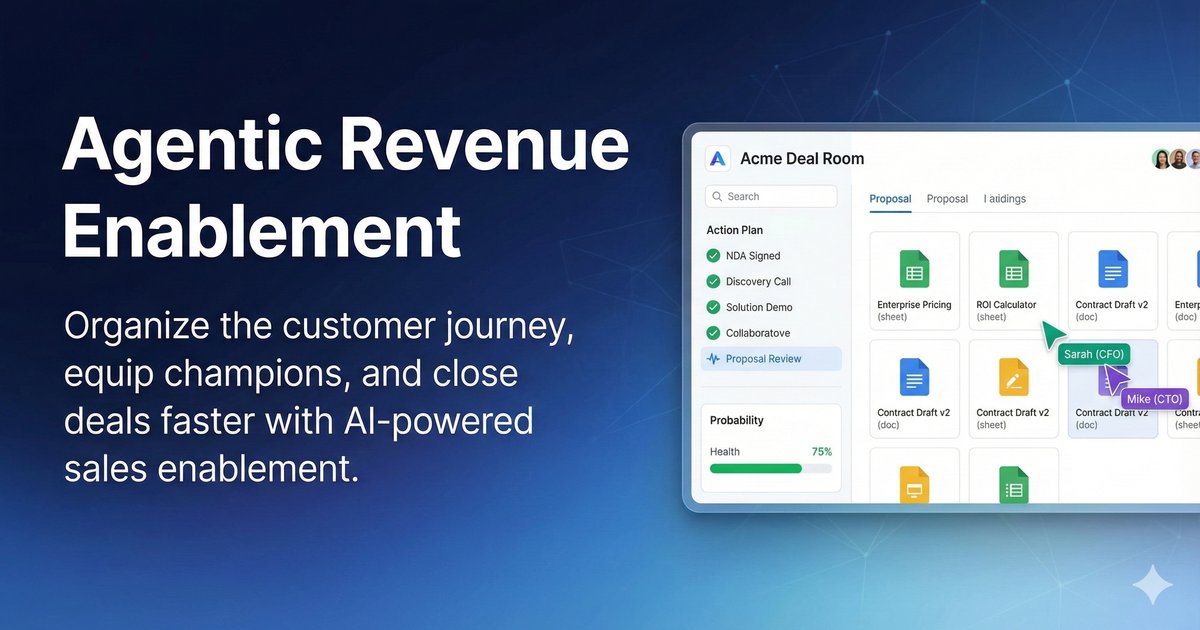
A digital sales room beats email, PDFs and shared folders when several people on the buyer’s side need the same current content, a shared plan and a single place to return to. Email is still fine for simple deals with one or two decision makers, and a PDF is still the right format for the final contract or a formal RFP response.
This guide compares the four options honestly, including where a deal room adds work you do not need, and shows how most teams combine them rather than replace email altogether.
Last updated: 27 October 2026
Disclosure: Revspire publishes this guide and sells digital sales room software. We have tried to say plainly when you do not need one.
Digital sales room vs email, PDF and shared folder: comparison
Question
Email with attachments
PDF proposal
Shared folder (Drive, SharePoint, Box)
Digital sales room
Is the buyer seeing the current version?
No, every forward is a copy
No, unless re-sent
Yes, if files are edited in place
Yes, the link shows the latest content
Can you control who sees what?
No, once sent it can be forwarded
Only with passwords
Yes, by folder permissions
Yes, by room and often by section
Do you know who engaged?
Open tracking at best
Only with a tracked link
Limited, depends on admin settings
Yes, views by stakeholder
Are next steps shared?
Buried in threads
Static, at time of writing
Only if you add a document
Yes, a mutual action plan
Buyer effort
Lowest, nothing new to open
Low
Medium, may need sign-in
Low to medium, one link
Seller setup time
Minutes
An hour or two
Minutes
Under an hour from a template
Extra cost
None
None, or a tracking tool
None if already licensed
Free plans exist; paid plans vary
General comparison. Specific tools vary; check the features of the one you use.
When is email enough?
Email is the right choice more often than deal room vendors admit. Stay with email when:
- One or two people decide. If the buyer and the budget holder are the same person, a room adds a step without adding clarity.
- The deal is short and transactional. A renewal at the same price or a small add-on rarely needs a shared plan.
- You are sending one document. A single quote or one-pager does not need a workspace.
- The buyer asks for it. Some buyers, especially in regulated sectors, are not allowed to open external portals. Respect that, and send what they can open.
- It is the first touch. A room sent before a first meeting is usually ignored. Earn the conversation first.
Even in a deal room process, email remains the notification channel: the link to the room arrives by email, and so do reminders.
When is a PDF the right format?
- Contracts and order forms that legal will file, sign and archive.
- Formal RFP responses where the buyer’s process asks for a document in a set format.
- Offline review , such as a board pack printed for a meeting.
If you need to know whether a PDF was read, a tracked-link tool sits in between. DocSend’s pricing page (checked 27 October 2026) lists Personal at $10 a user a month with document-level analytics and Standard at $45 a user a month; Advanced, at $150 a month for 3 users, adds lightweight data rooms. Our document tracking software guide and DocSend vs Papermark cover that category.
When does a shared folder work?
A shared folder in Google Drive, SharePoint or Box is a reasonable middle step when:
- You are working with a partner or an existing customer who already has access to your tenant.
- Files are large, such as design files, datasets or video.
- The buyer’s IT team prefers content in a system they already approve.
The weak points are structure and context. A folder holds files, not a story: it does not tell the CFO which document is for them, it does not hold dated next steps, and it rarely shows the seller who opened what. Folders also accumulate drafts, which is how buyers end up reading last quarter’s pricing.
When does a digital sales room earn its place?
A digital sales room is worth the setup when several of these are true:
- Three or more stakeholders. Gartner’s B2B buying journey research (undated, accessed 27 October 2026) says a typical buying group for a complex solution has six to 10 decision makers. Email threads break down at that size.
- The buyer will spend most of the decision without you. The same Gartner page says buyers spend only 17% of their buying time meeting potential suppliers, and Gartner’s March 2026 survey of 646 B2B buyers found 67% prefer a rep-free experience. A room is what they read in that time.
- Several kinds of content. Business case, security pack, legal documents and product videos for different readers.
- A dated plan matters. Security review, procurement and legal steps with owners on both sides. See our mutual action plan template.
- Your champion has to sell internally. One link they can forward does more than a folder of attachments they have to explain.
- You need early warning. Seeing that the economic buyer has never opened the proposal is a signal worth acting on. Our guide to signals that a deal is going dark covers what to watch.
Where deal rooms add work you do not need
- Empty rooms. A room with a logo and three generic decks is a slower way to send attachments.
- Sign-in friction. If the buyer has to create an account to read a quote, some will not. Check how your tool handles buyer access.
- Over-tracking. Engagement data is a prompt for a conversation, not a reason to email a buyer the minute they open a page.
- Too many tools. If proposals, signatures and rooms are three different products, the buyer gets three different links.
What does trying a digital sales room cost?
You can test the approach at no cost before you buy. On 27 October 2026, several vendors listed free or low-cost entry points:
Vendor
Entry option
Source
Aligned
Starter is free, with 4 rooms per seat; buyers never cost a seat
Dock
Free plan; Standard $350 a month for 5 users; external collaborators free
GetAccept
Professional, with mutual action plans, $49 a user a month billed annually, 5-user minimum
PandaDoc
Business, $49 per seat a month billed annually, includes up to 3 Deal Rooms
Vendor list prices on 27 October 2026. Feature limits differ by plan; see each page.
For a full comparison of vendors, see our digital sales room software guide.
A simple rule for choosing per deal
Score the deal before you decide how to share content. One point each for: three or more stakeholders, more than two kinds of content, a sales cycle longer than 30 days, a security or legal review, and a champion who has to present internally.
- 0 to 1 points: email, with a PDF for the quote.
- 2 points: email plus a tracked link or a tidy shared folder.
- 3 or more points: a digital sales room, with email for notifications and a PDF of the final contract inside the room.
The thresholds are our judgement, not a benchmark; adjust them to your deals. The value is in making the choice deliberately rather than by habit.
Revspire’s Digital Sales Rooms pull approved content from Content Hub, so the room shows the current version, and add mutual action plans, AI stakeholder mapping and engagement analytics by stakeholder.
Frequently asked questions
Is a digital sales room better than email?
For deals with several stakeholders, several documents and a dated plan, usually yes: everyone sees the same current content and next steps. For simple deals with one decision maker, email is faster and perfectly adequate.
What is the difference between a digital sales room and a PDF proposal?
A PDF is a fixed snapshot of one document. A digital sales room holds the proposal alongside other content, a mutual action plan and engagement data, and it updates when you change it. Many teams put the final PDF inside the room.
Is a digital sales room better than a Google Drive folder?
A folder stores files; a room presents them with context, per-stakeholder sections, next steps and engagement data. A folder is fine for large files or partners already inside your tenant.
Is a deal room the same as a data room?
No. A deal room in sales is a buyer-facing space for one opportunity. A virtual data room is usually used for due diligence in mergers, fundraising or legal processes, with an emphasis on document security and audit.
Do buyers actually use digital sales rooms?
They use rooms that are short, specific to them and tied to a plan they agreed. Generic rooms filled with old decks get ignored, just like generic email attachments. For published research, see our digital sales room statistics.
Related: digital sales room examples, digital sales room template and buyer enablement tools.
Sources
- The B2B Buying Journey, Gartner, undated, accessed 27 October 2026
- Gartner Sales Survey Finds 67% of B2B Buyers Prefer a Rep-Free Experience, Gartner, 9 March 2026, accessed 27 October 2026
- DocSend pricing, DocSend, undated, accessed 27 October 2026
- Aligned pricing, Aligned, undated, accessed 27 October 2026
- Dock pricing, Dock Labs, undated, accessed 27 October 2026
- GetAccept pricing, GetAccept, undated, accessed 27 October 2026
- PandaDoc pricing, PandaDoc, undated, accessed 27 October 2026