Revspire blog
How to Improve Post-Sale Buyer Success and Close More B2B Deals in 2026
A practical 2026 framework for auditing B2B deals, defining stage standards, improving stakeholder coverage, coaching reps, and learning from wins and losses.
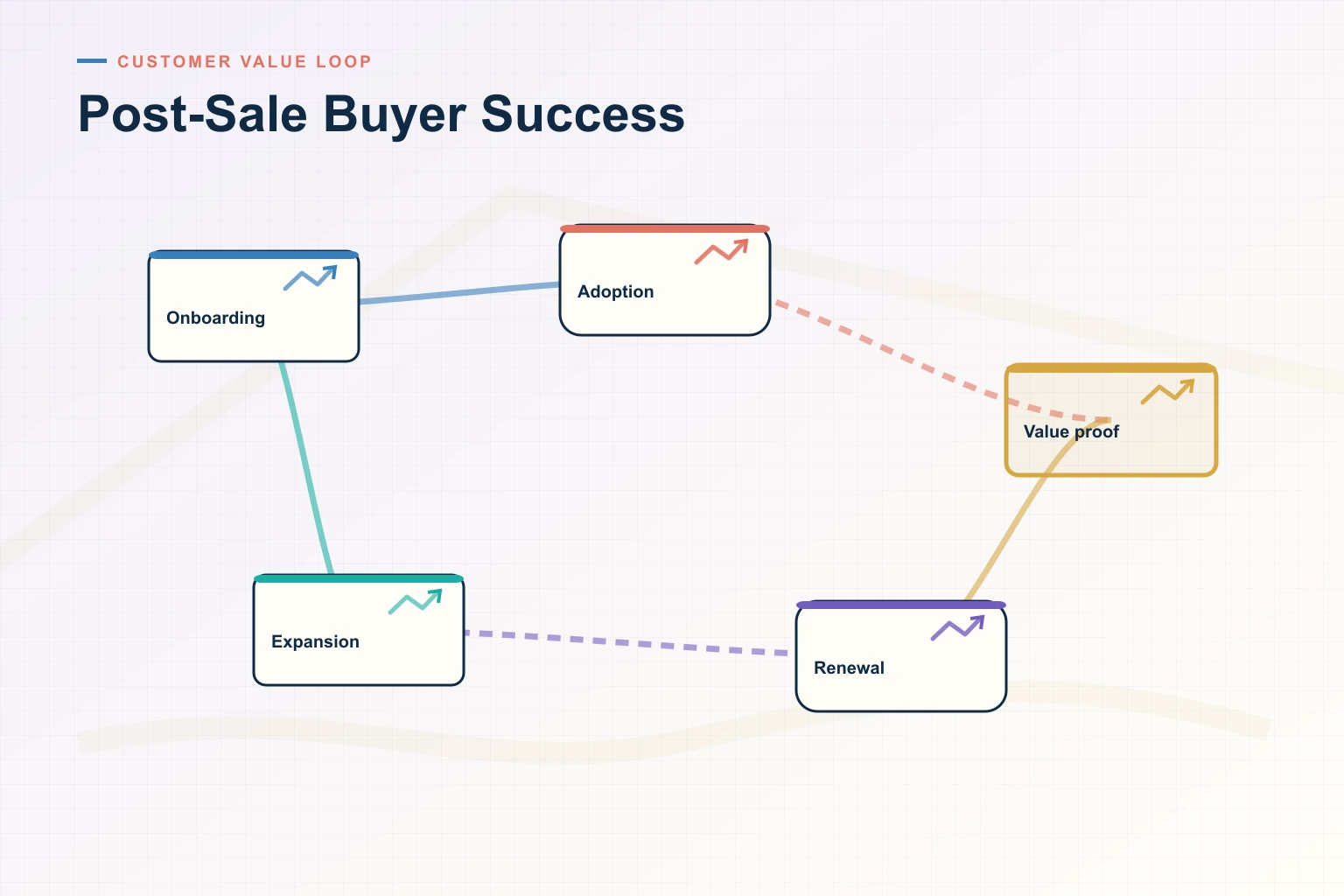
Post-Sale Buyer Success works best as a continuous, data-informed operating discipline rather than a one-time initiative. For B2B revenue teams, that means defining stage expectations, assigning ownership, monitoring buyer and deal signals, coaching active opportunities, and feeding lessons from wins and losses back into the process.
Why Post-Sale Buyer Success Matters to B2B Deals
A reactive approach built on tribal knowledge and manager intuition can produce inconsistent execution. Problems can appear throughout the pipeline: unsuitable opportunities consume capacity in early stages, qualified deals stall in the middle, and late-stage deals encounter procurement surprises, unstated objections, or stakeholder concerns.
A business-case review should examine more than close rates. Consider forecast confidence, rep development, resource allocation, the buyer experience, competitive risk, and the working environment created for revenue professionals. These dimensions can help leaders identify where a more structured process may reduce friction or improve execution without assuming that one intervention guarantees a particular result.
A Practical Framework for Post-Sale Buyer Success
Three-part explainer: Audit the current state, Build the operating model, and Measure and improve.
1. Audit the Current State
Start with an honest audit. Where is Post-Sale Buyer Success working well today? Where is it breaking down? What does the data say versus what the narrative says?
Pull the last six months of deal data and map opportunities against the relevant stages. Review where deals fall out and segment the findings by rep, customer segment, and deal size. Use the assessment to prioritize two or three specific improvements, each with a clear owner, a measurable goal, and a 90-day review cadence.
2. Define Stage Standards and Ownership
An operating model for Post-Sale Buyer Success answers three questions: what actions should happen, at what stage, and who is accountable. Document this explicitly.
Write down what strong execution looks like at each stage, including milestones, criteria, and a shared vocabulary. This creates a consistent basis for coaching and measurement. Someone on the leadership team should be accountable for outcomes, not just activities, with responsibility for goals, metrics, and changes to the approach.
3. Build Stakeholder Coverage Into the Process
Do not build an entire relationship around one contact. Map the stakeholders in the buying committee, assign coverage, and track engagement with each person. Treat an opportunity with only one active contact as a risk that requires investigation, and make multi-threaded engagement part of the stage-advancement criteria.
Three-part explainer: Align and onboard, Prove usage and value, and Renew and expand.
4. Instrument Each Stage With Useful Indicators
Define three to five leading indicators for Post-Sale Buyer Success and track them weekly. Depending on the process, examples can include stakeholder engagement rates, content consumption, mutual action plan progression, or deal velocity at each stage.
Pair leading indicators with lagging measures such as win rates, cycle times, and average deal sizes. Examine conversion rates at each stage, time-in-stage benchmarks, stage progression velocity, buyer engagement quality, stakeholder coverage breadth, and relationships between specific behaviors and win rates. Measure outcomes rather than activity counts.
5. Connect Weekly Reviews to Deal-Level Coaching
Build a standing review of Post-Sale Buyer Success health into the weekly pipeline cadence. Use it as a structured conversation about what should change in active opportunities rather than as a general status update.
Connect the dashboard to coaching conversations and territory reviews. Deal-specific coaching can examine a live opportunity, identify where execution is breaking down, and work through a practical correction with the rep. When activity is high but outcomes are weak, investigate the deal instead of simply asking for more activity.
6. Capture Win-Loss Intelligence Systematically
Capture lessons from won and lost deals through post-deal interviews, CRM data analysis, and structured win-loss reviews. Feed the findings into playbooks, training, and strategy so the process reflects current evidence rather than relying only on memory or intuition.
For significant losses, review the specific breakdowns with the rep, document the findings, and update the relevant playbook. This creates a reusable record of failure patterns and corrective actions instead of allowing the same issues to pass undocumented from quarter to quarter.
7. Align Technology and Data With the Process
Technology should serve the Post-Sale Buyer Success process rather than define it. Evaluate each tool by asking whether it makes execution easier and more consistent or adds friction.
Allow data to flow between systems such as a CRM, engagement platform, and deal room so leaders can maintain a current portfolio view. The supplied sources describe Revspire Buyer Enablement as an option for bringing deal-level signals, content, and stakeholder information into this workflow.
8. Make Improvement an Ongoing Discipline
Assign a permanent owner to Post-Sale Buyer Success outcomes. Build the work into the operating cadence with standing review meetings, defined metrics, and quarterly improvement goals.
Review results against targets, update playbooks when new information becomes available, and solicit feedback from buyers about their experience. This feedback loop connects day-to-day execution, coaching, win-loss findings, and buyer input to the next round of process improvements.
Putting the Framework Into Practice
Begin with the audit, select a small number of improvements, and name an accountable owner. Then define stage standards, stakeholder coverage, leading indicators, weekly coaching, and a structured learning process for wins and losses. Together, these practices provide a repeatable way to identify deal risk, improve execution, and support better B2B deal outcomes in 2026.