Revspire blog
Enterprise Deal Velocity: Why It Matters and How to Improve It
Learn where enterprise deals stall and how to audit stages, assign ownership, track useful indicators, coach live deals, and improve the process.
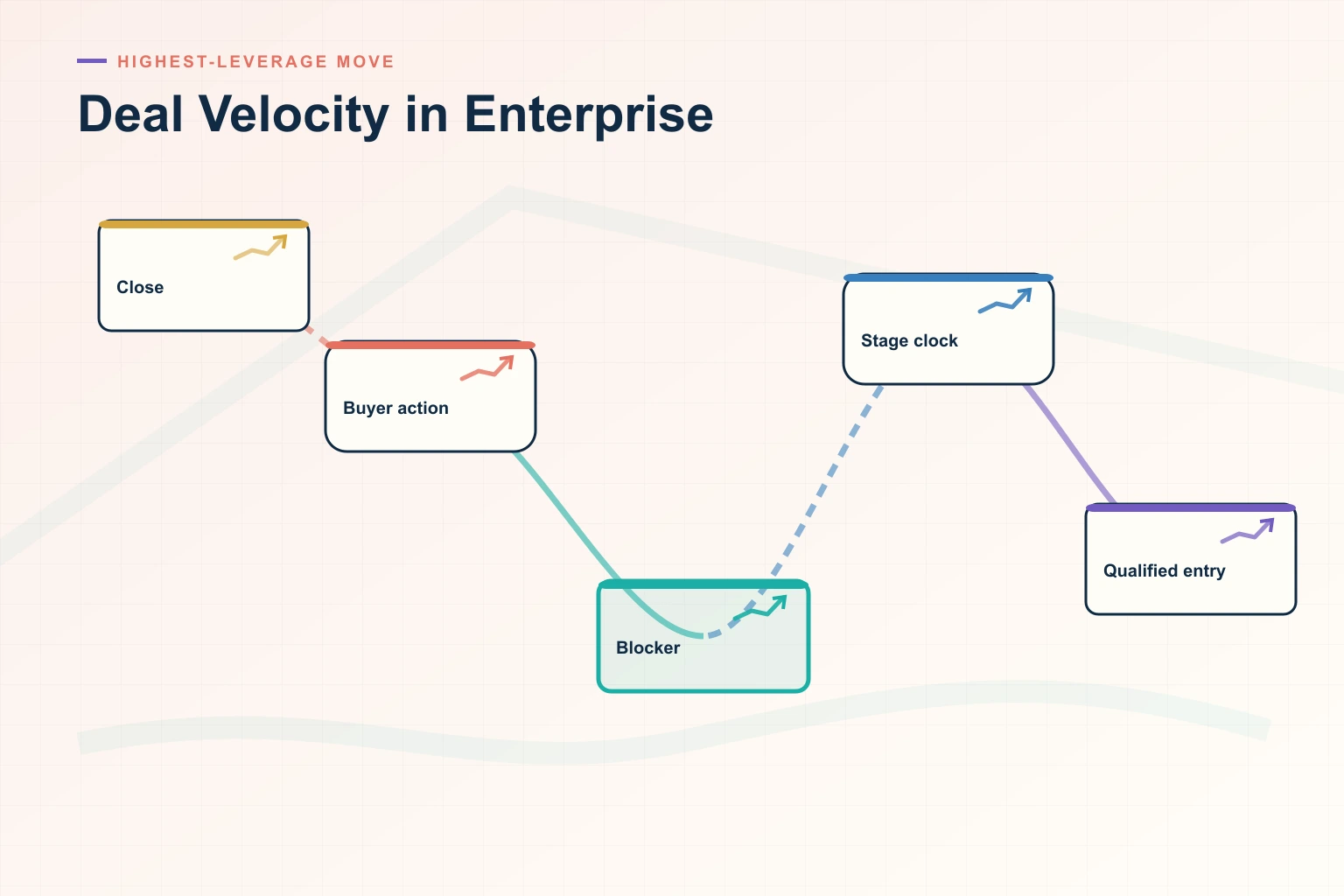
Enterprise deal velocity is an ongoing operating discipline that connects qualification, stage progression, stakeholder engagement, measurement, and coaching. This guide explains where deal progression can break down and provides a practical framework for auditing and improving the process.
Why enterprise deal velocity matters
Weak deal-velocity execution can create problems throughout the pipeline. Early-stage deals may consume representative capacity without sufficient qualification. Qualified deals may stall mid-cycle. Late-stage deals may encounter procurement surprises, unstated objections, or stakeholder concerns that were not surfaced earlier.
These breakdowns can affect qualification, forecast clarity, representative capacity, and the consistency of the buying process. Addressing them requires a documented operating approach rather than a temporary initiative.
The competitive dimension
When products are differentiated but not unique, the buying experience can become a competitive variable. A structured deal process can help teams surface stakeholder concerns and reduce avoidable friction in the buying path.
The operating dimension
A documented approach gives representatives and managers shared stage expectations, evidence requirements, and coaching standards. Clear ownership, useful data, and regular feedback help the team maintain that approach over time.
Three-part explainer: Expose the hidden cost, Build the business case, and Start where it matters.
Start with an honest audit
Start with an honest audit. Review recent opportunities against the stages of the sales process. Identify where deals fall out, where they remain too long, and whether the patterns differ by representative, segment, or deal size.
Compare the available data with the prevailing account narratives. Use the assessment to prioritize two or three specific improvements instead of attempting to change every part of the process at once.
An operating model should answer three questions: what actions should happen, at what stage, and who is accountable. Keep the model clear enough for the team to follow consistently.
Three-part explainer: Audit the current state, Build the operating model, and Measure and improve.
Build the operating foundation
Assign ownership
Assign a leader who is accountable for deal-velocity outcomes. That owner can set goals, define metrics, and maintain the operating approach as conditions change.
Document the process
Document stage criteria, required evidence, next actions, and accountable roles. Teach the process, reinforce it through managers, and update it when win-loss reviews or performance data reveal a useful change.
Align technology and data
The technology layer should reduce friction, not add it. Ensure your tools talk to each other so data flows without manual intervention.
Revspire Deal Acceleration is the deal-room platform referenced in the consolidated source material.
Ownership, process, technology, data, and feedback are components of the operating approach described in the source material.
Seven practices for deal progression
- Define the standard for each stage. Write down what execution should look like so representatives and managers can work from a shared definition.
- Instrument each stage. Track relevant leading indicators, including stakeholder engagement, content consumption, mutual action plan progression, and time in stage.
- Review deal velocity weekly. Use pipeline calls to discuss what should change during the next seven days rather than limiting the conversation to status updates.
- Coach live deals. Review current opportunities, identify where execution is breaking down, and work through a specific correction with the representative.
- Capture win-loss intelligence. Use post-deal interviews, CRM data analysis, and structured reviews to feed lessons back into playbooks and training.
- Align technology with the process. Evaluate whether each tool makes the process easier and more consistent or adds friction.
- Create feedback loops. Review metrics against targets, update playbooks when new information is available, and ask buyers about their experience.
Seven practices connect operating standards, indicators, weekly review, coaching, win-loss analysis, technology, and feedback.
Measure progress rather than activity
Use leading and lagging indicators together. Measures described in the source material include stakeholder engagement, content consumption, mutual action plan progression, stage conversion, time in stage, win rates, cycle times, and average deal sizes.
Build a dashboard that shows both. Review it weekly.
Avoid vanity metrics like activity counts. Measure outcomes, not activities. When activity is high but stage progression, buyer engagement quality, or stakeholder coverage is weak, investigate what is happening inside the deal.
Five mistakes to address
1. Treating deal velocity as a temporary project
Assign a permanent owner, define metrics, and include deal velocity in the standing operating cadence.
2. Relying on intuition alone
Define a small set of leading indicators, review them weekly, and investigate when the data and the prevailing account narrative disagree.
3. Depending on one stakeholder
Map the buying committee, assign stakeholder coverage, and treat a deal with only one active contact as a risk that requires review.
4. Confusing activity with progress
Measure outcomes, not activities. Use stage progression, buyer engagement quality, and stakeholder coverage as inputs to coaching and pipeline reviews.
5. Failing to learn from losses
Implement a structured loss review process. Document the breakdowns identified in significant lost deals and update the playbook accordingly.
Three-part explainer: Recognize the leak, Correct the behavior, and Prevent repeat failure.
A practical 90-day starting point
- Establish a baseline. Review recent deal data to identify where deals fall out and where they remain too long.
- Prioritize focused changes. Use the assessment to prioritize two or three specific improvements.
- Name an owner and goal. Give each change an accountable leader and a measurable goal.
- Review the measures. Discuss them weekly and conduct a broader review after 90 days.
- Update the system. Feed lessons from won and lost deals into the playbook, workflows, and coaching plan.