Best Mutual Action Plan (MAP) Software in 2026: 9 Tools Compared
A practical perspective for connecting this idea to your revenue team’s next move.
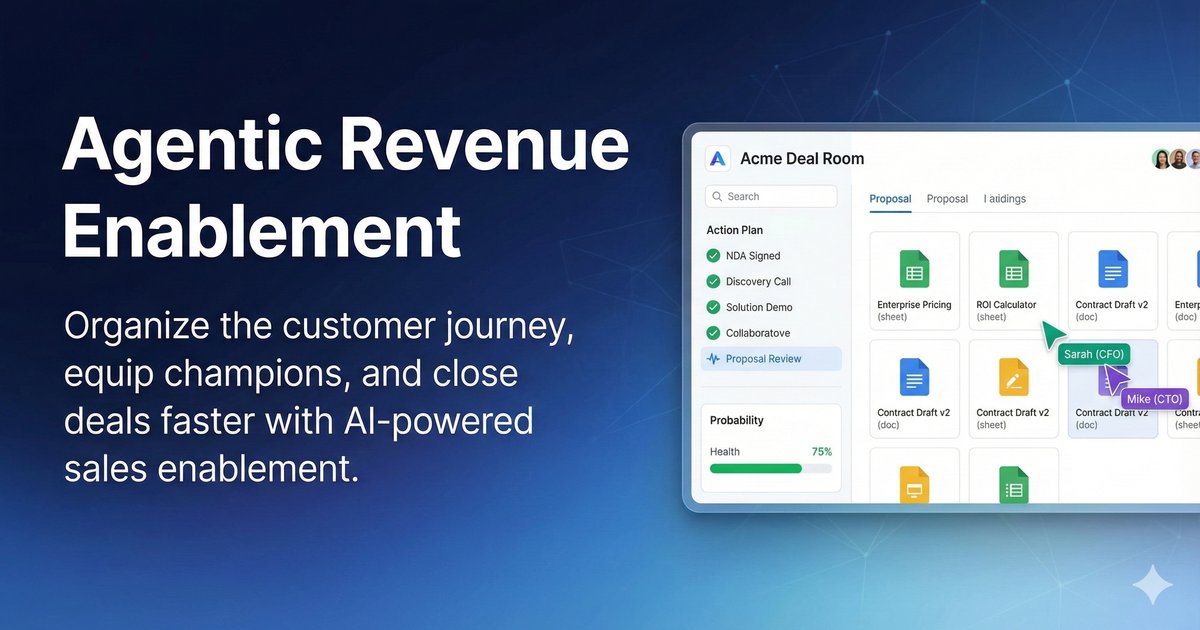
The best mutual action plan software depends on where you want the plan to live. For a MAP inside a buyer-facing deal room, look at Aligned, Dock, Flowla, GetAccept or Trumpet. For a MAP-first, methodology-led tool, Accord. For MAPs inside a broader sales platform, Mindtickle, Outreach or Revspire. Aligned, Dock, Flowla and Trumpet have free plans.
A mutual action plan is a shared list of the steps to a buying decision, each with an owner on the buyer or seller side and a date. MAP software keeps that list in front of the buying group, reminds owners and shows the seller who is engaged. This guide compares nine MAP tools with published pricing, one limitation each and when to choose them.
Last updated: 27 October 2026
Disclosure: Revspire publishes this list. Revspire appears once, in the broader-platform group, and is not ranked above other tools. Tools are grouped by type and listed alphabetically within each group. Every price and feature below was checked on the vendor’s own website on 27 October 2026.
Mutual action plan tools compared: summary table
Tool
Type
Best for
Published pricing (checked 27 Oct 2026)
Accord
MAP-first, methodology-led
MEDDPICC-style execution
Starter from $99, Growth from $119 per user a month, plus a platform fee
Aligned
Deal room with MAP
Low per-seat cost
Free; Basic $29, Pro $49 per seat a month (annual)
Dock
Deal room with MAP
Evaluation to onboarding
Free; Standard $350 a month (5 users); Premium $1,000 a month (10 users)
Flowla
Deal room with MAP
Monthly terms, no seat minimum
Free (up to 20 rooms); Team $99 per seat a month
GetAccept
Deal room with MAP and e-signature
Plan to signature in one place
Professional $49 per user a month (minimum 5 users, paid annually)
Trumpet
Deal room with MAP
Rooms that continue into onboarding
Free; Pro $45, Scale $100, Elite $160 per user a month
Mindtickle
MAP in a readiness platform
Teams already on Mindtickle
Not published
Outreach
MAP in a sales engagement platform
Teams already on Outreach
Not published; per user plus AI credits
Revspire
MAP in an enablement platform
Large buying committees
Per module, unlimited user licenses; about $25,000 USD a year
USD list prices from each vendor’s site, 27 October 2026. Entries below link each page.
One tool you may see on older MAP lists: Recapped says on its homepage that it is shutting down on 31 July 2026 and is not taking new customers (Recapped, checked 27 October 2026), so it is not included.
What should mutual action plan software do?
A MAP tool earns its place only if the buyer actually uses the plan. Flowla’s analysis of more than 30,000 deal rooms created in its product found rooms average 18.96 action items, and that about 48% of rooms never get any engagement (Flowla, 17 February 2026). Those are descriptive figures from one vendor’s data, but the lesson is clear: a long plan the buyer never opens does nothing. Check for these capabilities:
- Buyer-visible plan: the buying group sees the same plan as the seller, without a login wall that stops the champion forwarding it.
- Owners on both sides: each step can be assigned to a named buyer or seller, not only to the account executive.
- Dates and reminders: due dates, and reminders or alerts when a step slips.
- Templates by deal type: a standard plan for a mid-market deal, an enterprise deal with security and legal review, or a proof of concept.
- CRM sync: plan status visible on the opportunity, so managers can review it in forecast calls.
- Engagement and stakeholders: who opened the plan, and which stakeholders have not appeared yet.
Revspire’s own mutual action plan benchmark covers how plans are used in practice.
MAP-first tools
Accord
- What it does: turns value-selling methodologies such as MEDDPICC into playbooks and AI agents; mutual action plans are one playbook component, giving buyers “shared timelines and accountability”, and activity syncs to Salesforce and HubSpot (Accord).
- Pricing: Starter from $99 and Growth from $119 per user a month, each plus a platform fee whose amount is not stated; Enterprise custom (Accord pricing, checked 27 October 2026).
- Limitation: the pricing page’s feature matrix does not show which plans include mutual action plans, and the platform fee is not published.
- Choose it when: the plan should enforce a sales methodology, not only list steps.
Deal rooms with mutual action plans
These tools put the MAP inside a buyer-facing room with content and engagement tracking. Our digital sales room comparison covers the rooms themselves, and Aligned vs GetAccept and Trumpet vs Dock compare pairs head to head.
Aligned
- What it does: deal rooms with mutual action plans (“the shared deal plan that keeps both sides moving”) and a stakeholder map on every plan, including the free one (Aligned pricing).
- Pricing: Starter free, up to 4 active rooms per seat; Basic $35 a seat a month or $29 on annual billing; Pro $60 or $49; Enterprise custom; buyer stakeholders never cost a seat (checked 27 October 2026).
- Limitation: Salesforce and HubSpot sync is listed as limited below Enterprise.
- Choose it when: you want a MAP in every deal at a low per-seat price.
Dock
- What it does: its mutual action plan template adds milestones, due dates and action items with responsibilities on both sides inside a shared workspace, with real-time engagement tracking and Salesforce and HubSpot integration (Dock MAP template).
- Pricing: Free; Standard $350 a month with 5 users; Premium $1,000 a month billed annually with 10 users; extra seats $50 a month; Enterprise custom; external collaborators free (Dock pricing, checked 27 October 2026).
- Limitation: the pricing table does not show which plans include mutual action plans, and the free plan excludes the Salesforce and HubSpot integrations.
- Choose it when: the same workspace should carry the deal into onboarding.
Flowla
- What it does: deal rooms with mutual action plans, AI room generation, stakeholder mapping and room analytics on every plan, with HubSpot, Salesforce and Attio integrations (Flowla pricing).
- Pricing: Starter $0 with up to 20 rooms and 500 one-time credits; Team $99 per seat a month, rolling monthly with no minimum seats; Enterprise custom (checked 27 October 2026).
- Limitation: AI use draws on credits (500 per seat a month on Team), and additional AI usage is listed only on Enterprise.
- Choose it when: you want to start without an annual contract.
GetAccept
- What it does: digital sales rooms where sellers assign tasks with dates in a mutual action plan, send auto-reminders and see which stakeholders view content and for how long (GetAccept digital sales room); e-signature is on every plan (GetAccept pricing).
- Pricing: eSign $25 per user a month; Professional $49 per user a month with a minimum of 5 users, paid annually; Enterprise by contact (checked 27 October 2026).
- Limitation: mutual action plans start at Professional; the $25 eSign plan does not list them.
- Choose it when: the plan should end in a signature in the same room.
Trumpet
- What it does: rooms (“Pods”) with mutual action plans that “set clear next steps, owners and timelines”, stakeholder mapping and reusable Pod templates (Trumpet); MAPs are on every plan (Trumpet pricing).
- Pricing: Free; Pro $45 a user a month or $450 a year; Scale $100 or $1,000; Elite $160 or $1,600 (checked 27 October 2026).
- Limitation: Copilot, which builds a Pod from a prompt, is part of the full AI suite listed on Elite only.
- Choose it when: the same Pod should carry the plan from first call to customer onboarding.
MAPs inside a broader sales platform
If you already run an enablement or engagement platform, its MAP may be enough, and it avoids another tool for reps to update.
Mindtickle
- What it does: its digital sales rooms include mutual action plans where reps break buyer needs into tasks and “assign owners and deadlines”; reps, managers and leaders can be notified of overdue steps (Mindtickle digital sales rooms).
- Pricing: not published (Mindtickle pricing, checked 27 October 2026).
- Limitation: the page does not say whether tasks can be assigned to buyers.
- Choose it when: your sellers already train on Mindtickle.
Outreach
- What it does: mutual action plan templates that map to CRM fields; buyers and sellers agree purchase criteria and track progress, and sellers see which buying committee members open the plan (Outreach mutual action plans).
- Pricing: not published; per-user pricing plus AI credits, with no platform fees, across Amplify Essentials, Core, Plus and Pro (Outreach pricing, checked 27 October 2026).
- Limitation: the pricing page does not list mutual action plans in any named package, so confirm which one includes them.
- Choose it when: reps already run sequences and deals in Outreach.
Revspire
- What it does: Revspire is an AI sales enablement platform. In its Digital Sales Rooms, mutual action plans have owners and due dates, tasks can be assigned to buyer stakeholders and the system nudges users when dates slip. The same room carries AI stakeholder mapping that flags deal risks, AI content recommendations by deal stage and role, and real-time buyer engagement analytics, drawing on approved assets from Content Hub.
- Pricing: priced by module with unlimited user licenses; about $25,000 USD a year on average (Revspire pricing).
- Limitation: Revspire does not sell a standalone MAP tool. Every plan starts with Content Hub and Deal Room is added to it, so if mutual action plans are all you need, a per-seat room tool above costs less.
- Choose it when: the MAP should sit next to governed content, stakeholder mapping and seller practice for large buying committees.
Do you need MAP software, or is a template enough?
A shared document works when a rep runs a handful of enterprise deals a quarter and the buyer is happy to edit it. Our free mutual action plan template has the columns most plans need. Software starts to pay off when managers need to see every plan’s status, when steps slip without anyone noticing, or when the champion has to share the plan with ten colleagues.
Here is an example plan for an enterprise software deal (illustrative, not a recommendation for every deal):
Step
Owner
Due
Agree success criteria and decision date
Champion and account executive
Week 1
Technical validation or proof of concept
Buyer IT lead and solutions engineer
Weeks 2 to 4
Security questionnaire and review
Buyer security team
Week 4
Business case sign-off
Economic buyer
Week 5
Legal and procurement review
Buyer legal and procurement
Weeks 5 to 6
Signature and kickoff date
Economic buyer and account executive
Week 7
Illustrative plan. Each step has one named owner on the buyer or seller side.
Our guide to running mutual action plans covers how to introduce the plan to a buyer.
How do you choose a mutual action plan tool?
- Start from where reps work. If they live in Outreach or Mindtickle, test that MAP first.
- Check the plan tier. MAPs, CRM sync and AI features often sit on different plans; GetAccept starts MAPs at Professional, and Aligned limits CRM sync below Enterprise.
- Price the buyer side. Aligned, Dock and others do not charge for buyers or external collaborators; confirm this for any tool you shortlist.
- Test a slip. In the trial, let a step go overdue and see who is told, and how.
- Ask the champion. Send a draft plan to a friendly buyer and ask whether they would forward it.
If your deals involve large buying committees, book a Revspire demo of deal rooms with mutual action plans.
Frequently asked questions
What is mutual action plan software?
Mutual action plan software holds a shared plan of the steps to a buying decision, with owners on both sides and due dates. It keeps the plan visible to the buying group, sends reminders and shows sellers who has engaged. Most MAP tools sit inside a digital sales room.
Which digital sales rooms include mutual action plans?
Of the tools checked here, Aligned, Flowla and Trumpet list MAPs on every plan, GetAccept from its Professional plan, and Dock, Mindtickle, Revspire and Outreach describe MAP features on their product pages. Check the plan tier before you buy.
Is there free mutual action plan software?
Yes. Aligned’s Starter, Flowla’s Starter (up to 20 rooms) and Trumpet’s Free plan include mutual action plans at no cost, with limits on rooms, AI usage or integrations. Dock also has a free plan, but its pricing table does not say whether MAPs are included. A shared template is the other free option.
What is the difference between a mutual action plan and a close plan?
A close plan is often the seller’s internal plan to win the deal. A mutual action plan is agreed with the buyer and shared with them, with buyer-side owners. Many teams keep both; see our close plan definition.
Can you build a mutual action plan in Salesforce or HubSpot?
You can track steps as CRM tasks, but buyers do not see them. Most MAP tools sync with the CRM instead: Dock, Flowla and Accord name Salesforce and HubSpot, and Outreach maps MAP templates to CRM fields.
Sources
- State of Digital Sales Rooms in 2026, Flowla, 17 February 2026 (updated 2 April 2026), accessed 27 October 2026
- Recapped homepage, Recapped, undated, accessed 27 October 2026
- Accord homepage and Accord pricing, Accord, undated, accessed 27 October 2026
- Aligned pricing, Aligned, undated, accessed 27 October 2026
- Dock mutual action plan template and Dock pricing, Dock Labs, undated, accessed 27 October 2026
- Flowla pricing, Flowla, undated, accessed 27 October 2026
- GetAccept digital sales room and GetAccept pricing, GetAccept, undated, accessed 27 October 2026
- Trumpet homepage and Trumpet pricing, Trumpet, undated, accessed 27 October 2026
- Mindtickle digital sales rooms and Mindtickle pricing, Mindtickle, undated, accessed 27 October 2026
- Outreach mutual action plans and Outreach pricing, Outreach, undated, accessed 27 October 2026