Sales Role Play Exercises: 12 Team Drills With Buyer Briefs and Scoring
A practical perspective for connecting this idea to your revenue team’s next move.
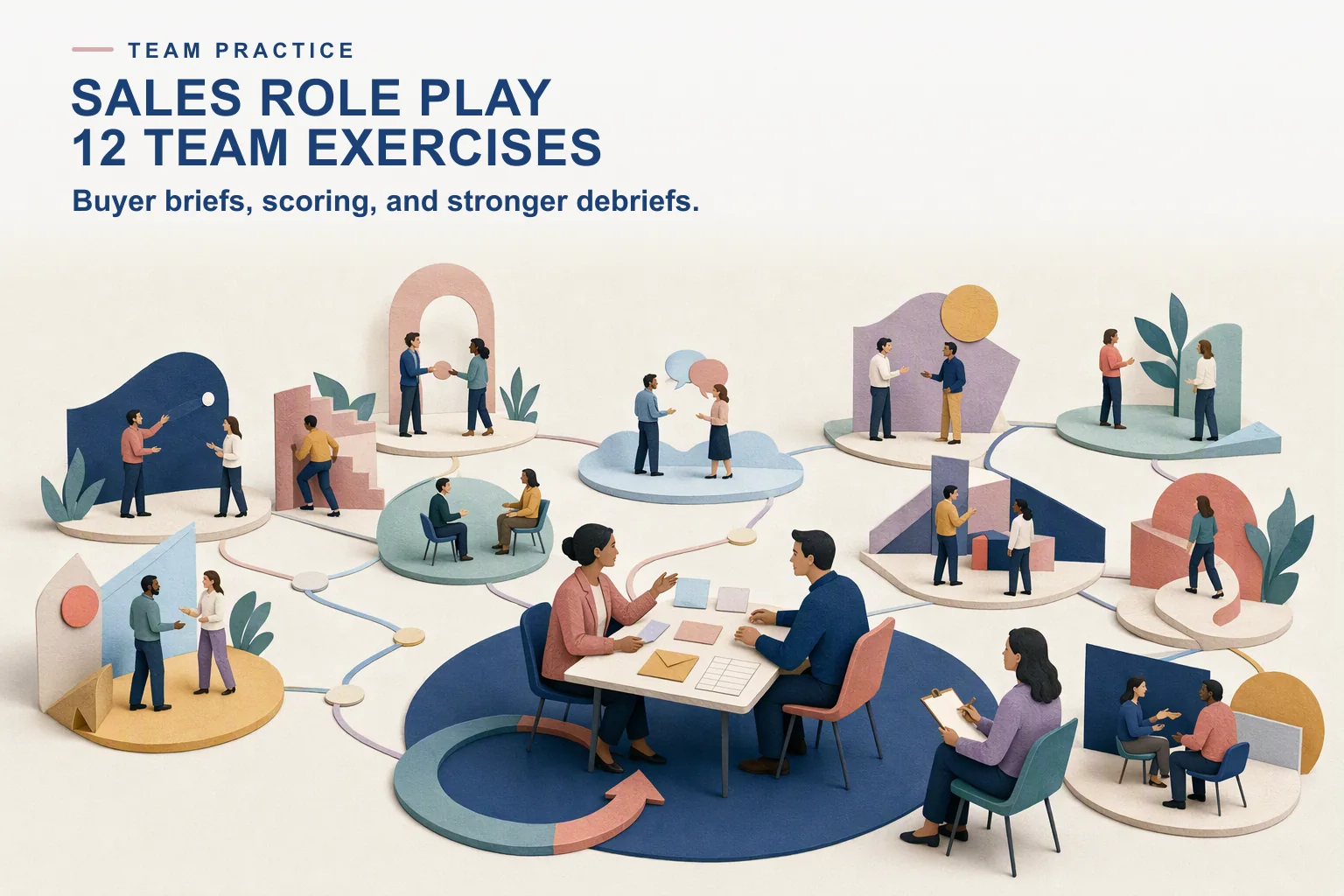
Good sales role play exercises have a fixed format: a short setup, clear roles, a written buyer brief with at least one hidden fact, three or four things to score, two debrief questions and a time limit. Below are 12 exercises in that format, covering prospecting, discovery, objections and deal progression, each with a fictional scenario you can run this week.
This guide is about the mechanics of each exercise: who plays what, what the buyer knows, and how you score it. If you need more situations to drop into these formats, our sales role play scenarios article has 32 of them.
Last updated: 27 October 2026
Disclosure: Revspire publishes this guide and sells software that includes AI role-play. Every exercise works with colleagues and a timer; an AI buyer is optional. All companies, people and prices in the scenarios are fictional.
The 12 exercises at a glance
#
Exercise
Skill
Group
Time
1
Trigger opener rewrite
Reason for the call
3
15 min
2
Voicemail and callback
Short, memorable message
2
10 min
3
Reverse role play
Buyer empathy
2 or 3
20 min
4
Sealed-envelope discovery
Finding the real pain
3
25 min
5
The one-word buyer
Question quality
3
15 min
6
Stakeholder drop-in
Adapting mid-call
4
20 min
7
Objection ladder
Composure under pressure
3
15 min
8
Closed-book battlecard drill
Accurate competitive claims
3
20 min
9
Price and pause
Stating price with confidence
2
10 min
10
Mutual action plan walk-back
Realistic close dates
3
25 min
11
Lost-deal replay
Spotting deal risk
3
30 min
12
Recap email race
Accurate follow-up
2
12 min
Group sizes include an observer where useful. Times include the debrief.
How to run any exercise in this guide
- Three roles. The rep sells, the buyer follows a written brief, and the observer scores. Rotate so everyone plays each role.
- A buyer brief card. Role and company, what they want, what worries them, one hidden fact they reveal only if asked well, and what makes them end the call.
- Score 0, 1 or 2 per criterion. 0 = not done, 1 = partly, 2 = clearly done. The observer writes down the exact words that earned each score.
- Debrief, then retry. Ask two questions, agree one change, and rerun the hardest minute. Our role play debrief questions guide has a fuller question bank.
Prospecting exercises
1. Trigger opener rewrite
- Setup: the rep gets a trigger event and five minutes to write a reason for calling in 25 words or fewer, then delivers it three times.
- Roles: rep, buyer, observer.
- Buyer brief: Head of Operations at Kestrelby Logistics, which announced a second warehouse last week. Busy and mid-task. Gives 30 more seconds only if the reason is about Kestrelby, not the product.
- What to score: reason tied to the trigger; asks permission to continue; one open question; under 25 words.
- Debrief questions: Which words were about them and which were about you? What would the buyer repeat to a colleague?
- Time needed: 15 minutes.
2. Voicemail and callback
- Setup: the rep leaves a voicemail of no more than 30 seconds. Two minutes later the buyer “calls back” having half-listened.
- Roles: rep and buyer.
- Buyer brief: Finance Director at Thornvale Dental Group, 14 clinics, sees missed-call numbers all day. Calls back with: “Who is this and what do you want?”
- What to score: voicemail under 30 seconds; one reason only; name and number said clearly; reintroduction in one sentence on the callback.
- Debrief questions: What did the buyer actually remember? What could you cut?
- Time needed: 10 minutes.
3. Reverse role play
- Setup: the rep plays the buyer. A peer or manager sells to them using the rep’s own usual opener and talk track.
- Roles: rep as buyer, peer as seller, optional observer.
- Buyer brief: IT Manager at Marrowgate Insurance, two years into a contract with a current vendor. The rep must raise the objections they believe a real buyer would have.
- What to score: the rep (as buyer) names the moment they would have ended the call; lists two objections real buyers raise; then reruns the call as the seller with one fix.
- Debrief questions: What made you want to hang up? What will you change in your own opener?
- Time needed: 20 minutes.
Discovery exercises
4. Sealed-envelope discovery
- Setup: the buyer holds a sealed card with one hidden pain and two decoy complaints. The rep has 12 minutes.
- Roles: rep, buyer, observer with a stopwatch.
- Buyer brief: VP Customer Success at Quenby Foods. Decoys: the dashboard looks dated; exports are slow. Hidden pain: two large accounts left last quarter after onboarding ran six weeks late. Reveal it only to a question about outcomes or customers.
- What to score: hidden pain found; minutes to find it; impact quantified; no pitching at the decoys.
- Debrief questions: Which question got you closest? When did you start pitching, and why?
- Time needed: 25 minutes.
5. The one-word buyer
- Setup: the buyer answers closed questions in one word, vague open questions in one sentence, and specific open questions in full.
- Roles: rep, buyer, observer tallying question types.
- Buyer brief: Plant Manager at Velloran Manufacturing, wary after a software rollout that stalled last year. Has a real problem with unplanned downtime but will not volunteer it.
- What to score: share of specific open questions; follow-ups that build on the last answer; rep talks less than half the time; problem uncovered.
- Debrief questions: Which question got the first full answer? What did you assume instead of asking?
- Time needed: 15 minutes.
6. Stakeholder drop-in
- Setup: a discovery call with one buyer. At minute six a second buyer joins without warning.
- Roles: rep, first buyer, second buyer, observer.
- Buyer brief: HR Director at Wexmoor Retail, 40 stores, struggling with shift scheduling. At minute six the CFO joins: “I have ten minutes. What does this cost, and why now?”
- What to score: recap for the newcomer in under 60 seconds; no blind price quote; links back to the HR Director’s problem; next step includes the CFO.
- Debrief questions: What did the CFO need to hear first? Did the HR Director stay in the conversation?
- Time needed: 20 minutes.
Objection and competition exercises
7. Objection ladder
- Setup: the same objection three times in a row, each round more intense: curious, firm, then hostile.
- Roles: rep, buyer, observer.
- Buyer brief: Operations Lead at Pellhaven Property: “We use spreadsheets and they work.” Round three adds: “Honestly, vendors like you always overpromise.”
- What to score: acknowledge, clarify, respond, check, advance in each round; tone steady in round three; no new claims under pressure.
- Debrief questions: What changed in your answer between rounds one and three? Where did you speed up?
- Time needed: 15 minutes.
8. Closed-book battlecard drill
- Setup: the rep reads a one-page battlecard for five minutes, then may use only claims printed on it. The observer flags any claim that is not on the card.
- Roles: rep, buyer, observer holding the card.
- Buyer brief: Procurement Lead at Ilvermere University, comparing you with Draycombe Systems: “Draycombe says they do everything you do for less.”
- What to score: off-card claims (target zero); concedes where the competitor wins; asks a discovery question from the card; proposes proof.
- Debrief questions: Which claim were you tempted to make that was not on the card? What should be added to the card?
- Time needed: 20 minutes. Use our sales battlecard template to build the card.
9. Price and pause
- Setup: the rep recaps three agreed priorities, states the price once, then stays silent until the buyer speaks.
- Roles: rep and buyer.
- Buyer brief: COO at Tarnfield Clinics. Proposal is $48,000 a year. Waits eight seconds, then says: “That is more than we planned.”
- What to score: recap accurate; price said once with no apology or early discount; silence held at least five seconds; first reply is a question.
- Debrief questions: What did you want to say during the silence? What did the buyer’s reaction actually tell you?
- Time needed: 10 minutes.
Deal progression exercises
10. Mutual action plan walk-back
- Setup: the buyer names a go-live date. The rep builds the plan backwards on a shared screen, step by step with the buyer.
- Roles: rep, buyer, observer.
- Buyer brief: Director of Operations at Saltmere Credit Union wants to go live on 1 March. Hidden facts: legal review takes three weeks, and a security questionnaire is due before contract.
- What to score: every step has an owner and a date; rep asks what is missing; hidden steps found; close date moved honestly if needed.
- Debrief questions: Which step did the buyer own that you assumed you owned? Is the date still real?
- Time needed: 25 minutes. Start from our mutual action plan template.
11. Lost-deal replay
- Setup: take a recently lost deal, remove names, and give the buyer-player the real loss reason as a hidden fact. The rep reruns the call where the deal turned.
- Roles: rep who did not work the deal, buyer, observer (ideally the original rep).
- Buyer brief (example): Head of Marketing at Corvalla Media, enthusiastic sponsor. Hidden fact: she is leaving in six weeks and has not told her team; the deal went to no decision.
- What to score: asks who else is involved; tests the decision process; spots the risk; proposes meeting a second stakeholder.
- Debrief questions: At what moment could the risk have been heard? What would you ask in the first call next time?
- Time needed: 30 minutes.
12. Recap email race
- Setup: straight after any exercise above, the rep has eight minutes to write the follow-up email. The buyer-player marks each line “I said this”, “I did not say this” or “missing”.
- Roles: rep and buyer.
- Buyer brief: reuse the brief from the exercise just run.
- What to score: no lines the buyer did not say; the buyer’s own words used for the problem; one next step with a date; under 150 words.
- Debrief questions: What did you write that the buyer never said? What did you leave out?
- Time needed: 12 minutes.
Running these exercises with an AI buyer
An AI sales role-play tool lets reps repeat an exercise without a colleague. Several vendor features map directly onto the formats above:
- Lost-deal replay: Hyperbound says an uploaded call transcript can generate a persona about 85% ready (Hyperbound Practice).
- Objection ladder: Showpad Roleplay AI adjusts difficulty “from Basic to Expert” (Showpad Roleplay AI).
- Stakeholder drop-in: Yoodli can put “a skeptical CFO and an eager champion in the same call” (Yoodli).
- Unpredictable objections: Mindtickle lets you upload objections, and the AI asks a subset each session (Mindtickle).
- Scoring: SalesHood supports a scorecard of up to 10 criteria with an 80% default pass mark (SalesHood).
Revspire’s AI Sales Training & Coaching supports the battlecard drill directly, with deal-specific objection practice with battle cards and instant AI scoring for clarity, confidence and objection handling. For a vendor comparison, see our AI sales role-play software guide.
A four-week practice plan
Week
Exercises
Team meeting slot
1
1 Trigger opener, 2 Voicemail, 3 Reverse role play
45 minutes
2
4 Sealed envelope, 5 One-word buyer
40 minutes
3
7 Objection ladder, 8 Battlecard drill, 9 Price and pause
45 minutes
4
10 Action plan walk-back, 12 Recap email race
37 minutes
Run exercises 6 and 11 separately: they need four people or a real lost deal.
For data on how teams practise and coach, see our sales practice and coaching benchmark. To run these exercises with an AI buyer and your own battle cards, book a Revspire demo.
Frequently asked questions
What are good role play exercises for sales teams?
Exercises with a hidden fact for the rep to find, a short time limit and three or four things to score. Sealed-envelope discovery, the objection ladder and the closed-book battlecard drill above work for most B2B teams.
How do you run a sales role play with a team?
Split into groups of three: rep, buyer and observer. Hand the buyer a written brief, set a timer, score 0 to 2 per criterion, debrief with two questions, and rerun the hardest minute. Rotate roles each round.
How long should a sales role play exercise take?
Ten to thirty minutes including the debrief. Short exercises such as price and pause fit into a weekly team meeting; discovery and deal exercises need longer.
How do you make sales role play less awkward?
Write the buyer brief down so the buyer is not improvising, keep each round short, score words and actions rather than personality, and let the rep retry straight away.
More practice guides: AI cold call practice tools, sales pitch practice tools and objection handling training tools.
Sources
- Hyperbound Practice, Hyperbound, undated, accessed 27 October 2026
- Roleplay AI, Showpad, undated, accessed 27 October 2026
- AI Sales Roleplay, Yoodli, undated, accessed 27 October 2026
- AI Sales Role Play, Mindtickle, undated, accessed 27 October 2026
- AI Role Play, SalesHood, undated, accessed 27 October 2026