Best AI Sales Roleplay Software in 2026: 8 Platforms Compared
A practical perspective for connecting this idea to your revenue team’s next move.
What is AI sales roleplay software?
AI sales roleplay software lets a seller practice a sales conversation with an AI buyer that answers, pushes back and asks questions, then scores the attempt against a rubric and explains what to change. Revenue teams use it to rehearse cold calls, discovery, demos, objection handling and negotiation before the same moment happens in a live deal.
The category now has its own review-site and analyst labels. G2 added an “AI Sales Roleplay” category in May 2026 (announced June 2, 2026), describing tools for realistic, two-way practice with AI buyer personas plus immediate scoring and feedback. Gartner published a Market Overview for B2B Sales AI Role-Play Applications on August 7, 2026; Yoodli’s post about that report (August 24, 2026) quotes Gartner’s definition: software that “uses AI to simulate realistic business conversations.” Before AI buyers, sales role-play meant a manager or peer playing the buyer, or a rep recording a pitch for someone to review later. The AI version replaces the human buyer and adds automated feedback, while managers keep the final judgment.
How AI sales roleplay works
- Scenario brief. An admin sets the buyer’s role, situation, hidden facts, objections and difficulty, plus the rubric the attempt is scored against.
- Conversation. Depending on the product, the rep talks, records a video answer or types. Live simulations reply turn by turn; asynchronous formats present a buyer prompt and capture the response.
- Scoring and feedback. The system transcribes the attempt, scores each rubric item and should point to the transcript moment behind each score.
- Retry and review. The rep retries the weak moment, and a manager reviews the evidence, overrides scores where needed and certifies.
Types of AI sales roleplay software compared
Most products fit one of five shapes. The shape tells you what to test first.
Type
How practice works
Strongest fit
Test first
Live voice or video simulators
The rep talks to an AI buyer that replies in real time, interrupts and objects
Cold calls, discovery, negotiation
Response delay, persona consistency, hidden facts that stay hidden
Asynchronous pitch and video challenges
The rep records an answer to a buyer prompt; AI and a manager score it
Pitch certification, objection responses, launches
Whether scoring checks accuracy, not only delivery
Readiness suites with a role-play module
Practice sits beside onboarding, courses, certification and coaching
Company-wide readiness programs
Conversation depth compared with specialist tools
Conversation intelligence suites with practice
Practice is scored with scorecards also used on recorded calls. Gong’s AI Trainer help page (updated September 22, 2026) describes 5 to 30 minute sessions scored automatically against an attached scorecard
Teams that already score live calls
Whether practice and live-call scores mean the same thing
Integrated enablement platforms
Role-play draws on the same governed content and playbooks reps use in deals
Teams consolidating content, playbooks and practice
Realism for the target skill
Revspire publishes this guide and is one of the eight platforms in the shortlist below, which is not ranked.
Do AI roleplay scores predict sales results?
In one large customer dataset, practice scores and live results moved together, which is a reason to judge software on scoring quality rather than avatar polish. In Revspire’s Sales Practice and Coaching Benchmark (aggregated customer data, 2026), reps in the top quartile of AI role-play scores won 42% of their deals, against 26% for the bottom quartile. That is a correlation: stronger reps may score well and win for the same reasons. The same benchmark found scores rose 0.7 points on a 1-5 scale for reps whose manager gave feedback within 7 days, against 0.2 points with no feedback (again an association, not proof of cause), so evaluate the manager review workflow as closely as the AI buyer.
The right role-play platform depends on the behavior you need to change
Searching for the best AI sales role-play software produces an awkward truth: there is no defensible universal winner. An SDR team practicing cold-call openings, an enterprise team rehearsing multi-stakeholder discovery, and a regulated field organization certifying approved claims need different interaction models, evidence, and controls.
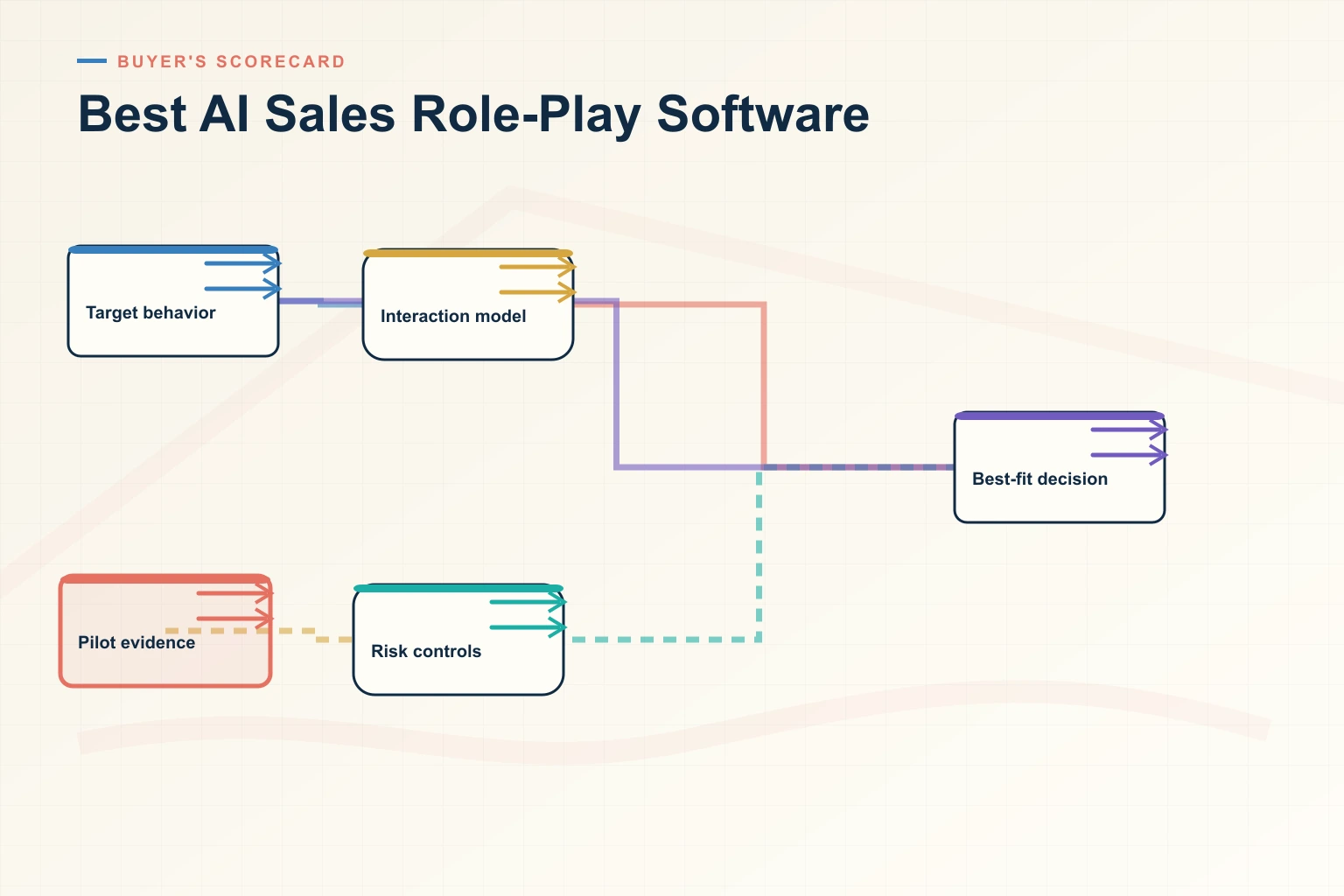
A visual summary of Best AI Sales Role-Play Software for Revenue Teams in 2026.
So this guide treats best as best fit for a documented requirement . The shortlist is based on capabilities described on vendor-owned pages available during research on August 30, 2026. Those descriptions are not independent test results, and product packaging can change. Use them to form a shortlist, then verify the critical workflow with your content, users, security requirements, and contract.
Revspire belongs in that evaluation when role-play must sit beside governed enablement content. Its sales training product page documents asynchronous video challenges using pre-recorded buyer prompts, evaluation feedback, and scoring for areas such as clarity, confidence, and objection handling. The comparison below also includes specialist and broader readiness platforms so buyers can test meaningful alternatives.
Scope note: This guide compares software for simulated sales practice. Use the AI sales role-play scenario library for ready-to-adapt exercises, the AI sales training guide for program design, and the AI deal-coaching guide for active-opportunity inspection.
Eight criteria to define before booking demos
Criterion
What to inspect
Proof to request
Interaction model
Live conversation, asynchronous response, voice, video, screen share, group, or text
Complete the same target scenario from launch through retry
Scenario control
Persona, hidden facts, objection path, difficulty, methodology, and prohibited claims
Have an enablement admin author and version a scenario
Feedback quality
Transcript evidence, rubric mapping, coaching explanation, and actionable retry
Challenge one score and trace it to observable behavior
Grounding
Use of approved messaging, product facts, and current playbooks
Change a source and confirm when the simulation reflects it
Administration
Assignment, certification, cohorts, manager review, calibration, and reporting
Run a small cohort with two managers and export the evidence
Workflow fit
Identity, LMS, CRM, conversation intelligence, conferencing, and APIs
Validate the exact integration and data direction, not a logo slide
Risk controls
Permissions, retention, model/data use, regional processing, auditability, and deletion
Review contract language and test role-based access
Economics
Licenses, usage, authoring, services, integrations, support, and internal administration
Model a full year with expected attempts and scenario volume
Because feedback quality is easy to overstate in a demo, use this AI coaching feedback evaluation framework to test evidence traceability, consistency, actionability, and governance with the same call sample across vendors.
Do not let conversational realism dominate the decision. Use these 12 AI sales call simulator tests to assess realism alongside feedback quality, reliability, governance, and enterprise safety. A convincing buyer avatar with an unstable rubric can create more debate than development. Conversely, a simple asynchronous exercise can be useful when the skill is a concise executive pitch or a controlled response to a known objection. Start with the job, then select the modality.
When objection handling is the target behavior, use this sales objection-handling and AI practice framework to define the response sequence and pilot scenario before comparing platforms.
AI sales role-play software shortlist for 2026
The table deliberately avoids rankings and vendor-reported outcome statistics. It summarizes publicly documented product characteristics and pairs each with a diligence question. A blank does not mean a capability is absent; it means the cited material did not provide enough evidence to make the claim here.
Platform
Publicly documented role-play signal
What to verify in a pilot
Second Nature
The Second Nature product page describes AI buyer personas for individual, group, and chat scenarios; scenario generation from prompts or uploads; immediate feedback; analytics; multilingual support; and several integration paths.
Build one scenario from your material, inspect the generated facts and rubric, and verify the exact CRM, LMS, identity, and language requirements in your edition.
Hyperbound
Hyperbound’s role-play page lists cold call, discovery, demo, renewal, upsell, manager, and multi-party simulations; custom ICP and methodology inputs; scorecards; coaching; multiple languages; and named integrations.
Test whether multi-party behavior reflects your buying committee, whether scorecard events are reproducible, and which integration objects are read or written.
Mindtickle
The Mindtickle AI Sales Role Play page describes selectable buyer voice and personality, scenarios across several sales motions, immediate qualitative and quantitative feedback, AI-assisted creation and grading, and admin progress reporting.
Measure author control, calibration between AI and managers, and how role-play fits the wider readiness and certification workflow you intend to operate.
SalesHood
SalesHood’s AI Role Play page describes buyer personas, branching logic, custom prompts, scenario configuration without engineers programming AI interactions, several revenue use cases, feedback on delivery and messaging, scoring, sentiment analysis, and coaching dashboards.
Use a branching objection with hidden information; inspect how branches affect scores, how managers override feedback, and which reporting dimensions can be exported.
Yoodli
The Yoodli sales role-play page describes using talk tracks, personas, objections, decks, and methodology to create scenarios spanning cold calls through negotiation, with custom rubrics and feedback.
Test content ingestion, multi-persona turns, rubric precision, and the specific connectors required; confirm how uploaded material and recordings are retained and used.
Quantified
The Quantified AI Roleplay page describes ICP-specific personas, multi-persona simulations, interruption and objection practice, custom rubrics, approved-messaging and compliance checks, feedback, audit records, and multilingual use.
Especially for regulated training, validate the compliance rule source, reviewer workflow, audit export, exception handling, and how unsupported claims are detected.
PitchMonster
PitchMonster’s role-play page describes AI buyers built from sources such as recordings, CRM notes, lost-deal reasons, and objection libraries; phone, face-to-face, and screen-share modes; playbook scoring; moment analysis; debriefs; and multilingual use.
Confirm ingestion permissions and connector behavior, test the screen-share scenario end to end, and inspect whether the debrief cites specific moments rather than generic advice.
Revspire
Asynchronous video challenges, pre-recorded buyer prompts, objection practice, battle cards, and evaluation feedback are described on the Revspire sales training page.
Confirm that its asynchronous format matches the target skill; test how rubric evidence and approved playbook content move into manager coaching.
Other products may deserve consideration, and each listed platform may offer capabilities not included here. The purpose of a shortlist is to reduce a large market to testable hypotheses—not to turn marketing pages into a procurement decision.
Match platform shape to the use case
If the primary need is…
Prioritize…
Watch for…
Repeatable pitch or objection submissions
Fast asynchronous recording, evidence-linked feedback, retry flow, and manager review
Scores that reward delivery while missing factual accuracy
Dynamic discovery and negotiation
Responsive buyer behavior, hidden facts, controlled branches, interruption, and realistic turn-taking
A persona that reveals information without a relevant question
Certification in a regulated environment
Approved claims, critical-error rules, versioning, reviewer sign-off, traceability, and retention controls
A high aggregate score masking one prohibited statement
Global onboarding
Language coverage, localized scenarios, accessibility, cohort administration, and manager calibration
Language availability without locally validated rubrics
Enablement consolidation
Role-play connected to content, playbooks, battle cards, assignments, and analytics
A broad suite with a weaker interaction model for the target skill
If role-play needs to reference current positioning, connect the exercise to a governed sales playbook rather than copying text into a prompt that nobody owns. The update path matters: when messaging changes, administrators should know which scenarios and rubrics require review. This workflow for turning sales playbooks into AI role-plays, quizzes, and coaching shows how to keep practice tied to approved source material.
Run a pilot that can disprove your preference
A polished vendor-created scenario tests the vendor’s authoring team. Your pilot should test your operating reality. Select two materially different skills, such as discovery and procurement handoff. Use sanitized, approved source content. Include frontline reps, two managers, an enablement administrator, and the functions responsible for identity, privacy, and security.
- Baseline the job. Define observable success, critical errors, target users, attempt volume, and the current coaching path.
- Build without vendor rescue. Let the person who will own scenarios create one while the vendor observes. Record time, ambiguities, and required specialist support.
- Test variance. Repeat the same scenario across accents, speaking styles, roles, correct answers phrased differently, and intentionally unsafe answers.
- Calibrate. Have qualified managers score a blind sample, compare evidence with the AI result, adjudicate disagreement, then rerun.
- Operate it. Assign a cohort, handle a content update, challenge a score, remove a user, export evidence, and delete a test recording.
- Review risk and cost. Complete security and legal diligence, then price the expected operating model rather than the demonstration tenant.
A practical pilot scorecard
The weights below are a starting point, not a benchmark. Change them before vendors are scored. For a competency-level model, use the weighted sales readiness scorecard framework to define rubric dimensions, critical gates, and certification thresholds. A regulated team may increase governance; a small coaching program may emphasize administration and time to launch.
Dimension
Starting weight
Pass evidence
Scenario fidelity
20%
Buyer follows the brief, protects hidden facts, and handles valid response variation
Feedback validity
20%
Scores cite observable behavior and align with calibrated human review
Authoring and maintenance
15%
Owner can build, version, approve, update, and retire scenarios
Manager workflow
10%
Manager sees evidence, coaches a retry, and resolves a challenge
Governance and security
20%
Required access, retention, deletion, audit, and data-use terms are verified
Integration and analytics
5%
Required data moves correctly through tested connectors or exports
Total operating cost
10%
Quote includes expected usage, services, integrations, support, and internal effort
Set minimum gates as well as a weighted score. For example, a platform that fails a required deletion workflow should not win because it has engaging avatars. NIST’s AI Risk Management Framework is a useful reference for organizing governance, context mapping, measurement, and risk response during the pilot.
Security, privacy, and governance questions
- Which inputs, recordings, transcripts, scores, embeddings, and logs are stored?
- Are customer inputs or outputs used to train or improve any model, and what contract term governs that use?
- Which model providers and subprocessors receive data, in which regions, and for how long?
- Can retention differ by cohort or content type, and can an administrator verify deletion?
- How do SSO, provisioning, role-based access, and tenant isolation work?
- Can a manager access only the teams and recordings they are entitled to review?
- How are scenario versions, rubric changes, AI feedback, overrides, and certifications audited?
- What accessibility testing covers keyboard use, captions, transcripts, screen readers, and speech variation?
- What happens when the buyer simulator, transcription, scoring model, or integration is unavailable?
- Can the system prevent or flag restricted personal data and confidential customer information in prompts?
- How can a rep challenge a score, and who makes the final certification decision?
- What export and deletion support exists at contract end?
Review answers with your security, privacy, legal, accessibility, and procurement owners. A trust page or certification may inform diligence, but it does not replace checking whether the controls cover your use, data, configuration, and responsibility.
Make the decision on coaching evidence
The useful output of AI role-play is not a novelty conversation or a leaderboard. It is reliable evidence that helps a rep recognize a behavior, retry it, and transfer it to a real customer interaction. Choose the platform whose operating model your team can sustain: current scenarios, defensible rubrics, manager coaching, safe data handling, and measurable adoption.
If an integrated enablement and asynchronous video role-play workflow fits your requirements, request a Revspire demo. Bring one approved scenario and scorecard so the evaluation stays anchored to your revenue team’s actual job.
Pricing guides and head-to-head comparisons
If you are shortlisting AI sales role-play software, these neutral pages compare two vendors at a time on how each runs practice and what each publishes about price, each with dated sources.
- Hyperbound vs Yoodli: sales call practice against communication coaching, including real-call scoring, integrations, security and pricing
- Second Nature vs Yoodli: two AI role-play and coaching tools compared on practice formats, scoring, real-call coaching and pricing
- Hyperbound vs Quantified: a B2B sales role-play and call-scoring tool against a life-sciences coaching platform, including compliance and pricing
- Hyperbound vs Second Nature: two AI role-play specialists compared on practice formats, real-call scoring, pricing and when to choose each
- Allego vs Second Nature: a learning-first enablement suite against an AI role-play specialist, compared on practice formats, scoring and languages
Choosing software to support this? Our comparison of AI sales coaching software looks at AI role play, call feedback and manager workflows.
Frequently asked questions
What software do enterprise sales teams use for role play practice?
Enterprise teams usually choose from three groups: specialist AI roleplay tools, readiness or enablement suites with a role-play module, and conversation intelligence suites that have added practice. The shortlist above includes examples of the first two. Large teams tend to weigh administration, certification records, single sign-on and data controls as heavily as conversation realism.
Can we reuse one scenario library across regions?
Ask whether a scenario can have one master version with regional variants for language, currency, regulation and competitors, each with its own owner and review date. Check that local managers validate rubrics rather than only translating them, and that reporting rolls up by scenario across regions. Our AI sales role-play scenarios guide shows a scenario structure that travels well.
How do we check that the CRM integration is secure?
Get the exact objects and fields the tool reads and writes, the direction of each sync and the permission scopes it requests. Test in a sandbox with a least-privilege integration user and confirm reps see only records they can already access. Put retention, deletion and model-training use of CRM data and recordings into the contract.
Will the software support our sales methodology and scoring criteria?
Load your own rubric in the pilot rather than accepting a generic one: methodology fields, required questions, approved claims and critical errors. Check that criteria can be edited and versioned per scenario, that each score cites transcript evidence, and that AI scores agree with calibrated managers on a blind sample.
Should we run a paid pilot before an annual contract?
Ask for one when the decision depends on your scenarios, users and security review rather than a demo tenant. Fix scope, users and success criteria in writing before kickoff, ask whether the pilot fee can be credited against the first-year contract, and include data export and deletion at the end. The pilot scorecard above gives you the criteria.
How do we find a tool that grades pitch accuracy, not delivery polish?
Run a contrast test: submit one confident answer containing a wrong product claim and one hesitant answer that is factually right. A tool that scores the confident answer higher is grading delivery. Ask for rubric items tied to approved content, and for critical-error rules that fail an attempt with a prohibited claim regardless of the overall score.
Sources
- New Categories Introduced to G2 in May 2026, G2, 2 June 2026 (accessed 18 October 2026)
- Yoodli named in the 2026 Gartner Market Overview for B2B Sales AI Role-Play Applications report, Yoodli, 24 August 2026 (accessed 18 October 2026)
- Practice customer calls with AI Trainer, Gong Help Center, updated 22 September 2026 (accessed 18 October 2026)
- Sales Practice and Coaching Benchmark, Revspire, 2026 (aggregated Revspire customer data)