Revspire blog
Executive Engagement in Account-Based Sales: 7 Mistakes to Correct in 2026
A practical guide to correcting executive engagement mistakes with ownership, revenue-linked measurement, stakeholder coverage, coaching, and feedback loops.
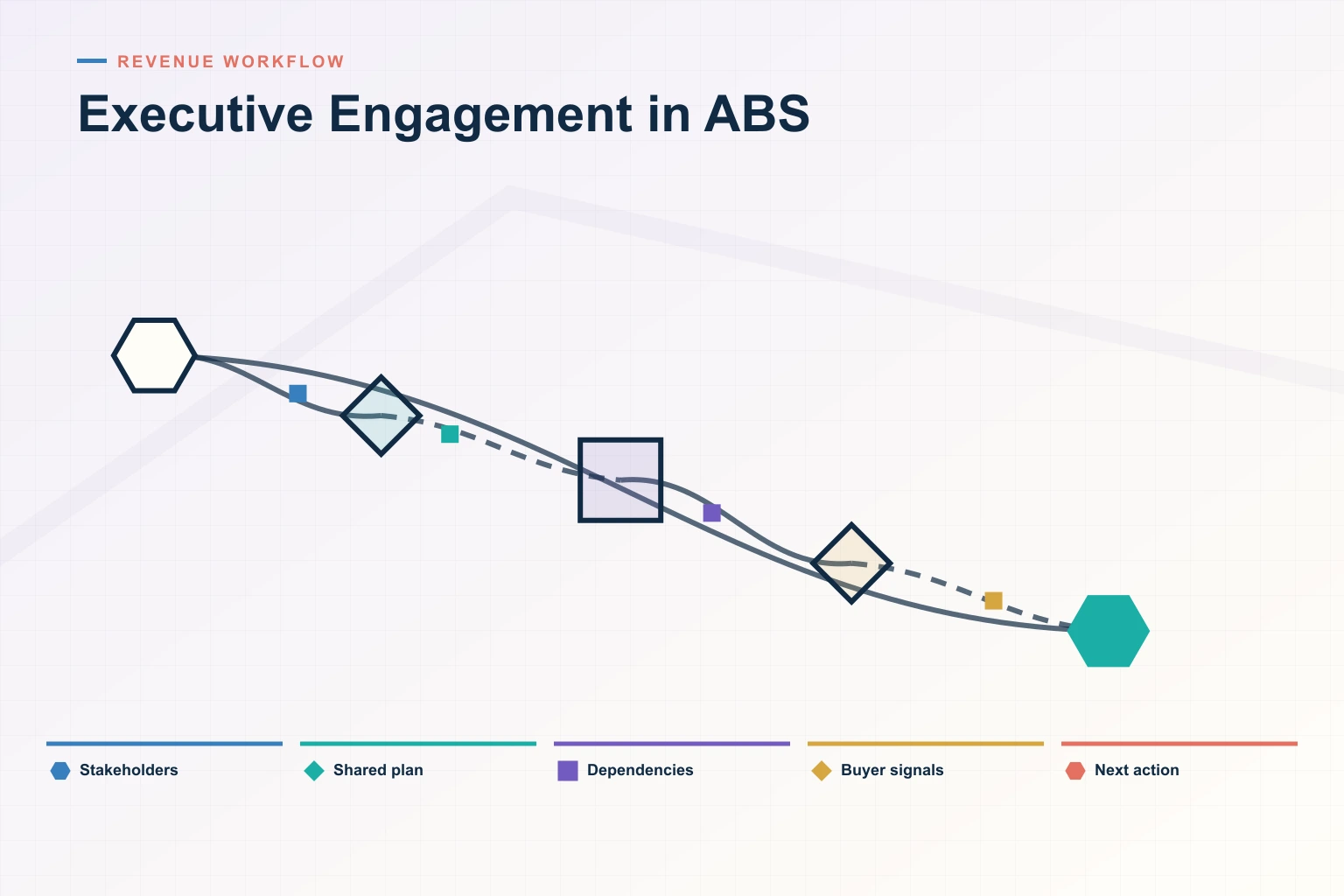
In this guide, ABS means account-based sales. Executive Engagement in ABS is the deliberate involvement of executives in that account-based sales process.
The core problem is that Executive Engagement in ABS is treated as a one-time event rather than an ongoing system.
An operating model for Executive Engagement in ABS answers three questions: what actions should happen, at what stage, and who is accountable.
Build an executive engagement system
- Ownership: Assign a permanent owner to Executive Engagement in ABS outcomes.
- Process: Document the actions, stages, responsibilities, and stakeholder coverage expected from the team.
- Measurement: Review leading indicators together with lagging indicators and connect the metrics directly to revenue outcomes.
- Feedback: Feed lessons from won and lost deals and buyer feedback into playbooks, coaching, and strategy.
Mistake 1: Treating executive engagement as a temporary project
Teams can allow a new approach to drift when routine pipeline pressure takes over. The source guidance treats executive engagement as an operating process connected to ownership, reviews, metrics, and improvement goals.
How to correct it
Assign a permanent owner to Executive Engagement in ABS outcomes. Define what excellent execution looks like at each deal stage, document the criteria, establish shared execution standards, and incorporate the process into the team’s regular pipeline cadence.
Mistake 2: Relying on intuition alone
Recent or memorable opportunities can shape a manager’s view of the portfolio. A documented measurement framework gives the team another basis for reviewing deal health.
How to correct it
For Executive Engagement in ABS, leading indicators might include stakeholder engagement rates, content consumption, mutual action plan progression, or deal velocity at each stage.
Lagging indicators — win rates, cycle times, average deal sizes — confirm whether your approach is working.
The metrics for Executive Engagement in ABS should connect directly to revenue outcomes.
Build a dashboard that shows both. Review it weekly. Adapt that review cadence to the team’s sales model.
The source material identifies Revspire Account Intelligence as the related platform resource.
Mistake 3: Depending on one stakeholder
A relationship centered on one contact can leave the team without another route into the account if that person disengages, changes roles, or leaves the organization.
How to correct it
Map every stakeholder in the buying committee, assign coverage, and track engagement with each one.
Mistake 4: Confusing activity with progress
Email volume, calls, meetings, and completed tasks do not by themselves show that an opportunity is progressing.
How to correct it
Measure outcomes, not activities. Track stage progression velocity, buyer engagement quality, and stakeholder coverage breadth.
Three-part explainer: Recognize the leak, Correct the behavior, and Prevent repeat failure.
Video summary: Recognize the leak, correct the behavior, and prevent repeat failure.
Mistake 5: Using only generic training
Deal-specific coaching applies the executive engagement framework to active opportunities and identifiable execution gaps.
How to correct it
What works is deal-specific coaching — reviewing live opportunities with each rep, identifying exactly where their executive engagement account based execution breaks down, and working through the fix in real time.
Mistake 6: Letting technology define the process
Technology should serve the executive engagement account based process, not define it.
How to correct it
Evaluate every tool in your stack against a simple question: does this make Executive Engagement in ABS easier and more consistent, or does it add friction?
Ensure your tools talk to each other so data flows without manual intervention.
Mistake 7: Failing to learn from completed deals
Every won and lost deal contains insights about what works and what does not in your approach to Executive Engagement in ABS.
How to correct it
The best teams capture them deliberately — through post-deal interviews, CRM data analysis, and structured win-loss reviews — and feed them back into playbooks, training, and strategy.
Review Executive Engagement in ABS metrics quarterly against targets, update playbooks when the team learns something new, and solicit feedback from buyers on their experience.
Before you can improve Executive Engagement in ABS, you need an honest baseline.
Start with an honest audit. Where is Executive Engagement in ABS working well today? Where is it breaking down? What does the data say versus what the narrative says?
Use that assessment to prioritize a small number of improvements, give each one a clear owner and measurable goal, and select a review period appropriate to the sales model.
Put the framework into practice
A repeatable approach combines ownership, documented stage expectations, shared execution standards, measurements connected to revenue outcomes, broader stakeholder coverage, deal-level coaching, quarterly target reviews, buyer feedback, and lessons from completed opportunities.
See how Revspire helps B2B revenue teams eliminate these patterns