Revspire blog
The Biggest Deal-Aligned Content Strategy Mistakes Costing Your Team Deals in 2026
A practical guide to six deal-aligned content strategy mistakes, with steps for improving ownership, measurement, coaching, technology, and feedback.
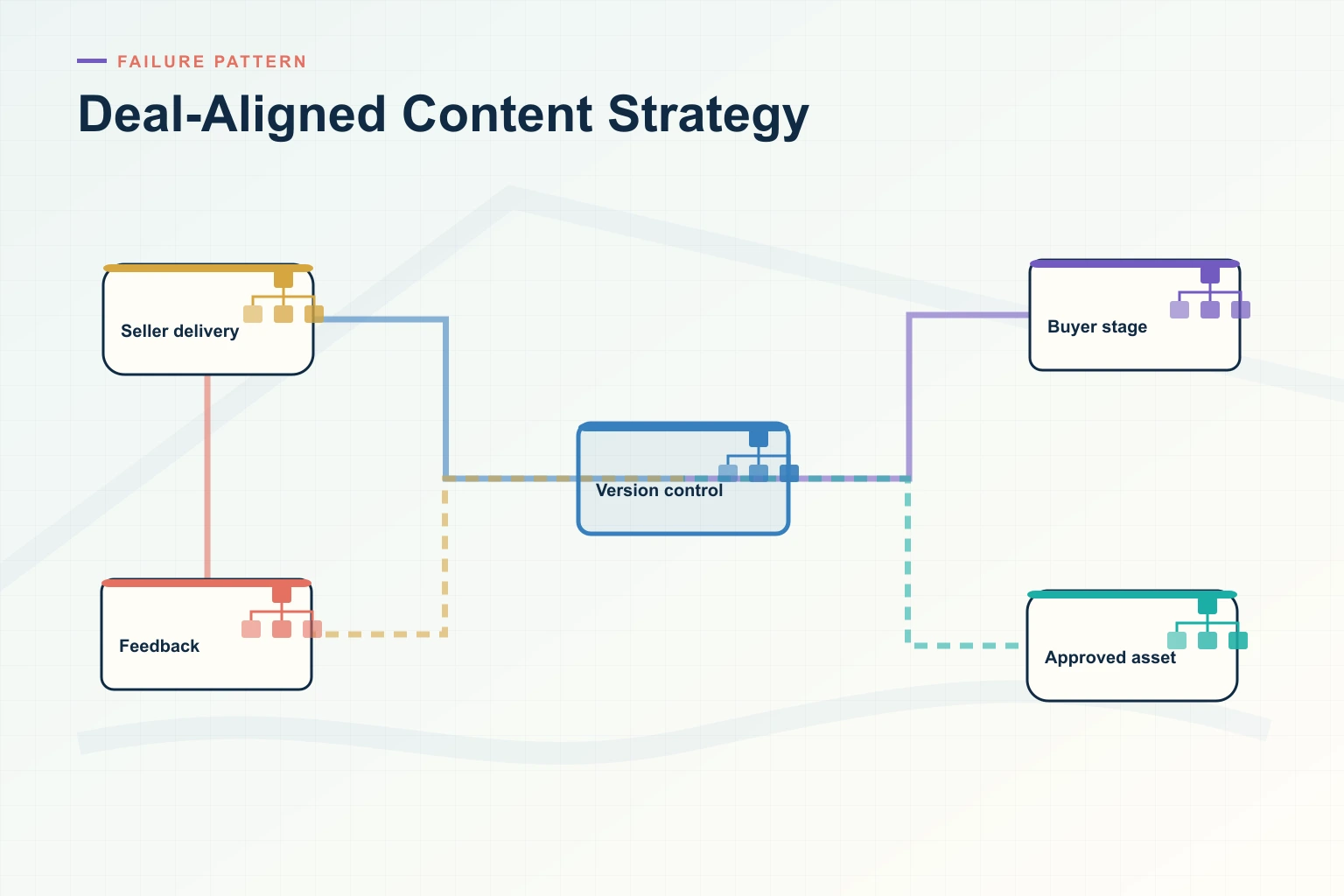
Many B2B revenue teams make predictable, fixable mistakes in how they approach deal-aligned content strategy. Common problems include treating the strategy as a one-time initiative, relying on intuition, confusing activity with progress, depending on one stakeholder, allowing technology to define the process, and failing to learn from completed deals.
This guide explains how to recognize those mistakes and build a more consistent operating model around ownership, measurement, coaching, technology, and feedback.
Why deal-aligned content strategy breaks down
Teams can assemble their approach from tribal knowledge, manager intuition, and an older playbook. Without shared standards and clear ownership, execution becomes difficult to evaluate and improve.
Revenue leakage from poor Deal-Aligned Content Strategy practice concentrates in three places. It can begin with unsuitable opportunities entering the pipeline, continue when qualified deals stall, and appear late when objections, procurement issues, or stakeholder concerns have not surfaced earlier.
A practical response is to treat deal-aligned content strategy as an ongoing system rather than a temporary project.
Mistake 1: Treating the strategy as a one-time initiative
A launch or new playbook can lose momentum when daily pipeline pressure takes priority. The source material recommends permanent ownership, defined metrics, standing reviews, and quarterly improvement goals.
How to correct it
- Assign a leader who is accountable for outcomes.
- Define effective execution at each deal stage.
- Include a structured review in the team’s operating cadence.
- Update the playbook as the team learns from completed deals.
An operating model for Deal-Aligned Content Strategy answers three questions: what actions should happen, at what stage, and who is accountable.
Ownership, process, technology, data, measurement, and continuous improvement form the operating foundation.
Mistake 2: Relying on intuition instead of evidence
Decisions based only on recent or memorable deals may not reflect the full portfolio. Teams can instead review a small set of leading and lagging indicators.
Leading indicators might include stakeholder engagement rates, content consumption, mutual action plan progression, or deal velocity at each stage. Lagging indicators include win rates, cycle times, and average deal sizes.
Build a dashboard that shows both. Review it weekly. When activity and outcomes point in different directions, investigate the discrepancy.
The supplied material states that the Revspire Content Hub surfaces these signals automatically so managers can act before deals go sideways.
Three-part explainer: Recognize the leak, Correct the behavior, and Prevent repeat failure.
Mistake 3: Confusing activity with progress
Email, call, meeting, and task volume can remain high while an opportunity fails to advance. Pipeline reviews should therefore distinguish activity from evidence of buyer progress.
How to correct it
Measure outcomes, not activities. Track stage progression velocity, buyer engagement quality, and stakeholder coverage breadth. Use activity as diagnostic context rather than treating it as proof of progress.
Deal-specific coaching can support this review. Managers can examine live opportunities with each representative, identify where execution is breaking down, and work through the next action in context.
Revenue leakage can appear in the early, middle, or late stages of the buying process.
Mistake 4: Depending on a single stakeholder
A relationship centered on one contact becomes vulnerable if that person disengages, changes roles, or leaves the company.
How to correct it
- Map the relevant stakeholders and their roles.
- Assign relationship coverage across the revenue team.
- Track engagement with each stakeholder.
- Flag opportunities with only one active contact as higher risk.
Content can then address the different questions, priorities, and perceived risks within the buying group.
Mistake 5: Letting technology define the process
Technology should serve the deal aligned content strategy B2B process, not define it.
How to correct it
Evaluate each tool against a practical question: does it make execution easier and more consistent, or does it add friction? Ensure your tools talk to each other so data flows without manual intervention.
Shared standards, leading indicators, coaching, aligned technology, and feedback loops support consistent execution.
Mistake 6: Failing to learn from wins and losses
Every won and lost deal contains insights about what works and what does not in your approach to Deal-Aligned Content Strategy.
How to correct it
- Conduct structured reviews of significant wins and losses.
- Compare the representative’s account with CRM data, engagement signals, and buyer feedback when available.
- Document the execution choices that contributed to the outcome.
- Feed the findings into playbooks, coaching, training, and measurement.
- Review the resulting changes against quarterly targets.
Feedback loops allow lessons from individual opportunities to inform future execution.
Three-part explainer: Audit the current state, Build the operating model, and Measure and improve.
A practical implementation plan
1. Establish a baseline
Start with an honest audit. Before you can improve Deal-Aligned Content Strategy, you need an honest baseline. Review recent opportunities by representative, segment, deal size, stage, and outcome to identify where deals enter incorrectly, stall, or fail.
2. Prioritize a small number of changes
Select two or three specific improvements. Give each one an owner, a measurable goal, and a 90-day review cadence.
3. Embed the model into weekly work
Use pipeline reviews to discuss buyer signals, stakeholder coverage, content engagement, stage progression, and the next required action.
4. Review and improve
Compare leading and lagging indicators with the baseline. Investigate discrepancies and update the playbook with lessons from live opportunities and win-loss reviews.
See the approach in action
Fixing these mistakes requires the right process, data, and platform working in alignment.
See how Revspire helps B2B revenue teams eliminate these patterns