Revspire blog
The Biggest Time to Productivity Mistakes Costing Your Team Deals in 2026
Learn how to address five recurring Time to Productivity mistakes with clearer ownership, selected measures, structured coaching, and continuous improvement.
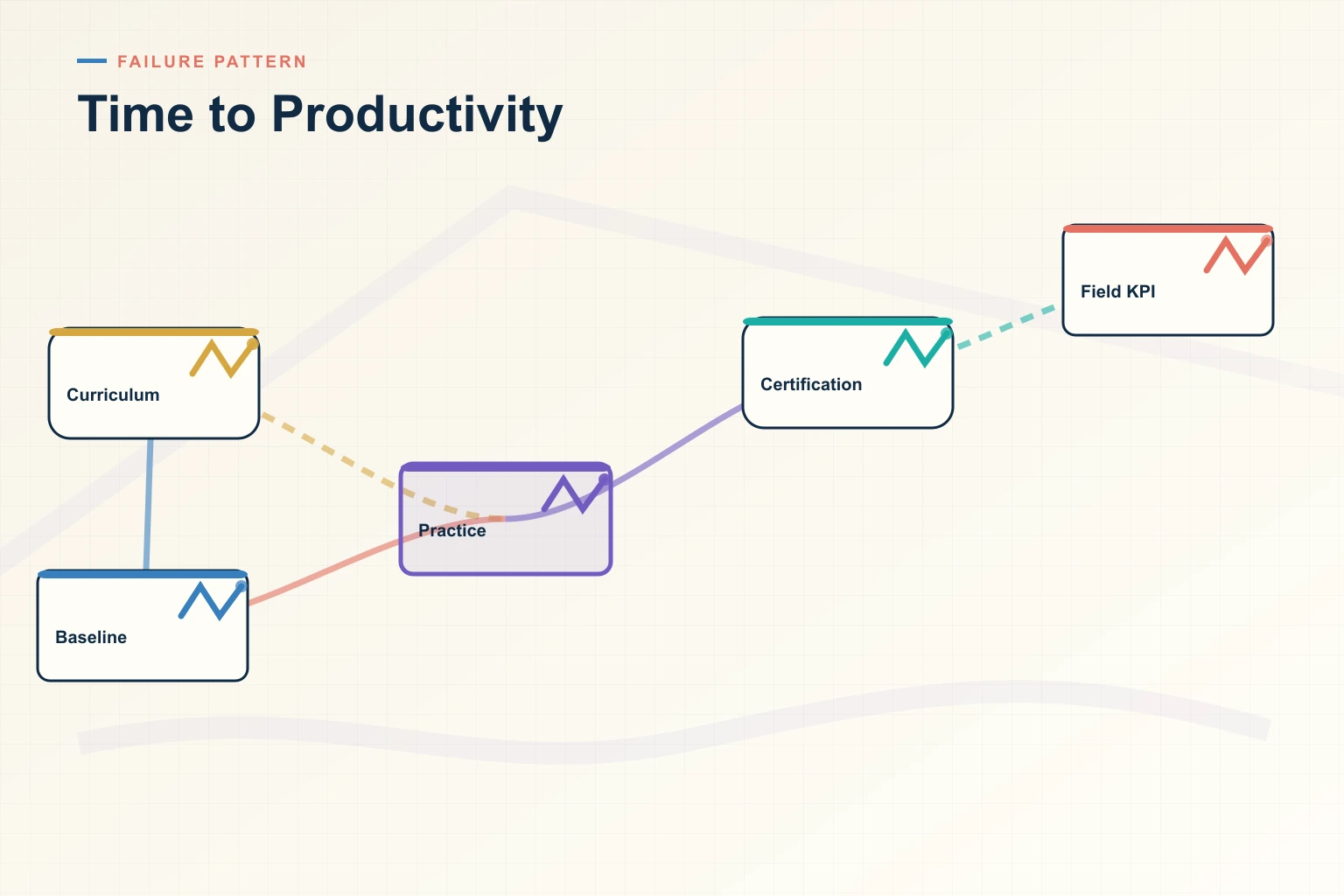
This guide organizes five recurring Time to Productivity problems and the operating practices revenue teams can use to address them.
Five Time to Productivity Mistakes
1. Treating Time to Productivity as a One-Time Initiative
Time to Productivity can be managed as an ongoing operational discipline rather than a project with a fixed end date.
The fix: Assign a permanent owner, establish a standing review cadence, define measurable outcomes, and set quarterly improvement goals.
2. Relying on Intuition Without Reviewing the Data
Decisions based only on recent or memorable deals may not reflect the full opportunity portfolio.
The fix: Define three to five indicators and review them weekly. Compare stakeholder engagement, content consumption, mutual action plan progress, deal velocity, and time in stage with outcomes such as win rate, cycle time, average deal size, and quota attainment. Learn more about Revspire Sales Onboarding.
3. Single-Threading the Buyer Relationship
Building a relationship around one stakeholder creates a continuity risk if that contact becomes unavailable.
The fix: Map the buying committee, assign stakeholder coverage, track engagement across the group, and flag opportunities that depend on only one active contact.
Three-part explainer: Recognize the leak, Correct the behavior, and Prevent repeat failure.
4. Confusing Activity with Progress
High activity does not by itself demonstrate that an opportunity is moving forward.
The fix: Review stage progression, buyer engagement quality, stakeholder coverage, and deal velocity. When activity is high but outcomes are weak, examine the work inside the opportunity before requesting more activity.
5. Failing to Learn from Losses
Won and lost opportunities can provide information about what worked and what did not.
The fix: Conduct structured reviews of significant losses, document the breakdowns, and feed the findings into playbooks, coaching, training, and strategy.
Build a Practical Operating Model
Before you can improve Time to Productivity, you need an honest baseline.
Review recent opportunity data by representative, segment, deal size, stage, and loss reason. Use the review to identify where opportunities stall or leave the pipeline and to select a small number of improvements for testing.
An operating model for Time to Productivity answers three questions: what actions should happen, at what stage, and who is accountable.
Document the actions, owners, milestones, and evidence required at each stage. Connect the model to coaching and pipeline reviews. Keep it simple enough to apply consistently.
The technology layer for Time to Productivity should reduce friction, not add it. Evaluate each tool by whether it supports the documented process and reduces unnecessary manual data movement.
Seven Continuous-Improvement Practices
Define what good looks like. Instrument each stage. Build review into the weekly cadence. Coach through live opportunities. Capture win-loss intelligence. Align technology with the process. Create feedback loops.
- Define what good looks like. Document stage-specific expectations and milestones.
- Instrument each stage. Review stakeholder engagement, content consumption, mutual action plan progress, deal velocity, and time in stage.
- Build review into the weekly cadence. Identify what should change during the next seven days.
- Coach through live opportunities. Use active deals to identify and address specific execution gaps.
- Capture win-loss intelligence. Feed findings from completed opportunities into playbooks, training, and strategy.
- Align technology with the process. Consolidate where appropriate and reduce manual data movement.
- Create feedback loops. Review metrics, update playbooks, gather buyer feedback, and select the next improvement to test.
Evaluate the Business, Competitive, and Talent Dimensions
A Time to Productivity business case can examine ramp time, average deal size, customer acquisition cost, forecast accuracy, and resource-allocation decisions. Treat these as evaluation areas rather than guaranteed outcomes, and validate them against your own data.
For the competitive dimension, examine whether the buying experience is easy to navigate, builds confidence, and addresses perceived risk. For the talent dimension, examine how the operating model affects onboarding, representative development, and retention. These assessments preserve the business-case, competitive, and talent perspectives from the source cluster without asserting unsupported performance results.
Measure and Review the System
The right metrics for Time to Productivity sit at the intersection of leading and lagging indicators.
- Potential leading indicators: stakeholder engagement, content consumption, mutual action plan progress, deal velocity, and time in stage.
- Lagging outcome measures identified in the source framework: win rate, cycle time, average deal size, and quota attainment.
- Diagnostic views: results by representative, segment, deal size, stage, and loss reason.
Start with an honest audit.
Use the findings to prioritize two or three improvements, give each one an owner and measurable goal, and review the results after 90 days.
Put the Improvements Into Practice
A practical Time to Productivity operating model combines clear ownership, documented expectations, selected measures, structured coaching, win-loss review, and a recurring improvement cadence.
See how Revspire helps B2B revenue teams eliminate these patterns