Sales Win Rate Benchmarks: How to Calculate and Compare Yours
A practical perspective for connecting this idea to your revenue team’s next move.
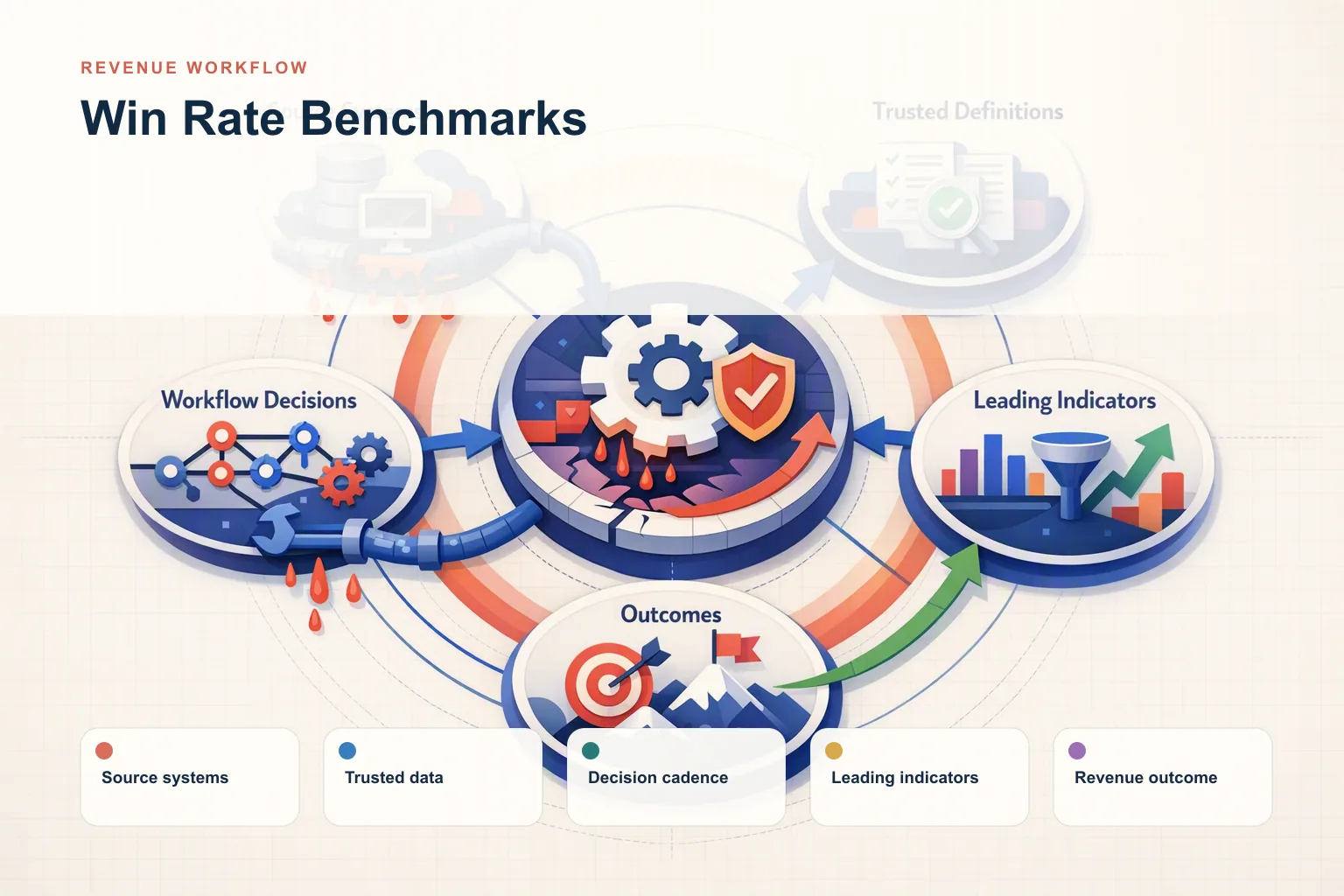
Sales win rate is the share of closed opportunities you win: won deals divided by won plus lost deals in a period. In Revspire’s 2026 benchmark of about 40 B2B companies, win rates ran from 35% on $10,000 to $20,000 deals down to 30% on deals above $100,000. Whether yours is “good” depends on how you define an opportunity, your deal size and how often you face competitors.
Last updated: 20 October 2026
This guide covers how to calculate win rate, the published benchmarks and what they actually measure, the mistakes that make comparisons misleading, and the factors that go with higher win rates.
How to calculate win rate
The standard formula is:
Win rate = deals won ÷ (deals won + deals lost) , for opportunities closed in the same period.
Teams use several variants, and mixing them is the most common reason benchmarks don’t match:
Variant
Formula
When to use it
Closed-deal win rate (count)
Won ÷ (won + lost), by number of deals
The default; most benchmarks use it
Value-weighted win rate
Won value ÷ (won value + lost value)
When deal sizes vary a lot; shows whether you win the big ones
Pipeline win rate
Won ÷ all opportunities created in a cohort
Forecasting and coverage planning (includes deals still open or abandoned)
Stage win rate
Won ÷ deals that reached a given stage
Diagnosing where in the funnel deals are lost
Competitive win rate
Won ÷ closed deals where a named competitor was present
Measuring positioning against specific competitors
A worked example (hypothetical): a team closes 40 deals in a quarter, wins 13 and loses 27. Its win rate is 13 ÷ 40 = 32.5%. If the 13 wins were worth $520,000 and the 27 losses $1,600,000, the value-weighted win rate is 520,000 ÷ 2,120,000 ≈ 24.5%: the team wins smaller deals more often than big ones.
B2B win rate benchmarks
Benchmark
Finding
Source and sample
Win rate by deal size
35% on $10k–$20k ACV, 33% on $20k–$100k, 30% above $100k
Revspire win rate benchmark: about 40 B2B companies, closed deals October 2025 to September 2026
Competitive vs non-competitive
90% of closed deals had a named competitor; those were won 30% of the time vs 35% without one
Same Revspire benchmark
Buyer relationships
Peak win rates of 29% for small deals with 1–3 buyer relationships, 48% for medium deals with 7–9, 42% for enterprise deals with 10–12
Ebsta and Pavilion, 3.2 million opportunities, 2022 data
Buyer engagement in a deal room
22% with one buyer viewer, rising to 45% with eleven or more
Revspire digital sales room benchmark, about 40 B2B companies, October 2025 to September 2026
Customer indecision
Win rates of 6% in deals with high buyer indecision vs 30% with medium indecision
Challenger, research by Matt Dixon and Ted McKenna on 2.5 million recorded sales conversations (22 February 2024)
Read every benchmark as a pattern in someone’s data, not a target. The Revspire figures, for example, are observed in Revspire customer data and are not a random sample of all B2B companies.
What is a good win rate?
For B2B software, the Revspire data puts typical closed-deal win rates around 30% to 35%, falling gently as deal size rises. Beyond that, “good” depends on three things:
- How you define an opportunity. A team that only creates opportunities after a qualified discovery call will show a higher win rate than one that creates them at first meeting. Neither is wrong, but they aren’t comparable.
- Deal size. Larger deals involve more stakeholders, security and procurement review, and more alternatives.
- Competition. Track competitive and non-competitive win rates separately; in the Revspire data the gap was five points.
A win rate far above your peers can also be a warning: it may mean opportunities are being created too late, or that sellers aren’t pursuing enough new business.
The biggest win rate benchmark mistakes
1. Comparing different definitions
Comparing your pipeline win rate to someone else’s closed-deal win rate makes you look worse than you are. Always check the formula behind a benchmark before you compare.
2. Mixing deal sizes
A team selling mostly six-figure deals shouldn’t judge itself against a $10,000-deal win rate. Put your deals into the same size bands as the benchmark first.
3. Leaving stale deals open
If lost deals are never closed out, they never count against you, and win rate looks inflated. Set a rule (for example, close-lost any deal with no buyer activity for a set number of days past its close date) and apply it before measuring.
4. Under-recording “no decision”
In the Revspire benchmark, only 10% of closed-lost deals were tagged “no decision” or “status quo” in the CRM, far below the 40% to 60% of lost deals that Challenger’s call-recording research attributes to indecision. Sellers tend to record a competitor or price instead. Treat your no-decision rate as a floor, and interview lost buyers to find the real reasons. Our loss reasons analysis guide covers how.
5. Using counts when value matters
A team can win 40% of deals and 20% of the value. Report both.
6. Reading small samples
A rep who closed eight deals this quarter doesn’t have a meaningful win rate. Use rolling periods (two to four quarters) for individuals and small segments.
7. Treating vendor benchmarks as causal
“Deals with X won more often” doesn’t mean X caused the win. Better teams often adopt better tools and habits at the same time. Use benchmarks to find questions, not to prove answers.
What goes with higher win rates
The evidence below is correlational, but it points to where to look.
Factor
Evidence
What to do
Fit with your ideal customer profile
Ebsta reported win rates 3.1 times higher when opportunities matched the ICP, and that only 18% of 2024 pipeline did (Ebsta, July 2024)
Tighten what counts as an opportunity
Qualification quality
Ebsta reports deals with strong qualification won 50% of the time vs 8% for poorly qualified deals (Ebsta, page updated 26 July 2025; method not published)
Use a framework such as MEDDPICC and review it weekly
Deals that slip
Ebsta found win rates fell 34% when deals slipped one to four weeks past their close date, and a further 67% beyond a month (July 2024)
Treat a slipped date as a risk signal, not an admin change
Senior buyer involvement
Gong found decision-maker involvement associated with a 233% higher win rate on enterprise deals, highest when the decision maker acted as approver rather than evaluator (Gong, updated March 2026)
Engage the economic buyer early, briefly and on outcomes
Reaching more of the buying group
Ebsta/Pavilion and Revspire data both show win rates rising with more buyer relationships
Map the stakeholders and multi-thread
Competitive positioning
Five-point gap between competitive and non-competitive deals in the Revspire data
Current battlecards and proof for the competitors you meet most
Win rate, pipeline coverage and sales velocity
Win rate sets how much pipeline you need. As simple arithmetic, required coverage is roughly 1 ÷ win rate: at a 25% win rate you need about 4x pipeline to hit a number; at 33%, about 3x. Our pipeline coverage guide works through the full calculation.
Win rate is also one of four inputs to sales velocity. Salesforce gives the formula as (number of opportunities × average deal value × win rate) ÷ length of the sales cycle (Salesforce, 12 March 2024). Raising win rate by a few points often adds more revenue than adding more opportunities of the same quality. See the win rate glossary entry for related terms.
Frequently asked questions
What is a good sales win rate in B2B?
In Revspire’s 2026 benchmark of about 40 B2B companies, closed-deal win rates ran from 35% on $10,000 to $20,000 deals to 30% above $100,000. Compare against deals of a similar size, defined the same way.
How do you calculate win rate?
Divide the number of deals won by the number of deals won plus lost, for opportunities closed in the same period. For example, 13 wins out of 40 closed deals is a 32.5% win rate.
Should open deals be included in win rate?
Not in the standard closed-deal win rate. Including open or abandoned deals gives a pipeline (cohort) win rate, which is useful for forecasting but lower and not comparable to closed-deal benchmarks.
Why is my win rate lower than benchmarks?
Check the definition first: when opportunities are created, whether stale deals are closed out, and whether you’re comparing similar deal sizes. If those match, look at fit, qualification, competitive positioning and how many buyer stakeholders you reach.
What is the difference between win rate and close rate?
Many teams use the terms interchangeably. Where they differ, close rate often means won deals divided by all opportunities or leads, while win rate counts only closed opportunities. State which one you mean when you report it.
See how Revspire connects deal rooms, playbooks and coaching to the deals you’re working: request a demo.
Sources
- B2B SaaS Win Rate and Sales Cycle Benchmark (2026), Revspire, data October 2025 to September 2026 (accessed 20 October 2026)
- Digital sales room benchmark, Revspire, data October 2025 to September 2026 (accessed 20 October 2026)
- 2023 B2B Sales Benchmark Report, Ebsta and Pavilion, February 2023 (accessed October 2026)
- 2024 B2B Sales Benchmarks: H1 Update, Ebsta, July 2024 (accessed October 2026)
- Highlights of the Sales Qualification Report, Ebsta, last updated 26 July 2025 (accessed October 2026)
- How to Overcome Customer Indecision Using the JOLT Effect Approach, Challenger Inc., 22 February 2024 (accessed October 2026)
- Selling to Decision Makers and How it Impacts Win Rates, Gong, 10 December 2020, updated 6 March 2026 (accessed October 2026)
- How to Supercharge Your Sales Velocity for Quicker Wins, Salesforce, 12 March 2024 (accessed October 2026)