Revspire blog
Champion vs Influencer Framework for Revenue Teams
Build a team-specific champion vs influencer framework with documented criteria, clear ownership, stakeholder signals, coaching, and structured reviews.
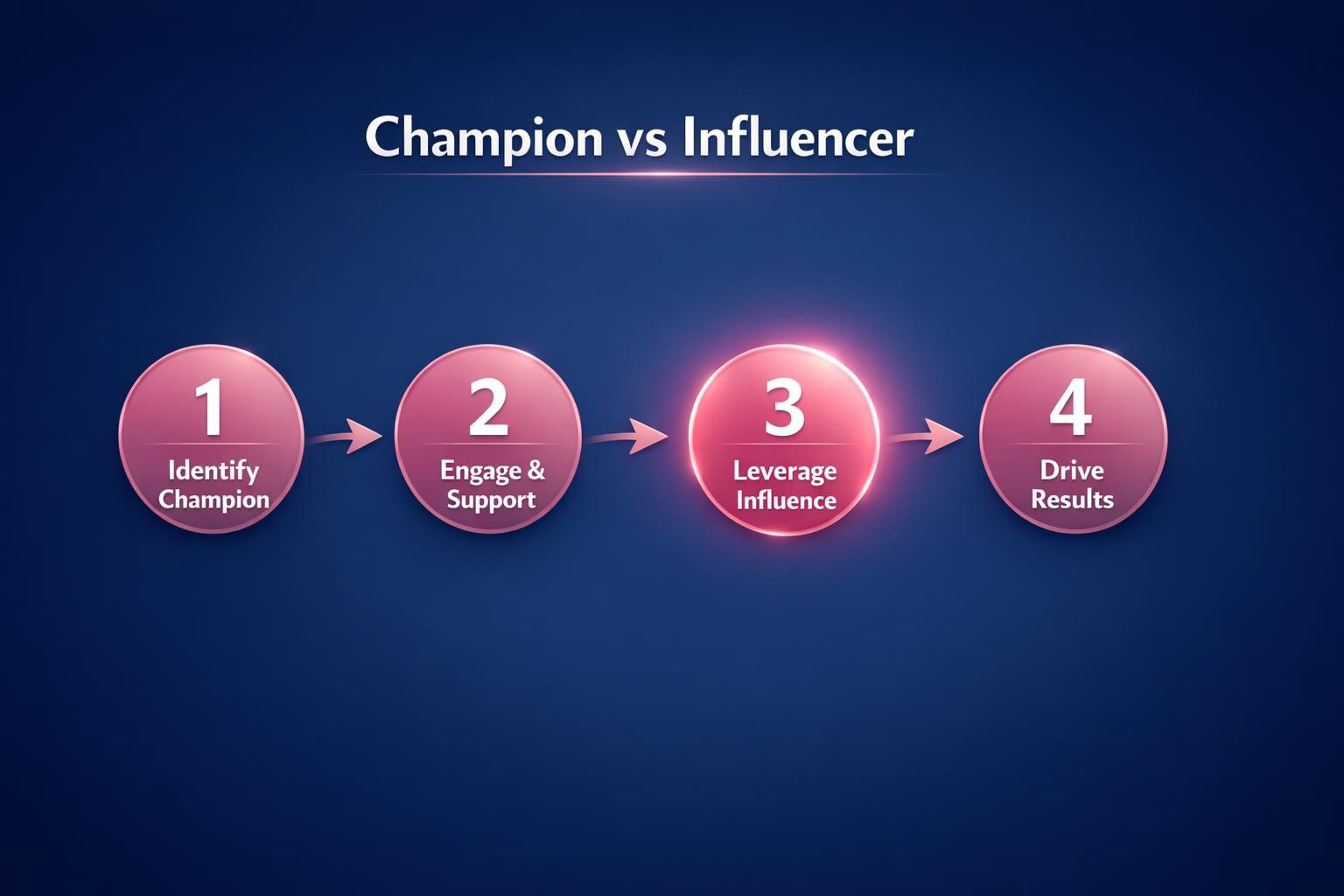
Use this operating framework to distinguish champion and influencer labels through documented team criteria, observable stakeholder evidence, explicit ownership, and consistent deal reviews.
Evidence boundary: The frozen sources do not establish universal definitions or qualification criteria for these roles. The framework therefore helps each revenue team define, apply, review, and improve its own distinction without presenting internal criteria as universal standards.
Build a Champion vs Influencer Distinction Matrix
Start by writing down what acceptable execution looks like at each deal stage. Create separate champion and influencer columns, then document the actions, evidence, milestones, and ownership your team requires for each label. Use the same vocabulary across representatives and managers.
- Required actions: Record the stakeholder actions your team expects for each label.
- Required evidence: Identify what representatives must observe or document before applying a label.
- Stage milestones: Specify when each criterion should be evaluated during the deal.
- Ownership: Assign responsibility for recording the evidence and reviewing the classification.
- Review status: Treat a label as unverified when the available evidence does not meet the corresponding team-defined criteria.
This matrix creates an operational distinction: a stakeholder is evaluated against the documented criteria for each label rather than classified through intuition alone. Review the criteria as win-loss evidence and buyer feedback become available.
Establish the Operating Model
An operating model for Champion vs Influencer answers three questions: what actions should happen, at what stage, and who is accountable. Document the expected actions and evidence for each stage so managers can coach against a shared standard.
Someone on the leadership team should be accountable for outcomes, goals, metrics, and updates to the operating model. Champion-versus-influencer management should operate as a continuous discipline rather than a one-time initiative.
Audit the Current State
Before you can improve Champion vs Influencer, you need an honest baseline. Review recent opportunities by representative, segment, deal size, and sales stage. Compare the account narrative with engagement and progression data to identify where execution worked and where deals stopped progressing.
Prioritize two or three structural improvements, give each improvement an owner and measurable goal, and establish a review cadence.
Monitor Leading and Lagging Indicators
Lagging metrics such as win rate and quota attainment tell you what happened. Potential leading indicators in the source material include stakeholder engagement, content consumption, mutual action plan progression, deal velocity, and stakeholder coverage.
Measure outcomes, not activities. High email, call, or task volume can coexist with weak engagement and limited stage progression. Use progression, engagement quality, and stakeholder coverage as prompts for further review.
Build a dashboard that shows leading and lagging indicators. Review it weekly and connect the findings to pipeline reviews, coaching conversations, and territory discussions.
The source materials present Revspire Stakeholder Intelligence as a way to surface deal-level engagement and stakeholder signals.
Avoid Common Execution Errors
Single-threading the relationship
Building the relationship around one stakeholder creates risk if that person disengages, changes roles, or leaves the company. Map the buying committee, assign coverage, track engagement, and flag opportunities that rely on one active contact.
Confusing activity with progress
When activity rises without stronger engagement or stage progression, investigate what is happening inside the opportunity rather than simply requesting more activity.
Relying only on intuition
Define a small set of leading indicators, track them consistently, and investigate discrepancies between the data and the account narrative.
Failing to learn from losses
Use structured loss reviews to identify stakeholder-role breakdowns in significant lost opportunities. Document the findings and update playbooks and coaching materials.
Build a Continuous Improvement Cadence
- Review opportunities weekly. Discuss what needs to change during the next seven days instead of limiting the conversation to status reporting.
- Use deal-level coaching. Review live opportunities with each representative and work through execution problems in context.
- Capture win-loss intelligence. Use post-deal interviews, CRM analysis, and structured reviews to feed lessons into playbooks, training, and strategy.
- Align technology with the process. Technology should serve the champion vs influencer B2B deal roles process, not define it.
- Create feedback loops. Review metrics against targets, update playbooks when new information emerges, and incorporate buyer feedback when available.