Revspire blog
The Complete 2026 Guide to Deal Loss Post-Mortems for Revenue Leaders
A practical guide to deal loss post-mortems, including audits, ownership, review methods, feedback loops, playbook updates, live-deal signals, and metrics.
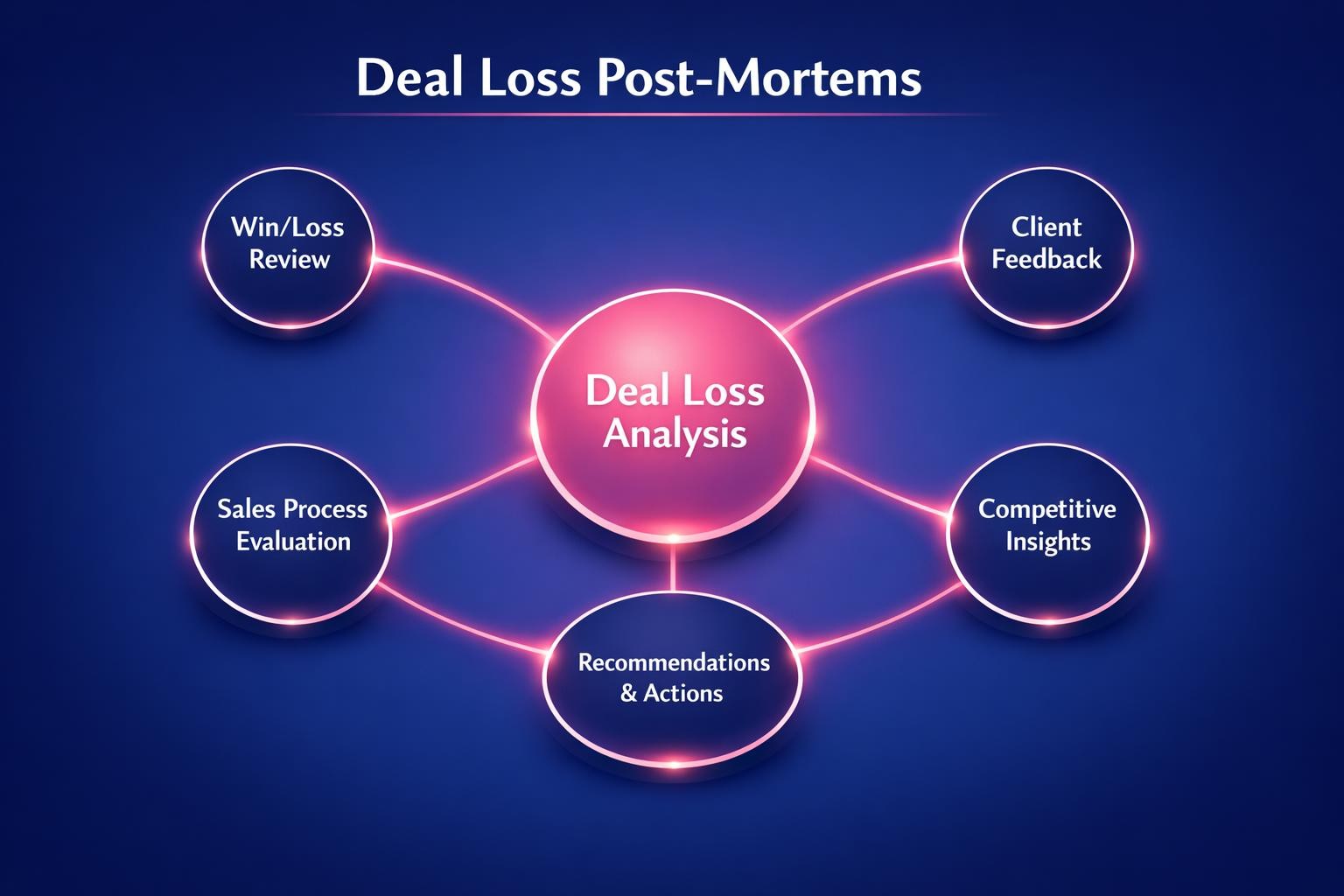
A deal loss post-mortem provides a structured way to learn from completed deals. The supplied sources connect that retrospective work with ownership, documented processes, measurement, playbook updates, and feedback loops. This guide distinguishes post-deal review from live deal inspection so each practice has a clear purpose.
Retrospective Review and Live Deal Inspection
Retrospective review examines completed deals. Findings from completed won and lost deals can be captured through post-deal interviews, CRM data analysis, and structured win-loss reviews, then fed into playbooks, training, and strategy.
Live deal inspection is a separate, pre-close activity. The source describes deal-specific coaching as reviewing live opportunities with each representative and working through execution gaps in real time. Findings from retrospective reviews can inform that inspection, but the two workflows should not be treated as the same activity.
Start With an Audit
Before you can improve Deal Loss Post-Mortems, you need an honest baseline. Pull the last six months of deal data. Map every opportunity against the relevant stages and identify where deals are falling out and why. Review results by representative, segment, and deal size.
Audit the current state before changing the operating model.
An operating model for Deal Loss Post-Mortems answers three questions: what actions should happen, at what stage, and who is accountable. Document this explicitly. Use the audit to identify a focused set of improvements rather than creating an unnecessarily complex process.
Build the Core System
Ownership, process, technology, and measurement form the core system.
Assign ownership
Someone on the leadership team is accountable for the outcomes, not just the activities. That owner can set goals, define metrics, and maintain the review process as new findings emerge.
Document the process
The process that governs Deal Loss Post-Mortems must be documented, taught, and enforced. Define when a review occurs, who participates, what evidence is examined, and how findings are recorded. Update playbooks when recurring findings indicate that the current guidance needs to change.
Use technology to support the process
The technology layer for Deal Loss Post-Mortems should reduce friction, not add it. Evaluate tools according to whether they make relevant evidence easier to collect, review, and share. Related information about Revspire Win-Loss Intelligence is available separately.
Create feedback loops
Document findings and feed them back into playbooks, training, and strategy. Review Deal Loss Post-Mortems metrics against targets, update playbooks when the team learns something new, and collect buyer feedback where it is available.
Capture and Apply Win-Loss Findings
Completed won and lost deals can provide evidence for retrospective analysis. A structured review can use post-deal interviews, CRM data analysis, and structured win-loss reviews. The resulting findings should identify what the team will retain, change, or investigate further.
Three-part explainer: Reconstruct the loss, Verify the root cause, and Prevent repeat failure.
Keep the review evidence-based. Record the available deal data, participant observations, and buyer feedback separately so assumptions are not presented as verified findings. Assign an owner when a review leads to a process, playbook, or coaching change.
Use Live-Deal Signals Separately
Leading indicators might include stakeholder engagement rates, content consumption, mutual action plan progression, or deal velocity at each stage. These indicators relate to active opportunities and belong in live pipeline inspection rather than the retrospective portion of a loss review.
Deal-specific coaching can use those signals to examine active opportunities. Retrospective findings can help managers decide what to inspect, but a post-mortem should remain focused on learning from completed deals.
Common Mistakes to Avoid
Three-part explainer: Recognize the leak, Correct the behavior, and Prevent repeat failure.
Treating the review as a one-time initiative
Assign a permanent owner and establish a recurring review cadence. Treat the work as an ongoing process rather than a project with a fixed end date.
Relying only on recent recollections
Compare individual observations with the broader portfolio of available deal evidence. Investigate discrepancies instead of allowing the most recent loss to determine policy by itself.
Confusing activity with progress in active deals
In active pipeline management, high activity can mask a complete absence of forward momentum. Compare activity with stage progression, buyer engagement quality, and stakeholder coverage. This is a live-deal inspection issue, not a measure of the retrospective post-mortem practice.
Failing to preserve the lesson
Document the findings and update playbooks accordingly. A finding that is not recorded or assigned is less likely to influence later reviews, training, or process decisions.
Measure the Practice
Measure the retrospective practice alongside, but separately from, live-deal indicators. Lagging indicators include win rates, cycle times, and average deal sizes. Leading indicators relate to behaviors or conditions that can be examined while deals remain active.
Build a dashboard that shows both. Review it weekly. Keep the interpretation clear: retrospective reviews explain completed outcomes, while leading indicators support intervention in active opportunities.
Begin With Focused Improvements
Use an audit, clear ownership, and measurable goals to begin.
Start with an honest audit. Ask where the current process works, where it breaks down, and what the data says compared with the prevailing narrative. Prioritize two or three specific improvements. Deploy them with a clear owner, a measurable goal, and a 90-day review cadence.