Enterprise Sales Pipeline Management: Process, Reviews and Metrics
A practical perspective for connecting this idea to your revenue team’s next move.
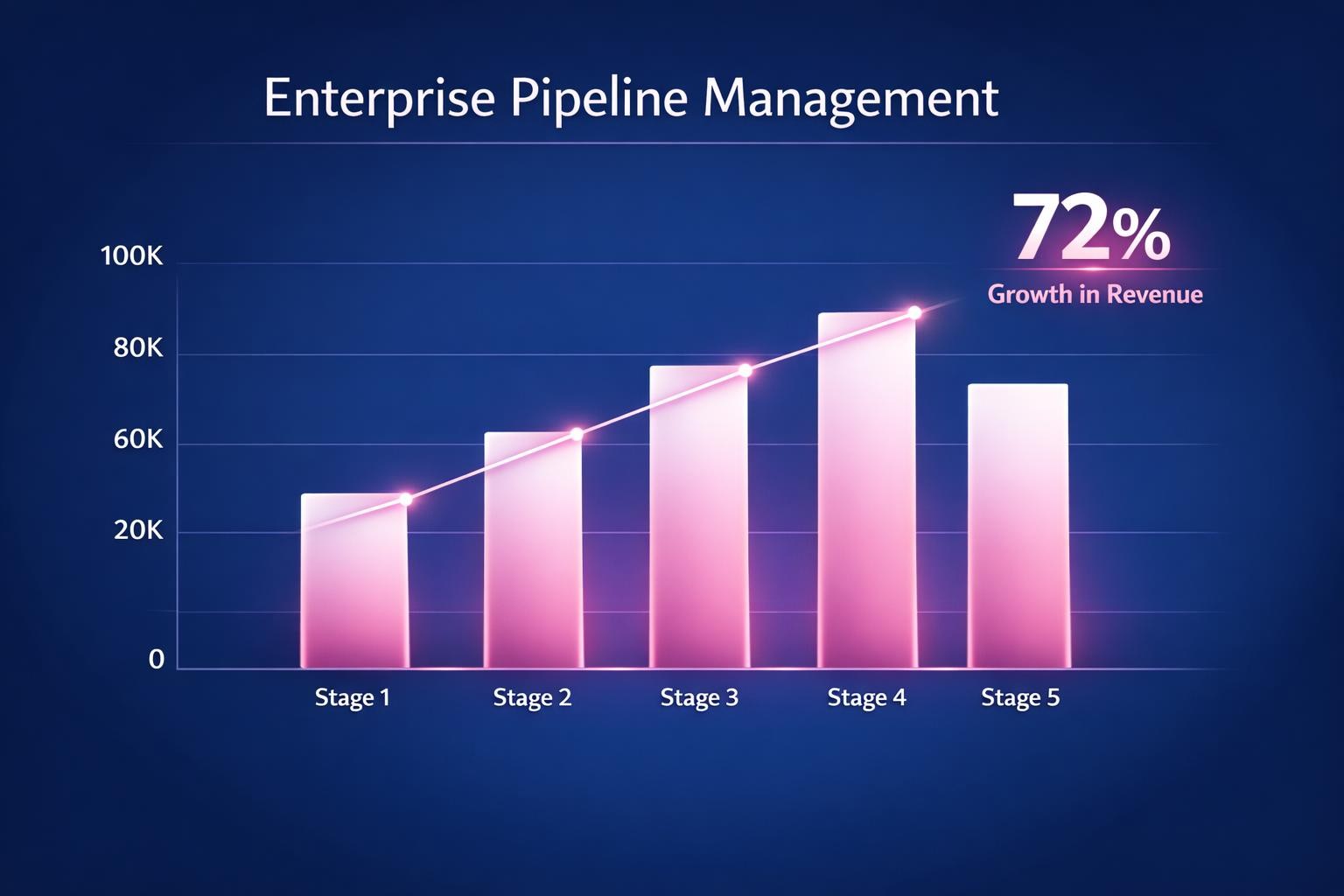
Sales pipeline management is the ongoing work of qualifying, inspecting and advancing every open opportunity so the forecast reflects what buyers will do. In an enterprise B2B team, with long cycles and large buying committees, it rests on stage exit criteria backed by buyer evidence, a weekly pipeline review, a few leading indicators and fast action on stalled deals.
This guide covers the process step by step: an example stage model, aging and slippage rules, a pipeline review agenda and question bank, the weekly metrics, where AI helps, and a 90-day improvement plan. It reflects research and product documentation checked in October 2026.
Last updated: 16 October 2026
What is sales pipeline management?
A sales pipeline is the set of open opportunities, each in a stage that describes how far the buyer has progressed. Pipeline management is what the revenue team does with that set every week: deciding which deals are real, which need help, which have stalled and which to close out. It is often confused with the disciplines around it.
Discipline
Question it answers
Usual cadence
Pipeline generation
Do we have enough new opportunities?
Weekly and monthly
Pipeline management
Which deals are real, and what must happen next on each?
Weekly
Pipeline hygiene
Is the CRM data (stage, amount, close date) accurate?
Continuous, checked weekly
Sales forecasting
What will we close this period?
Weekly, rolled up monthly and quarterly
Deal coaching
How can this seller win this deal?
Weekly one-to-ones
How pipeline management relates to the disciplines around it. Cadences are common practice, not benchmarks.
Pipeline management sits in the middle: an honestly staged pipeline is the input to every forecast, and the weekly review is where data problems get fixed. For the data side, see the pipeline hygiene guide.
Why does pipeline management matter to revenue leaders?
A widely cited study on the topic is a survey by Vantage Point Performance and the Sales Management Association of executives at 62 B2B companies. Reporting it in Entrepreneur on 11 March 2015, Jason Jordan wrote that 44% of the executives called their organizations ineffective at managing the pipeline, and that companies reporting effective pipeline management grew revenue 15% faster than their peers. Three practices stood out: a defined, formal sales process (an 18% difference in revenue growth), at least three hours per month spent managing each rep’s pipeline (11% greater growth), and trained managers (9% faster growth, though 61% of executives said their managers had not been adequately trained).
These are self-reported, correlational results, but forecast data points the same way. In a Gartner release of 12 February 2020, only 45% of sales leaders and sellers had high confidence in their organization’s forecasting accuracy. In Gong’s survey of 928 sales and revenue professionals (19 July 2022), 52% of leaders said their organization regularly misses its forecast by more than 10%. Much of that error starts in the pipeline: deals staged on optimism and close dates nobody believes.
What makes enterprise pipeline management different?
In a press release of 3 May 2022, Gartner described enterprise transactions as typically running six months or more, for deals above $125,000, with eight to 11 stakeholders, against less than three months, under $25,000 and fewer than six stakeholders for volume-and-velocity deals. That changes the job:
- Each deal moves the quarter. With fewer, larger deals, inspection happens deal by deal. In the Ebsta and Pavilion 2023 B2B Sales Benchmark Report (3.2 million opportunities from 364 companies, 2022 data), the share of deals that slipped rose to 37%.
- Close dates are often placeholders. The same report found 89% of close dates fell on the last day of a calendar month, and 17% of opportunities had their close date changed more than three times by more than a week.
- More people, more single-threading risk. Ebsta’s 2024 B2B Sales Benchmarks: H1 Update (July 2024) reports the number of stakeholders involved grew from 5 to 8.
- The late stages belong to the buyer. Security review, legal and procurement happen inside the customer and stay invisible in the CRM unless someone records them with an owner and a date.
- Almost every deal is competitive. In Revspire’s B2B SaaS win rate and sales cycle benchmark (about 40 B2B companies, October 2025 to September 2026), 90% of closed deals had a named competitor, and those were won 30% of the time against 35% without one.
A bigger pipeline is not a healthier one
Old, unqualified opportunities inflate coverage, distort the forecast and take up seller time. The Ebsta and Pavilion 2023 report found that opportunities open longer than twice the average sales cycle had a 3% chance of closing, and only 15% of opportunities were fully qualified. Before celebrating a coverage number, check how much of the pipeline would pass your own exit criteria; the pipeline coverage ratio guide explains how to set the target.
How do you manage a sales pipeline, step by step?
Steps 1 to 3 are design work you do once and revisit each quarter. Steps 4 to 6 are the weekly routine.
Step 1: Write stage exit criteria as buyer evidence
A deal should advance because the buyer did something you can verify, not because the seller feels good about it. An example for an enterprise software sale:
Stage
Exit criterion: what the buyer has done
Evidence a manager can check
1. Discovery
Confirmed a problem worth solving and agreed to bring more people in
Next meeting booked with at least one new stakeholder
2. Qualified
Named an executive sponsor, the decision process and a target date
Sponsor confirmed; decision steps written into the plan
3. Solution validation
Key stakeholders agreed the solution fits their requirements
Demo or pilot feedback; technical sign-off or a list of open gaps
4. Business case
The sponsor accepted the value case and the route to budget
Business case reviewed by the sponsor or finance
5. Proposal
The economic buyer reviewed commercial terms
Proposal viewed by the economic buyer; questions or redlines received
6. Security, legal, procurement
Buyer-side reviews started, each with an owner and a date
Questionnaire, redlines or vendor onboarding in progress
7. Commit
The buyer confirmed signatory, signature date and paper process
Written confirmation; order form out for signature
An example enterprise stage model with buyer-evidence exit criteria. Adapt names and criteria to your own process.
Build the criteria into the CRM as required fields or a checklist so a deal cannot advance without them. The sales pipeline stages guide goes deeper on stage design.
Step 2: Give every stage owners on both sides
List the actions that move each stage forward and who owns them: the seller (run the technical deep dive, draft the business case) and the buyer (return the security questionnaire, book the finance review). A mutual action plan puts both on one dated list. In Revspire’s mutual action plan benchmark (October 2025 to September 2026), deals above $50k with a plan closed in a median of 85 days against 120 without one, and across all deal sizes, deals with a plan were won 35% of the time against 28%. Buyers owned only 20% of plan milestones, so most plans are still seller to-do lists. These are observed patterns, not proof of cause: teams that write plans may also qualify harder. A mutual action plan template is a quick way to start.
Step 3: Set aging, slippage and inactivity rules
Agree written rules that flag stalled deals automatically, with thresholds taken from your own closed-won history:
- Deal age. Flag any open deal older than the 75th percentile of your won-deal cycle for its size band. For reference, in Revspire’s win rate and sales cycle benchmark, won deals above $50k closed in a median of 90 days, with a 75th percentile of 150 days.
- Time in stage. Flag a deal that has sat in one stage for about twice your median time in that stage.
- Close-date changes. Send any deal whose close date has moved twice to a manager review. Ebsta’s 2024 H1 update reports win rates declined 34% when deals slipped one to four weeks past their close date, and a further 67% beyond a month.
- No next step. No buyer meeting or milestone on the calendar means the deal is at risk, whatever its stage says.
- Buyer silence. Set a limit on days without buyer engagement (see step 5).
A flag is not a loss. It guarantees a conversation: re-qualify, re-plan with the buyer, or close the deal out.
Step 4: Clean the pipeline every week
Have sellers update amount, stage, close date and next step before the weekly review, not during it. Ebsta’s 2024 H1 update found opportunities updated weekly were 17% more likely to be closed won. Move deals with no response and no plan to nurture, or close them as lost with a reason. CRM tools help here: Salesforce describes Pipeline Inspection as highlighting “changes to amounts, stages, or close dates” (Salesforce Trailhead).
Step 5: Track buyer engagement, not only seller activity
Calls logged and emails sent show how busy the seller is, not whether the deal is moving. Buyer actions say more: a new stakeholder joined, the champion forwarded the proposal, or nobody has opened anything for three weeks. In Revspire’s digital sales room benchmark (October 2025 to September 2026), closed deals with an active deal room (at least one buyer view before close) were won 35% of the time against 28% without one, and once a room went 20 days without a buyer view, the win rate fell below half the overall rate (observed patterns, not proof of cause). That makes 20 days of silence a practical alert; respond with something new for the champion, such as a revised business case or an implementation plan, not another check-in. Revspire’s Digital Sales Rooms record buyer views, stakeholder engagement and mutual action plan progress per deal.
Step 6: Measure velocity, not just volume
Sales velocity shows how fast revenue moves through the pipeline: (qualified opportunities × average deal size × win rate) ÷ average cycle length in days. A worked example with illustrative numbers: 40 opportunities × $60,000 × 30% ÷ 90 days = $8,000 a day. Shorten the cycle to 75 days and velocity rises to $9,600 a day, a 20% gain without one extra opportunity. The pipeline velocity guide covers each lever.
How do you run a pipeline review meeting?
The common failure is the status interrogation: the manager asks “where are we on this one?” and gets an optimistic story. A good review starts from data everyone has seen, spends its time on the few deals that need a decision, and ends with owners and dates.
How often should you hold pipeline reviews?
Meeting
Cadence
Who attends
Focus
Deal review (one-to-one)
Weekly, about 30 minutes
Seller and manager
Commit and best-case deals, plus any deal that tripped a rule
Team pipeline review
Weekly, 45 minutes
Manager and team; RevOps optional
Changes, flagged deals, clean-up decisions
Forecast call
Weekly, after the reviews
Managers, sales leader, RevOps
Commit and upside for the period
Strategic deal review
Every two weeks, largest deals
Seller, manager, executive sponsor, solutions
Stakeholder map, buyer-side milestones, competitive plan
Quarterly pipeline review
Quarterly
Sales leadership, RevOps, marketing, customer success
Next two quarters’ coverage, stage conversion, process changes
A typical enterprise pipeline review cadence. Lengths and attendees are recommendations, not benchmarks.
The evidence favours a weekly rhythm with real manager time: the Vantage Point and Sales Management Association study (Entrepreneur, 2015) linked at least three hours per month per rep to faster revenue growth. Keep the forecast call separate so the number does not crowd out deal work.
A 45-minute weekly pipeline review agenda
- What changed (5 minutes). New deals, stage moves, slipped dates, amount changes and losses, read from a change report.
- Commit deals (10 minutes). Is the signatory confirmed, are buyer-side reviews on schedule, what could still slip?
- Flagged deals (20 minutes). The three to five deals that tripped a rule. For each, decide: re-plan, escalate to an executive sponsor, or close out.
- Clean-up (5 minutes). Confirm deals moving to nurture or closed-lost, with loss reasons.
- Actions (5 minutes). Every decision gets an owner and a date in the next seven days.
Pipeline review questions that get evidence, not optimism
- What did the buyer do since last week?
- Who at the customer owns the next step, and when is it?
- Which members of the buying committee have we not met, and who can introduce us?
- What has to be true for this deal to close by the date in the CRM?
- Are security, legal and procurement on the plan, with dates the buyer agreed?
- Who are we competing with, including doing nothing, and what would make us walk away?
Keep inspection and coaching apart. Inspection asks what is happening in a deal; coaching asks how the seller can handle it better. Use the team review to inspect and decide, and take skill feedback, such as a weak discovery call, to the one-to-one.
Which pipeline metrics should you review each week?
Start with three to five leading indicators each week and review the lagging ones monthly or quarterly.
Metric
What it tells you
How to calculate it
Type
Pipeline coverage
Enough pipeline to reach target?
Qualified pipeline closing in the period ÷ remaining target
Leading
Stage conversion rate
Where deals leak
Deals leaving a stage forward ÷ deals entering it
Leading
Deal age and time in stage
Which deals have stalled
Days since creation and in current stage, against won-deal percentiles
Leading
Slippage rate
How reliable close dates are
Deals whose close date moved out of the period ÷ deals forecast in it
Leading
Stakeholders engaged
Single-threading risk
Distinct buyer contacts active in the last 30 days
Leading
Days since buyer engagement
Buyer silence
Days since a buyer meeting, reply or content view
Leading
Win rate by deal-size band
Qualification and competitiveness
Won ÷ all closed, by band, competitive and not
Lagging
Median sales cycle
How long deals take
Median days from creation to closed-won, by band
Lagging
Forecast accuracy
How well the system works
1 − (absolute forecast error ÷ actual), per period
Lagging
Core pipeline management metrics for enterprise B2B teams, with standard calculations.
Compare like with like: put deals into deal-size bands before comparing win rates or cycle length, and use the median cycle, because a few very long deals pull averages up. Both habits follow the guidance in Revspire’s win rate and sales cycle benchmark, where win rates ran from 35% on $10k–$20k deals to 30% above $100k.
Where does AI help in pipeline management?
AI pipeline management uses machine learning and generative AI to capture deal activity, detect changes and risks, and summarize each opportunity so reviews start from evidence. Salesforce’s sixth State of Sales report (25 July 2024, 5,500 sales professionals) found 81% of sales teams experimenting with or fully using AI, but only 35% of sales professionals completely trust the accuracy of their organization’s data.
Results are uneven. The Bridge Group’s 2026 AE Models, Motions & Metrics report (22 June 2026, 158 B2B companies) found 57% of reps at quota in the top tercile of AI engagement against 39% in the bottom, an observational gap, yet a plurality rated 10 of 11 AI use cases “hit or miss”. Gong’s 2022 survey found organizations using insights from customer interactions were twice as likely to report accuracy within 5% of their monthly forecast as those relying on seller-entered data (22% against 11%).
AI is most useful for the mechanical work: logging activity, flagging changed amounts and dates, scoring risk from engagement data and summarizing calls. It does not replace exit criteria or a manager’s judgment on a strategic deal; without clear stage definitions, it only reports on inconsistent data faster.
Which tools support pipeline management?
Disclosure: Revspire publishes this guide and sells digital sales rooms, which appear once below. Tools are grouped by category and listed alphabetically, not ranked. Prices are omitted because several vendors do not publish them. Each entry was checked on the vendor’s own page on 16 October 2026.
Category
Tool
What it adds
Limitation to know
CRM-native
HubSpot forecast tool
Forecasts by deal stage or forecast category, weighted or total pipeline (HubSpot)
Requires Sales Hub or Service Hub Professional or Enterprise
CRM-native
Salesforce Pipeline Inspection
Pipeline changes in one view, change highlights, opportunity score tiers (Trailhead)
The Trailhead module does not state which editions include it
Revenue intelligence
Gong Forecast
AI deal prediction, deal boards, forecast roll-ups (Gong)
Prices not published on the product page
Revenue intelligence
Salesloft Inspect
Deal health scored on engagement and activity data; flags slipping stages and coverage gaps (Salesloft)
Prices not published; product names are changing after Clari and Salesloft merged in December 2025 (Salesloft)
Digital sales rooms
Revspire Digital Sales Rooms
Buyer-side signals per deal: stakeholder views, mutual action plan milestones, engagement analytics
Covers only deals run through a room; forecast roll-ups stay in your CRM
Tools that support pipeline management, checked on vendor pages on 16 October 2026. Grouped by category; not a ranking.
When to choose which: start with CRM-native inspection if your main problem is stale CRM data, since sellers already work there. Choose revenue intelligence instead if forecast calls rely on seller opinion and you already record calls and email. Add a digital sales room if deals stall in the buyer-owned late stages and you cannot see who on the committee is engaged.
A 90-day plan to improve pipeline management
- Days 1–15: baseline. Pull 6 to 12 months of closed deals. Calculate won-cycle percentiles and win rate by size band, stage conversion, slippage and close-date changes, and compare them with what the team believes.
- Days 16–30: design. Name one owner, often RevOps with a sales leader as sponsor. Write the exit criteria, aging and silence rules and review agenda, and build the criteria into the CRM.
- Days 31–75: run. Hold reviews to the agenda, put a mutual action plan on every deal above your enterprise threshold, and track three to five leading indicators weekly.
- Days 76–90: evaluate. Compare slippage, stage conversion and forecast error with the baseline. Keep what moved, change what did not, and train managers on the rules.
To set your first aging thresholds, compare your won-deal cycle times and win rates by deal size with the Revspire B2B SaaS win rate and sales cycle benchmark.
Frequently asked questions
What is the difference between pipeline management and sales forecasting?
Pipeline management decides what is real in each open deal and what must happen next; forecasting turns that pipeline into a number for the period. A forecast is only as good as the pipeline under it, so optimistic stages produce an optimistic forecast. Most teams run the pipeline review first and the forecast call after it.
How often should you review your sales pipeline?
Weekly, at three levels: a seller-and-manager deal review, a team pipeline review and a forecast call, plus a quarterly review of coverage and process. The Vantage Point and Sales Management Association study linked at least three hours a month of pipeline management per rep to faster revenue growth (Entrepreneur, 2015).
What is AI pipeline management?
It is the use of AI to capture deal activity, flag changes and risks, score deals from engagement data and summarize calls before a review. It works best on top of clear stage exit criteria. Salesforce Pipeline Inspection, Gong Forecast and Salesloft Inspect are common examples.
How do you know a deal has stalled?
Look for a deal older than the 75th percentile of your won cycle, a close date that has moved twice, no buyer meeting on the calendar, or a run of buyer silence. In Revspire’s digital sales room benchmark, deals whose room went 20 days without a buyer view had a win rate below half the overall rate. Treat these as reasons to re-qualify, not as losses.
What makes enterprise pipeline management different from SMB?
Enterprise deals are fewer, larger, slower and involve more people: Gartner’s May 2022 release puts them at six months or more, above $125,000, with eight to 11 stakeholders. The work shifts from managing volume to inspecting each deal and planning buyer-side steps such as security review and procurement.
Sources
- 3 Best Practices of All-Star Sales Forces (Infographic), Entrepreneur (Jason Jordan; Vantage Point Performance and Sales Management Association research, 62 B2B companies), 11 March 2015. Accessed 16 October 2026.
- 2023 B2B Sales Benchmark Report, Ebsta and Pavilion, February 2023 (2022 data). Accessed 16 October 2026.
- 2024 B2B Sales Benchmarks: H1 Update, Ebsta, July 2024. Accessed 16 October 2026.
- Gartner Says Less Than 50% of Sales Leaders and Sellers Have High Confidence in Forecasting Accuracy, Gartner, 12 February 2020. Accessed 16 October 2026.
- Gartner Predicts 65% of B2B Sales Organizations Will Transition from Intuition-Based to Data-Driven Decision Making by 2026, Gartner, 3 May 2022. Accessed 16 October 2026.
- As Economic Headwinds Grow Stronger, Only 24% of Sales Leaders Are Confident In Their Team’s Revenue Forecast, Gong, 19 July 2022. Accessed 16 October 2026.
- Salesforce Report: Sales Teams Using AI 1.3x More Likely to See Revenue Increase, Salesforce, 25 July 2024. Accessed 16 October 2026.
- 2026 AE Models, Motions & Metrics, The Bridge Group, 22 June 2026. Accessed 16 October 2026.
- Get to Know Pipeline Inspection, Salesforce Trailhead, undated. Accessed 16 October 2026.
- Use the forecast tool, HubSpot Knowledge Base, updated 7 August 2026. Accessed 16 October 2026.
- Gong Forecast, Gong, undated product page. Accessed 16 October 2026.
- Pipeline Inspection Software for Revenue Visibility, Salesloft, undated product page. Accessed 16 October 2026.
- Clari and Salesloft Complete Merger, Appoint Steve Cox as CEO to Build First Predictive Revenue System, Salesloft, 3 December 2025. Accessed 17 October 2026.
- Revspire data (aggregated customer data, October 2025 to September 2026; observed patterns, not proof of cause): B2B SaaS win rate and sales cycle benchmark, mutual action plan benchmark and digital sales room benchmark, Revspire, 16 October 2026. Accessed 16 October 2026.