Personalized Sales Content: How to Personalize It at Scale
A practical perspective for connecting this idea to your revenue team’s next move.
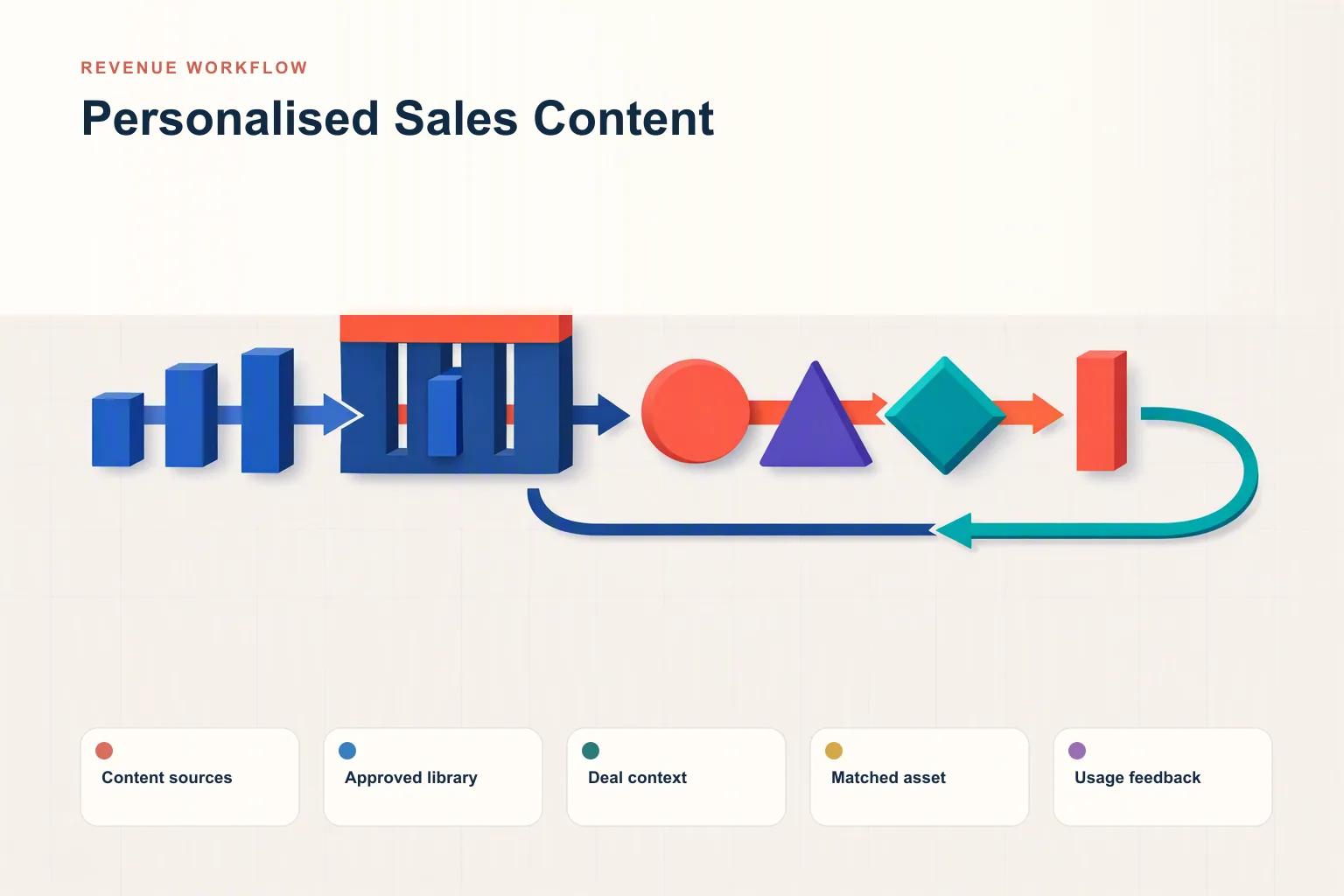
Personalized sales content is approved sales material, such as decks, business cases, proposals, deal rooms and follow-up emails, adapted to one buyer’s industry, role, account and stage of the deal. To personalize sales content at scale, build modular, governed assets with locked and editable parts, then let reps and AI fill the editable parts from CRM and engagement data.
This guide covers the four levels of personalization, a seven-step method for running it across a sales team, a worked example, where AI helps and where it needs guardrails, and the metrics that show whether it is working. It draws on buyer and seller research published since June 2025 and on Revspire’s own aggregated customer benchmarks.
Last updated: 16 October 2026
What is personalized sales content?
Personalized sales content is any asset a seller shares that has been shaped for the person and company receiving it. The shaping can be light, such as choosing an industry case study over a generic one, or deep, such as a business case built from the buyer’s own figures. What makes it personalized is relevance to the buyer’s situation, not their name or logo on the cover.
It is not the same as personalized outreach (first-touch prospecting emails and calls) or marketing personalization (websites, ads and nurture emails for audiences). Sales content is shared by a named seller with named buyers in an active deal, so it can use what was learned in discovery.
Customization, personalization at scale and hyper-personalization
- Customization: a seller edits a copy of an asset by hand for one deal. It is flexible, but every copy drifts from the approved version.
- Personalization at scale: assets are designed so the right parts change by segment, role, account and stage, while the rest stays approved and current.
- Hyper-personalization: one-to-one tailoring for an account and individual, often driven by live signals such as which sections a stakeholder has read.
Why does personalized sales content matter in B2B?
Four findings from recent buyer and seller research explain why generic content loses ground. A fifth explains why careless personalization can be worse than none.
Buying groups are large and mixed
Forrester’s 2026 buyer insights release (21 January 2026) says the typical buying decision now involves 13 internal stakeholders and nine external influencers, and that procurement professionals are decision-makers in 53% of business buying cycles. A finance lead, a security reviewer and a procurement manager each need different evidence from the same vendor. One deck written for the champion serves none of them well.
Most of the evaluation happens without the seller
6sense’s 2025 B2B Buyer Experience Report (nearly 4,000 buyers; released 12 November 2025) found that buyers were 61% of the way through their journey when they first contacted a seller, and that 94% had already ranked their shortlist. Content that reaches a buying group is read, forwarded and compared while the rep is not in the room, so it has to make the case to each reader on its own.
Irrelevance and inconsistency are penalized
In a Gartner survey of 632 B2B buyers (published 25 June 2025), 73% said they actively avoid suppliers that send irrelevant outreach, and 69% reported inconsistencies between a supplier’s website and what its sellers told them. The same buyers preferred seller input for questions that need context, such as whether a product fits their company. Personalization is how sellers supply that context, but it must not contradict the approved story.
Sellers cannot tailor everything by hand
Salesforce’s State of Sales announcement (3 February 2026; 4,050 sales professionals in 22 countries) reports that the average seller spends 40% of their time selling. If every proposal and follow-up is rebuilt from scratch, personalization competes with selling time, and quality depends on which rep owns the deal.
Personalization can backfire
A Gartner survey of 1,464 B2B buyers and consumers (published 3 June 2025, fielded November to December 2024) found that personalized marketing had produced negative experiences for 53% of customers, and that those customers were 3.2 times more likely to regret a purchase and 44% less likely to buy again. Customers who met personalization in a recent purchase were also twice as likely to feel overwhelmed by the volume of information. By contrast, customers engaged through what Gartner calls active personalization, which draws out customers’ unstated needs and validates their decisions, were 2.3 times more likely to complete critical purchase decisions with confidence.
The lesson for sales content: personalize to help the buyer decide, send fewer and more relevant assets, and confirm needs with the buyer instead of guessing from clicks.
What are the levels of sales content personalization?
Personalization works at four levels. Each level needs different data and a different owner, and not every asset needs all four.
Level
What changes
Example
Data needed
Usual owner
1. Industry or segment
Proof points, customer examples, regulations, vocabulary
A healthcare case study and compliance page instead of a generic overview
Industry and segment on the account record
Product marketing, once per segment
2. Role or persona
Which problem leads, which proof, how much technical detail
The CFO version leads with cost, payback inputs and implementation risk; the IT director version with security architecture, integrations and data residency
Buying role on each contact
Product marketing and enablement, once per role
3. Account
The buyer’s goals, current tools, terminology, named stakeholders, agreed scope
A deal room with the account’s logo, its objective from discovery and a section for each named stakeholder
Discovery notes, CRM opportunity, stakeholder map
The account executive, helped by templates and AI
4. Moment
What comes next, triggered by deal stage or by what the buyer read
After the CFO rereads the pricing section, the follow-up walks through the cost model instead of a generic check-in
Stage, mutual action plan, engagement analytics
The seller, prompted by alerts
The four levels of sales content personalization. Levels 1 and 2 are prebuilt; levels 3 and 4 happen per deal.
A useful rule: early-stage assets such as overviews and industry pages need levels 1 and 2 and should be prebuilt. Late-stage assets such as the business case, proposal, implementation plan and security answers need levels 3 and 4, because that is where the buying group checks whether the deal fits their company.
How do you personalize sales content at scale?
Scale comes from the system, not from asking every rep to try harder. When personalization depends on the individual, the best reps tailor everything, the average rep tailors the first meeting, and the rest send the same deck to everyone. The seven steps below move most of the work into modules, rules and recommendations, so the median rep sends what the best reps would.
1. Start from recent deals, not the content library
Pull 20 to 30 recent won and lost opportunities from one segment and deal-size band. For each, list the assets shared, the buyer roles that engaged and the stage where the deal stalled or sped up. Look for roles that never received anything written for them, and for late-stage questions that were only ever answered on calls.
Then check the library. In Revspire’s sales content benchmark (aggregated customer data, October 2025 to September 2026), 35% of active sales assets had no shares and no opens in the previous 90 days, and the median won deal had four more distinct assets shared than the median lost deal. These are observed patterns, not proof of cause, but they suggest an order of work: retire or merge unused assets, then fill gaps in later-stage material such as the business case and security answers.
2. Build a role-by-stage matrix
List the buying roles you meet in most deals as rows and your sales stages as columns. In each cell, write the question that role has at that stage and the asset that answers it. Procurement at the proposal stage asks about terms, pricing structure and vendor risk; a security reviewer during evaluation asks about architecture, certifications and data handling. Empty cells are your content gaps. Our guide to buyer journey content mapping covers the stage side in more depth.
3. Make each high-use asset modular
Design it in three layers:
- Locked core: product facts, claims, pricing logic, legal and security statements. Nobody edits these per deal.
- Swappable modules: an industry proof section, a role-specific page, a region or language variant, chosen from an approved set.
- Editable fields: the buyer’s company, objectives, current process, success measures and named stakeholders, filled from discovery notes and the CRM.
A business case template, for example, keeps the calculation method locked, offers benefit modules by role, and leaves the inputs to be filled with the buyer’s own numbers. The CFO gets a document about their company without the seller rewriting the method.
4. Write the personalization rules down
Decide what a seller may change without review, what needs approval and what is never edited. A short rule set covers most cases: editable fields are open; module swaps are open within the approved set; any new claim, figure, customer name, discount or security statement goes to review. Keep one master version of each asset so an update reaches every personalized copy, and retire copies that drift. Our sales content governance framework sets out approval and versioning rules in detail.
5. Recommend the right starting asset where sellers work
Sellers personalize more when they do not have to hunt for the right starting point. Tag assets by industry, role, stage and use case, then surface recommendations inside the CRM opportunity based on the deal’s stage, the account’s industry and the contacts’ buying roles. See how AI content recommendations work in practice. In Revspire, the Content Hub keeps approved, versioned assets searchable by meaning, context and tags, and recommends content inside the CRM.
6. Package content for the whole buying group
Instead of a string of attachments, give each account one shared space: a digital sales room with a short summary at the top, the mutual action plan, and a section per role so the CFO, the security lead and the champion each find their material quickly. Write the summary for the colleague who was not on the call.
In Revspire’s digital sales room benchmark (same data window), 80% of rooms gained a new viewer after the first share, and rooms engaged 15 unique buyer stakeholders against 1 to 5 on deals without a room. In the 14 days before a won deal closed, 80% of buyer views went to the proposal and the implementation plan. These are observed patterns, not proof that rooms cause wins, but they mark late-stage documents as the ones most worth personalizing for the account.
7. Follow up on what the buyer actually read
Engagement data turns personalization into a conversation. If the finance stakeholder spent most of their time on pricing, reply about the pricing options. If a new viewer from IT appears, send them the security pack. If only one person has opened anything, the deal is single-threaded: ask the champion who else needs to see the material. Review these signals in the weekly pipeline meeting, asking what each active deal needs next rather than for a status update.
Worked example: one business case, personalized four ways
This is an illustrative scenario, not a customer result. A vendor of IT service management software is selling to a regional bank. The seller starts from the approved business case template.
- Industry: the seller swaps in the financial services module, with a regulated-industry customer example, the audit trail and change-control features, and banking vocabulary such as “operational resilience” and “change advisory board”.
- Role: two versions come from the same template. The CFO version leads with the cost model, the inputs behind it and implementation risk. The IT director version leads with integrations, data residency and the migration plan.
- Account: the editable fields carry the bank’s goal from discovery (consolidating several ticketing tools after an acquisition), the names of its current tools, its own ticket volumes and staff costs as calculator inputs, and the names of the sponsor and evaluators.
- Moment: the deal room shows the CFO returning to the cost section and a new viewer from procurement. The seller sends the CFO a short walkthrough of two pricing options and gives procurement the standard terms and vendor-risk pack.
Nothing in the locked core changed: same method, same product claims, same pricing logic. The seller’s work was choosing modules and filling fields, which is what makes the approach repeatable across a team.
How can AI personalize sales content?
AI personalized sales content works best when AI assembles and adapts approved material instead of writing claims from nothing. Adoption is already broad: Salesforce’s 2026 State of Sales survey (3 February 2026) found that 87% of sales organizations use some form of AI, for tasks such as prospecting and drafting emails, and sellers expect AI agents to cut email drafting time by 36%.
Task
Good use of AI
Guardrail
Account brief
Draft a one-page summary from CRM fields, call notes and the buyer’s public reports
The seller checks every fact before anything reaches the buyer
Asset selection
Recommend modules and assets by stage, industry and buying role
Recommend only from the approved library
Adaptation
Shorten a deck for an executive, rewrite a section for a technical reader, translate
The locked core and all figures cannot be rewritten
Follow-ups
Draft a reply that refers to what the stakeholder read
The seller edits and sends; claims and prices are never sent automatically
Gap detection
Spot questions sellers keep answering by hand and searches that return nothing
Content owners decide what gets built
Where AI helps with sales content personalization, and the guardrail for each task.
Where AI personalization needs guardrails
Forrester’s 2026 B2B marketing, sales and product predictions (28 October 2025) forecast that new, untested generative AI features, combined with lagging AI skills among users, will cause incidents costing B2B companies more than $10 billion in enterprise value, through falling share prices, legal settlements and fines. The same release says 19% of buyers using AI applications felt less confident in their purchase decisions because the AI gave them inaccurate or unreliable information.
Buyers also run your content through AI. Forrester’s State of Business Buying 2026 summary says 94% of business buyers use AI during their buying process, and 6sense’s 2025 report puts large language model use at 94% too. A personalized proposal with an invented figure will be summarized, compared and questioned.
Practical rules: ground generation in the approved library and the deal record only; keep figures, prices and claims in locked fields; have a person review anything external that contains a number or a commitment; and log what was generated for which deal.
Personalization also has to survive the live conversation. The page for Highspot’s 2026 Go-to-Market Performance Gap Report (a survey of 450 GTM leaders; page modified 19 August 2026) puts “sellers struggle to apply messaging live” at 36%, without stating the question asked. Role-specific talk tracks and practice before key meetings help; tailored slides alone do not.
How do you measure personalized sales content?
Track leading indicators weekly, so you can act on a deal, and lagging indicators quarterly, to see whether the approach works. Compare deals within the same segment and deal-size band, and treat differences as signals to test rather than proof.
Metric
How to calculate
What it tells you
Buying roles covered
Roles that received role-specific content ÷ roles on the stakeholder map
Whether content reaches beyond the champion
Unique stakeholders engaged
Distinct buyer-side people who opened shared content, per deal
How multithreaded the deal is; count people, not views
Forwarding rate
Deals where shared content gained a new viewer after the first share ÷ deals with shared content
Whether the champion is selling internally
Days since last buyer view
Today minus the date of the most recent view by anyone on the buyer side
An early stall warning
Late-stage personalization rate
Deals with an account-level business case or implementation plan ÷ deals that reached the proposal stage
Whether the work happens where it matters most
Unused library share
Active assets with no shares and no opens in 90 days ÷ all active assets
Library hygiene
Win rate and cycle length
Deals with and without personalized late-stage content, same deal-size band
Lagging evidence; test over two or more quarters
Metrics for personalized sales content, with formulas.
Also watch which fields and modules sellers edit most. Repeated edits to the same section usually mean a module is missing, and the fix belongs in the template, not in more manual work. After significant losses, check whether a buying role never received material written for it, and add that cell to the role-by-stage matrix.
Personalized sales content checklist
Run this before a late-stage asset goes to the buyer:
- It states the buyer’s goal in their words, taken from discovery.
- Each named stakeholder can find the section meant for them within a minute.
- Every figure is either the buyer’s own input or an approved figure; none was typed in or generated without review.
- The locked core (claims, pricing logic, legal and security statements) matches the current master version.
- It is no longer than it needs to be: anything that does not help this buyer decide is cut.
- The first screen makes sense to someone who was not on the call.
- The next step has an owner and a date, and matches the mutual action plan.
- You know who has opened it, and you have a follow-up ready for each role.
Personalization starts with knowing who is in the buying group. Map each stakeholder’s role, priorities and influence with our stakeholder map template, then build your role-by-stage matrix from it.
Frequently asked questions
What is personalized sales content?
Personalized sales content is sales material, such as decks, business cases, proposals, deal rooms and follow-ups, adapted to a buyer’s industry, role, account and deal stage. Unlike personalized outreach or marketing personalization, it is shared by a named seller with named buyers in an active deal.
How do you personalize sales content at scale?
Build modular assets with a locked core, swappable industry and role modules, and editable fields for account details. Write down what sellers may change, recommend the right starting asset inside the CRM, package content for the whole buying group in one shared space, and follow up on what each stakeholder read.
How is AI used to personalize sales content?
AI drafts account briefs, recommends approved assets by stage and role, adapts length and tone for each reader, and drafts follow-ups based on engagement. It should work only from approved content and the deal record, with a person reviewing anything that contains a figure, price or commitment.
What is hyper-personalization in B2B sales?
Hyper-personalization is one-to-one tailoring for a specific account and individual, often using live signals such as which sections a stakeholder has read. In B2B it matters most for late-stage material (business case, proposal, implementation plan) and follow-ups, not for every asset in the library.
Can personalization hurt a B2B deal?
Yes, when it overwhelms or guesses wrong. A Gartner survey published 3 June 2025 found that customers who had a negative experience with personalized marketing (53% of those surveyed) were 3.2 times more likely to regret a purchase, while personalization that draws out customers’ needs and validates their decisions helped them decide with confidence. Send fewer, more relevant assets, and confirm needs with the buyer instead of inferring them.
Sources
All pages were accessed on 16 October 2026. Publication or modification dates are shown where the page gives one.
- Forrester’s 2026 Buyer Insights: GenAI Is Upending B2B Buying, Forrester, 21 January 2026, accessed 16 October 2026
- The State Of Business Buying: Risk-Averse Buyers Demand Proof, Not Promises, Forrester (blog on The State Of Business Buying, 2026; no date shown), accessed 16 October 2026
- Forrester’s 2026 B2B Marketing, Sales, And Product Predictions, Forrester, 28 October 2025, accessed 16 October 2026
- 2025 B2B Buyer Experience Report, 6sense (no date shown on the page), accessed 16 October 2026
- The Timeline for Influencing B2B Buyers Is Shrinking: Insights From 6sense’s 2025 Buyer Experience Report, 6sense via Business Wire, 12 November 2025, accessed 16 October 2026
- Gartner Sales Survey Finds 61% of B2B Buyers Prefer a Rep-Free Buying Experience, Gartner, 25 June 2025, accessed 16 October 2026
- Gartner Survey Reveals Personalization Can Triple the Likelihood of Customer Regret at Key Journey Points, Gartner, 3 June 2025, accessed 16 October 2026
- The Productivity Gap: New Survey Shows 9 in 10 Sellers Are Betting on AI and Agents To Help, Salesforce, 3 February 2026 (modified 19 February 2026), accessed 16 October 2026
- 2026 Go-to-Market Performance Gap Report, Highspot, a Seismic company (page modified 19 August 2026), accessed 16 October 2026
- Sales content benchmark: how much content goes unused, and what wins, Revspire, 16 October 2026 (aggregated customer data, October 2025 to September 2026), accessed 16 October 2026
- Digital sales room benchmark: do deal rooms improve win rates?, Revspire, 16 October 2026 (aggregated customer data, October 2025 to September 2026), accessed 16 October 2026