RevOps Team Structure: Models, Reporting Lines and Alignment
A practical perspective for connecting this idea to your revenue team’s next move.
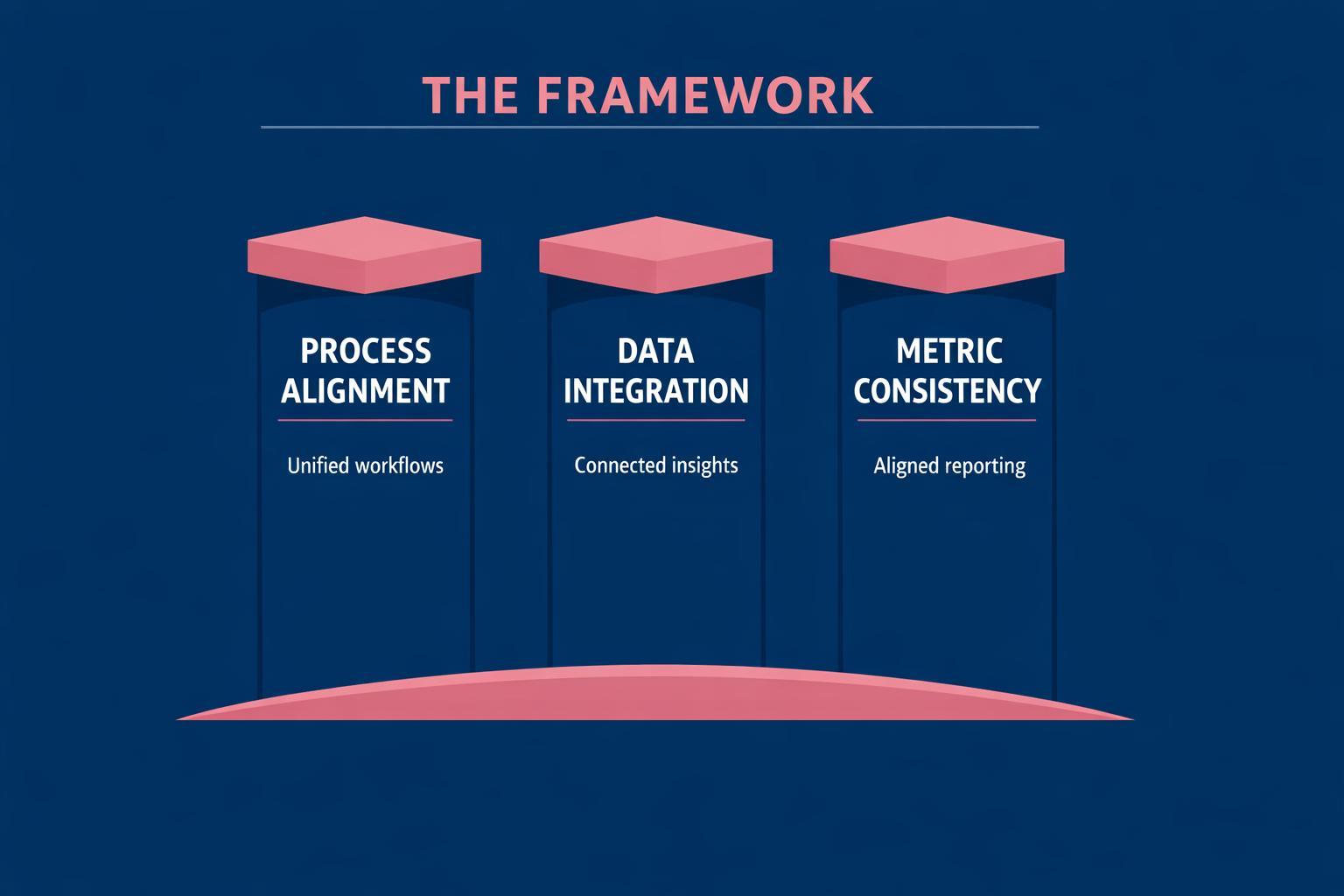
RevOps team structure is how a company organizes revenue operations: which model it uses (centralized, embedded or hybrid), who the head of RevOps reports to, and which roles it hires first. For most B2B companies with 300 or more employees, a hybrid works best: one RevOps leader, shared systems and definitions, and named partners for sales, marketing and customer success.
Structure is only half the job. RevOps alignment means those three functions work from the same definitions, data, stage rules and targets. This guide covers both, plus a 90-day plan and a meeting cadence, and reflects research checked in October 2026.
Last updated: 17 October 2026
What is RevOps alignment?
Revenue operations (RevOps) is the function that runs the systems, data, processes and planning behind the whole revenue engine, instead of one team’s slice of it. When Gartner predicted in May 2021 that 75% of the highest growth companies would deploy a RevOps model by 2025, it described that model as aligning the technology, data and KPIs of sales, marketing and customer success to give an end-to-end view of revenue, and named silos that hand customers off between departments as a barrier to growth.
Alignment is the result that structure is supposed to produce. A revenue team is aligned when it can answer yes to five questions:
- Do marketing, sales and customer success use one written definition for a lead, a qualified opportunity, each deal stage, a lost reason, churn and expansion?
- Is there one system of record, with a named owner for every field that feeds a board-level report?
- Does every handoff (marketing to sales, sales to customer success, customer success back to sales) have a service-level agreement with a response time and an accept or reject reason?
- Do the three functions share at least one target none of them can hit alone, such as pipeline created, win rate or net revenue retention?
- Is there one recurring meeting where conflicts between the functions are settled with data rather than opinion?
How common is misalignment, and does fixing it pay?
Misalignment is the normal state. In Gartner’s B2B Commercial Strategy Survey, published in June 2024, 90% of 412 senior marketing and sales leaders said their functional priorities conflict, and the two functions collaborated on only three of 15 commercial activities. The survey was fielded in November and December 2023.
The evidence that alignment pays is correlational, but it points one way. Forrester reported in February 2023 that firms with high alignment across customer-facing functions saw 2.4 times higher revenue growth and twice the profitability growth of firms without it. Neither source shows that a reorganization alone causes growth. Shared definitions, data and targets do the work, whatever the org chart says.
In the pipeline, misalignment shows up in three places: poor-fit opportunities enter because marketing and sales qualify differently; qualified deals stall mid-cycle because no one owns the next step; and late-stage deals fail on concerns (security review, procurement, a stakeholder nobody met) that surfaced too late. Each leak usually traces back to a definition or a handoff without an owner.
What are the main RevOps team structure models?
There are three models. They differ in where the operations people sit, who sets their priorities, and who owns the definitions.
Centralized RevOps
One team, one leader and one backlog serve sales, marketing and customer success. Definitions, systems and reporting are owned in one place, so there is one version of the numbers. The risk is a queue: functions that feel deprioritized start building their own spreadsheets. That risk is real. In a survey of 180 RevOps professionals in 28 countries by the agency Revenue Wizards (September to November 2024), 45% of teams said they prioritize sales over the other functions.
Embedded (decentralized) operations
Operations people sit inside, and report to, each function: sales ops under the sales leader, marketing ops under the CMO, customer success ops under the customer success leader. They are close to the work and fast. The cost is three versions of the truth. Definitions drift, the same field means different things in different reports, and handoffs fall between teams. This is the structure RevOps was created to replace.
Hybrid: a central team plus embedded partners
A central RevOps team owns systems, data, definitions, planning and cross-functional reporting. Named RevOps partners work with each function day to day, with a solid reporting line to the head of RevOps and a dotted line to the function leader. The partner knows the function’s priorities; the central team keeps everyone on the same rules. It suits companies with several segments, regions or products.
Model
How it works
Best fit
Main strength
Main risk
Sign you have outgrown it
Centralized
One RevOps team and backlog serves all revenue functions
One CRM, one sales motion, a small ops team
One set of definitions and numbers
Queue and bias toward the loudest function
Functions build shadow reports while requests wait
Embedded
Ops people report into sales, marketing and customer success
Rarely the right end state; common before RevOps exists
Speed and closeness to each team
Conflicting definitions and broken handoffs
Leaders argue about whose pipeline number is right
Hybrid
Central systems, data and planning; named partners per function
300+ employees, several segments, regions or products
Shared rules with function-level focus
Partners drift back into their function if the solid line is weak
Partners start keeping their own definitions
Who should RevOps report to?
RevOps should report to the executive who owns the full revenue number, across new business, retention and expansion. Where a chief revenue officer (CRO) owns marketing, sales and customer success targets, that is the CRO. Without a CRO, report to the CEO; a COO or CFO line suits specific situations.
Published data on reporting lines comes from small, self-selected surveys, so treat it as a sketch rather than a market share. In the Revenue Wizards survey (fielded September to November 2024), 38% of RevOps teams reported directly to a CRO, and the author notes that many smaller companies have RevOps report to the CEO.
Reports to
When it fits
What to watch
Safeguard
CRO
The CRO owns marketing, sales and customer success targets
A sales-first backlog if the CRO really only runs sales
Marketing and customer success leaders take part in RevOps prioritization
CEO
No CRO yet, or RevOps also covers product-usage data
CEO time; RevOps becomes a catch-all
A fixed monthly RevOps review on the CEO’s staff agenda
COO
Company-wide process or systems transformation
Distance from live deals
Head of RevOps attends the weekly pipeline review
CFO
Planning, pricing and deal-desk discipline are the priority
A cost-first, reporting-only function
Revenue leaders co-own the RevOps roadmap
The reporting box matters less than three rules. The head of RevOps sits in the revenue leadership meeting. There is one prioritization process for requests from every function. And RevOps is never measured on a single function’s quota. QuotaPath’s guide to RevOps reporting lines (May 2024, updated December 2025) makes a similar point: a CRO line brings revenue focus but can tilt RevOps toward sales at the expense of marketing and customer success.
What roles does a RevOps team need?
RevOps work falls into six jobs. A small team combines several in one person; a large one gives each its own role. Hire in the order the work hurts.
Role
Owns
Typical outputs
Usually added when
Head of RevOps (or first RevOps lead)
Roadmap, definitions, prioritization, executive reporting
Revenue glossary, meeting cadence, planning inputs
First hire; often a generalist who also builds
GTM systems / CRM administrator
CRM configuration, integrations, tool stack, access
Stage fields, validation rules, lead routing, integrations
Change requests wait weeks, or several tools write to the CRM
Revenue analyst
Dashboards, funnel and cohort analysis, forecast inputs
One funnel dashboard, conversion and win-loss analysis
Leaders dispute whose numbers are right
GTM planning
Territories, quotas, capacity, compensation inputs
Capacity model, territory and quota plan
Headcount growth makes annual planning a spreadsheet crisis
Deal desk
Pricing approvals, non-standard terms, quotes
Discount policy, approval matrix, quote templates
Discounts and custom terms slow late-stage deals
Enablement operations (shared with enablement)
Content and training systems, adoption and usage data
Content usage reports, onboarding operations
No one can say which content and training sellers actually use
How to size a RevOps team
There is no reliable published benchmark for RevOps headcount per seller; ratios that circulate online rarely name a study. What surveys do show is that many teams are tiny: 23% of respondents in the Revenue Wizards survey (late 2024) worked solo, and teams in the survey used an average of 11 tools. Size the team from workload instead:
- Count recurring requests per month by type (reports, field changes, routing, quotes, planning) and how long each takes.
- List every system that writes to the CRM and who maintains it.
- Add the fixed cycles: weekly forecast, monthly funnel review, quarterly planning, annual territories and quotas.
- Hire the role whose backlog is oldest, in the order in the table above: lead, systems, analyst, then planning and deal desk.
Whatever the size, one person must be accountable for the definitions and the backlog. A function where “everyone owns alignment” has no owner.
How do you align sales, marketing and customer success through RevOps?
Alignment is built from six pieces of shared infrastructure. Each has an owner in RevOps and a written output.
1. Write one revenue glossary
Start with the terms that cause arguments. In Gartner’s survey of more than 200 sales leaders, published in March 2023, 62% said their sales and marketing functions define qualified leads differently. Write each definition once, name who can change it, and log every change.
Term
Example rule to write down
Agreed by
Marketing-qualified lead
Fit criteria plus the behavior that triggers handoff
Marketing and sales
Sales-accepted lead
Accepted or rejected within an agreed time, with a reason from a fixed list
Sales and marketing
Opportunity
Created only when a buyer has agreed a next meeting on a defined problem
Sales and RevOps
Stage exit criteria
Buyer evidence required to move a deal forward
Sales and RevOps
Closed-lost reason
A short picklist with a definition for each reason, including no decision
Sales, product marketing and RevOps
Churn and expansion
What counts as churn, contraction and expansion, and when it is booked
Customer success, finance and RevOps
Loss reasons show why definitions matter. In Revspire’s B2B SaaS win rate and sales cycle benchmark (about 40 B2B companies, October 2025 to September 2026), only 10% of closed-lost deals carried a no-decision or status-quo reason in the CRM. The benchmark treats that as a floor, because sellers tend to record a competitor or price instead. If no one defines “no decision”, the CRM cannot report it.
2. Define deal stages by buyer evidence
Each stage needs an exit criterion the buyer can confirm (a meeting held, a problem agreed, a business case reviewed), an owner, and an expected next action. Add a coverage rule from the second stage onward: map the buying committee, name who covers each stakeholder, and flag any deal with only one active contact. Then review conversion and time in stage by segment, rep and deal size, so a stalled stage shows up as a pattern rather than an anecdote.
3. Put a service-level agreement on every handoff
- Marketing to sales: a response time for new leads, and an accept or reject decision with a reason. Rejected reasons go back to marketing every month.
- Sales to customer success: a handoff packet completed before kickoff: why the customer bought, agreed success criteria, stakeholders and their roles, commitments made in the deal, and the implementation plan. Our guide to the sales to customer success handoff covers what to include.
- Customer success to sales: expansion and risk signals, routed to a named seller with a response time.
4. Share targets and one dashboard
Give marketing, sales and customer success at least one shared target, and report it from one dashboard that everyone uses. The same March 2023 Gartner release said sales organizations that align cross-functional KPIs are nearly three times more likely to exceed new customer acquisition targets. Good shared metrics include pipeline created by source, stage conversion, win rate, sales cycle length and net revenue retention; our guide to RevOps metrics and KPIs defines them.
5. Keep one system of record with named data owners
Few RevOps teams trust their data. On its 2025 State of RevOps survey page (January 2025), Openprise reports that only 11% of RevOps teams have excellent data, while 42% call theirs “good enough”. Name an owner for every field that feeds a shared report, decide which system wins when two disagree, and retire fields nobody uses. Gartner’s May 2021 release also advised inventorying sales, marketing and service tools and removing redundant enablement technology.
6. Connect content and enablement to the stages
Marketing creates content and enablement trains on it, but no one may measure which content sellers use at which stage. Gartner’s June 2024 release recommended gathering sales input early when building content and tools, and found that only 17% of functional leaders collaborate on buyer journey mapping. In Revspire’s content-to-revenue benchmark (October 2025 to September 2026), 35% of active sales assets had no shares and no opens in 90 days, and deals that followed a playbook with its recommended assets were won 36.9% of the time against 30% without one. That is an observed pattern, not proof of cause, but it gives marketing, enablement and RevOps one usage signal to review together. A governed library such as Revspire Content Hub reports asset usage and content gaps and recommends content inside the CRM.
RevOps vs SalesOps: what is the difference?
Sales operations (SalesOps) runs the processes, systems and data behind the sales team: CRM set-up for sellers, territory and quota inputs, the sales forecast and sales reporting. Revenue operations (RevOps) does that job across the whole revenue lifecycle, so it also owns how marketing, sales and customer success share definitions, data, handoffs and targets. SalesOps improves one function; RevOps improves the path from first touch to renewal.
Dimension
SalesOps
RevOps
Scope
New-business selling, from accepted lead or opportunity to closed-won
The full revenue lifecycle: marketing, sales, customer success, renewal and expansion
Usual reporting line
The head of sales (VP Sales or sales director)
The executive who owns the full revenue number: usually the CRO, or the CEO where there is no CRO (see the reporting-line table above)
Typical responsibilities
Sales CRM fields and views, territory and quota inputs, the forecast call process, commission data, pipeline and rep reporting, and often the deal desk in smaller teams
The revenue glossary and stage rules, CRM and GTM system architecture, lead routing and handoff SLAs, full-funnel reporting, the forecast method, planning and capacity, and the renewal and expansion process
Data it owns
Opportunity, quota, territory and commission data
The shared revenue data model: leads, accounts, opportunities, contracts and, where available, product usage
Measured on
Sales productivity and forecast reliability: quota attainment spread, pipeline coverage, cycle length, forecast accuracy
End-to-end revenue performance: pipeline created by source, conversion across handoffs, forecast accuracy, CAC payback, net revenue retention
Main risk
Definitions and reports that differ from marketing’s and customer success’s
A central queue that feels slow to each function, or a RevOps title on what is still a sales-only team
Responsibilities vary by company; the split that matters is one function versus the whole lifecycle.
The KPIs in the “measured on” row, including forecast accuracy and CAC payback, are defined with formulas in our B2B sales metrics and RevOps KPIs guide.
Do you need both RevOps and SalesOps?
Most companies past a single sales motion need both kinds of work, but not two independent teams. The real choice is where sales operations sits:
- SalesOps only. Works while sales is the only revenue function with real operations needs: one sales motion, a modest flow of marketing leads, and renewals handled by the account executive. It stops working once a second operations team appears and starts keeping its own numbers.
- RevOps with SalesOps as a partner role. The usual end state once marketing ops and customer success ops exist. SalesOps keeps its day-to-day work with sales managers (forecast calls, territory changes, rep reporting) but has a solid line to the head of RevOps, so definitions and the data model stay shared. This is the hybrid model described above.
- RevOps beside an independent SalesOps team. Rarely a good idea. Two teams that both change CRM fields and both publish forecast reports produce the conflicting numbers RevOps exists to remove. If it cannot be avoided for a while, for example after an acquisition, give RevOps written ownership of definitions and the data model, and let SalesOps own sales-only processes.
Signs it is time to move from SalesOps to RevOps
- Marketing, sales and customer success report different pipeline, bookings or churn numbers for the same period.
- Leads, onboarding handoffs or expansion signals regularly fall between teams, and nobody owns the gap.
- More than one team changes CRM fields, routing rules or integrations.
- The CRO now owns retention and expansion targets, but operations support stops at closed-won.
- The board wants a full-funnel view, from pipeline by source to net revenue retention, that no single ops team can produce.
The move does not have to start with a reorganization. Give the current SalesOps lead written ownership of the revenue glossary and the CRM data model across all three functions, add a marketing or customer success partner when the backlog calls for one, and change the title once the scope has changed. Forecasting is usually the first process to move, because the forecast has to include renewals and expansion as well as new business; our sales forecast methodology guide covers how to build it.
RevOps vs sales ops, marketing ops and enablement: who owns what?
In a hybrid model, sales ops, marketing ops and customer success ops become RevOps partners rather than separate teams, and enablement stays a peer function that RevOps supports with data. For a fuller comparison of the two roles, see RevOps vs sales ops.
Work
Central RevOps
Function partner (sales, marketing or CS ops)
Enablement
Definitions and stage rules
Owns and publishes
Proposes changes
Trains sellers on them
CRM and integrations
Owns architecture and data model
Requests and tests changes
Consulted on seller workflow
Lead scoring and routing
Owns rules and SLA reporting
Marketing ops runs campaigns and scoring inputs
None
Forecast method and reporting
Owns method and accuracy reporting
Sales ops supports managers’ calls
Coaches deal inspection skills
Territories, quotas, capacity
Owns the model with finance
Gives function input
Plans ramp and onboarding
Content and training
Provides usage and outcome data
Marketing ops runs content systems
Owns programs and certification
Renewal and expansion process
Owns stages and reporting
CS ops runs health scoring and playbooks
Trains customer success managers
How do you run a 90-day RevOps alignment plan?
Whether you are creating RevOps or restructuring it, start with evidence, decide a small number of changes, then run them through a fixed review.
Days 1-30: audit
- Pull the last six months of closed and open opportunities. Map where deals leave the pipeline by stage, segment, rep and deal size, and compare the result with the story each leader tells.
- Collect every function’s written (or unwritten) definitions of lead, opportunity, stages, loss reasons and churn. Note each conflict.
- List every tool, who owns it, and what it writes to the CRM.
- Measure each handoff: lead response time, accept and reject rates, and how often customer success receives a complete handoff packet.
Days 31-60: decide
- Choose the structure model and reporting line, and name the head of RevOps and the function partners.
- Publish version one of the revenue glossary and stage exit criteria.
- Agree the three handoff SLAs.
- Pick two or three fixes from the audit. Give each an owner, a metric, a baseline and a review date 90 days out.
Days 61-90: run
- Ship one funnel dashboard built on the new definitions, and retire duplicate reports.
- Start the cadence below and hold the first quarterly review.
- Log every definition change and every disputed number, and resolve each by changing the glossary or the data, not by debate.
To judge maturity before and after, the RevOps maturity model guide gives stage-by-stage criteria.
What meeting cadence keeps revenue teams aligned?
Cadence
Who attends
Inputs
Decisions
Weekly pipeline review
Sales leaders, managers, RevOps
Stage movement, single-threaded deals, stalled deals
What must change in the next seven days, deal by deal
Monthly funnel and SLA review
Marketing, sales, customer success leaders, RevOps
Conversion by stage and source, SLA results, rejected-lead reasons
Fixes to routing, scoring, content or handoffs
Quarterly revenue review
CRO, function heads, finance, RevOps
Win-loss findings, shared targets, glossary change log
Definition changes, priorities for the next quarter
Annual planning
Executive team, finance, RevOps
Capacity model, retention and expansion data
Territories, quotas, headcount, RevOps roadmap
Worked example: from three ops teams to one RevOps function
This is a hypothetical scenario, not a customer result. A 450-person B2B software company has sales ops under the VP of Sales, marketing ops under the CMO and a customer success ops analyst under the VP of Customer Success. Sales does not recognize marketing’s pipeline number, and customer success hears what was promised only at kickoff.
- Structure. A head of RevOps reports to the CRO, who owns new business and retention. Systems, analytics and planning move to a central team; marketing ops and customer success ops become partners with a solid line to RevOps and a dotted line to their old leaders.
- Glossary. Version one defines lead, accepted lead, opportunity, five stages, eight loss reasons, churn and expansion, so the pipeline dispute becomes a definition question with one answer.
- Handoffs. Sales must accept or reject each lead with a reason; customer success receives a handoff packet before kickoff; expansion signals route to the account owner.
- Shared target. Marketing and sales share pipeline created; sales and customer success share net revenue retention. Both sit on one dashboard.
- Review. At the first quarterly review, the team compares stage conversion and cycle length with its six-month baseline and keeps, changes or drops each fix.
Before that first review, compare your own win rate and cycle length by deal size with the B2B SaaS win rate and sales cycle benchmark, so your baseline has an outside reference point.
Frequently asked questions
What does a RevOps team do?
A RevOps team runs the systems, data, processes and planning behind marketing, sales and customer success. It owns the CRM and connected tools, shared definitions and stage rules, revenue reporting, the forecasting method, and inputs to territories and quotas, so the whole revenue team works from one version of the numbers.
Should RevOps report to the CRO, CEO or CFO?
RevOps should report to the executive who owns the full revenue number: the CRO, when the CRO owns new business, retention and expansion. Without a CRO, report to the CEO. A CFO line suits a company whose priority is planning and pricing discipline, and a COO line suits a company-wide transformation. Whatever the line, the head of RevOps should sit in the revenue leadership meeting.
How big should a RevOps team be?
There is no reliable published ratio of RevOps staff to sellers, so size the team from workload: recurring requests, systems to maintain and planning cycles. Many teams start with one person; 23% of respondents in a late-2024 Revenue Wizards survey worked solo. Add a systems administrator, then an analyst, then planning and deal desk roles as the backlog grows.
What is the difference between RevOps and sales ops?
Sales ops supports the sales team: its CRM views, territories, quotas and forecast. RevOps covers the whole revenue lifecycle, so it also owns how marketing, sales and customer success share definitions, data and handoffs. In a hybrid structure, sales ops can become the RevOps partner role for the sales team.
When should a company create a RevOps function?
Create one when separate ops teams start producing conflicting numbers, when handoffs between marketing, sales and customer success regularly fail, or when the tool stack has grown past what one function can manage. A practical first step is a single RevOps lead who owns the revenue glossary and the CRM, before any reorganization.
Is sales ops part of RevOps?
In a hybrid RevOps model, yes: sales operations becomes the RevOps partner for the sales team. It still works day to day with sales managers, but it follows the definitions, data model and prioritization process that RevOps owns. In a company without RevOps, sales ops is a standalone team that usually reports to the head of sales.
Do you need both RevOps and sales ops?
You need both kinds of work, but usually not two independent teams. Once marketing ops or customer success ops exist, fold sales ops into RevOps as a partner role with a solid line to the head of RevOps. Two separate teams that both own CRM fields and forecast reports tend to produce competing numbers.
Sources
- Gartner Predicts 75% of the Highest Growth Companies in the World Will Deploy a RevOps Model by 2025, Gartner, 17 May 2021. Accessed 16 October 2026.
- Gartner Survey Finds Aligning Commercial Functions as Sales Leaders’ Top Priority for 2023, Gartner, 7 March 2023. Accessed 16 October 2026.
- Gartner Survey Reveals Marketing and Sales Functions Collaborate on Only Three Out of 15 Commercial Activities, Gartner, 4 June 2024. Accessed 16 October 2026.
- Forrester: Aligning Around The Customer Will Turbocharge Companies’ Growth Engines, Forrester, 21 February 2023. Accessed 16 October 2026.
- RevOps in 2025: Here’s What We Learned from 180 Global Leaders, Revenue Wizards (survey fielded September to November 2024; post undated). Accessed 16 October 2026.
- 2025 State of RevOps Survey: Data quality’s impact on GTM execution, Openprise, 29 January 2025. Accessed 16 October 2026.
- Who Should RevOps Report To?, QuotaPath (Kelly O’Halloran), 14 May 2024, updated 31 December 2025. Accessed 16 October 2026.
- B2B SaaS Win Rate and Sales Cycle Benchmark (2026), Revspire, 16 October 2026 (data October 2025 to September 2026). Accessed 16 October 2026.
- Sales Content Benchmark: Usage and Win Rates 2026, Revspire, 2026 (data October 2025 to September 2026). Accessed 16 October 2026.