Renewal Management: Process, Checklist and Retention Strategies
A practical perspective for connecting this idea to your revenue team’s next move.
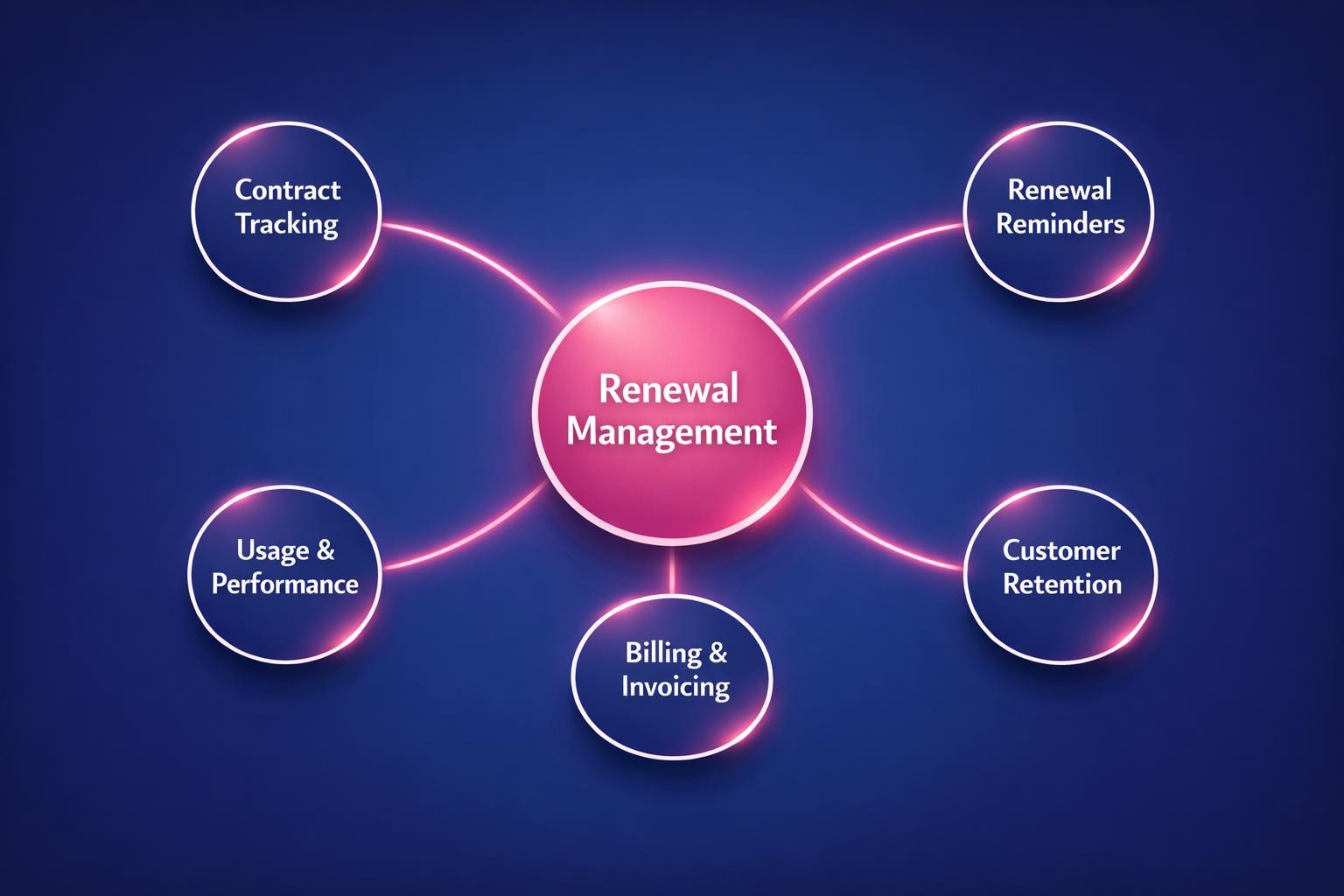
Renewal management is the process of securing each customer’s contract renewal before it falls due: tracking every renewal date, reviewing risk about 120 days out, proving value in a business review, negotiating terms and getting signatures before the deadline. Customer retention strategies make that renewal easy by getting customers to value quickly and catching risk early.
This guide gives a renewal timeline you can run, a risk review, how to handle renewal negotiation and multi-year terms, eight retention strategies, and a renewal checklist. For scoring account health and growing accounts after renewal, see our separate guides linked below.
Last updated: 17 October 2026
Why renewal management deserves its own process
A renewal is a new buying decision made by people who now know your product’s flaws. Gartner’s survey of 1,503 B2B technology buyers involved in renewing or expanding as-a-service agreements (February to March 2023, organisations with at least $50 million in revenue) found that 60% regret nearly every purchase they make, up 6% from 2020. Gartner attributes most of that regret to buying with distributed teams and funding, not to the provider, and recommends spotting regret signals early, giving buyers enablement content, and using shared workspaces to review objectives and build the business case (Gartner, 14 June 2023).
Retention also sets the ceiling on growth. SaaS Capital’s 2025 survey of more than 1,000 private B2B SaaS companies put median net revenue retention at 101% and median gross revenue retention at 91%, meaning the typical company loses about 9% of recurring revenue a year before any upsell (SaaS Capital, 2025 B2B SaaS Retention Benchmarks). SaaS Capital also reports that companies with net retention of at least 110% grew faster than the survey median, and those below 100% grew slower (SaaS Capital, 18 September 2025). How to calculate and improve those metrics is covered in our net revenue retention guide.
What is the renewal management process? A 120-day timeline
Start the formal renewal process about 120 days before the renewal date for a typical annual contract, and 180 days or more for large, multi-year or heavily procured accounts. Work back from the real deadline: if the contract requires 60 days’ notice to cancel or change terms, the date that matters is 60 days before renewal, not the renewal date itself.
180 days or more out: large and strategic accounts
- Confirm the executive sponsor is still in role and still cares about the original goal.
- Note the customer’s budget cycle; if budgets are set in Q3 for a Q1 renewal, the real decision happens months before the paperwork.
- Decide whether you will propose a multi-year term, a scope change or an expansion with the renewal.
120 days out: renewal risk review
- Assign a single renewal owner and record the renewal date, notice deadline, current contract value and proposed value in the CRM.
- Score the risk using the review in the next section, and agree a save plan for anything rated medium or high.
- Check the contract for automatic renewal and notice clauses. Some jurisdictions regulate them even between businesses: New York’s General Obligations Law section 5-903 makes an automatic renewal clause in a contract for service, maintenance or repair to or for real or personal property unenforceable against the customer unless the provider gives written notice, by personal service or certified mail, 15 to 30 days before the customer’s cancellation deadline (New York State Senate, text revised 22 September 2014). Whether that covers a given software contract is a question for your counsel.
90 days out: value review with the decision-makers
- Run a business review with the economic buyer, not only the day-to-day admin (the format is below).
- Share a written renewal plan with dated steps: proposal, procurement, security questionnaire, legal review, signature.
- Ask directly: “Is there anything that would stop you renewing on the current scope?”
60 days out: proposal and negotiation
- Send the renewal proposal with options, such as a one-year renewal at the new price and a multi-year term with price protection.
- Start procurement, security and legal steps now; they are the steps most likely to slip. In Revspire’s mutual action plan benchmark, security and legal review was the milestone most often overdue, in 34% of plans (aggregated Revspire customer data). Renewals usually involve the same security and legal steps.
30 days out to renewal date: signature
- Chase the signature and the purchase order; escalate blockers to your executive sponsor and theirs.
- If the customer will not renew on time, agree in writing on a short extension rather than letting service lapse by accident.
After renewal: reset the success plan
- Within 30 days of signature, agree the goals for the next term and when you will next review them.
- Hold a short internal review: what slipped, what nearly lost the renewal, and what to change in the process.
How do you run a renewal risk review?
A renewal risk review is a short, evidence-based check of whether the customer will renew, at what value, and what could stop it. Do it at 120 days and again at 60. Score each signal, then assign a play to anything that is not green.
Signal
What to check
If it is red, do this
Champion or sponsor change
Has your main contact or executive sponsor left, changed role or gone quiet?
Meet the replacement within two weeks and re-sell the original business case
Usage and adoption
Is active use flat or falling, or concentrated in one team?
Run a targeted adoption plan for the teams that stalled, with dated goals
Value evidence
Can the customer name a result they got, in their own numbers?
Build the value summary with them before the business review, not in it
Stakeholder coverage
How many people at the customer could argue for renewal?
Add contacts in finance, IT and the user teams; avoid a single-threaded account
Open issues
Unresolved support escalations, missed commitments or roadmap promises
Close or give a dated plan for each before the proposal goes out
Commercial pressure
Budget cuts, a merger, a procurement mandate to cut vendors, or a price increase they have not budgeted
Prepare options (scope, term, ramp) and bring finance in early
Competitive activity
Is a competitor or an internal tool being evaluated?
Ask directly, then show the switching cost and what they would lose
Use the same signals in your customer health score so risk is visible long before the 120-day mark.
Most of these signals belong in a customer health score that you track all year. Our guide to the customer health score covers how to build and weight one; this review is the point where the score becomes a renewal decision.
How should you run a QBR before a renewal?
A quarterly business review (QBR), or executive business review for larger accounts, is a meeting where you and the customer compare results against the goals they bought for and agree what happens next. Before a renewal, it is your strongest argument, so it should be about the customer’s outcomes, not your feature list.
- Goals they set: restate the two or three outcomes from the original business case, in their words.
- Results so far: show progress in the customer’s own metrics. If you do not have the numbers, ask for them before the meeting.
- What did not work: name the gaps yourself and give a plan for each. Customers trust a vendor that raises problems first.
- Next term: propose the goals for the next 12 months and what each side will do.
- Renewal steps: walk through the dated renewal plan and confirm who signs.
Send the agenda a week ahead to the economic buyer as well as your daily contact. If the economic buyer will not attend a renewal QBR, treat it as a risk signal, not a scheduling problem.
How do you negotiate a renewal?
Negotiate a renewal from the value delivered, with options prepared in advance, and trade every concession for something in return. Expect procurement to push on price: Vertice, a SaaS purchasing platform, reported SaaS inflation of 16.4% in June 2026, the highest monthly rate it has recorded, based on more than $75 billion of spend it processed (Vertice, updated July 2026). Buyers who see increases like that across their software stack arrive at your renewal with benchmarks and a mandate to hold costs.
- Lead with results: the business review should already have established what the customer gained, so the price conversation starts from value rather than from your list price.
- Explain any increase: tie it to added scope, usage or capability, and give notice early; a surprise uplift at 30 days out invites a competitive evaluation.
- Prepare give-gets: a discount or price cap in exchange for a longer term, earlier signature, a case study, a reference call or a broader rollout.
- Offer options, not a single number: for example, a one-year renewal at the new price, a multi-year term with a capped annual increase, or a reduced scope for a customer who over-bought.
- Know your walk-away: agree internally the lowest acceptable outcome before the first call.
Our AI sales role-play scenarios include renewal conversations, such as a customer asking for a discount, that account managers can rehearse before the real call.
Should you offer a multi-year renewal?
Offer a multi-year term when the customer is getting clear value and expects to keep growing with you; avoid pushing one on an unhappy customer, because a locked-in, dissatisfied customer becomes a certain churn later.
Multi-year renewal
For you (vendor)
For the customer
Main benefit
Revenue certainty and fewer renewal cycles to run
Price protection and a predictable budget
Typical trade
A discount, a cap on annual increases or a price lock
A longer commitment, sometimes with upfront or annual prepayment
Main risk
Less room to reprice if your costs or product change
Being locked in if needs change or the product stops fitting
Make it fair with
Annual business reviews written into the agreement
Agreed terms for adding or removing scope during the term
Customer retention strategies that make renewals easier
The best customer retention strategies start at the sale, not at the renewal: set measurable goals, get customers to first value fast, and keep more than one person invested. These eight work for B2B subscription businesses.
1. Start retention in the sales handoff
Write down the customer’s goals, success metrics and stakeholders before the contract is signed, and pass them to the team that owns the account. A renewal is much harder when nobody can say what the customer bought the product to achieve. Pass the same context on at every later handover, from onboarding to support to a new CSM, so the customer never has to explain their goals twice.
2. Get to first value quickly with a success plan
Agree an onboarding plan with dated milestones and a first result the customer can see, such as the first team live or the first report used in a meeting. Track it like a deal: owners, dates, and an escalation when it slips. After kick-off, keep adoption moving with short, role-specific learning, such as a two-minute video or a one-page guide when a feature the customer needs is released, rather than one long training session.
3. Agree how value will be measured, then report it
Pick two or three outcomes the customer already measures and set a baseline at kick-off. Report against them every quarter so the value case for renewal writes itself.
4. Watch health signals and act on them
Track usage, support issues, sentiment and stakeholder changes continuously, and decide in advance what each warning triggers. Early warnings are often small: a champion who stops logging in, or product update emails nobody opens. Positive signals count too, such as your business review deck being forwarded inside the customer. A health score nobody acts on is a dashboard, not a retention strategy.
5. Multithread every account
Build relationships with the executive sponsor, finance, IT and the user teams as well as your champion. If your champion leaves and nobody else knows the value, a healthy account can become at risk overnight.
6. Run business reviews about outcomes
Hold reviews quarterly for key accounts and at least twice a year for the rest, using the QBR format above. Invite the economic buyer every time, not just before the renewal.
7. Close the feedback loop
Log product feedback and feature requests, tell customers what happened to them, and flag churn reasons to product and sales leadership.
8. Make renewal paperwork easy
Give the customer one place with the renewal proposal, the value summary, security documents and the dated renewal plan, so the champion can forward it to finance and procurement without rebuilding your case. That is the shared-workspace approach Gartner recommends; a digital sales room with a mutual action plan can serve as the renewal room. Better still, keep one workspace for the life of the account, so the original business case, success plan and review history are already there when the renewal comes round.
Who should own the renewal?
Give every renewal one named owner, with clear support roles, so nothing falls between customer success and sales. ChurnZero’s 2024 Customer Success Leadership Study of more than 1,000 CS leaders found that most customer success teams own renewals, about 40% have owned expansion over the last five years, and account management’s share of expansion ownership rose from 20% to 29% since 2022 (ChurnZero, 8 October 2024, updated 11 July 2025).
Task
Customer success manager
Account manager or AE
Sales or revenue leadership
Health tracking and risk review
Owns
Contributes
Reviews monthly
Business review (QBR or EBR)
Owns
Joins for commercial topics
Joins for strategic accounts
Renewal proposal and negotiation
Owns where CS carries the renewal number; otherwise supports
Owns where AM carries the number
Approves discounts and non-standard terms
Expansion during renewal
Identifies
Owns
Approves
Forecast
Commits renewal likelihood
Commits expansion
Owns the roll-up
Expansion has its own motion; our customer expansion strategy guide covers it.
Renewal checklist
Use this renewal checklist for every contract. Adjust the timing to the customer’s notice period and procurement process.
When
Checklist item
Owner
Done when
At signature
Renewal date, notice deadline and auto-renewal terms recorded in the CRM
Sales ops or RevOps
Fields filled and a 120-day task created
Kick-off
Success plan with goals, baseline metrics and stakeholders
CSM
Customer has confirmed the plan in writing
Every quarter
Health score reviewed and business review held
CSM
Notes and next steps logged
180 days (large accounts)
Executive sponsor confirmed; budget cycle known; term strategy decided
CSM and AM
Account plan updated
120 days
Renewal risk review; save plan for medium or high risk
Renewal owner
Risk rating and plan in the CRM
120 days
Contract checked for notice periods and any legally required renewal notices
Renewal owner with legal
Notice dates on the calendar
90 days
Value review with the economic buyer
CSM
Value summary agreed by the customer
90 days
Dated renewal plan shared with the customer
Renewal owner
Customer has accepted the steps and dates
60 days
Proposal with options sent; procurement, security and legal started
Renewal owner
All reviews in progress with dates
30 days
Signature and purchase order; blockers escalated
Renewal owner and leadership
Signed contract and PO received
Within 30 days after
Next-term success plan; internal lessons review
CSM
New goals agreed with the customer
To turn the 90-day step into a document the customer co-owns, start from our mutual action plan template and replace the sales milestones with renewal ones: value review, proposal, security, legal, signature.
Choosing a platform to run renewals? Customer success platforms with health scores, renewal risk and playbooks are compared in our guide to the best customer success software.
Frequently asked questions
What is renewal management?
Renewal management is the process of tracking, forecasting and securing customer contract renewals before they fall due. It covers the renewal calendar, risk reviews, business reviews, renewal proposals and negotiation, and the paperwork through to signature.
When should the renewal process start?
Start about 120 days before the renewal date for a typical annual contract, and 180 days or more for large or multi-year accounts. If the contract has a notice period, count back from the notice deadline rather than the renewal date.
What are the best customer retention strategies for B2B SaaS?
Set measurable goals at the sale, get customers to first value quickly, report value against their own metrics, act on health signals, build relationships beyond one champion, run outcome-focused business reviews and close the feedback loop. Each one makes the renewal conversation shorter.
What is a good gross revenue retention rate?
SaaS Capital’s 2025 survey of more than 1,000 private B2B SaaS companies found a median gross revenue retention of 91% and a median net revenue retention of 101%. Compare yourself with companies at a similar contract value, which SaaS Capital recommends over comparing by age or industry.
Should you offer a discount for a multi-year renewal?
A discount or a cap on annual increases is a reasonable trade for a longer commitment or prepayment, as long as you get something in return. Avoid using a multi-year discount to rescue an unhappy customer; fix the value problem first.
Sources
- Gartner Survey Reveals 60% of Technology Buyers Involved in Renewal Decisions Regret Nearly Every Purchase They Make, Gartner, 14 June 2023 (accessed 17 October 2026)
- 2025 B2B SaaS Retention Benchmarks (Research Brief 32), SaaS Capital, 2025 (accessed 17 October 2026)
- What is a Good Retention Rate for a Private SaaS Company in 2025?, SaaS Capital, 18 September 2025 (accessed 17 October 2026)
- New York General Obligations Law section 5-903, New York State Senate, text revised 22 September 2014 (accessed 17 October 2026)
- SaaS inflation rate, Vertice, updated July 2026 (accessed 17 October 2026)
- Three 2024 Customer Success Leadership Study key findings, ChurnZero, 8 October 2024, updated 11 July 2025 (accessed 17 October 2026)
- Mutual action plan benchmark, Revspire, aggregated customer data (accessed 17 October 2026)