Revspire blog
Upselling vs. Cross-Selling: A Practical Guide for Revenue Teams
Learn when to upsell versus cross-sell, which customer-lifecycle signals to use, how to assign ownership, and how to review expansion opportunities.
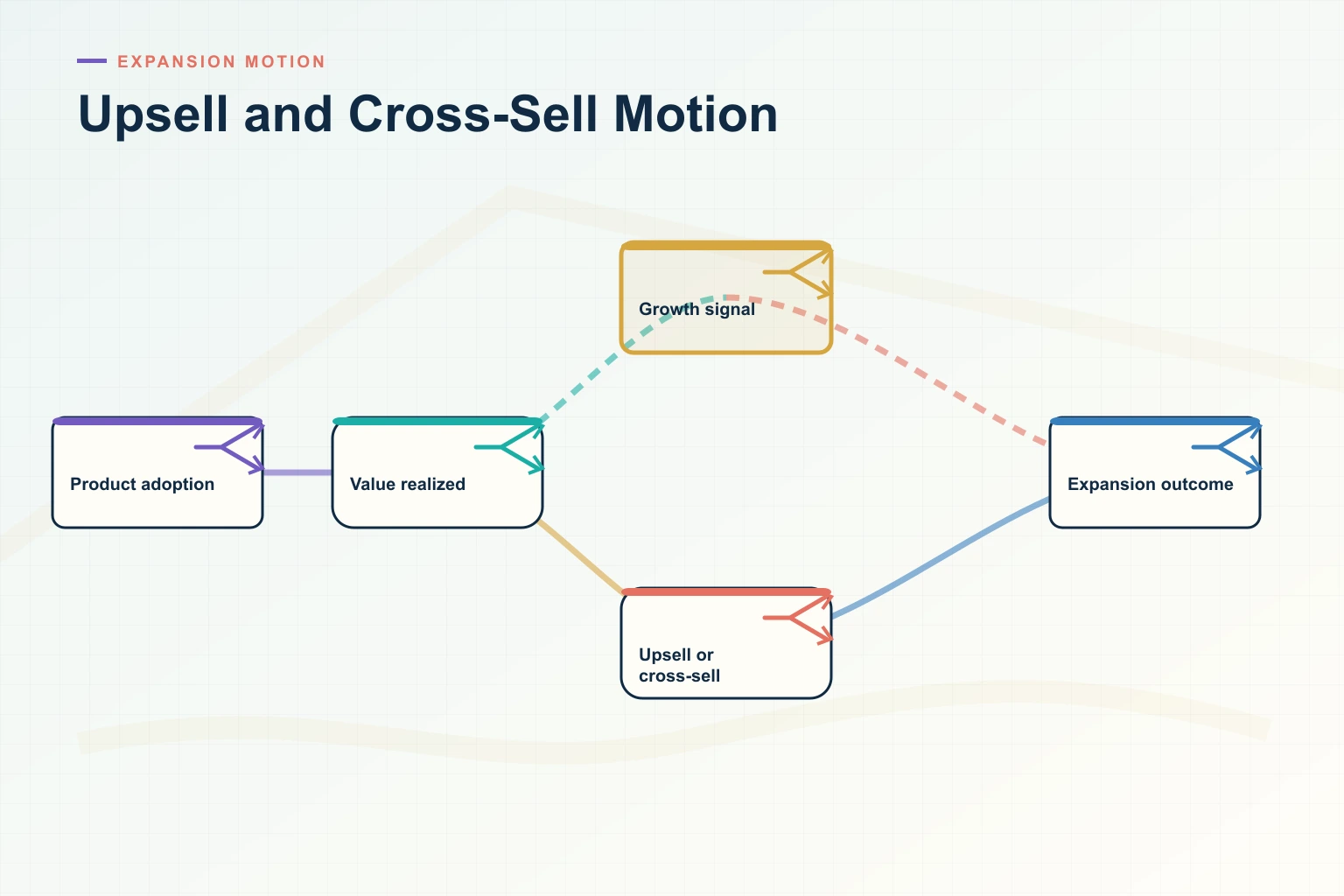
Upselling and cross-selling are related expansion motions, but they answer different customer needs. An upsell moves a customer to a more expensive version of the product, based on the additional value and return it can provide. A cross-sell adds a complementary product or service that addresses an adjacent need. Both should begin with customer value and evidence, not a generic request to spend more.
Salesforce’s cross-selling guide makes the same distinction and cautions against pitching an irrelevant offer or approaching an unhappy customer at the wrong time. A durable motion therefore needs clear ownership, customer-lifecycle signals, documented qualification, and a feedback loop from results.
Define when to upsell and when to cross-sell
Three-part explainer: Define the system, Operationalize the workflow, and Measure the impact.
Use an upsell for deeper value from the current product
Consider an upsell when the customer’s existing product is working and the customer needs more capacity, broader access, a higher service level, or capabilities available in a more advanced version. The commercial conversation should connect the larger commitment with a specific customer outcome rather than presenting the higher tier as an automatic next step.
Use a cross-sell for an adjacent need
Consider a cross-sell when discovery reveals a separate but related problem that another product or service can solve. The new offer should complement the original purchase. For example, a customer using a core platform may need an adjacent workflow, service, or integration that removes a problem discovered after adoption. Relevance matters more than the size of the catalog.
Do not force the motion
If adoption is weak, an unresolved service issue exists, or the proposed offer does not match a stated need, resolve that condition before pitching expansion. Periodic customer conversations and open-ended questions help determine whether the timing is appropriate.
Audit the current expansion motion
Establish a baseline from the last six months of opportunity data. Separate upsell and cross-sell opportunities so the team can see whether the two motions behave differently. Map opportunities against the stages used by the team, identify where they fall out, and review the pattern by representative, customer segment, and deal size.
Compare the data with the narrative used in account and pipeline reviews. Select two or three improvements with a clear connection to customer or revenue outcomes, assign an owner and measurable goal, and set a 90-day review. A focused cycle is easier to evaluate than changing qualification, messaging, process, and systems at once.
Turn customer-lifecycle signals into qualification
Listen after the initial sale
Continue the conversation after purchase and ask how adoption is progressing. Customer feedback can reveal an unmet need, a new use case, or a constraint in the current setup. These are discovery inputs, not automatic sales triggers. Confirm the problem and the customer’s desired outcome before matching an offer.
Recognize useful signals
Relevant communication cues can include a request for more capacity, interest in a higher tier, questions about another capability, or engagement with relevant pricing or product content. A periodic customer conversation may also surface an adjacent need. Use the signal to begin discovery; do not treat it as consent to pitch.
Apply explicit entry and exit criteria
Before creating an expansion opportunity, record whether the current product is delivering value, which need has been confirmed, whether the offer is an upsell or cross-sell, who owns the customer decision, and what evidence supports the timing. At each stage, specify the required action and evidence for advancement. This converts broad interest into a reviewable motion.
Make ownership explicit across the lifecycle
Assign one leader to the overall expansion motion. That owner sets goals, defines measures, maintains the process, and coordinates quarterly improvements. For each customer opportunity, also record the person accountable for discovery, the next action, and the decision to advance or close the opportunity.
A practical responsibility map can identify who captures adoption and service signals, who validates the customer need, who confirms product fit, who owns the commercial conversation, and who maintains CRM stages and reporting. The exact job titles will vary. What matters is that each action, stage, and handoff has one visible owner rather than being left to a general team.
Document and teach the process, then embed it where account teams work. Connected CRM, engagement, and deal-room data should reduce manual handoffs and preserve a current view. Teams evaluating that workflow can explore Revspire Customer Intelligence.
Review expansion opportunities with evidence
Add upsell and cross-sell health to the weekly operating rhythm. Use the review to decide what should happen during the next seven days, not merely to report activity. Inspect customer engagement, product or content signals, stage progression, stakeholder coverage, and the agreed next action.
Coach from live opportunities. When the account story and observed evidence disagree, investigate the difference. Email, call, and task totals do not establish customer progress. A strong review asks whether a real need is confirmed, the offer is relevant, the timing is appropriate, and the people involved in the decision are engaged.
Measure the two motions separately
Use leading and lagging evidence together. Earlier signals can include adoption conversations, stakeholder engagement, relevant content consumption, mutual action plan progress, and deal velocity. Outcome measures can include opportunity conversion, time in stage, win rate, cycle time, and average expansion value. Compare upsell and cross-sell results separately before combining them into a portfolio view.
Segment results by customer type and offer so one successful motion does not conceal another that is poorly qualified. Use the measures in coaching and quarterly reviews, and avoid claiming that one benchmark applies to every business. The purpose is to locate a decision or workflow that needs attention.
Learn from customer outcomes
Capture learning from won, lost, and declined expansion opportunities through CRM analysis, customer conversations, and structured reviews. Record whether the original need was real, the offer matched it, the timing was appropriate, and the stakeholder coverage was sufficient. Feed repeated findings into qualification criteria, playbooks, training, and product feedback.
Compare the selected measures with their targets each quarter and choose the next focused improvement. Maintain trust by offering relevant value, accepting when the timing is wrong, and continuing to support the customer after the decision. Then reinforce the revised standard in weekly reviews and test it against new opportunities.
Request a Revspire demo to discuss how to operationalize an evidence-led upsell and cross-sell motion.