Revspire blog
Content ROI for Revenue Teams: A Practical B2B Sales Framework
A practical framework for revenue leaders to audit content ROI, define ownership and metrics, review live deals, and turn findings into better playbooks.
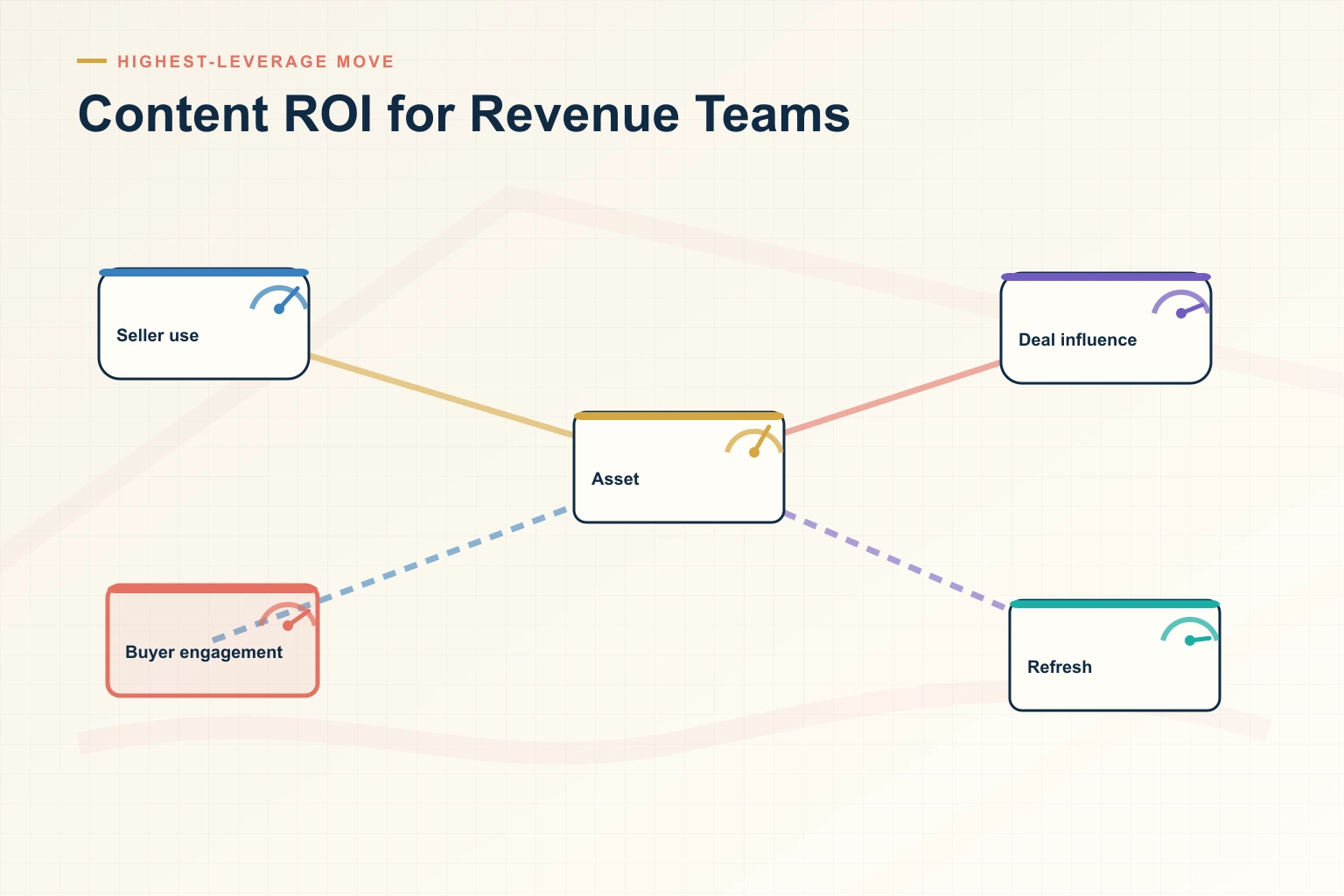
Content ROI for revenue teams works best as an ongoing operating discipline rather than a one-time reporting project. Use this framework to establish a baseline, assign ownership, select useful metrics, review live opportunities, and feed lessons back into the process.
Audit the current state
Before you can improve Content ROI for Revenue Teams, you need an honest baseline. Pull the last six months of deal data and map opportunities against the current sales content ROI measurement process. Identify where deals are falling out and compare the data with the explanations used in pipeline discussions.
Define the operating model
An operating model for Content ROI for Revenue Teams answers three questions: what actions should happen, at what stage, and who is accountable. Document the milestones, evidence, and ownership required at each stage without making the model more complicated than the team can consistently follow.
Assign ownership
Assign a revenue leader to set the goals, define the metrics, maintain the review cadence, and update the approach when the evidence changes. Accountability should focus on outcomes rather than activity counts alone.
Document the process
The process that governs sales content ROI measurement must be documented, taught, and enforced. Reinforce it through manager coaching and daily workflows instead of leaving it in a presentation that teams rarely consult.
Align technology with the process
Technology should serve the sales content ROI measurement process, not define it. Evaluate tools according to whether they reduce friction, support the documented workflow, and allow relevant information to move between systems.
For the product referenced by the source material, review Revspire Content Hub.
Three-part explainer: Define the system, Operationalize the workflow, and Measure the impact.
Measure and review the process
The metrics for Content ROI for Revenue Teams should connect directly to revenue outcomes. Leading indicators can include stakeholder engagement, content consumption, mutual action plan progression, and deal velocity. Lagging indicators can include win rates, cycle times, and average deal sizes.
Build a dashboard that shows both. Review it weekly. Tie it directly to coaching conversations and territory reviews.
Add a standing content ROI discussion to the weekly pipeline cadence. Use the discussion to identify what should change during the next seven days rather than repeating a general status update.
Three-part explainer: Expose the hidden cost, Build the business case, and Start where it matters.
Use live deals and feedback loops
Use deal-specific coaching to review live opportunities, identify where execution is breaking down, and work through the correction with the rep.
Capture findings from won and lost deals through post-deal interviews, CRM data analysis, and structured reviews. Feed those findings into playbooks, training, metrics, and strategy.
Review metrics against targets, update playbooks when new evidence is available, and ask buyers for feedback about their experience. This creates a repeatable feedback loop instead of leaving the process fixed after launch.
Avoid common execution mistakes
Treating the work as a temporary initiative
Give the process a permanent owner, standing reviews, defined metrics, and improvement goals. Keep it connected to revenue outcomes rather than treating it as a project with a fixed end date.
Relying only on intuition
Define a small set of leading indicators and track them consistently. When the data and the prevailing narrative disagree, investigate the discrepancy before changing the process.
Depending on one stakeholder
Map the buying committee, assign stakeholder coverage, and track engagement with each person. Flag opportunities where engagement remains concentrated in one relationship.
Confusing activity with progress
Measure outcomes, not activities. Use stage progression, buyer engagement quality, and stakeholder coverage as primary inputs to coaching and pipeline reviews.
Failing to learn from losses
Use a structured review after significant lost deals. Document the execution breakdowns and update the relevant playbooks so the findings remain available for future coaching.
Where to start
Start with an honest audit. Select two or three improvements, give each one a clear owner and measurable goal, and review the results after 90 days before choosing the next changes.