Revspire blog
Deal Room vs Email Selling: A Practical B2B Sales Evaluation
Compare deal room and email-centered selling across process consistency, deal signals, stakeholder coverage, coaching, and continuous improvement.
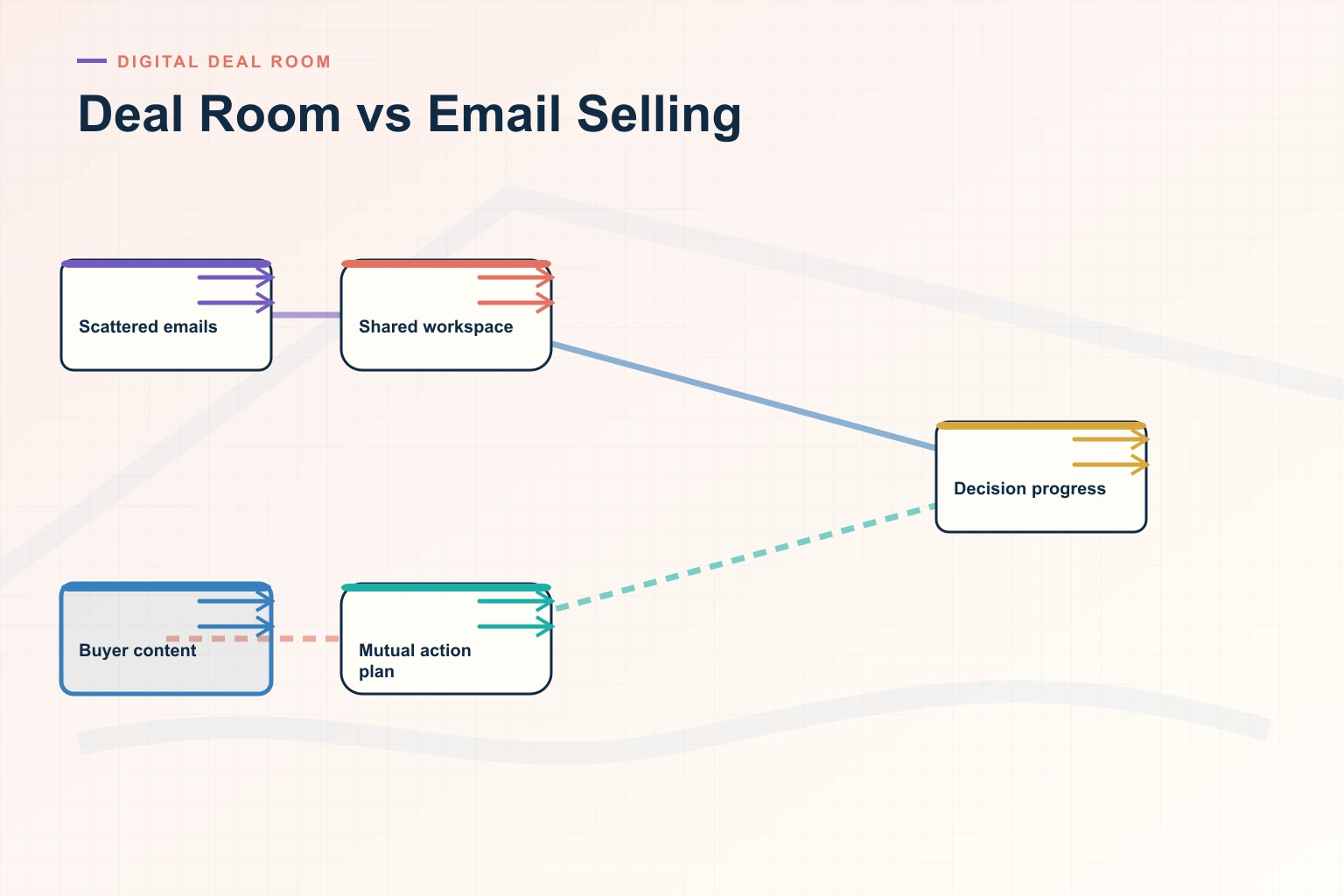
Most B2B revenue leaders know digital deal room vs email matters in principle. But knowing and systematizing are very different things. Revenue teams can compare email-centered selling with a structured deal room process across process consistency, stakeholder visibility, deal signals, coaching, and ongoing improvement.
Three-part explainer: Expose the hidden cost, Build the business case, and Start where it matters.
What is the practical difference?
An email-centered process can become reactive when teams piece together their approach from tribal knowledge, manager intuition, and an existing playbook. A structured deal room operating model instead defines what actions should happen, when they should happen, and who is accountable.
This distinction does not mean email must disappear. The useful evaluation question is whether the team can consistently organize buyer-facing work, identify stakeholder engagement, monitor stage progression, and apply the same execution standards across opportunities.
Evaluation area
Email-centered process
Structured deal room process
Process
May depend on rep habits, manager intuition, and scattered guidance.
Can use documented actions, stages, and accountability.
Signals
Activity volume alone may not show whether a deal is progressing.
Teams can review stakeholder engagement, content consumption, mutual action plan progression, and stage velocity.
Stakeholders
A relationship centered on one contact creates limited coverage.
Teams can map the buying committee, assign coverage, and track engagement.
Improvement
Lessons may remain with individual reps or managers.
Teams can feed post-deal interviews, CRM analysis, and win-loss reviews into playbooks and training.
Audit the current sales process
Before you can improve Deal Room vs Email Selling, you need an honest baseline. Pull the last six months of deal data. Map every opportunity against the stages of digital deal room vs email and identify where deals are falling out and why. Be specific: which reps, which segments, which deal sizes.
A framework for reviewing the current process and identifying where deals lose momentum.
During the audit, separate activity from progress. Measure outcomes, not activities. Track stage progression velocity, buyer engagement quality, and stakeholder coverage breadth.
Define the operating model
An operating model for Deal Room vs Email Selling answers three questions: what actions should happen, at what stage, and who is accountable. Document this explicitly.
The technology layer should reduce friction, not add it. Every tool should answer one question: does this help reps spend more time on high-value activities or less? Technology should serve the digital deal room vs email process, not define it.
For product information, visit Revspire Deal Rooms.
Strategy, ownership, process, technology, data, and review cadence form the operating model.
Compare the signals each approach provides
Lagging metrics like win rate and quota attainment tell you what happened. Leading indicators — the behaviors that predict those outcomes — tell you what is about to happen.
For Deal Room vs Email Selling, leading indicators might include stakeholder engagement rates, content consumption, mutual action plan progression, or deal velocity at each stage. These indicators give the team a more specific basis for reviewing execution than activity counts alone.
Use a repeatable improvement cadence
- Define execution standards. Write down what excellent execution looks like at each stage of the deal.
- Review deal signals weekly. Include Deal Room vs Email Selling health in the pipeline cadence.
- Coach with live opportunities. Review live opportunities with each rep and identify where execution breaks down.
- Capture win-loss intelligence. Use post-deal interviews, CRM data analysis, and structured win-loss reviews.
- Update the playbook. Feed lessons from won and lost deals back into playbooks, training, and strategy.
Practical steps for defining, reviewing, coaching, and improving deal room execution.
Watch for common execution risks
Treating the process as a one-time initiative
Assign a permanent owner to Deal Room vs Email Selling outcomes. Build it into your operating cadence with standing review meetings, defined metrics, and quarterly improvement goals.
Relying on one stakeholder
Map every stakeholder in the buying committee, assign coverage, and track engagement with each one.
Confusing activity with progress
High activity does not by itself establish forward momentum. Use stage progression, buyer engagement quality, and stakeholder coverage as the basis for investigation and coaching.
Failing to learn from losses
Implement a structured loss review process. Document the findings and update playbooks accordingly.
Ownership, outcome-based measurement, stakeholder coverage, and loss reviews address common execution risks.
How to decide where to start
Start with an honest audit. Where is Deal Room vs Email Selling working well today? Where is it breaking down? What does the data say versus what the narrative says?
Use that assessment to prioritize two or three specific improvements that will have the biggest impact on revenue outcomes. Deploy them with a clear owner, a measurable goal, and a 90-day review cadence. Then build from there.
Revspire helps B2B revenue teams build this foundation systematically. See a demo