How to Improve Multi-Threading in Enterprise and Close More B2B Deals in 2026
A practical perspective for connecting this idea to your revenue team’s next move.
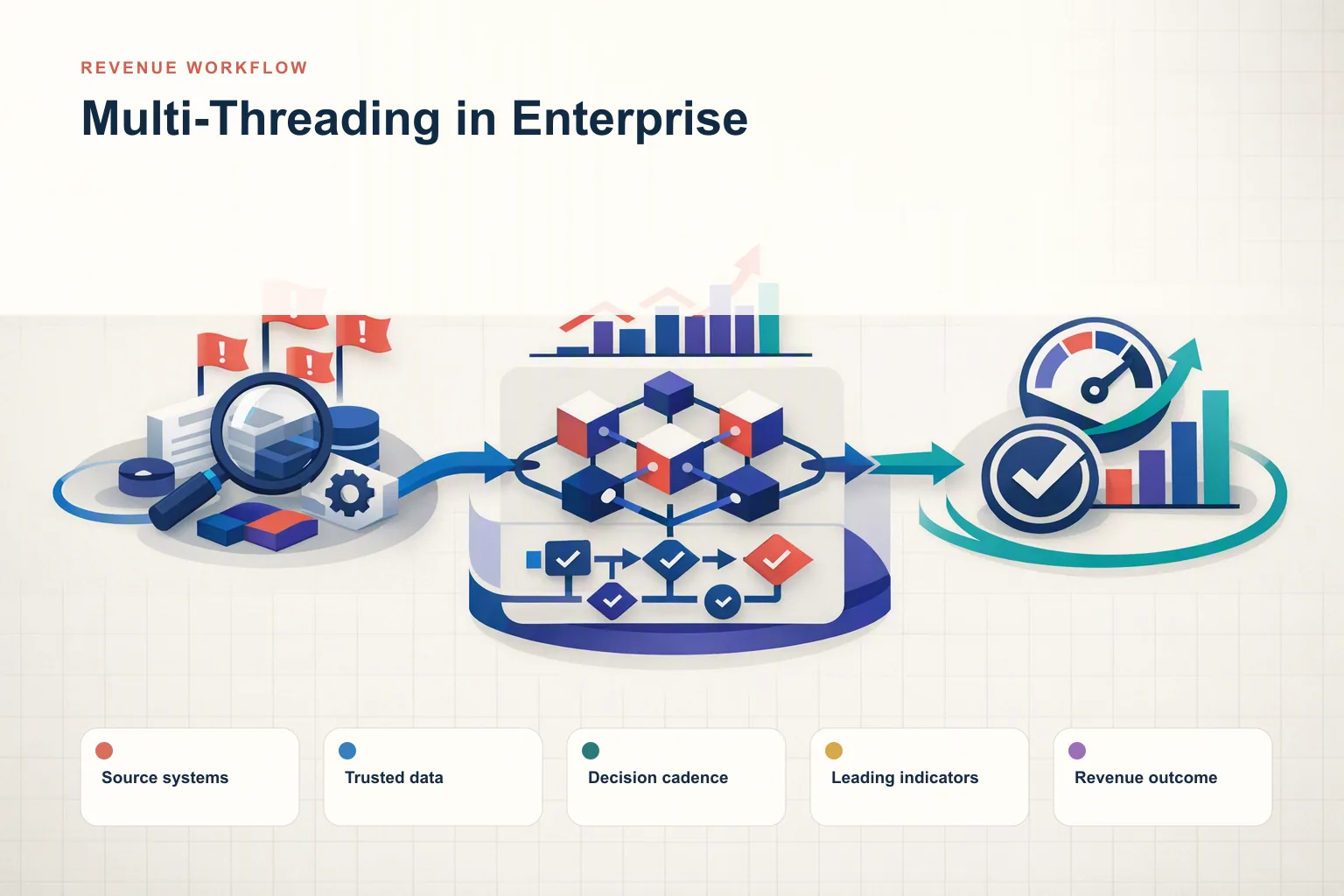
Multi-threading in enterprise should be treated as a continuous, data-driven discipline rather than a one-time initiative. A durable approach combines documented standards, clear ownership, stakeholder coverage, measurable signals, deal-level coaching, and feedback from wins and losses.
Why enterprise multi-threading matters
Poor multi-threading can create problems throughout the funnel. Early-stage deals that should not enter the pipeline can consume rep capacity, qualified deals can stall mid-cycle, and procurement surprises, unstated objections, or stakeholder concerns can emerge late.
Building an entire relationship around one stakeholder also creates risk. If that person goes quiet, changes roles, or leaves the company, the team may have no fallback relationship.
The frozen business-case material associates systematic multi-threading with faster ramp times, higher average deal sizes, lower customer-acquisition costs, and improved forecast accuracy. These are attributed source claims; the supplied sources do not provide an external study or methodology that independently verifies them.
The same material presents a competitive and buyer-experience argument: in markets where a product is differentiated but not unique, effective multi-threading can create a better buying experience that builds trust and reduces perceived risk. This argument is attributed to the source rather than presented as independently verified research.
The material also argues that top-performing revenue professionals seek organizations that take multi-threading seriously and that a strong operating approach can support faster development and longer retention. This argument is likewise attributed rather than independently verified.
A practical framework for multi-threading in enterprise
Three-part explainer: Audit the current state, Build the operating model, and Measure and improve.
1. Audit the current state
Start with an honest audit. Compare the available data with the team’s narrative, identify where deals stop progressing, and examine the results by rep, segment, stage, and deal size. The purpose is to locate recurring structural problems instead of treating every stalled or lost opportunity as an isolated event.
2. Define the operating model and ownership
An operating model for multi-threading in enterprise answers three questions: what actions should happen, at what stage, and who is accountable. Document the model, assign a leadership owner who is accountable for outcomes, and reinforce the process through managers and live deal reviews.
3. Define stakeholder-coverage standards
Write down what effective execution looks like at each stage. Map the buying committee, assign relationship coverage, and track engagement with each stakeholder. An opportunity with only one active contact should be treated as a relationship risk rather than relying solely on the rep’s assessment.
4. Measure leading and lagging indicators
If you cannot measure it, you cannot improve it. Lagging indicators such as win rate, cycle time, and average deal size describe outcomes. Leading indicators can include stakeholder engagement, content consumption, mutual action plan progression, and deal velocity.
Measure outcomes, not activities. Stage progression, buyer engagement quality, and stakeholder coverage breadth provide a stronger basis for coaching than email, call, or task volume alone.
5. Use weekly reviews and deal-level coaching
Make multi-threading part of the weekly pipeline cadence. Use the review to determine what needs to change, where relationship gaps exist, and who owns the next action. Deal-specific coaching can then focus on the point where execution is breaking down in a live opportunity.
6. Align technology with the process
Technology should serve the multi-threading enterprise complex sales process, not define it. Evaluate tools by whether they reduce friction, make relevant signals visible, and allow data to flow between the CRM, engagement platform, and deal room.
Revspire Stakeholder Intelligence is presented in the frozen sources as a way to surface stakeholder signals and deal-level data.
7. Build feedback loops from wins and losses
Capture lessons through post-deal interviews, CRM analysis, and structured win-loss reviews. Feed the findings into playbooks, coaching, and strategy, and review the operating model against its targets as new evidence becomes available.
Five mistakes to avoid
- Treating multi-threading as a temporary project. Assign permanent ownership and connect the discipline to standing reviews and defined metrics.
- Relying only on intuition. Compare the team’s narrative with portfolio and deal-level evidence.
- Single-threading the relationship. Map stakeholders, assign coverage, and monitor whether more than one relationship is active.
- Confusing activity with progress. Prioritize stage movement, engagement quality, and stakeholder breadth.
- Failing to learn from losses. Document the specific breakdowns found in structured reviews and update the playbook.
Build a repeatable operating discipline
The objective is a simple, consistently followed system: establish a baseline, document stage-specific expectations, assign ownership, review meaningful indicators, coach live deals, and update the model with evidence from wins and losses.
Map the buying committee by role
Every significant B2B purchasing decision involves a predictable cast of stakeholders, even when they are not all visible at the start. Use the following roles to identify who needs to be engaged and what each person cares about.
The Economic Buyer controls budget and has final approval authority. They care about ROI, business case credibility, and risk. They rarely attend early sales calls — your job is to build a business case your champion can use to earn their engagement.
The Technical Buyer evaluates security, compliance, integrations, and implementation complexity. They are often IT, InfoSec, or Engineering. They are veto players — their thumbs-down can kill a deal the economic buyer has already approved in principle.
The User Buyer is the team that will actually use your product daily. Their buy-in predicts adoption success and renewal probability. Champions who have the economic buyer’s support but not the user community’s enthusiasm discover this painfully at implementation.
The Champion is your internal advocate — the person who has identified the problem, believes in your solution, and is willing to expend political capital to push the deal forward. Protect them, enable them, and never let them carry the deal alone.
The Influencer shapes the economic buyer’s opinion without formal authority — often a trusted advisor, a peer at another company, or an industry analyst. Identify influencers early ; they can accelerate or derail deals without ever appearing in an org chart.
The procurement gatekeeper may enter late but can still influence terms, timing, and competitive positioning. Include procurement in the stakeholder map before its requirements become a late-stage surprise.
Expand relationships through the champion
Multi-threading can weaken a deal if the champion believes the seller is going around them. Instead, make the champion the leader of the expansion and position each additional relationship as a way to remove a blocker or reduce the champion’s workload.
“Based on our conversation, it sounds like getting your CISO comfortable with the security architecture would remove a key blocker. Would it be helpful if we set up a separate call with your security team so they can ask technical questions directly? That way you don’t have to be the technical translator in every conversation.”
This framing makes the additional conversation a service to the champion rather than an attempt to bypass them.
Personalize engagement and keep the map current
Each stakeholder has different motivations, concerns, and definitions of success. The CFO wants IRR and payback period, the IT Director wants implementation risk and integration complexity, and the Head of Sales wants rep adoption and pipeline impact. Give each stakeholder materials relevant to their evaluation criteria rather than relying on the same content for the entire committee.
Manual stakeholder maps stored in CRM notes, whiteboard photos, or shared spreadsheets can degrade rapidly as deals evolve. Maintain a live view of who is engaged, who is not, and where coverage gaps remain. Update it when a procurement contact, security reviewer, or other stakeholder enters the process.
Measure buying-committee coverage directly
Add these specific measures to the broader leading and lagging indicators used in pipeline reviews:
- Average number of unique buyer-side stakeholders engaged per deal at each pipeline stage.
- Deal closure rate by the number of active stakeholders.
- Champion-departure impact on outcomes, comparing deals preserved through multi-threading with deals lost after the original champion left.