Why Teams Are Replacing Highspot and Seismic, and What to Check First
A practical perspective for connecting this idea to your revenue team’s next move.
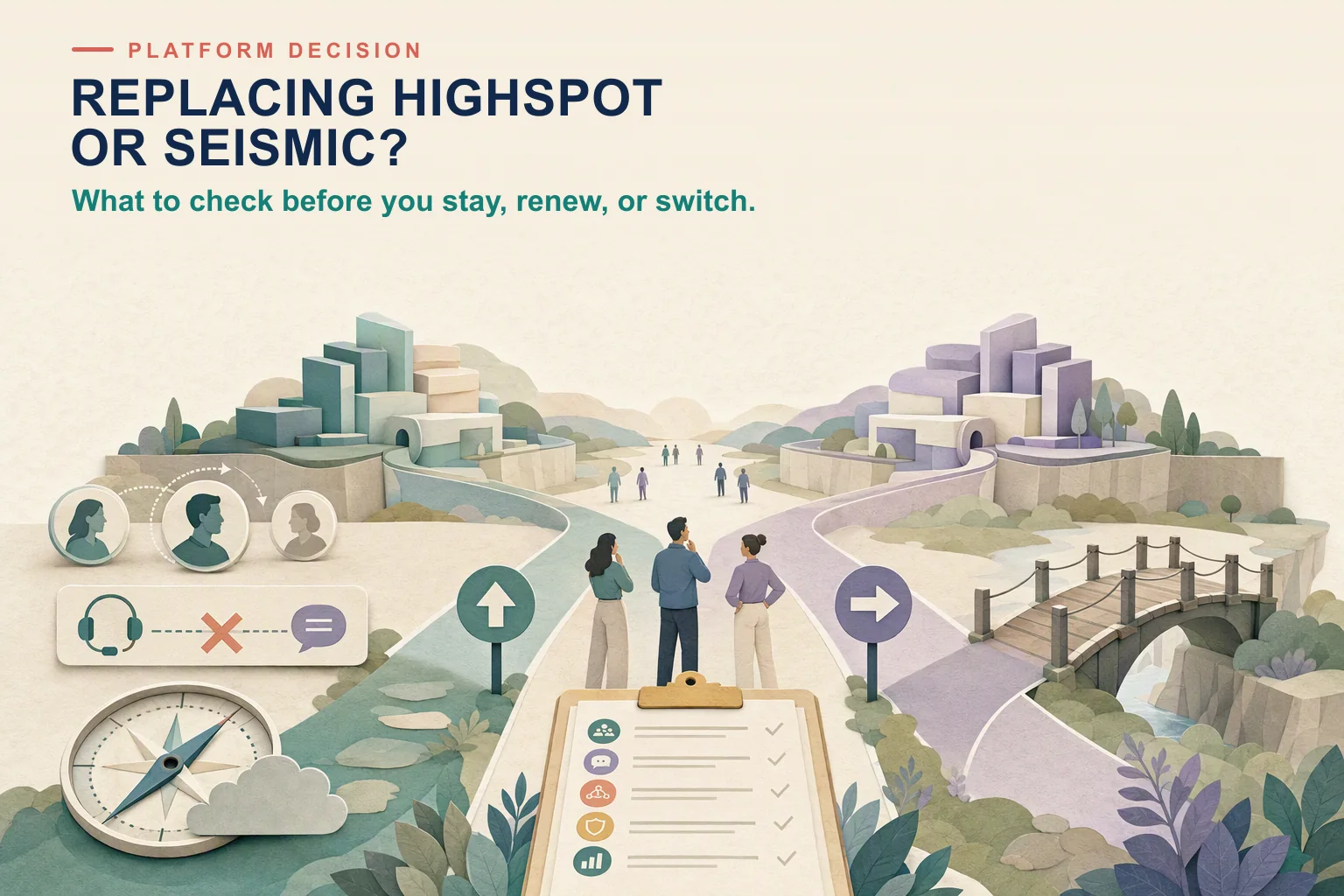
Highspot and Seismic customers who talk to us about switching give three reasons: their customer success contact keeps changing, support feels slower than it used to, and the product direction has been unclear since the two companies merged in August 2026. Before switching, check contract timing, content export, CRM integration, licenses and retraining.
Staying put is often the right call, too. This guide sets out what has been published about the merger, the three concerns in more detail, what to ask your vendor about each, when not to switch, and a checklist for teams that do.
Last updated: 26 October 2026
Disclosure: Revspire publishes this guide and sells a sales enablement platform that competes with Highspot and Seismic. The three concerns below come from Revspire’s own sales conversations with people who use Highspot or Seismic today. We have no survey behind them and give no numbers or percentages, we name no customer, and plenty of Highspot and Seismic customers are well served and do not share these concerns. Every public fact is linked to its source with a date.
What changed with the Highspot and Seismic merger?
Seismic completed its merger with Highspot on Tuesday 18 August 2026, GeekWire reported that day. The company operates under the Seismic name, led by CEO Rob Tarkoff, and the product is branded “Highspot by Seismic”. Tarkoff told GeekWire the companies were “carefully evaluating our organizations to identify areas of overlap” and that decisions would be communicated directly to employees; the article did not say how overlapping products would be handled. The dated record so far:
Date
What was published
Source
February 2026
Definitive agreement to merge; combined company to operate as Seismic; both platforms to continue to be supported after closing
18 August 2026
Merger completed; product branded “Highspot by Seismic”; about 1,700 employees; Seismic reports 2,500 customers and 3.5 million users
18 August 2026 (page updated 9 October 2026)
Highspot’s merger page tells customers their current customer success or account contact remains their primary point of contact, and points to Shift 2026 for an in-depth roadmap
1 September 2026
Umberto Milletti appointed Chief Product and Technology Officer, leading product, engineering, technical support, R&D and AI; Shift 2026 named as the first in-depth look at the new roadmap
Seismic via Business Wire, on Yahoo Finance
After completion (interview undated)
Tarkoff says both platforms will continue to be sold and supported for the time being, declines to set a timetable for consolidating them; GeekWire reports initial job cuts surfaced online, with no confirmed totals
13 October 2026
At Seismic Shift, Seismic launches AI agents; its Deal Agent is available on both the Highspot by Seismic and Seismic platforms
The short version: the corporate questions are settled, and both products are still sold and supported. What has not been published, as of 26 October 2026, is a timetable for consolidating the two platforms or any change to existing contracts, packaging or support terms. Our Highspot and Seismic merger guide quotes the announcements in full, and the Highspot vs Seismic comparison covers how the two products differed before the merger.
Why are teams switching from Highspot and Seismic?
When Highspot and Seismic customers talk to Revspire, three concerns come up. They are what people tell a competing vendor, so read them as prompts to check your own situation, not as a verdict on either product. For each, we set out what is public and what to ask your account team, ideally in writing.
1. Service continuity: the customer success contact keeps changing
The first concern is rotation: customer success managers changing, with each new one relearning the account, the integrations and the reasons behind past configuration choices. On an enablement platform much of the value sits in how content, permissions and CRM workflows were set up, so that context matters.
What is public: Highspot’s merger page says your current customer success or account contact remains your primary point of contact and that you will be contacted if anything changes. In a GeekWire interview after the merger closed, Tarkoff said that after a merger there is always some overlap where “you don’t need two people doing a task that requires one”. GeekWire reported that initial job cuts had surfaced on LinkedIn and online forums, but the company had not confirmed specifics or totals, and nothing published says which teams were affected.
What to ask your vendor:
- Who is my named customer success contact, how long have they been on my account, and who covers when they are away?
- If my contact changes, how much notice will I get, and what handover note will the new person receive?
- Is my customer success coverage written into the contract, or is it a pooled service that can change without notice?
2. Support responsiveness
The second concern is service quality: tickets that take longer to resolve, or answers that do not reach someone who knows the product deeply. It often travels with the first, because a support case can need the context the customer success manager used to hold.
What is public: Seismic’s 1 September 2026 release places technical support in the product and technology organization led by its new Chief Product and Technology Officer. To be fair to both vendors, public review sites do not show slow support as a dominant theme. When we read the Highspot and Seismic review pages on G2 on 26 October 2026, many recent reviews praised implementation and support teams, and only a few asked for faster issue resolution. Your own ticket history is better evidence than either our conversations or a review site.
What to ask your vendor:
- What are the contracted response and resolution times for each severity level, and how did you perform against them for my account last quarter?
- Has the support team or process for my product changed since 18 August 2026, and will it change in the next year?
- Can I get a named escalation contact for severity one issues?
3. Product direction and roadmap
The third concern is direction: which platform customers will be on in two years, whether features they rely on survive consolidation, and whether to keep building content and workflows in the meantime.
What is public: the February 2026 announcement described a unified platform as the goal. In the same GeekWire interview, Tarkoff said both platforms would be sold and supported for the time being, declined to set a timetable for consolidating them, and said customers would move to a new platform when one is ready. At Shift on 13 October 2026, destinationCRM reported that Seismic’s new Deal Agent is available on both platforms, so at least some new capabilities are shipping on both platforms for now. We have not found a published consolidation timetable.
What to ask your vendor:
- Which platform will my company be on in 12 and 24 months, and will you put that in writing?
- If you move me to a new platform, who does the migration work, who pays for it, and how much notice will I get?
- Will the modules and features I license today continue to be sold and supported under the same names and prices through my next renewal?
The three concerns at a glance
Concern customers raise
What is public (as of 26 October 2026)
What to get in writing
Customer success contact keeps changing
Current contact stays primary point of contact; you will be told if it changes. Job cuts reported online, totals not confirmed.
Named contact, notice period for changes, handover process
Support responsiveness
Technical support now sits under the new CPTO. G2 reviews are mostly positive about support.
Response and resolution times by severity, last quarter’s performance, escalation contact
Product direction unclear
Unified platform is the stated goal; both platforms sold and supported for now; no consolidation timetable
Which platform you are on and until when, migration scope and cost, module continuity
When is staying with Highspot or Seismic the right call?
Switching platforms costs time and goodwill with sellers. For many teams the better move is to stay and negotiate, usually when:
- You have a large, well-governed content estate. If years of content, tagging, permissions, templates and analytics history are built and working, rebuilding them elsewhere is a real cost, and sellers who trust the library will feel any disruption.
- Your contract timing is wrong. If you are early in a multi-year term, leaving early may mean paying for two platforms. Use the time to collect evidence and revisit at renewal instead.
- Your account team is stable and responsive. If your customer success contact has been consistent and your tickets get resolved, the concerns above may simply not apply to you.
- You depend on capabilities you cannot replace. GeekWire notes that Seismic has focused on complex enterprise workflows and regulated industries, financial services in particular. If your compliance or archiving workflows rely on that depth, weigh it carefully.
- The new roadmap fits your plans. Seismic has said it plans to invest more than $100 million a year in R&D (GeekWire, 18 August 2026). If what was shown at Shift matches what you need, staying and asking for roadmap commitments in your renewal may be the lowest-risk path.
Even if you stay, the renewal is your best moment to ask for the written commitments listed above. A shorter term while the combined packaging settles also keeps your options open.
Switching checklist: what to check before you replace Highspot or Seismic
If you do evaluate a move, work through these before you sign with any new vendor.
- Contract end date and notice period. Find the renewal date, the notice window for non-renewal, whether the agreement renews automatically, and any early termination terms. Missing a notice window can lock you in for another full term.
- Content export and metadata. Ask your current vendor, in writing, what you can export and in what format: files, versions, tags and folder structure, permissions, owners, expiry dates and usage history. Ask what happens to links already shared with buyers once the account closes. A sales content audit before you move is the best time to retire content nobody uses.
- CRM integration. List every place the current platform touches your CRM: content recommendations on opportunities, activity logging, engagement fields, reports. Confirm the new platform supports your CRM and which of those workflows it replaces.
- User licenses. Count active users against licensed seats, and note who needs access beyond sellers: customer success, partners, product marketing. Understand how each vendor prices more users, because this changes the long-term cost more than the first-year quote.
- Re-training. Plan training for three groups: administrators, content owners, and sellers. Include any onboarding courses, certifications or coaching content that would need rebuilding.
- Running both in parallel. Decide whether you will run the two platforms side by side, for how long, and which one is the source of truth during cutover. Set a date when the old library becomes read-only.
- Success metrics. Record a baseline before you switch so you can tell whether it worked: how long it takes sellers to find content, active usage, content used in won deals, and time to productivity for new hires. Our guide to sales enablement metrics covers definitions.
If you are running a formal evaluation, the sales enablement RFP template and scorecard lets you score each vendor against the same requirements, including the continuity and roadmap questions above.
How does Revspire fit if you do switch?
Revspire sells a competing platform, so weigh this section accordingly. It connects governed sales content, AI playbooks, AI sales training and coaching, and digital sales rooms in one revenue workflow. Its Content Hub is the base: tag-based and contextual search, version and duplicate management, content recommendations inside the CRM, content gap, usage and performance analytics, and two-way sync with SharePoint and OneDrive. Deal Room, Academy (training and certification), Partner Portal and CPQ are added to it as modules.
On the checklist items above, Revspire lists integrations with Salesforce, HubSpot, Microsoft Dynamics 365, Zoho CRM and Pipedrive, and with Okta, OneLogin, Microsoft Entra ID, custom SAML 2.0 SSO and SCIM provisioning. Revspire says the first team is typically live two weeks after contract signature and full rollout typically takes six weeks; ask how that applies to the volume of content you would bring.
On pricing, Revspire is priced per module rather than per seat, every plan includes unlimited user licenses, and the average contract is about $25,000 USD a year. If your current contract is priced per seat, that difference in pricing model is worth modelling as part of the license check. Side-by-side detail is on our Highspot alternative and Seismic alternative pages.
Switching offer: if you move from Highspot or Seismic, Revspire migrates your content and its metadata at no cost and credits the time left on your current contract. Ask us for the terms.
If you want to see how it would work with your content and CRM, request a Revspire demo and bring your switching checklist.
Frequently asked questions
Is Highspot part of Seismic now?
Yes. Seismic completed its merger with Highspot on 18 August 2026, and the combined company operates under the Seismic name. The Highspot product is now branded “Highspot by Seismic”, and both platforms continue to be sold and supported for now.
Will Highspot be discontinued?
Nothing published says it will be shut down on a set date. Seismic’s CEO has said customers will move to a new platform when one is ready, without giving a timetable. If you depend on Highspot, ask your account team which platform you will be on in 12 and 24 months and get the answer in writing.
Should I renew Highspot or Seismic after the merger?
It depends on your contract timing, how much you have built, and how stable your account team has been. If you renew, ask for a named customer success contact, support commitments, module continuity through the term, and consider a shorter term while the combined packaging settles.
What are the main reasons teams switch away from Highspot or Seismic?
In Revspire’s sales conversations, customers raise customer success contacts that keep changing, support that feels less responsive, and unclear product direction since the merger. These are what people tell a competing vendor, not survey results, and many customers do not share them.
How do I migrate from Highspot or Seismic?
Start with the contract end date and notice period, then confirm in writing what content and metadata you can export. Map every CRM workflow, plan training for admins, content owners and sellers, run both platforms in parallel for a fixed period, and record baseline metrics before cutover. If you move to Revspire, it migrates your content and its metadata at no cost.
Sources
- Seismic Announces Intent to Merge With Highspot, Seismic via Business Wire, February 2026, accessed 26 October 2026.
- Seismic completes Highspot merger, says it will keep Seattle and B.C. sites, GeekWire (Todd Bishop), 18 August 2026, accessed 26 October 2026.
- Highspot + Seismic merger page (FAQ), Highspot, announced 18 August 2026 and updated 9 October 2026, accessed 26 October 2026.
- Seismic Appoints Enterprise Software Pioneer Umberto Milletti as Chief Product and Technology Officer, Seismic via Business Wire, on Yahoo Finance, 1 September 2026, accessed 26 October 2026.
- Seismic CEO on the Highspot merger: revenue, job cuts, Seattle, AI, and the Salesforce question, GeekWire, 2026 (page undated), accessed 26 October 2026.
- Seismic Unveils AI Agents for Sales Teams at Its Shift Event, destinationCRM, 13 October 2026, accessed 26 October 2026.
- Highspot reviews, G2, continuously updated, accessed 26 October 2026.
- Seismic reviews, G2, continuously updated, accessed 26 October 2026.