Revspire blog
Sales Enablement RFP Template: Requirements, Vendor Questions, and a Weighted Scorecard
A practical sales enablement RFP template with evidence-based requirements, mandatory gates, vendor questions, demo scripts, and a weighted scorecard.
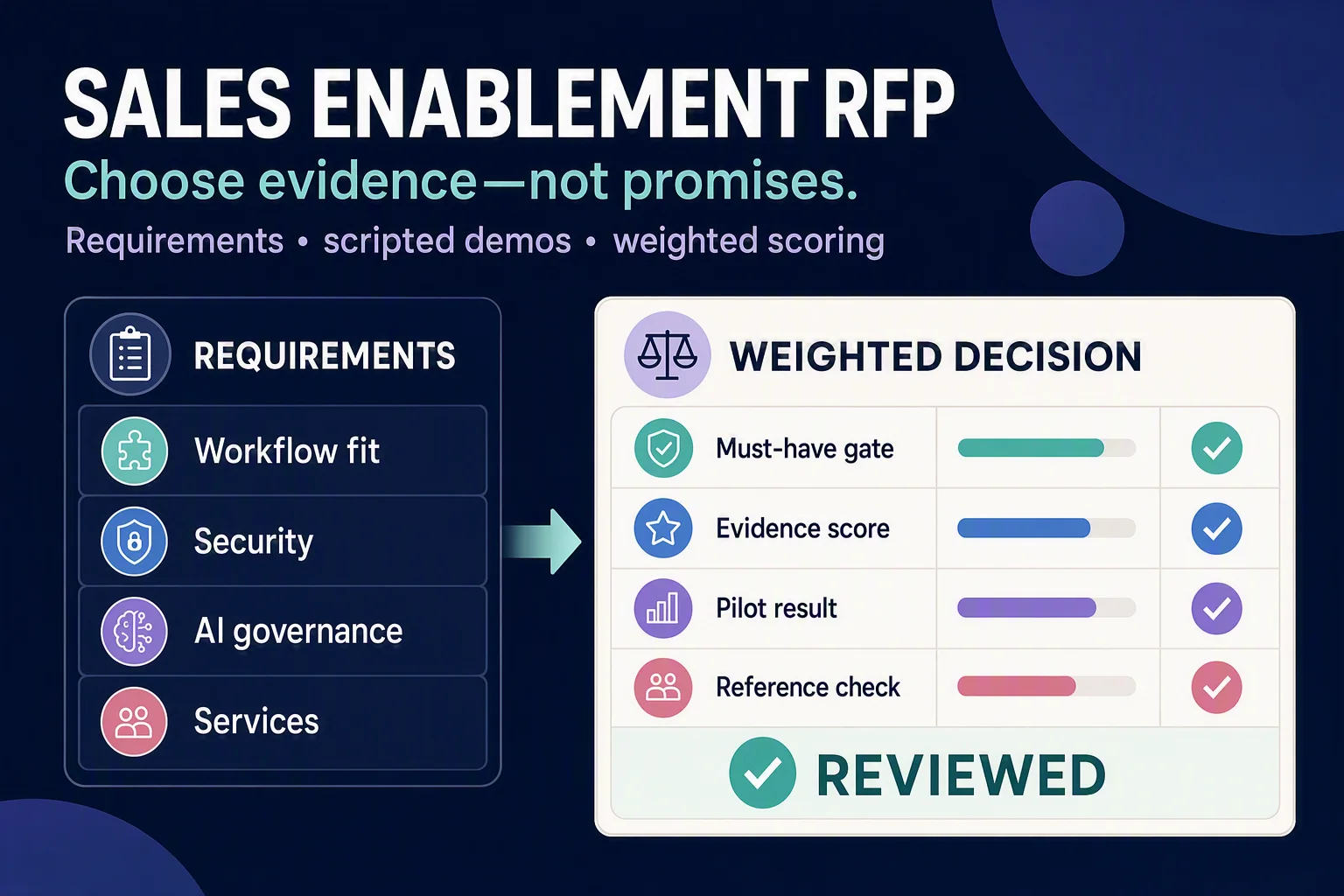
A sales enablement RFP should make vendor claims testable
A sales enablement request for proposal can create clarity, or it can turn into a spreadsheet full of nearly identical yes-or-no answers. The difference is whether the document describes software categories or the work your revenue team must perform.
“Includes AI,” “supports content management,” and “provides analytics” are not useful requirements by themselves. A supplier can answer yes without showing who completes the workflow, what data moves, or how change is governed. A stronger RFP names the job, operating condition, required evidence, and consequence of failure.
This template uses non-negotiable gates, weighted requirements, and discovery questions. Gates protect hard boundaries; weights distinguish meaningful strengths; questions expose cost, effort, limitations, and ownership.
The procurement principle is simple: disclose what will affect the decision and evaluate every response against that published standard. U.S. federal acquisition rules require proposal evaluation factors and their relative importance to be stated in the solicitation. [1] A private-company RFP is not bound by those rules, but the discipline is worth borrowing because it makes the decision more consistent and auditable.
If the team is still defining the category, begin with Revspire’s guide to the best sales enablement tools. If build versus purchase is unresolved, use the AI revenue enablement build-versus-buy framework. Start the RFP only after the problem is clear.
Write a decision brief before the feature grid
A requirements list without a decision brief rewards the broadest product vocabulary. Start with one page stating what must change, who will use the system, and what evidence the team will accept.
Decision field
What to document
Example of a bounded answer
Target workflow
The work that needs improvement.
Sellers find approved content, assemble a buyer space, and expose coaching evidence.
Users and roles
User groups, administrators, reviewers, and data owners.
Account executives, managers, enablement, product marketing, and security.
Current friction
Observed failure, workaround, and affected systems.
Sellers search three repositories and cannot verify the current asset.
Success evidence
Adoption, quality, and relevant outcome measures.
Eligible sellers repeat the workflow using approved content.
Risk boundary
Data, permissions, claims, actions, and decisions to control.
Buyer files stay account-bound; AI output does not become an approved claim automatically.
Operating owner
The person accountable after implementation, including capacity and review cadence.
Revenue enablement owns adoption; IT owns identity; product marketing owns approved messaging.
Use the brief to remove irrelevant scope. Modularity matters only when required modules share the right permissions, source content, workflow, and reporting. Before sending the RFP, record who sets requirements, supplies evidence, scores, approves exceptions, and makes the decision.
Separate gates, scored requirements, and discovery questions
Not every requirement belongs in one scoring model. Otherwise, convenient features can compensate for a failed security or data-portability requirement.
Class
Use it for
Evaluation treatment
Gate
A requirement whose absence makes the proposed use unacceptable, such as required identity control, regional processing, accessibility, or data deletion.
Pass, conditional pass with an approved remedy, or fail. Do not average a failure into the weighted total.
Scored requirement
A capability where degree, usability, evidence quality, or operating effort differentiates proposals.
Score against published anchors and apply the agreed weight.
Discovery question
An uncertainty that informs risk, cost, implementation, or contract review but cannot yet be scored fairly.
Record the answer, owner, supporting evidence, and whether it creates a new gate or scored requirement.
Write gates as testable statements. “Enterprise-grade security” is marketing language. “An administrator can remove a user through the approved identity workflow and verify access has ended” can be demonstrated. For AI, name the job, allowed sources, reviewed outputs, and prohibited actions.
NIST describes its AI Risk Management Framework as voluntary guidance for incorporating trustworthiness considerations into the design, development, use, and evaluation of AI systems. [2] Use that lifecycle view to assign owners for AI risks instead of adding a single generic compliance question near the end of the RFP.
Build requirements as observable acceptance tests
Use one requirement per row and give every row an identifier. Include the actor, action, condition, expected result, and proof. This format reduces ambiguous answers and later supports demos, pilots, and acceptance tests.
ID
Testable requirement
Proof to request
Class
CON-01
An entitled seller can locate the current approved asset for a named buyer situation and see its owner and effective version.
Complete a scripted search with seeded current, expired, and restricted content.
Scored
GOV-01
An owner can approve, replace, retire, and audit an asset without leaving a usable ungoverned duplicate.
Run a version change and export its history.
Gate
PLY-01
A seller can use approved playbook guidance inside the defined selling workflow without copying it into a separate unmanaged document.
Trace one playbook element from source through seller use and update.
Scored
TRN-01
A manager can inspect training-feedback evidence and route an exception for human review.
Challenge one result and record its disposition.
Scored
BUY-01
A seller can create a buyer-facing workspace with account-specific access and revoke that access when the deal condition changes.
Create, share, inspect as the recipient, and revoke a test workspace.
Scored
ANA-01
An analyst can distinguish eligible users, first use, repeated use, workflow completion, and the defined outcome signal.
Use a seeded cohort and reconcile the interface with an export.
Scored
INT-01
The integration uses only approved objects and fields with documented failure behavior.
Test exact data direction, including a failed write.
Gate
IAM-01
Identity, provisioning, deprovisioning, and role-based access satisfy the organization’s approved control design.
Provision two roles, attempt an unauthorized action, then deprovision one user.
Gate
AI-01
An administrator can identify the approved sources used for an AI-assisted answer and route unsupported output for correction.
Run supported, ambiguous, and unsupported prompts; inspect citations and escalation.
Scored
EXT-01
The customer can export agreed content, metadata, configuration, and records and can verify contractual deletion at exit.
Review a sample export, schema, deletion process, timing, and responsibility map.
Gate
The same requirements move from written RFP to scripted demonstration, pilot evidence, and a weighted decision gate.
Revspire’s Content Hub, sales playbook workspace, sales training workspace, and digital deal room illustrate distinct workflow areas that a buying team may place in scope. Evaluate only the combination in the decision brief; adjacent capabilities should not substitute for a failed requirement.
Use a weighted scorecard that resists demo theater
Set weights before opening proposals. The 100-point sample below is not an industry benchmark. Adapt it to the decision brief, publish the change, and retain the original.
Dimension
Starting weight
What a high score must demonstrate
Workflow and user fit
20
Target users complete representative jobs accurately and with acceptable effort.
Administration and governance
15
Owners can configure, approve, version, audit, correct, and retire the relevant objects.
Security and privacy
20
Required controls, data lifecycle, access boundaries, assurance evidence, and responsibilities are clear.
AI evidence and control
10
AI output is grounded, reviewable, bounded, monitored, and correctable for the proposed use.
Integration and data
10
Required objects and events move reliably without unsafe or costly duplication.
Implementation and adoption
10
The supplier identifies dependencies, customer effort, rollout sequence, support, and adoption evidence.
Analytics and outcomes
10
Reports distinguish availability, adoption, quality, workflow completion, and appropriate business outcomes.
Commercial terms and exit
5
Pricing assumptions, change terms, service boundaries, export, transition, and deletion are understandable.
Use a four-point anchor: 0 = absent or contradicted; 1 = claimed but unproven or dependent on a major workaround; 2 = demonstrated with acceptable limits; 3 = demonstrated for the stated workflow; 4 = demonstrated with materially stronger administration, evidence, or resilience.
Calculate each contribution as dimension weight × rating ÷ 4 . Require a proposal, demo, test, or contract citation for every rating. Resolve materially different reviewer evidence before averaging scores.
Run sensitivity analysis on the largest weights and plausible implementation costs. If the preferred vendor changes easily, gather more evidence or clarify the priority.
Ask questions that reveal the operating reality
Content, playbooks, and buyer workflows
- How does the platform identify a source’s owner, effective date, audience, and review status?
- What happens to search, links, collections, and buyer spaces when an asset is retired?
- Can an administrator find each workflow affected by changed playbook guidance?
- How are buyer permissions, forwarding, expiry, revocation, and activity represented?
Use Revspire’s sales content governance framework to turn ownership, versioning, approval, and sunset rules into concrete questions.
AI, coaching, and readiness
- Which models support each workflow, and how are material changes communicated?
- Which customer inputs and outputs are retained, processed, or used to improve models?
- How does an answer cite approved sources, state uncertainty, abstain, and route correction?
- Can a reviewer see and challenge the evidence behind a recommendation, score, or coaching action?
- Which decisions require a named human reviewer, and how is that enforced?
NIST’s generative-AI profile identifies risks including confidently stated erroneous content, privacy concerns, harmful bias, and human over-reliance. [3] Do not ask a vendor whether its AI is “accurate.” Give it a representative evaluation set, define acceptable and prohibited behavior, and inspect failures as well as successful outputs.
Security, accessibility, and resilience
- Which party owns each identity, encryption, logging, retention, incident, vulnerability, and deletion control?
- What assurance evidence covers the service, regions, subprocessors, and product in scope?
- How are vulnerabilities and tenant or role boundaries tested, remediated, and evidenced?
- What happens to sellers, buyer spaces, integrations, and audit records during a failure?
- Which accessibility criteria were tested across author, administrator, seller, and buyer experiences?
NIST’s Secure Software Development Framework groups practices around preparation, software protection, well-secured releases, and vulnerability response. [4] Ask for the supplier’s actual process and proof, not a framework name. WCAG 2.2 provides testable accessibility criteria. [5] Ask what was tested, by whom, and with which exceptions.
Revspire’s Trust Center is the appropriate starting point for its published security and compliance material. Apply the same evidence standard to every shortlisted supplier.
Implementation, service, and economics
- What must the customer complete before configuration, migration, integration, and launch?
- Which roles and effort are required from each party during implementation and operation?
- Which services are included, optional, usage-based, or partner-delivered?
- What limits apply to storage, external users, AI usage, sandboxes, APIs, and exports?
Replace generic demos with scripted proof
Give every finalist the same demonstration script and sanitized sample data. State permitted setup, then let an administrator and end user operate the system. A presentation can explain a product; it cannot establish that your workflow works.
Scene
Vendor action
Evidence captured
Find
A seller locates the approved asset for a defined account and buyer stage.
Steps, search behavior, result relevance, permissions, and version signal.
Use
The seller applies the content or playbook guidance in the target workflow.
Workflow continuity, required copying, system handoffs, and resulting record.
Govern
An owner replaces the source and retires the prior version.
Approval path, affected objects, audit history, and stale-link behavior.
Coach
A manager reviews evidence, assigns a next action, and resolves a challenged result.
Source evidence, permissions, override path, and retained decision.
Integrate
A test event crosses the required integration, including one controlled failure.
Fields, direction, latency, error visibility, retry, and duplicate prevention.
Exit
An administrator exports an agreed record and initiates the documented deletion path.
Format, completeness, timing, dependencies, and confirmation evidence.
For a high-value or high-risk purchase, follow with a time-boxed pilot that can disprove the preferred choice. Give finalists the same jobs, users, gates, score anchors, and volumes. Revspire’s guide to multi-vendor evaluation adds comparison context.
Turn the winning proposal into an operating contract
Procurement work should survive signature. Convert accepted requirements into an implementation backlog, acceptance tests, owners, and service measures. Preserve the scorecard, assumptions, exceptions, remedies, demo records, and contract references. Use the 90-day sales enablement implementation plan to sequence ownership, pilot scope, adoption, governance, and ROI measurement after selection.
Define the measurement chain before launch. Availability does not prove adoption; adoption does not prove quality; quality does not by itself prove a revenue outcome. Revspire’s guide to sales content analytics beyond downloads and views shows how to separate those layers. Its guide to measuring sales enablement ROI can help frame the broader business case without turning every product event into a revenue claim.
Add exit requirements before signature: export formats, metadata, configuration, activity, training records, audit evidence, identity shutdown, retention, deletion, transition help, and responsibility for downstream copies. Exit readiness protects operational continuity.
Copy-and-paste RFP structure
- Purpose and decision brief: problem, target workflow, users, success evidence, constraints, and owner.
- Current environment: source systems, repositories, identity, integrations, data classifications, volumes, and known friction.
- Scope: included use cases, excluded use cases, regions, teams, languages, and rollout assumptions.
- Response rules: answer format, evidence requirements, assumptions, exception notation, and response deadline.
- Mandatory gates: legal, security, privacy, accessibility, architecture, integration, and operating boundaries.
- Scored requirements: atomic requirement IDs, weights, score anchors, and required proof.
- Demonstration and pilot: common scripts, supplied test data, participants, evaluation method, and cleanup.
- Implementation and service: plan, dependencies, responsibilities, support, change control, and acceptance.
- Commercial response: pricing units, volume assumptions, services, increases, renewals, and total-cost inputs.
- Contract and exit: data use, assurance, service commitments, export, transition, retention, and deletion.
Final review checklist
- The RFP begins with a bounded workflow and decision owner.
- Every requirement has one ID and one interpretable obligation.
- Mandatory gates are separate from weighted scores.
- Weights and score anchors were approved before proposals arrived.
- “Yes” answers require documents, demonstrations, tests, or contract terms.
- AI requirements name the source, output, reviewer, prohibited action, and correction path.
- Security and privacy questions assign responsibilities across the complete data lifecycle.
- Accessibility is tested across buyer, seller, manager, and administrator experiences.
- All finalists receive the same demo script and representative test conditions.
- Implementation estimates state customer effort and dependencies.
- Pricing is modeled at expected and stress-case volumes.
- Export, transition, retention, and deletion are defined before signature.
Choose the evidence your team can operate
The best sales enablement RFP is not the longest. It is the one that helps a buying team distinguish a credible operating fit from a familiar feature vocabulary. Define the job, protect the gates, publish the weights, test the difficult moments, and retain the evidence behind the decision.
If Revspire is on your shortlist, request a Revspire demo and bring the decision brief, mandatory gates, and one scripted workflow. The session can then test your requirements instead of following a generic product tour.
Sources
- Federal Acquisition Regulation 15.304, Evaluation Factors and Significant Subfactors. The rule describes disclosing the factors and relative importance used to evaluate competitive proposals.
- NIST AI Risk Management Framework. NIST describes a voluntary framework for incorporating trustworthiness considerations into AI design, development, use, and evaluation.
- NIST AI 600-1, Generative Artificial Intelligence Profile. The profile identifies generative-AI risks and actions organizations can use when governing and evaluating a proposed system.
- NIST SP 800-218, Secure Software Development Framework. The framework groups secure-development practices across preparation, software protection, well-secured releases, and vulnerability response.
- W3C Web Content Accessibility Guidelines 2.2. WCAG provides testable accessibility success criteria for web content.
Frequently asked questions
What should be included in a sales enablement RFP?
Include the decision brief, environment, scope, response rules, gates, weighted requirements, demo and pilot method, implementation responsibilities, pricing, contract terms, and exit provisions. Each requirement should identify the action, condition, expected result, and proof.
How should sales enablement vendors be scored?
Use published dimensions, score anchors, and common evidence conditions. Keep gates outside the weighted total, cite the evidence for every rating, resolve reviewer disagreement, and test whether reasonable weight changes alter the result.
How many vendors should receive the RFP?
There is no universal number. Invite suppliers that appear capable of meeting the brief and gates while preserving enough comparison to test assumptions. Do not invite more vendors than the team can evaluate consistently.
What is the difference between an RFI and an RFP?
An RFI gathers market information while needs are still being explored. An RFP asks qualified suppliers to propose against defined scope and evaluation. Use RFI answers to refine the RFP, not as tested commitments.
Should an RFP require a product demo or pilot?
Use a scripted demo for representative workflows. Add a time-boxed pilot when usability, integration, AI behavior, governance, or operating effort cannot be established in a demo. Define success, failure, data handling, support, and cleanup first.