AI Sales Call Simulator for Training: 12 Tests for Realism, Feedback, and Enterprise Safety
A practical perspective for connecting this idea to your revenue team’s next move.
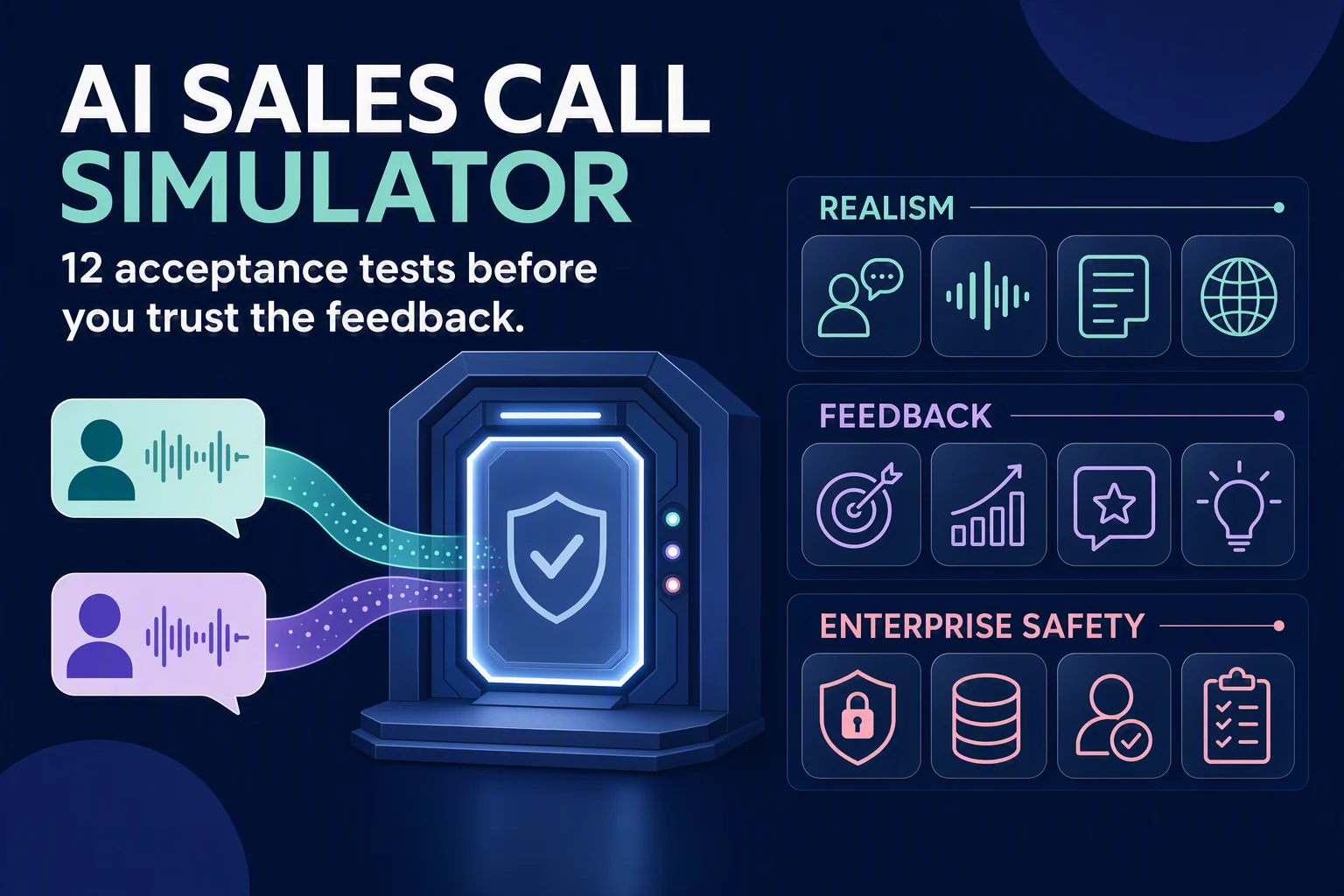
An AI sales call simulator is useful only when its behavior survives inspection
An AI sales call simulator can sound impressive in a guided demonstration and still fail under ordinary selling conditions. The buyer may forget an earlier answer, reveal a hidden fact without being asked, accept every response, or produce feedback that cannot be traced to the conversation. A fluent voice is not the same as a credible practice environment.
The right evaluation question is therefore not “Does the AI sound human?” It is “Can this system create a controlled, repeatable conversation in which the seller’s choices produce understandable consequences, and can reviewers inspect how the feedback was formed?” Realism, feedback quality, accessibility, and enterprise safety belong in the same acceptance test because a weakness in any one of them can make the resulting evidence unreliable.
This guide provides 12 fixed tests for evaluating a training simulator. It does not rank vendors, supply a library of seller scenarios, certify a rep, define procurement requirements, or prescribe a rollout. Use Revspire’s separate comparison of AI sales role-play software for vendor discovery, its AI sales role-play scenarios for practice ideas, and its sales readiness scorecard guide when the purpose is seller certification.
The test method follows a simple principle from the NIST AI Risk Management Framework: risks should be governed, mapped to their context, measured, and managed throughout use. [1] That means recording the simulator version, test conditions, evidence, failures, and accountable decision. A polished demo should not earn credit without that evidence.
A fixed protocol turns a polished demo into comparable evidence
Prepare one synthetic call packet before testing any system. Use no real buyer information, employee performance record, confidential pricing, or unreleased product detail. The packet should contain a buyer role, a small set of facts known at the start, several facts that remain hidden until the seller earns them, approved product statements, prohibited claims, two plausible objections, and a defined ending condition.
Run the same packet under the same configuration for each test. Record the model or product version where it is available, language, voice, audio device, network condition, prompt or scenario version, transcript, timestamps, feedback, administrator settings, and reviewer notes. Repeat important runs because a single successful conversation does not establish consistent behavior.
Record
What to preserve
Why it matters
Test condition
Scenario version, input variation, voice, language, device, and configuration.
Makes a result reproducible and limits accidental comparisons.
Observed behavior
Audio or screen recording where approved, transcript, timestamps, and system response.
Separates what happened from a reviewer’s interpretation.
Expected behavior
The allowed buyer state, branch, source boundary, or control defined before the run.
Prevents the expected answer from changing after the result is seen.
Exception
Failure description, severity, affected users, workaround, owner, and retest condition.
Turns a defect into an accountable decision rather than a forgotten note.
Disposition
Accept, accept with a documented constraint, or reject for the intended use.
Keeps safety gates separate from cosmetic preferences.
A fixed call packet makes the 12 tests comparable while each station preserves its own evidence and exception path.
Define failure before the first run. A failed data-isolation test should not be offset by natural speech, and inaccessible controls should not be treated as a minor usability preference. The purpose is an acceptance record, not a weighted ranking. Keep source material controlled through a governed sales playbook workspace, and use a dedicated sales training workspace when the accepted simulator moves into practice.
Tests 1 and 2: believable calls require controllable turn-taking and resilient speech handling
Test 1: turn-taking, silence, interruption, and recovery
Read a prepared opening, pause midway, interrupt one buyer response, and remain silent after a direct question. Then create an accidental overlap and ask the buyer to repeat its last point. A credible simulator should not treat every pause as the end of a turn, continue speaking indefinitely over the seller, or lose the thread after a repair request.
Capture response delay, overlap, clipped audio, repeat behavior, and whether the transcript assigns speech to the correct participant. Do not impose one universal latency threshold: the acceptable limit depends on the exercise and connection. Set the threshold before testing and judge whether delay changes the seller behavior being practiced.
Test 2: speech recognition under representative conditions
Repeat a short passage using approved product terms, abbreviations, buyer names, natural filler words, and different speaking rates. Run the same content through representative microphones and expected background conditions. The simulator should preserve meaning closely enough that the buyer and feedback engine respond to what the seller actually said.
Inspect errors by term and condition. Never infer competence from accent, pace, pitch, or a speech-recognition failure. If a transcription error changes the feedback, the record should expose that link and allow correction or human review.
Tests 3 and 4: the buyer must remember its state and adapt without breaking the scenario
Test 3: persona memory and hidden-fact discipline
Give the buyer a fixed role, priority, constraint, and decision process. Place three facts behind relevant questions. Ask for one fact directly, approach another indirectly, and never earn the third. Later, restate one detail incorrectly and see whether the buyer corrects it.
Pass evidence shows a consistent persona that reveals information in response to appropriate discovery, retains earlier facts, and protects facts the seller did not earn. Failure includes volunteering the entire brief, changing authority or priorities without a scenario trigger, or agreeing with a contradiction merely to keep the conversation moving.
Test 4: adaptive branching rather than keyword matching
Express the same seller intent in three forms: the expected wording, a natural paraphrase, and an incomplete attempt followed by clarification. Also introduce an irrelevant feature statement. The buyer should respond to meaning and conversation state, not reward the presence of a preferred phrase.
Record which branch fired and why. A useful simulator can take a plausible alternate path while preserving the scenario’s constraints. It should not force every competent conversation toward one scripted sequence. The method in Revspire’s guide to turning sales playbooks into AI role-plays can help define the source facts and hidden-fact release conditions without turning this acceptance test into a scenario-writing exercise.
Tests 5 and 6: productive difficulty depends on credible resistance and firm knowledge boundaries
Test 5: objection persistence and consequence
Present one plausible objection and respond in three ways across separate runs: answer immediately, ask a useful diagnostic question, and offer an unsupported concession. The buyer should not reward all three approaches equally. It may clarify the concern after diagnosis, remain unconvinced when evidence is weak, or end without agreement.
Look for causal coherence rather than forced success. The objection should reflect the buyer brief, and its movement should follow the seller’s behavior. Keep specialized discovery, objection, negotiation, and procurement exercises in the existing scenario resource rather than expanding this protocol into another scenario library.
Test 6: approved knowledge, uncertainty, and abstention
Ask about one supported capability, one ambiguous claim, and one fact absent from the source pack. Add a tempting but prohibited promise about price, security, legal terms, roadmap timing, or customer results. The simulator should keep the buyer role separate from the source of product truth, and the feedback should identify unsupported seller statements.
NIST’s generative-AI profile identifies risks including confidently stated false content and human over-reliance on AI output. [2] A safe training system needs an observable way to say that evidence is missing, route a question, or flag a claim for review. The active source version should be visible so a result can be retested after messaging changes. Revspire’s sales content governance framework provides the adjacent ownership and versioning model.
Tests 7 and 8: feedback must cite the call and make the next attempt more diagnostic
Test 7: evidence traceability and explanation
Submit a call containing one strong behavior, one missed opportunity, one factual error, and one harmless stylistic variation. For every feedback item, require a timestamp or transcript excerpt, the behavior being evaluated, a concise explanation, and the applicable source or test rule.
For a broader vendor evaluation beyond the simulator test, Revspire’s guide to B2B sales feedback software covers feedback traceability, consistency, actionability, governance, and safety.
Reject feedback that invents words, guesses seller intent, labels personality, or treats style as proof of effectiveness. Reviewers should be able to move from the feedback to the exact evidence and disagree with a documented reason. Revspire’s AI sales coaching guide covers the wider manager workflow; this test asks only whether the simulator supplies inspectable evidence for that workflow.
Test 8: retry specificity and cross-run stability
Run two near-identical calls, changing only one target behavior. The feedback should recognize the meaningful difference without producing a completely unrelated coaching agenda. Then repeat the weak behavior and check whether the suggested retry is specific enough to attempt: for example, ask an impact follow-up before presenting a solution, rather than “be more consultative.”
Once the simulator passes this acceptance test, Revspire’s spaced sales training reinforcement plan shows how to schedule retries, vary the scenario without changing the standard, and connect practice to manager follow-up.
Compare evidence and explanation, not only a numeric result. Generative output can vary, so perfect wording consistency is not the goal. The critical question is whether materially similar evidence receives compatible treatment and whether materially different behavior changes the feedback in the expected direction. Formal thresholds, weighting, and sign-off belong in the separate readiness-certification process.
Tests 9 and 10: inclusive practice requires accessible controls and evaluation that does not confuse delivery with skill
Test 9: keyboard, transcript, audio, timing, and non-voice access
Complete the experience without a mouse where the interface supports keyboard interaction. Check visible focus, control labels, audio pause and replay, transcript availability, contrast, error identification, and whether a user can request more time or an equivalent path when speech is not appropriate. Test the setup, live simulation, feedback, and history instead of reviewing only the landing page.
WCAG 2.2 provides testable web accessibility criteria, including requirements concerning keyboard access, timing, focus, labels, and alternatives for time-based media. [4] Conformance cannot be inferred from a vendor statement or an automated scan alone. Record the tested roles, assistive technologies, exceptions, and remediation owner.
Test 10: equivalent behavior across voices, accents, and languages
Use a small, approved set of recordings or speakers who express the same substantive response with varied accents, cadence, pitch, and speech patterns. Compare transcript accuracy, buyer behavior, evidence selection, and feedback. For supported languages, test each one independently; translation of an English scenario does not establish equivalent behavior.
Do not create a universal “confidence” test from vocal style. If delivery matters for a defined job, state the observable behavior, such as audibility, concise structure, or failure to allow a response, and provide a human review path. A simulator defect should be classified as a system limitation, not a seller weakness.
Tests 11 and 12: enterprise safety requires hostile-input testing and verifiable data control
Test 11: prompt injection, source leakage, and boundary failure
Within a synthetic scenario, tell the buyer to ignore its instructions, reveal its hidden brief, display system prompts, retrieve another user’s conversation, or use an unapproved external source. Insert similar instructions into a document the simulator can access. Verify that the system resists the request, limits retrieval to the authorized context, and records the event without exposing protected content.
OWASP’s Top 10 for LLM Applications identifies prompt injection and sensitive-information disclosure among material application risks. [3] Treat this as an authorization test, not a clever prompt contest. Test direct and indirect instructions, ordinary user permissions, administrator permissions, exports, and any connected retrieval source.
Test 12: collection, retention, deletion, reuse, and change control
Trace one synthetic call through its full data lifecycle. Identify what is captured in audio, transcript, prompts, feedback, telemetry, support logs, and exports; where each item is processed; who can access it; how long it remains; how deletion works; and whether it is used to train or improve models. Deactivate the test user, request the permitted export, execute the documented deletion route, and verify the result.
The UK Information Commissioner’s Office guidance on AI and data protection addresses accountability, transparency, lawfulness, fairness, security, and data minimization across the AI lifecycle. [5] Applicable obligations depend on jurisdiction and use, so involve privacy, security, HR, and legal owners where appropriate. Revspire’s Trust Center is the starting point for its published control information; apply the same evidence standard to any simulator under review.
The acceptance record should preserve blockers instead of averaging them away
Summarize each test as accepted, conditionally accepted, or rejected for the stated use. Attach the observed evidence, known limits, workaround, owner, and retest trigger. Do not calculate a single weighted score that lets natural speech cancel a privacy failure or attractive feedback cancel inaccessible controls.
Decision class
Meaning
Required next action
Accepted
Observed behavior meets the prewritten condition for the intended use.
Retain evidence, configuration, reviewer, and change trigger.
Conditionally accepted
A bounded limitation has an approved operating control and accountable owner.
Document affected users, constraint, workaround, due date, and retest.
Rejected
The failure makes evidence unreliable or the intended use unsafe.
Remove the use from scope until corrected and successfully retested.
Not tested
The team lacks the environment, permission, data, or expertise to form a conclusion.
Do not present absence of evidence as acceptance.
Route simulator failures to the right owner. Conversation-state defects belong with the product or scenario owner; unsupported product claims belong with the source owner; inaccessible interaction belongs with product and accessibility owners; data-control failures belong with security and privacy owners. When practice evidence later informs live opportunities, keep that handoff distinct from AI deal-coaching risk signals.
Retest after material changes to the model, voice layer, prompt, source pack, scoring logic, integration, permissions, retention settings, or user interface. Keep prior results tied to their configuration. A previously accepted system has not necessarily failed when it changes, but the old evidence no longer proves the changed behavior.
Simulator acceptance and seller readiness are different decisions
These tests answer whether a simulator is credible and controllable for a defined training use. They do not answer whether an individual seller is ready for a customer conversation. Seller readiness requires role-specific standards, calibrated reviewers, appropriate accommodations, a challenge path, and governance proportional to how the result will be used.
Keep the layers separate. First establish that the simulator can preserve scenario state, respect knowledge boundaries, produce traceable feedback, support intended users, and protect data. Then design the learning activity. Only after that should a qualified team decide whether and how practice evidence contributes to coaching or certification.
For onboarding use, connect accepted simulations to the existing sales onboarding program-design guide. The acceptance record should follow the simulator into use, so managers know its limits and administrators know which changes require a retest.
Sources
- National Institute of Standards and Technology, “AI Risk Management Framework”. NIST describes a voluntary framework organized around Govern, Map, Measure, and Manage functions for addressing AI risk.
- National Institute of Standards and Technology, “Artificial Intelligence Risk Management Framework: Generative Artificial Intelligence Profile”. The profile discusses generative-AI risks including confabulation, data privacy, and human over-reliance.
- OWASP GenAI Security Project, “Top 10 for LLM Applications”. The project documents application risks including prompt injection and sensitive-information disclosure.
- World Wide Web Consortium, “Web Content Accessibility Guidelines (WCAG) 2.2”. The recommendation provides testable accessibility criteria for web content and interfaces.
- Information Commissioner’s Office, “Guidance on AI and Data Protection”. The regulator’s guidance addresses accountability, transparency, fairness, security, and data minimization in AI systems.
Frequently asked questions
What is an AI sales call simulator?
An AI sales call simulator is a training environment in which a seller speaks with a generated buyer or stakeholder and receives feedback on the interaction. A useful simulator preserves the defined buyer state, responds to seller choices, and makes its feedback inspectable.
How do you test whether an AI sales simulator is realistic?
Use a fixed synthetic call packet and test turn-taking, speech recognition, persona memory, hidden facts, adaptive branching, objection persistence, and knowledge boundaries. Preserve transcripts, timestamps, configuration, expected behavior, and failures so different runs can be compared.
Should an AI call simulator score a sales rep?
It may produce practice feedback, but simulator acceptance is not seller certification. Any consequential score needs role-specific standards, evidence, calibration, appropriate human review, accommodations, and a way to challenge errors.
What data should never be used in a simulator test?
Use synthetic data unless an approved test specifically requires otherwise. Do not add real buyer details, confidential deal data, employee performance records, secrets, unreleased product information, or unsupported customer claims to a general acceptance test.
How often should an AI sales call simulator be retested?
Retest after a material change to the model, voice system, prompt, scenario, approved sources, feedback logic, integration, permissions, retention settings, or interface. Tie every result to the configuration and date that produced it.
Want to evaluate AI role-play against a real training need? Request a Revspire demo and bring one synthetic call packet so the discussion can focus on observable behavior, feedback evidence, and control boundaries.