Revspire blog
B2B Sales Feedback Software: How to Evaluate AI Coaching Quality
A practical framework for evaluating B2B sales feedback software across evidence quality, AI explanations, human review, workflow fit, and measurable behavior change.
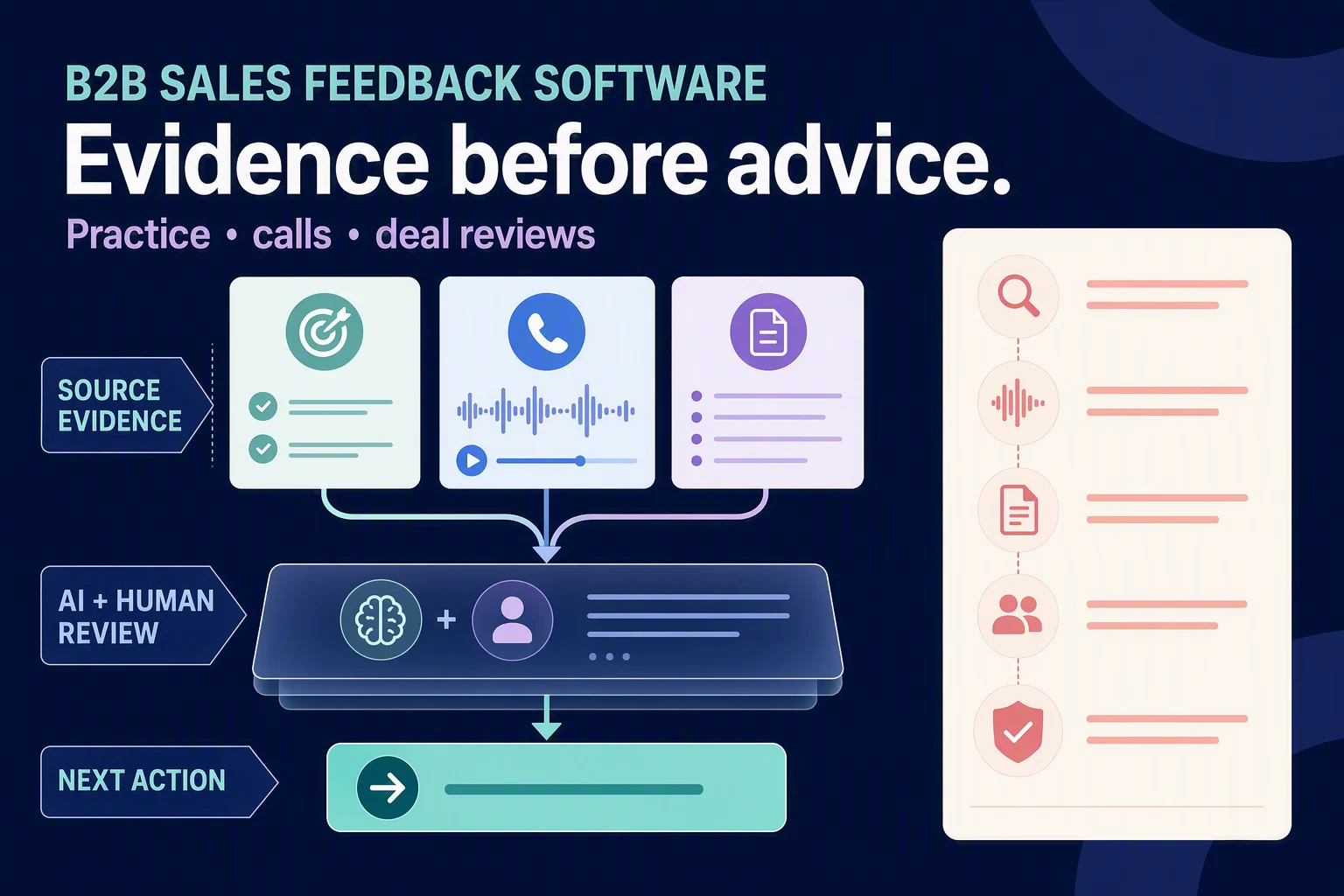
B2B sales feedback software should improve the next decision, not merely score the last one
B2B sales feedback software is useful when it helps a seller recognize a consequential choice, understand the evidence, and try a better action in the next conversation. A transcript summary, sentiment label, or numerical score may describe activity without producing that change. The real product is a dependable feedback loop: capture relevant evidence, interpret it within context, involve the right reviewer, turn the observation into a specific next step, and verify whether behavior improved.
That standard matters more as AI becomes the first reviewer. An automated system can process more practice sessions, calls, and deal records than a manager, but scale also multiplies weak assumptions. Feedback that sounds fluent may be unsupported, generic, inconsistent across groups, or impossible for a seller to challenge. NIST’s AI Risk Management Framework describes trustworthy AI through characteristics including validity and reliability, transparency, explainability, privacy, and fairness. [1] Those are practical buying criteria, not abstract ideals.
Objection handling is a useful test case because a strong coaching system must distinguish the buyer’s concern, cite the seller’s response, and recommend a bounded retry. Revspire’s objection-handling and AI practice guide provides a controlled workflow for running that test.
Begin with the coaching decision the software must improve. If leaders cannot name the user, evidence, behavior, and follow-up action, feature comparisons will reward attractive output instead of coaching quality. Revspire’s operational sales coaching measurement framework provides the broader measurement context; this guide concentrates on the feedback itself.
Map the complete feedback lifecycle before comparing features
Feedback is not one generated paragraph. It moves through a chain, and a failure at any point can make a correct-looking recommendation unusable. Map the lifecycle for one real coaching moment before discussing AI models or dashboards.
Stage
Question to answer
Evidence of quality
Trigger
What event makes feedback valuable now?
A completed practice, reviewed call, changed deal condition, or manager request.
Evidence
Which observable words, actions, and context support the observation?
Time-coded call moments, scenario turns, CRM changes, or cited approved guidance.
Interpretation
What behavior occurred, and what remains uncertain?
A bounded claim that distinguishes observation from inference.
Coaching action
What should the seller or manager do next?
One prioritized behavior, an example, and a realistic opportunity to apply it.
Review
Who can accept, correct, escalate, or dismiss the feedback?
Visible ownership, rationale, edit history, and an appropriate human route.
Verification
Did the behavior appear again in a relevant setting?
A comparable later observation rather than course completion or a login.
Assign an owner and retention rule to every stage. A manager may own coaching priority, enablement may own examples, operations may own data definitions, and a content owner may control the approved source. The most suitable pattern will depend on the coaching motion; Revspire’s guide to sales coaching frameworks helps clarify that operating choice. Also inspect the rep-performance coaching mistakes that can persist even when the technology works.
Separate observation, interpretation, and recommendation
A defensible feedback record separates what happened from what it may mean and what the seller should try next.
High-quality feedback makes its reasoning inspectable. It first identifies what happened, then explains why that evidence may matter, and finally proposes an action. Combining all three into a confident verdict hides uncertainty and makes correction difficult.
Teams can apply that separation with these sales coaching templates for an evidence log, feedback form, action tracker, and review record. Each artifact keeps source, interpretation, requested behavior, ownership, and human review explicit.
- Observation: “The buyer named two implementation risks at 14:08 and 16:31; the seller moved to pricing without confirming either one.”
- Interpretation: “The transition may have left the buying criteria unresolved.”
- Recommendation: “At the next meeting, restate both risks, ask which is decision-critical, and agree on the evidence required.”
The system should link an observation to its source and label inference honestly. It should also show which playbook, coaching standard, or manager instruction informed the recommendation. A generic “improve discovery” message offers neither evidence nor a rehearseable action.
Scores can support prioritization, but they should not replace the explanation. If a separate readiness or certification process needs a calibrated rubric, use the sales readiness scorecard guide. Feedback software has a different job: help a person understand and improve a behavior while preserving the evidence behind that advice.
Evaluate coaching quality with six observable tests
A useful evaluation model examines the feedback, not just the feature that produced it. Test representative outputs against the same six dimensions and record disagreements rather than averaging them away.
Quality dimension
Strong feedback
Failure signal
Grounded
Cites the relevant turn, field, artifact, or approved source.
Introduces a fact or behavior that cannot be located.
Specific
Names one consequential behavior and its context.
Uses generic praise, personality labels, or broad advice.
Proportionate
Matches confidence and urgency to the available evidence.
Treats a weak signal as a definitive judgment.
Actionable
Provides a concrete next behavior and when to use it.
Describes the problem without a feasible next step.
Consistent
Applies the stated standard similarly across comparable cases.
Changes expectations with wording, accent, role, or reviewer.
Contestable
Lets the user inspect, correct, and route disputed output.
Hides the source, rationale, version, or appeal path.
Use “not enough evidence” as a valid outcome. A system that always produces a coaching point will manufacture certainty when a recording is incomplete, speakers are mislabeled, deal context is stale, or the approved standard does not address the situation. NIST’s generative-AI profile identifies risks including confident false output, privacy concerns, bias, and inappropriate human reliance. [2] The product should expose those boundaries in normal use.
When comparing capabilities, use the broader AI sales role-play software evaluation guide for platform context, but keep this review focused on the quality and movement of feedback rather than a vendor shortlist.
Test AI feedback against a governed evaluation set
A polished demonstration cannot show how feedback behaves across normal variation. Build a small, governed evaluation set from sanitized or synthetic examples that represent the decisions the system will encounter. Include strong and weak performance, ambiguous evidence, incomplete recordings, different sales motions, regional language, technical terminology, and cases where the correct response is to defer to a manager.
For each case, record the source evidence, acceptable observations, prohibited claims, useful next actions, and review owner. Do not require one exact sentence. Multiple coaching responses may be valid if they remain grounded and lead to the intended behavior. Track unsupported claims, missed critical moments, incorrect source use, harmful or irrelevant advice, and unwarranted certainty separately; a single average can hide a severe failure.
Re-run a stable subset after prompt, model, transcription, source, or policy changes. Version the evaluation set and record why examples were added or retired. NIST’s AI RMF Playbook organizes risk work through Govern, Map, Measure, and Manage activities. [3] That cycle fits feedback systems: define accountability, map the use context, measure representative behavior, and manage failures after release.
Human review should be designed into the coaching path
“Human in the loop” is meaningful only when the human has time, evidence, authority, and a clear decision. Decide which feedback can go directly to a seller, which requires manager review, and which must never trigger a personnel or certification consequence without separate evidence and due process.
- Let sellers flag wrong speaker attribution, missing context, stale guidance, or an unsupported inference.
- Let managers accept, edit, dismiss, or replace advice while preserving the original and rationale.
- Route repeated source errors to content owners and repeated system errors to the accountable product or operations owner.
- Separate developmental coaching records from formal employment decisions and apply the organization’s access and retention policies.
The ICO’s guidance on explaining AI-assisted decisions emphasizes explanations that are meaningful in context and understandable to the affected person. [4] The UK government’s transparency and accountability framework likewise treats governance, meaningful information, and routes for challenge as operating responsibilities. [5] Even where those documents are not legally controlling, they provide useful design questions. Revspire’s AI sales coaching guide adds program context for dividing work between automation and managers.
Practice, calls, and deal reviews need different feedback contracts
The same feedback engine should not treat every surface as interchangeable. Practice is designed for experimentation, calls capture real buyer interactions, and deal reviews combine partial evidence with commercial judgment. Define a separate contract for each.
Surface
Appropriate evidence
Useful feedback
Important boundary
Practice
Scenario turns, supplied context, expected behaviors, and repeated attempts.
Immediate, low-stakes guidance followed by another attempt.
Do not present simulated performance as proof of customer-call performance.
Recorded call
Transcript, audio, speaker labels, meeting context, and cited moments.
A small number of evidence-linked observations for the next similar call.
Respect consent, access, recording, retention, and regional requirements.
Deal review
Call evidence, CRM history, buyer activity, stage criteria, and seller context.
Questions about risk, evidence gaps, and the next decision to validate.
Do not convert incomplete deal data into certainty about buyer intent.
Manager observation
Direct observation plus the team’s agreed coaching standard.
Contextual judgment, priority, and follow-through.
Make subjective inference visible rather than disguising it as system fact.
Peer feedback
Shared artifact or observed behavior under a bounded prompt.
Examples, alternatives, and reflection from credible peers.
Control visibility and prevent popularity from becoming a quality measure.
For practice design, link to the existing AI sales role-play scenarios rather than recreating a scenario library. For real conversations, use the call coaching and review guide. For opportunity judgment, the deal-level coaching guide defines the manager’s broader role.
Evidence, permissions, and version history are product capabilities
Feedback quality depends on what the system knew at the time. Preserve the source reference, transcript or artifact version, coaching standard, model or workflow version, generated output, human edits, and disposition. That trail lets an owner investigate why advice changed instead of debating screenshots.
Permissions should follow the underlying context. A peer invited to review a practice attempt does not automatically need access to an active deal. A manager moving teams should not retain prior access. A global enablement administrator may need aggregate patterns without unrestricted access to every recording. Test export, deletion, reassignment, legal hold, and source revocation as part of normal administration.
Inspect transcription and identity quality before judging coaching quality. Incorrect speaker attribution, domain vocabulary, overlapping speech, or a missing section can invalidate a confident observation. A system should retain the uncertainty, enable correction, and avoid using a disputed record as future truth. The conversation intelligence guide provides the adjacent call-data context.
Measure feedback by behavior change, coverage, and correction cost
Volume is not value. Counts of generated tips, completed reviews, or positive reactions can rise while managers spend more time correcting output and sellers ignore repetitive advice. Use a balanced measurement chain.
- Coverage: eligible coaching moments with sufficient evidence, segmented by surface and role.
- Quality: grounded, specific, proportionate, actionable, consistent, and contestable feedback in a reviewed sample.
- Use: whether feedback was opened, discussed, accepted, edited, dismissed, or routed rather than merely delivered.
- Behavior: the targeted action observed in a comparable later moment.
- Correction cost: manager time, seller dispute time, source repair, and system maintenance.
- Outcome: the commercial or operational result plausibly connected to the behavior, with attribution limits recorded.
Watch for gaming. If a dashboard rewards talk-time balance, sellers may optimize the ratio instead of improving discovery. If managers are measured on completed reviews, they may approve shallow feedback quickly. Use metrics as investigation signals, review counterexamples, and change incentives when the measure becomes the target.
Feedback should also stay aligned with current guidance. The process for converting sales playbooks into practice and coaching explains why source ownership, versioning, and maintenance matter when advice depends on approved messaging.
Run a bounded evaluation that exposes workflow quality
Evaluate one or two material coaching workflows with representative users. Include sellers, frontline managers, enablement, operations, security or privacy owners, and the people responsible for source content. Use normal examples, edge cases, and deliberately incomplete evidence. The goal is to discover how the system behaves, not to maximize a presentation score.
- Define the coaching decision. Name the user, surface, target behavior, evidence, next action, and human owner.
- Prepare the evaluation set. Sanitize examples, document expected boundaries, and include cases that should produce uncertainty or escalation.
- Observe the workflow. Let intended users find, review, correct, discuss, assign, and revisit feedback without facilitator shortcuts.
- Sample output quality. Review each quality dimension and severe-error category separately. Record who disagreed and why.
- Test administration. Change a source, revoke access, correct a transcript, update guidance, export a record, and trace the resulting version history.
- Measure follow-through. Verify whether a targeted behavior appears in a later comparable moment and calculate correction cost.
A manager agreeing with AI does not prove accuracy; both may share the same missing context. A seller disagreeing does not prove error; difficult feedback can still be well grounded. Resolve disputes against evidence and the declared standard. Keep formal readiness, certification, procurement, and implementation decisions in their own processes rather than stretching this feedback evaluation into a universal assessment.
Choose software that keeps evidence and action connected
The strongest B2B sales feedback software does not promise a perfect automated coach. It makes useful feedback repeatable, inspectable, correctable, and appropriately human. It carries evidence into the coaching conversation, makes uncertainty visible, protects context, and helps the team verify the next behavior.
Before deciding, ask whether a seller can locate the evidence, understand the inference, act on one priority, and challenge a mistake. Ask whether a manager can add context without rebuilding the record, whether an owner can trace changes, and whether leaders can distinguish feedback volume from behavior change. If those paths work under ordinary conditions, AI can expand coaching coverage without severing judgment from evidence.
Sources
- National Institute of Standards and Technology, “AI Risk Management Framework”. NIST describes a voluntary framework for managing AI risks and improving trustworthy and responsible AI use.
- National Institute of Standards and Technology, “Artificial Intelligence Risk Management Framework: Generative Artificial Intelligence Profile”. The profile identifies generative-AI risks and suggested risk-management actions.
- National Institute of Standards and Technology, “AI RMF Playbook”. The playbook provides suggested actions across the Govern, Map, Measure, and Manage functions.
- UK Information Commissioner’s Office, “Explaining Decisions Made With AI”. The guidance addresses meaningful explanations for people affected by AI-assisted decisions.
- UK Government, “Ethics, Transparency and Accountability Framework for Automated Decision-Making”. The framework sets out governance, transparency, fairness, and accountability considerations for automated decisions.
Frequently asked questions
What is B2B sales feedback software?
It captures evidence from practice, calls, deal reviews, or manager observation and turns that evidence into coaching a seller can understand and apply. Strong software also supports human review, correction, permissions, version history, and verification of later behavior.
How is sales feedback software different from conversation intelligence?
Conversation intelligence primarily captures and analyzes customer conversations. Feedback software connects observations across calls, practice, deal reviews, managers, and peers to a governed coaching action. One product may provide both, but the workflows and quality tests remain distinct.
Can AI replace a sales manager’s feedback?
AI can expand coverage, surface evidence, and suggest next actions. Managers still supply commercial context, prioritize behaviors, resolve disputed interpretations, and judge when evidence is sufficient. High-consequence employment or certification decisions need separate governance and human accountability.
How should a team test AI coaching quality?
Use a versioned evaluation set with representative, ambiguous, incomplete, and boundary cases. Review grounding, specificity, proportionality, actionability, consistency, and contestability, then track severe errors and correction cost separately from an average score.
Which metric matters most for sales feedback software?
No single metric is enough. Pair feedback coverage and reviewed quality with use, later behavior, correction cost, and a relevant outcome. Generated-feedback volume or seller satisfaction alone cannot show that coaching was accurate or effective.
Ready to evaluate a feedback workflow using your own evidence? Request a Revspire demo and bring one coaching moment, its source evidence, and the next behavior your team wants to improve.