Revspire blog
Sales Readiness Scorecards: Weighted Rubrics for AI Role-Plays and Seller Certification
A practical framework for designing weighted, evidence-based scorecards that make AI role-play feedback useful for coaching and defensible for seller certification.
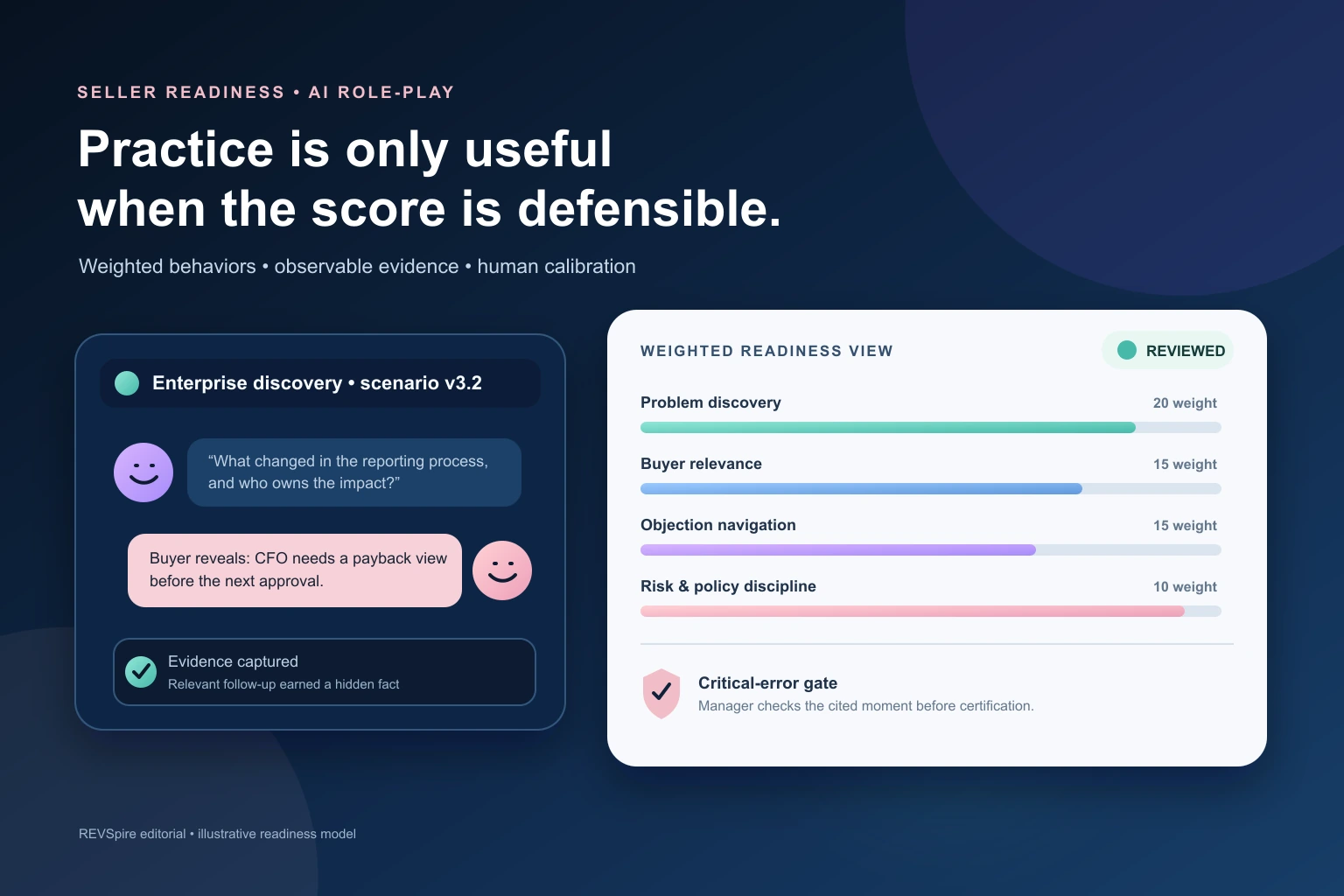
AI role-play only becomes a readiness signal when the score means something
AI role-plays can give sellers more chances to practice difficult conversations: a rushed discovery call, a skeptical executive, an objection that should not be answered with an unapproved claim, or a procurement handoff with incomplete information. The hard part is not generating the conversation. It is deciding what a good response looks like, applying that standard consistently, and using the result responsibly.
That is the job of a sales readiness scorecard. A useful scorecard is a weighted rubric: it separates the few behaviors that matter in a specific selling motion, assigns their relative importance, and ties every rating to evidence a manager can inspect. It should make a rep’s next practice attempt clearer—not produce a mysterious number.
This matters as teams expand AI coaching in 2026. Generative systems can sound confident while producing wrong content; NIST calls this risk confabulation . [1] The answer is not to avoid AI practice. It is to design the workflow so an AI score is traceable to approved scenario facts and observable seller behavior, with an accountable human decision where the stakes require one.
Revspire’s sales training workspace is designed around AI-powered role-play, asynchronous video challenges, battle cards, and evaluation feedback. The framework below is platform-neutral: use it to improve any role-play program, then test whether your chosen technology can preserve the evidence, versioning, review, and retry loop the program needs.
For surrounding program design, see Revspire’s AI sales coaching guide for revenue leaders and its comparison of AI sales coaching versus a traditional LMS. This article focuses on the narrower scorecard and certification layer.
To test the feedback system behind the score, use Revspire’s B2B sales feedback software guide for evidence-traceability, consistency, actionability, and governance checks.
For platform selection, compare AI sales role-play software; for ready-to-adapt discovery, objection, negotiation, and procurement exercises, use the AI sales role-play scenarios. Keep the approved source material in a governed sales playbook workspace so each scenario and rubric can be reviewed when guidance changes.
A scorecard is not a checklist
A checklist asks whether a rep mentioned a feature, used a phrase, or completed a step. That can be useful for controlled messaging, but it is weak evidence of selling judgment. A scorecard asks whether the rep did the right thing for the buyer’s situation and can show the moment that supports the rating.
Weak scoring pattern
Why it fails
Evidence-based alternative
“Asked discovery questions”
Rewards volume rather than relevance.
“Asked a follow-up that connected the stated workflow problem to an owner, impact, or decision.”
“Handled the objection”
Does not show whether the response was accurate or advanced the conversation.
“Acknowledged the concern, tested the underlying assumption, used approved evidence, and agreed a next step.”
“Demonstrated confidence”
Invites subjective judgments about style.
“Used a clear structure, made no unsupported promise, and paused to confirm buyer understanding.”
“Passed certification”
Hides the conditions and scenario version behind a binary label.
“Met the scenario’s weighted threshold, cleared all critical-error gates, and has a review record.”
A delivery or confidence score can support low-stakes coaching when it is tied to observable behaviors. Do not use a subjective impression of charisma, accent, or style as a certification signal; define, validate, and govern any rating that could affect an employment decision.
Start by writing the claim a certification is meant to make. “Qualified to deliver the approved enterprise discovery conversation for product launch version 3.2” is a controllable claim. “Ready to sell” is not. The narrower statement gives enablement a clear scenario, a defined audience, approved source material, and a date when the standard must be reviewed.
How to build a sales readiness scorecard and weight the dimensions
Choose four to seven dimensions that represent the selling work, not the AI tool’s default labels. Interview experienced managers, review approved call guidance, and inspect a small set of representative calls or deal reviews. The result should be a short set of behaviors that distinguish a safe, useful conversation from a polished but ineffective one.
Copyable AI role-play scorecard template
Copy the columns below into your readiness system, then replace the example behaviors, weights, and critical errors with standards approved for your role and selling motion. This enterprise-discovery example is a starting template, not an industry benchmark. Change the weights before assigning a cohort, especially when compliance, technical qualification, or partner selling changes the risk.
Dimension
Weight
What earns credit
Critical-error example
Problem discovery
20
Uses relevant open and follow-up questions to establish process, impact, and owner.
Moves to a solution without testing the stated problem.
Buyer relevance
15
Connects the conversation to the buyer’s role, priority, and stated context.
Uses an irrelevant or generic pitch after contrary evidence appears.
Value hypothesis
15
Summarizes an outcome hypothesis in the buyer’s language and asks for confirmation.
Presents an invented result, customer proof point, or ROI claim.
Objection navigation
15
Acknowledges, diagnoses, responds with approved material, and checks whether the concern changed.
Dismisses a valid concern or makes an unapproved commercial concession.
Conversation control
10
Uses a clear structure, listens, and keeps the discussion proportional to the buyer’s answer.
Talks over the buyer or ignores a direct question.
Next-step discipline
15
Confirms purpose, participants, preparation, and date for a mutually useful next step.
Claims commitment when the buyer did not agree.
Risk and policy discipline
10
Stays within approved claims and routes unknown security, legal, pricing, or roadmap questions appropriately.
Gives a prohibited, fabricated, or confidential answer.
Weights express risk and importance. A sentence in the middle of a discovery conversation should not carry the same consequence as an invented security commitment. That is why a weighted total needs a separate critical-error gate: no strong score in other dimensions should erase a prohibited claim.
Use a consistent four-point scale for each dimension. For example: 0 = absent, unsafe, or contrary to the brief; 1 = attempted but incomplete or unsupported; 2 = adequate and evidence-based; 3 = strong, buyer-specific, and advances the stated objective. Write one or two observable anchors for each dimension at levels 0, 2, and 3. Anchors prevent evaluators from treating eloquence as competence.
Calculate the total as sum(weight × rating ÷ 3) . This converts the example above to a 100-point scale. Set a provisional threshold only after scoring a pilot cohort and reviewing the distributions and evidence. An 80 may be sensible for one controlled product launch and wrong for another. Publish the scenario version, weights, rating anchors, threshold, and critical-error rules with the certification—not only the final score.
Give the AI a bounded job
An AI evaluator should identify candidate evidence, apply the published rubric, explain the rating, and route uncertainty. It should not silently invent a standard or make an unreviewable employment decision. NIST’s AI Risk Management Framework is voluntary guidance for incorporating trustworthiness considerations into AI design, development, use, and evaluation. [2] That is a practical model for readiness programs: govern the policy, map the context, measure the output, and manage exceptions.
For each scenario, provide the system with a small scenario contract:
- Objective: the one behavior or decision being tested.
- Buyer state: role, incentives, known facts, and facts revealed only after a relevant question.
- Approved source: the versioned messaging, battle card, policy, and escalation path the seller may use.
- Rubric: dimensions, weights, rating anchors, and critical-error conditions.
- Evidence format: timestamp or transcript excerpt, rating, short rationale, and recommended retry.
- Human route: the owner for a challenged score, a model failure, or a policy-sensitive response.
Ask the evaluator to quote the observed behavior or transcript segment for every score. If it cannot find evidence, it should return “insufficient evidence,” not infer intent. The generative-AI profile from NIST also identifies over-reliance and automation bias as risks in human–AI configurations. [1] A manager who sees the evidence is therefore part of the control, not an expensive fallback.
Calibrate before calling it certification
Calibration resolves disagreement by refining the evidence anchor and rescoring the design set—not by averaging ratings.
Calibration is the practice of checking whether qualified reviewers interpret the rubric in a sufficiently consistent way. It is what turns a well-written scorecard into an operating standard.
- Run a design set. Have two or more qualified reviewers independently score a small, anonymized set of recordings or transcripts. Include clear, borderline, and unsafe responses.
- Compare the evidence, not just the totals. Discuss where reviewers chose different excerpts or read an anchor differently. Refine the scenario, anchors, or source material before changing a seller’s result.
- Check the AI against the reviewed standard. Compare the AI’s dimension ratings and cited evidence with the adjudicated record. Track recurring disagreement by scenario version, buyer persona, accent or language, and dimension.
- Keep a sample review cadence. Re-score a rotating sample after launch and whenever the model, prompt, rubric, product messaging, or policy changes.
- Provide a challenge path. A seller should be able to request review, see the evidence, and receive the disposition. Log overrides and the reason for them.
This approach follows ordinary test-design discipline without pretending a role-play rubric is a clinical instrument. The joint AERA, APA, and NCME testing standards address technical issues in test development and use in employment settings. [3] If a result will affect promotion, compensation, assignment, or continued employment, involve HR and legal early. The EEOC explicitly lists performance tests, simulations, and work samples as examples of selection procedures, and advises that employment tests be properly validated for the positions and purposes for which they are used. [4]
Design a certification path that supports practice
Certification should be a sequence, not a single high-stakes recording. Give sellers access to the scenario contract and approved resources, allow low-stakes practice, show evidence-based feedback, and then assign the formal attempt. For a product launch, the path might include a short knowledge check, a discovery role-play, an objection role-play, and manager review of a sample or an exception. Teams building that sequence can pair this with Revspire’s sales onboarding program-design guide.
For a late-stage practice scenario, Revspire’s guide to 12 sales-closing techniques and AI practice provides observable decision moments that can be converted into a calibrated role-play and manager-review workflow.
Use a score-to-sign-off workflow
- Score: apply the published rubric and cite the observed evidence for every rating.
- Remediate: assign one specific coaching action for the highest-impact behavior gap or any critical error.
- Retry: let the seller repeat the same skill in a comparable buyer condition, then compare and retain both attempts according to policy.
- Manager sign-off: route formal certification, challenged scores, and policy-sensitive exceptions to the accountable reviewer.
Deliberate practice research describes practice as structured activity designed to improve performance, with feedback and opportunities to correct errors. [5] In practical terms, a failed attempt should say what to practice next: “ask an impact follow-up before offering a demo,” rather than “improve discovery.” A retried skill is more useful than a leaderboard rank.
Keep developmental coaching separate from the formal certification record. The sales coaching evidence log, feedback form, and action tracker templates provide a connected place for the cited attempt, one requested behavior, retry, and human review without silently turning coaching notes into a certification decision.
Use a certification record that includes the scenario and rubric versions, attempt date, score by dimension, critical-error result, AI evidence, human reviewer if applicable, status, expiry or review date, and override history. Revspire’s partner portal also describes training and certification features for channel programs; the same version-and-evidence discipline is valuable when a company extends readiness requirements to partners.
Measure program health, not just average score
A rising average can mean sellers improved, the scenario became easier, the rubric drifted, or the AI became more lenient. Pair outcome numbers with diagnostic measures:
Measure
Question it answers
Action if it moves unexpectedly
Completion and retry rate
Are sellers getting enough practice opportunity?
Check assignment design, manager follow-up, and friction in the experience.
Dimension-level distribution
Which behavior is persistently weak?
Improve the battle card, coaching content, or scenario—not only the threshold.
Critical-error rate
Where could customer or policy risk appear?
Review source material, escalation routes, and whether the simulator is triggering the risk realistically.
Human–AI disagreement
Is the automated evaluation behaving predictably?
Recalibrate anchors, prompts, and model configuration; do not bury overrides.
Version performance
Did a change in product, policy, or scenario change the signal?
Keep results comparable only within a documented version or re-baseline.
Connect these leading measures to a business conversation carefully. The Revspire guide to sales enablement metrics is a useful related read for the broader measurement discussion. Do not claim that a role-play score caused a win rate, ramp-time, or revenue change unless the organization has a credible design and data to support that conclusion.
A 30-day implementation plan
- Week 1: define the claim. Select one role, one motion, one high-value scenario, the approved sources, and the decision the certification may or may not support.
- Week 2: build and calibrate. Draft the scenario contract and anchors; run the design set; agree the critical-error and challenge rules.
- Week 3: pilot with a small cohort. Collect completion, evidence quality, reviewer disagreement, and seller feedback. Fix the system before raising the stakes.
- Week 4: launch with governance. Publish version ownership, review cadence, retention and access controls, and a dashboard for the measures above.
The goal is not a perfect universal score. It is a standard your managers can explain, your sellers can improve against, and your organization can govern as products, messages, and AI capabilities change. For an illustrative composite of launch-readiness work in a regulated setting—not a customer-verified result—see how a medical diagnostics provider could accelerate launch readiness. For teams that want AI role-play alongside governed sales enablement, request a Revspire demo with one real scenario and draft rubric in hand.
Sources
- NIST AI 600-1, Generative Artificial Intelligence Profile (July 2024). The profile defines confabulation and identifies over-reliance and automation bias among human–AI risks.
- NIST AI Risk Management Framework 1.0 (January 2023). NIST describes the voluntary framework for incorporating trustworthiness considerations into the design, development, use, and evaluation of AI systems.
- AERA, APA, and NCME, Standards for Educational and Psychological Testing (2014 edition). The standards cover professional and technical issues in test development and use, including employment contexts.
- U.S. Equal Employment Opportunity Commission, Employment Tests and Selection Procedures. The guidance covers performance tests, simulations, and work samples and advises validation for the position and purpose.
- Ericsson, Krampe, and Tesch-Römer, “The Role of Deliberate Practice in the Acquisition of Expert Performance” (1993). The paper describes structured practice designed to improve performance, supported by feedback and repeated correction.
Frequently asked questions
How do you calculate a weighted sales readiness score?
Rate each rubric dimension from 0 to 3 against defined anchors, calculate weight × rating ÷ 3 , and add the dimension results for a score out of 100. For example, a 20-point dimension rated 2 out of 3 contributes 13.3 points. Keep critical-error rules separate from the total so a prohibited claim cannot be offset by strengths elsewhere.
What is a good passing score for an AI sales role-play?
There is no universal passing score. Pilot the scenario with qualified reviewers, inspect the evidence behind the distribution, and set a threshold appropriate to the specific role, motion, and risk. Document the decision and recalibrate when the scenario changes.
Can an AI score certify a seller on its own?
AI can provide fast evidence and consistent first-pass scoring, but a certification workflow should include defined governance, an appeal route, and human oversight for exceptions or decisions with meaningful employment consequences.
How many criteria should a sales certification rubric include?
Usually four to seven dimensions is enough to express the job without making scoring unmanageable. Each dimension should be observable, distinct, and relevant to the scenario; split broad categories only when the coaching or risk action would differ.
How often should sales scorecards be recalibrated?
Recalibrate on a regular sample-review cadence and whenever the scenario, product messaging, policy, model, prompt, or intended use changes. Track version history so scores are interpreted in their original context.