Revspire blog
How to Turn Sales Playbooks Into AI Role-Plays, Quizzes, and Coaching
A practical method for turning approved sales playbooks into practice experiences that test judgment, surface coaching evidence, and remain maintainable as messaging changes.
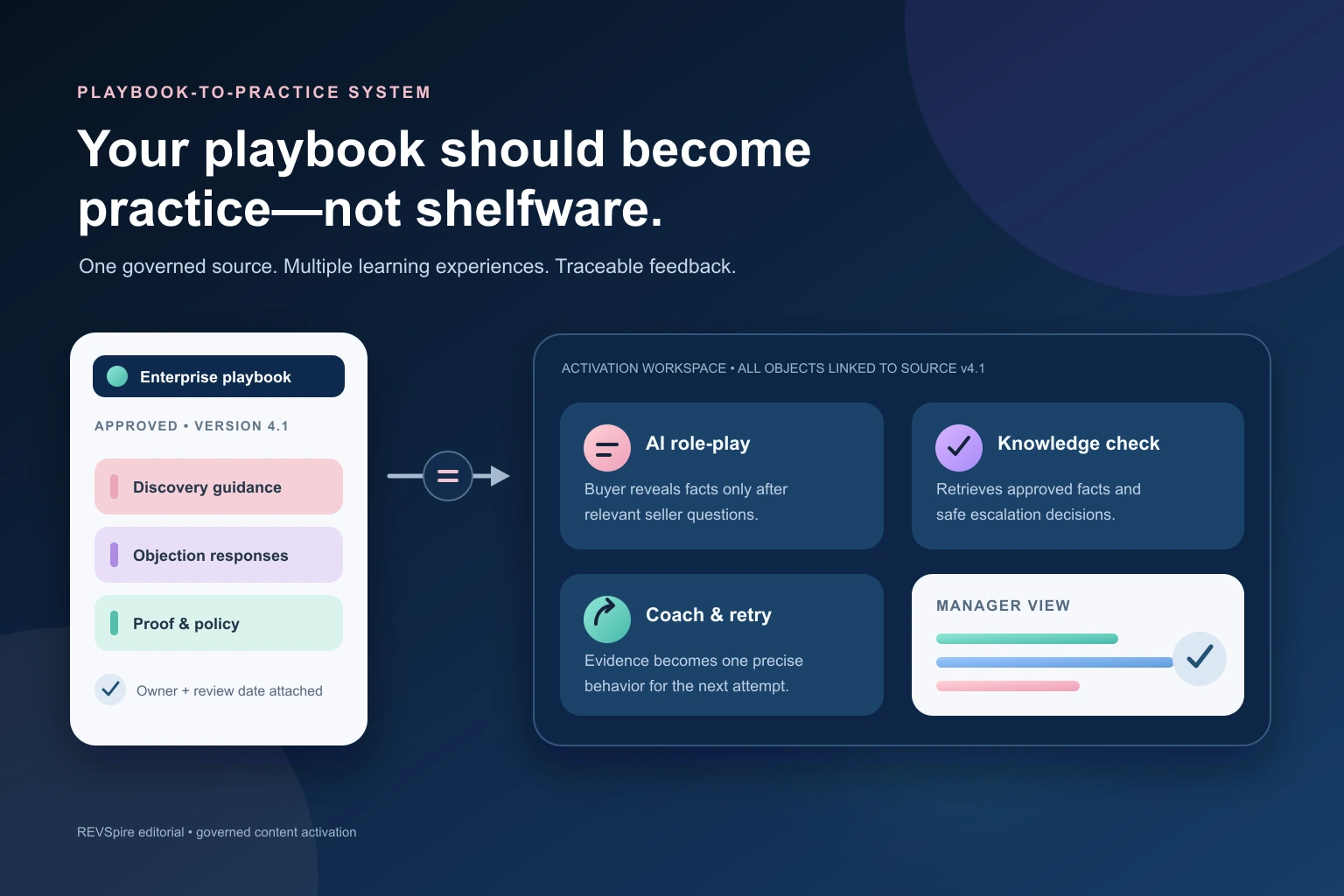
A playbook is only useful when sellers can apply it under pressure
Most sales playbooks begin life as useful source material: positioning, discovery guidance, proof points, objection responses, deal-stage actions, and rules about what a seller may not promise. The problem arrives when the document becomes the finish line. A seller can open a page, recognize familiar language, and still struggle to decide what to ask when a buyer changes the subject or challenges a claim.
Turning a playbook into AI role-plays, quizzes, and coaching closes that gap. It converts approved knowledge into a set of choices a seller must make, captures the evidence behind those choices, and gives a manager a concrete coaching moment. Done poorly, it creates hundreds of generic prompts that drift away from the source. Done well, it creates a governed practice system that stays connected to the current playbook.
In 2026, the design question is not simply whether an AI can produce a buyer persona or a quiz. It is whether the practice experience is grounded in approved material, handles the right kind of seller judgment, and can be updated when messaging, policy, or product facts change. NIST’s generative-AI profile warns that models can produce confidently stated but erroneous content—a risk it calls confabulation . [1] That makes source control and evidence-linked feedback central to enablement quality.
Revspire’s playbook workspace and sales training workspace provide a useful example of the connected problem: playbook guidance, battle cards, role-play, and feedback should reinforce the same approved selling motion. The method below can be used with any toolset, as long as the owner can version content, trace an exercise back to its source, and review what the system actually evaluated.
Start with a playbook inventory, not a prompt
Do not copy an entire playbook into an AI prompt and ask it to “create training.” A playbook contains different kinds of information, and each needs a different learning interaction. Begin with a small inventory of the claims and decisions that matter most for one role and one sales motion.
Playbook element
What it is for
Best activation format
Evidence to capture
Positioning statement
Explain a customer-relevant problem and outcome.
Role-play opening or concise-message exercise.
Seller uses approved language in a buyer-specific way and checks relevance.
Discovery guidance
Understand process, impact, stakeholders, and decision path.
Branching role-play with hidden facts.
Questions and follow-ups that earn each hidden fact.
Proof point or customer story
Support a claim with approved evidence.
Scenario selection or short-answer quiz.
Correct proof point, stated limits, and a buyer-relevant bridge.
Objection response
Diagnose the concern before responding.
Role-play with an interruption or skeptical buyer.
Acknowledgment, clarifying question, approved response, and confirmation.
Competitive or battle-card guidance
Differentiate without inventing or disparaging.
Claim sorting quiz plus role-play.
Chosen evidence and any safe escalation.
Policy or escalation rule
Prevent unsafe pricing, security, legal, or roadmap commitments.
Decision quiz with a critical-error gate.
Correct route, owner, and follow-up commitment—not an improvised answer.
The source-to-practice graph makes every affected exercise discoverable when messaging or policy changes.
Each line should have an accountable owner, source URL or asset ID, version, effective date, audience, and review date. If no one owns a claim, it should not become a graded question. This modest inventory is the bridge between content governance and readiness. It also reveals duplicate or conflicting guidance before the AI repeats it at scale.
Use the right conversion pattern for the behavior
A quiz and a role-play are not interchangeable. A quiz is useful when a seller needs to retrieve a policy, identify a supported proof point, or choose the correct next action from a bounded set. A role-play is useful when the seller must listen, diagnose, adapt, and earn a next step in a conversation. Coaching is useful when the evidence points to a habit that needs practice across attempts.
Closing is a useful example of this distinction: sellers need judgment practice, not memorization of a “magic phrase.” Revspire’s sales-closing and AI practice guide provides 12 techniques that can be converted into controlled scenarios with explicit buyer conditions.
If the playbook requires the seller to…
Convert it into…
Avoid…
Recall an approved fact
A short retrieval question with plausible distractors and an explanation.
Trivia that tests a word-for-word memory of a page heading.
Choose a safe path
A decision question with a policy citation and explanation of why alternatives are unsafe.
A question where several answers are technically defensible but only one is marked correct.
Ask, listen, and diagnose
A buyer scenario with hidden facts released only after relevant follow-ups.
A persona that volunteers the answer regardless of the seller’s questions.
Respond to an objection
A constrained role-play that scores acknowledgment, diagnosis, approved evidence, and next step.
Rewarding a polished response that gives an unsupported promise.
Deliver a concise message
A recorded or spoken challenge with time, audience, and proof-point constraints.
Scoring charisma or accent rather than clarity, accuracy, and buyer relevance.
Use a process consistently
A coaching checkpoint tied to a call review, deal review, or follow-up task.
Assuming a completed quiz proves transfer to live selling.
Retrieval practice deserves a deliberate place in the flow. Roediger and Butler’s review describes retrieval practice as a powerful way to improve long-term retention and discusses its value beyond simple assessment. [2] In a sales context, that does not mean replacing conversation practice with multiple choice. It means using short knowledge checks to expose gaps before a seller needs the answer in front of a customer.
For teams that need starting briefs for discovery, objections, negotiation, and procurement, Revspire’s AI sales role-play scenario guide is a useful companion. Build the scenario from your own approved playbook material rather than treating any generic example as product truth.
Before standardizing this workflow, compare AI sales role-play software against your evidence, versioning, governance, and retry requirements, and treat those requirements as hard selection criteria.
Worked example: turn a pricing-objection playbook into AI practice
Copy this playbook-to-practice worksheet and replace the example values with one approved section from your own playbook. The purpose is traceability: every activity, feedback item, and maintenance action points back to the governed source.
Revspire’s objection-handling framework and AI practice guide provides the response sequence and examples that can be converted into this worksheet, while this section focuses on governance and exercise design.
Workflow element
Worked example
Approved source
Pricing-objection guidance v3.2, owned by product marketing and approved for the enterprise segment.
Knowledge check
Question: “Which response is safe?” Correct answer: clarify the concern, use approved evidence within its stated limits, and route any unapproved commercial claim.
AI role-play
The buyer says rollout costs too much. The hidden fact is an implementation-capacity concern, revealed only after a relevant follow-up. The seller must not promise an unauthorized discount or ROI result.
Evidence captured
Transcript excerpt, source version, behavior observed, and the applicable rubric anchor.
Coaching action
“You moved to price before asking what made rollout costly. Retry by clarifying the operational impact, then use only the approved proof point.”
Governance trigger
A pricing, messaging, or proof-point change flags the quiz, scenario, and feedback card for owner review before reuse.
This produces a traceable knowledge check, role-play, feedback record, and maintenance trigger while leaving pass/fail governance to the readiness program.
Write a scenario contract that keeps the exercise honest
Every AI role-play should have a compact contract. It tells the platform what the buyer may know, what the seller has to discover, what source material is approved, and what counts as evidence of success. Without it, the evaluator has too much discretion and the buyer can introduce facts that do not belong in the exercise.
Contract field
What to define
Example
Learning objective
One primary behavior, stated observably.
Connect a reporting delay to an owner, operational impact, and next step.
Buyer state
Role, priorities, attitude, and known information.
VP Operations; interested but cautious after a previous failed rollout.
Hidden facts
Information the buyer shares only after a relevant question.
The CFO requested a payback view before approving the next phase.
Allowed sources
Named, versioned pages, cards, policies, and proof points.
Enterprise discovery playbook v4.1; security escalation policy v2.0.
Prohibited responses
Claims or commitments that must fail or be routed.
No discount, roadmap date, security certification, or customer result not in the source.
Rubric and evidence
Dimensions, rating anchors, critical errors, and required transcript evidence.
Quote the question that earned a hidden fact and the words that confirmed the next step.
Retry coaching
One actionable behavior to practice next.
Ask an impact follow-up before demonstrating the product.
The contract creates a useful separation: the playbook is the source of approved knowledge, while the scenario is a designed test of applying that knowledge. When a playbook changes, the owner can identify exactly which quiz items, role-plays, scoring anchors, and coaching cards need review.
Build feedback around evidence, not an AI verdict
“Try harder to uncover pain” is not coaching. A usable AI feedback record includes the observed moment, the relevant rubric dimension, the source or policy that applies, a concise explanation, and the next attempt. It should not guess at intent or call a seller “not consultative” because the language sounded awkward.
Use Revspire’s AI coaching feedback quality framework to test whether a platform produces this kind of evidence-linked, repeatable, and actionable feedback before scaling the workflow.
A practical feedback card has five parts:
When the practice result becomes a manager coaching conversation, use the sales coaching evidence log, feedback form, and action tracker templates to preserve the cited behavior, agreed retry, ownership, and review outcome.
- Observed evidence: a transcript excerpt, timestamp, or answer selected.
- Rubric mapping: the behavior rated and the anchor used.
- Source grounding: the specific playbook section, battle card, or policy version.
- Why it matters: the buyer or deal consequence stated without exaggeration.
- Next practice: one retry instruction with the same or a comparable buyer condition.
NIST’s AI Risk Management Framework is voluntary guidance for incorporating trustworthiness considerations into AI design, development, use, and evaluation. [3] Apply that mindset to a feedback system: establish ownership and review rules; map the task and its users; measure whether feedback aligns with qualified reviewers; and manage failures, overrides, and changes. NIST also identifies automation bias and over-reliance as risks in human–AI configurations. [1] Managers should therefore inspect representative evidence, especially before a score is used as a certification signal.
For the broader operating model, link practice to the Revspire AI sales coaching guide for revenue leaders. The important handoff is simple: enablement owns the current standard, the AI surfaces evidence, and managers turn that evidence into a specific retry or real-call coaching conversation.
Make quiz and role-play maintenance part of playbook governance
Static training breaks quietly. A product update can make a once-correct quiz answer wrong. A policy change can turn an approved response into a risk. An updated proof point may need to replace a claim across onboarding, partner enablement, and role-play scenarios. The solution is a change path, not an annual content clean-up.
Change event
Required action
Record to retain
Messaging or positioning update
Review message exercises, rating anchors, and source links.
Old and new source versions; affected activities; reviewer approval.
New proof point or customer story
Check audience, permitted wording, and expiry before adding it to questions.
Evidence owner, allowed claim, geography or segment limits, review date.
Security, legal, pricing, or roadmap change
Retire unsafe answers, update escalation scenarios, and notify active cohorts.
Critical-error rules, effective date, acknowledgment requirement.
New product or packaging release
Run a fresh scenario design set and recalibrate scoring.
Scenario version, rubric change log, pilot evidence, launch owner.
AI model or prompt change
Compare a sample against human-reviewed records before expanding use.
Configuration version, test sample, disagreements, remediation.
A visible version label on the assignment is more honest than pretending results are comparable forever. It also makes re-certification targeted: a seller may only need a short updated quiz and one new scenario after a narrow policy change, not an entire onboarding program. The sales onboarding program-design guide can help teams fit these activities into a wider ramp plan.
Use the scorecard workflow for calibration and certification
This playbook workflow should produce grounded practice evidence, not invent a separate pass/fail standard. Use the sales readiness scorecard guide to define weighted dimensions, critical-error gates, calibration, challenge paths, retries, and manager sign-off. This keeps source-to-practice conversion maintainable while the readiness program governs pass/fail decisions.
Measure whether the system is useful and controlled
Track more than course completion. A sound dashboard should distinguish content use from behavior evidence and governance quality.
Measure
What it reveals
Useful follow-up
Playbook-to-activity coverage
Whether high-priority guidance has an appropriate practice format.
Prioritize the unactivated claims that carry the greatest buyer or policy risk.
Completion, retry, and time-to-retry
Whether sellers can engage with the practice loop.
Inspect assignment friction, manager follow-up, and feedback clarity.
Activity-to-source traceability
Whether each quiz, role-play, and coaching card points to an approved source version.
Repair missing ownership or source links before the activity remains active.
Unsafe-answer and escalation coverage
Whether high-risk guidance has a tested safe route.
Review uncovered claims and escalation paths with the accountable owner.
Feedback grounding accuracy
Whether sampled feedback cites the correct evidence and current playbook source.
Restrict use and repair grounding when feedback cannot be traced.
Version currency
Whether active activities use the current approved source.
Retire or update stale activities and document the change.
Use the Revspire sales enablement metrics guide for the broader measurement framework. Do not assume a higher quiz score caused higher revenue or a shorter ramp. Those business outcomes require their own credible measurement design and should not be inferred from completion data alone.
A practical launch sequence
- Select one motion. Start with a high-value, bounded moment such as enterprise discovery, a new-product launch, or a sensitive security handoff.
- Inventory and approve the source. Name the owner, version, allowed claims, and escalation rules. Remove unresolved or duplicate guidance first.
- Build three activities. Create one retrieval quiz, one decision check, and one role-play with a bounded scenario contract.
- Set the evaluation handoff. Link the activity to its scorecard, reviewer, retry path, and sign-off standard; keep pass/fail governance in the readiness program.
- Launch with a maintenance owner. Assign the cohort, publish the change path, sample feedback quality, and watch the measures above.
For partner audiences, apply the same source and version discipline through a controlled partner enablement portal; channel certification should not depend on copied, unowned slides. When your team is ready to connect governed content with AI role-play and coaching, request a Revspire demo using one real playbook section as the working example.
Sources
- NIST AI 600-1, Generative Artificial Intelligence Profile (July 2024). The profile defines confabulation and discusses over-reliance and automation bias in human–AI configurations.
- Roediger and Butler, “The Critical Role of Retrieval Practice in Long-Term Retention” (2011). The review explains how retrieval practice supports learning beyond simple assessment.
- NIST AI Risk Management Framework 1.0 (January 2023). NIST describes the voluntary framework for incorporating trustworthiness considerations into the design, development, use, and evaluation of AI systems.
Frequently asked questions
How do you turn a sales playbook into an AI role-play?
Choose one observable selling behavior, define a buyer state and hidden facts, name the approved source material, set prohibited claims and escalation routes, then score the response against evidence-based anchors. Keep the scenario version linked to the originating playbook.
When should a sales playbook become a quiz instead of a role-play?
Use a quiz for bounded recall or safe-choice decisions, such as selecting an approved proof point or escalation path. Use a role-play when the seller must ask, listen, adapt, or make a judgment in a conversation.
How can AI coaching stay aligned to current sales messaging?
Give each activity an owner, source ID, version, effective date, and review date. When the playbook changes, review the linked questions, scenarios, scoring anchors, and feedback cards before they remain active.
Ready to activate one governed playbook? Request a Revspire demo and bring one approved playbook section so the conversation can focus on a real quiz, role-play, feedback, and maintenance workflow.