Self-Directed B2B Buyers: How They Research and How to Sell to Them
A practical perspective for connecting this idea to your revenue team’s next move.
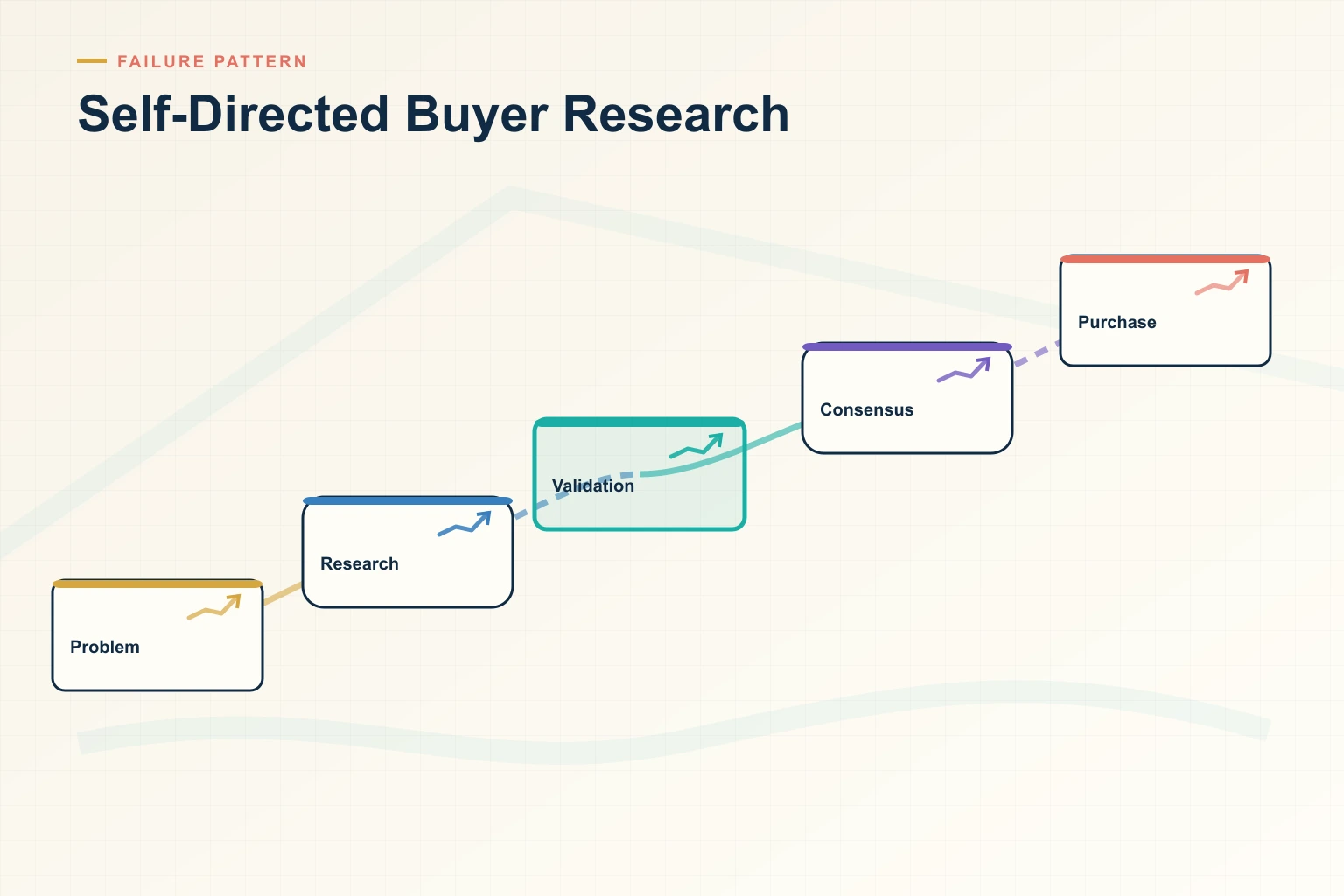
Self-directed B2B buyers research the problem, compare vendors and rank a shortlist on their own, using vendor websites, review sites, peers and, increasingly, AI chatbots, before they speak to a seller. Selling to them means making that independent research accurate and easy to act on, then adding the judgment about fit, risk and rollout that buyers cannot get alone.
The shift is well documented. In a Gartner survey of 646 B2B buyers, 67% said they prefer a rep-free experience (Gartner, 9 March 2026), and 6sense’s 2025 study of nearly 4,000 buyers found that first contact with a seller came about 61% of the way through the buying journey (6sense, 2025). This guide draws on research published between 2018 and 2026. It covers what buyers do on their own, how AI assistants are changing that research, where self-directed research costs sellers deals, and how to run a buying friction audit.
Last updated: 16 October 2026
What is self-directed buyer research?
Self-directed buyer research is the part of a B2B purchase that buyers complete without a salesperson: defining the problem, learning what kinds of solution exist, drafting requirements, comparing vendors and checking what other customers say. It happens on vendor websites, review sites, community threads, peer conversations and AI assistants. The buyer usually still buys through a sales team. What changes is when the seller arrives and how much the buyer already believes by then.
Gartner’s research shows where buyers draw the line. In its survey of 632 B2B buyers (fielded August to September 2024), buyers preferred self-service for general information and learning but wanted seller input on tasks that need context, such as judging whether a product fits their company. Across all buying stages they preferred to complete an average of 3.0 activities through both channels, 2.3 with sales reps and 1.8 through digital self-service tools alone (Gartner, 25 June 2025). Self-directed research is not the absence of sellers. It is buyers deciding which jobs they want help with. For the full set of stages around it, see our guide to B2B buyer journey mapping.
Self-directed research vs rep-free buying vs self-serve buying
These terms are often used as synonyms, but they describe different behaviour, and each calls for a different response from the sales team.
Term
What the buyer does alone
Where sellers still fit
Typical purchases
Self-directed research
Researches, compares and shortlists before contacting sales
Fit, risk, business case, internal consensus, negotiation
Most mid-market and enterprise B2B purchases
Rep-free buying
Would prefer to complete the whole purchase without a sales rep
On request, or through tools the buyer uses in their own process
Lower-risk, repeat or well-understood purchases
Self-serve buying
Signs up, trials, orders or pays through digital channels
Expansion, larger contracts, complex configuration
Product-led software, reorders, digital commerce
Seller-assisted digital buying
Uses digital tools and content, with a seller helping interpret them
Explaining implications and trade-offs inside the buyer’s own research
Complex purchases where buyers want to self-navigate but not decide blind
Gartner argued for a “seller-assisted digital buying experience” in a May 2021 release, accessed 16 October 2026.
How much research do B2B buyers do before contacting sales?
Most of it. 6sense’s 2025 B2B Buyer Experience Report found that buyers first contacted sellers about 61% of the way through their journey, earlier than the 69% seen in its previous research. By that point, 94% had already put their shortlist in order of preference, buyers initiated 79% of engagements, and they bought from their day-one shortlist 95% of the time (6sense, 2025). Gartner has estimated that buyers spend around two-thirds of any B2B buying journey gathering, processing and de-conflicting information, much of it without a sales rep (Gartner, 8 August 2018).
Finding
Source
Date and sample
First contact with sellers about 61% of the way through the journey, down from 69%
6sense
2025 report; nearly 4,000 buyers
94% ranked their shortlist before engaging sellers; 95% bought from their day-one shortlist
6sense
2025 report; nearly 4,000 buyers
67% prefer a rep-free experience
Gartner
9 March 2026; 646 buyers, August to September 2025
61% prefer an overall rep-free buying experience
Gartner
25 June 2025; 632 buyers, August to September 2024
79% had heard of the product before researching; 83% shortlisted three or fewer products
TrustRadius 2026 B2B Buying Disconnect, summarised by HG Insights
15 July 2026; 1,862 buyers and 444 vendors
51% start software research with an AI chatbot more often than with Google
G2
15 April 2026; 1,076 buyers, March 2026
Sources: 6sense (2025), Gartner (2026), Gartner (2025), HG Insights (2026), G2 (2026). All accessed 16 October 2026.
Two cautions when you use these numbers. First, earlier contact does not mean an open mind: in the same 6sense data, 77% of buyers first spoke with the vendor they eventually chose, so the favourite usually holds. Second, the rep-free figures are not a trend line. Gartner’s 2025 and 2026 results come from different samples and slightly different questions. The safe conclusion is simpler: most buyers arrive informed, with a favourite, and with fewer vendors left to consider than the seller assumes.
How are AI chatbots changing self-directed buyer research?
AI assistants are becoming the first stop. G2’s survey of 1,076 B2B software buyers, run in March 2026, found that 51% now start their research with an AI chatbot more often than with Google, up from 29% in G2’s 2025 survey, and 71% rely on chatbots at some point in their research. G2 also reports that 69% of buyers chose a different vendor than they had planned because it appeared in a chatbot’s recommendation (G2, 15 April 2026). G2 runs a software review marketplace, so read these as vendor survey results.
Estimates of how many buyers use AI vary widely, because each survey asks a different question of a different group:
Source
What it measured
Sample
Gartner, 9 March 2026
45% used AI during a recent purchase
646 B2B buyers
TrustRadius via HG Insights, 15 July 2026
63% used AI during their buying process; 94% fact-check AI-generated information
1,862 buyers
G2, 15 April 2026
71% rely on AI chatbots at some point in their research
1,076 software buyers
6sense, 2025
94% use large language models in their buying process, with use peaking mid-journey, mainly to compare vendors
Nearly 4,000 buyers
Sources: Gartner, HG Insights, G2, 6sense. All accessed 16 October 2026.
Whatever the exact share, three things follow for sellers:
- Buyers check the answers. In the TrustRadius data, 94% of buyers fact-check AI-generated information, and the share who always or very often verify AI outputs rose from 58% to 72% (HG Insights, 15 July 2026). Forrester’s 2026 buying study says answer engines are fast but often give incomplete or unreliable information, which sends buyers back to trusted sources and to people (Forrester, 21 January 2026).
- Your public pages become your first pitch. An assistant answers from what it can find: your website, documentation, review profiles and other people’s articles about you. If your pricing model, integrations or security posture are missing or out of date, it fills the gap with somebody else’s description.
- The seller’s first job is to confirm or correct. A buyer who arrives with an AI-built comparison holds a list of beliefs about you, and some of them will be wrong. Finding out which ones is worth more than a standard pitch.
Does self-directed buying lead to better or worse decisions?
It depends on whether buyers get help making sense of what they find. Gartner’s research points both ways:
- In a survey of 725 B2B buyers (fielded November to December 2021), 65% of buyers who self-navigated the purchase process completed a high-quality deal, against only 24% of buyers in primarily rep-led purchases. The same release found that digital commerce buyers were significantly more likely to experience purchase regret than traditional buyers (Gartner, 22 June 2022).
- A year earlier, Gartner reported that purchase regret among customers who prefer a rep-free experience was 23% higher than among customers who interact with a rep, and that buyers with high decision confidence were 10 times more likely to make a high-quality, low-regret purchase (Gartner, 17 May 2021).
- Most recently, Gartner found that confident buyers are twice as likely to report a high-quality deal as buyers with low decision confidence (Gartner, 9 March 2026).
The common factor is confidence, not channel. Gartner’s customer confidence research links information that helps buyers advance with a 2.8 times change in the likelihood of an easy purchase and a 3 times change in the likelihood of a high-value, low-regret deal, and reports that 77% of B2B buyers called their latest purchase very complex or difficult (Gartner, Customer Confidence, undated page, accessed 16 October 2026). Buyers do well on their own when what they find is clear and consistent. They do badly when they are left to reconcile conflicting sources alone. In a self-directed purchase, the seller’s job is to raise the buyer’s confidence, not to take back control of the process.
Where self-directed research costs sellers deals
Most of the damage happens before the seller knows the deal exists, or in the first conversation. Use this table in a pipeline or marketing review. Each row is a pattern you can check against your own recent deals.
Mistake
What you see
What to do instead
Website, AI answers and sellers disagree
The buyer quotes a price model, integration or limit that your rep then contradicts
Keep one governed set of product facts; check public pages and AI answers every quarter
Hiding the answers buyers look for first
Pricing, security documents and implementation detail are “on request”
Publish the pricing model, a security overview and a typical rollout plan
Outreach that ignores what the buyer has read
Generic sequences fire after a pricing-page visit
Send something specific to the buyer’s situation, or improve what they will find next
First calls that repeat the website
Company overview and standard demo before the buyer’s open questions are known
Ask what they have read, what they concluded and what is still unresolved
Research that stops with the champion
One engaged contact; finance, IT and procurement research separately
Give the champion material written for the people who were not on the call
Reading silence as interest
No buyer activity for weeks, deal still in the forecast
Track buyer-side activity and set a re-engagement threshold
Common mistakes with self-directed buyers and the fix for each.
Website, AI answers and sellers disagree
Gartner found that 69% of B2B buyers report inconsistencies between the information on a supplier’s website and what its sellers tell them, and advises keeping the two aligned to protect trust (Gartner, 25 June 2025). AI assistants add a third version: whatever the model assembled from your pages, review profiles and old articles. Self-directed buyers notice the gaps because they have read all three. Fix the source, not the symptom. Keep one owned set of approved product facts, messaging and pricing rules that the website, sales content and talk tracks all draw from (a sales content governance process gives each fact an owner and a review date), and put your buyers’ ten most common questions to the main AI assistants each quarter to see what they say about you.
Hiding the answers buyers look for first
Buyers who cannot find an answer do not stop researching. They get it elsewhere: from a competitor’s comparison page, a review site or an AI summary. In the 2026 TrustRadius data, 74% of buyers consulted customer reviews and 53% spoke with a peer, while vendor marketing collateral ranked last among the resources buyers consult (HG Insights, 15 July 2026). Publishing the basics (how pricing works, what security documentation exists, how long implementation usually takes, which systems you connect to) puts your own version of the answer in front of the buyer. Hands-on evaluation belongs on the list too: Forrester reports that more than 60% of business buyers use a trial, rising to 78% for purchases of $10 million or more (Forrester, 21 January 2026).
Outreach that ignores what the buyer has already read
Self-directed buyers are often visible before they make contact, through repeat site visits, pricing-page views or intent data. Gartner found that 73% of B2B buyers actively avoid suppliers who send irrelevant outreach (Gartner, 25 June 2025). A research signal is a reason to be relevant, not a trigger for a generic sequence. If you cannot say something specific to the buyer’s situation, it is usually better to improve the page they will read next.
First calls that repeat the website
A discovery call that starts with the company overview and a standard demo spends the buyer’s time on things they already know. Gartner’s advice is to offer specific guidance rather than generic information buyers can find for themselves, and to act as a sounding board on what matters most at their stage (Gartner, 25 June 2025). In practice, ask four questions early: What have you looked at so far? What have you concluded? Who else are you comparing, and on what? What can you still not answer? Then spend the call on the last one.
Research that stops with the champion
The person who contacts you is rarely the only person researching. Finance, IT, security and procurement each run their own checks, often without meeting the seller. In Revspire’s digital sales room benchmark (about 40 B2B companies, October 2025 to September 2026), 80% of deal rooms gained a new viewer after the first share, and rooms engaged 15 unique buyer stakeholders, against 1 to 5 on deals run without a room. These are observed patterns in Revspire customer data, not proof that a room caused any result. The practical lesson is to write what you send for the colleague who was not on the call: a one-paragraph summary of the problem, the business case and the agreed next steps at the top.
Reading silence as interest
A self-directed buyer who goes quiet may be evaluating a competitor, or may have stopped. Seller-side activity counts, such as emails sent and calls logged, cannot tell you which. Track buyer-side activity instead: who opened what, which stakeholders have engaged, which buyer-owned steps are done. In the same Revspire benchmark, once a deal room went 20 days without a buyer view, the win rate fell below half the overall rate. A threshold like that is a prompt to give the champion something new, such as a revised business case or a rollout plan, rather than another check-in email.
How to sell to self-directed buyers
- Audit what buyers can learn without you. List the 10 to 15 questions buyers try to answer before they shortlist: pricing model, integrations, security, implementation time, alternatives, proof. Check what your website, review profiles and the main AI assistants say for each. Fix contradictions first, then gaps.
- Publish decision support, not just collateral. Gartner recommends tools that help buyers decide, such as diagnostics, benchmarking data and configurators (Gartner, 17 May 2021). Good examples are a sizing or cost calculator, comparison pages that say when a competitor is the better fit, a sample implementation plan and a security overview. Our buyer enablement guide covers the content side in more depth.
- Make the first call about the buyer’s conclusions. Confirm or correct what the buyer learned from AI answers and reviews, agree the evaluation criteria, and list the steps left on both sides.
- Give the buyer somewhere to keep researching with you. After first contact, self-directed buyers keep reading on their own time and forward material to colleagues. A digital sales room puts the business case, security pack, proposal and plan in one link they can share. Revspire Digital Sales Rooms, for example, combine shared content with mutual action plans, stakeholder mapping and buyer-engagement analytics, so the seller can see which stakeholders have engaged.
- Share the plan, not only the content. A mutual action plan should include the buyer’s own steps (security review, legal, procurement, sign-off), each with a named owner at the customer. In Revspire’s mutual action plan benchmark (October 2025 to September 2026), buyers owned only 20% of plan milestones, and deals with a plan were won 35% of the time against 28% without one, an observed pattern rather than proof of cause.
- Measure buyer progress, not seller activity. Pair leading indicators (stakeholders engaged, buyer-owned milestones completed, days since the last buyer activity) with lagging ones (win rate, cycle length, deal size). Review them weekly in pipeline calls, and decide what changes in the next seven days rather than restating status.
How to run a buying friction audit
Buying friction is anything that makes it harder for a buyer to take the next step on their own: a missing answer, a contradiction, a gated document, a slow reply or an approval nobody planned for. The two posts this guide replaces both made the same sound point: treat friction as a standing process with a permanent owner, not a one-off project that fades when pipeline pressure rises. A workable version:
- Reconstruct recent deals. Take 10 to 20 recently closed deals, won and lost. For each, note where the buyer first heard of you, what they read, when they made contact and where the deal slowed.
- Ask buyers. A 20-minute interview with recent won and lost buyers (“What did you look for and not find? What did you ask an AI assistant? What nearly stopped the purchase?”) surfaces friction your CRM will not show.
- Test your own answers. Put the buyers’ top questions to your site search, your review profiles and two or three AI assistants, and compare the answers with what your sellers say.
- Map and prioritise. Place each friction point on a stage in the table below. Pick two or three to fix, each with a named owner and one measure.
- Review after 90 days. Check the measures, update the playbook, and run the audit again with a fresh set of deals.
Buyer stage
What the buyer is trying to do alone
Common friction
Fix
Signal to watch
Problem and solution research
Understand the problem and the options
Content that pitches the product before explaining the problem
Problem-first guides, definitions and honest comparisons
Visits to problem pages from search and AI referrals
Shortlisting
Decide who to evaluate
No pricing model, unclear integrations, stale review profiles
Pricing page, integration list, current review profiles
Pricing and integration page visits; inbound demo requests
First contact
Get specific questions answered
Generic discovery and demo; slow response
Diagnosis-led first call; same-day reply
Time to first response; meetings held vs booked
Validation
Prove fit and limit risk
Gated security documents, no trial route, references only on request
Security pack and trial route ready before anyone asks
Days from security request to delivery
Consensus
Get finance, IT and procurement to agree
Champion has nothing written for colleagues; procurement appears late
Shareable business case; mutual action plan with procurement steps dated
Stakeholders engaged; buyer-owned milestones completed
Signature and rollout
Confirm what they will pay and how rollout works
Current proposal and implementation plan hard to find
Proposal and dated implementation plan at the top of the deal room
Views of the proposal and plan in the final two weeks
A stage-by-stage friction audit for a self-serve buying experience.
The last row reflects what buyers read just before they sign. In Revspire’s digital sales room benchmark, 80% of buyer views in the 14 days before a won deal closed went to the proposal and the implementation plan, and 20% to value proposition material. Late-stage buyers are checking cost and rollout, not rereading the pitch.
Worked example: one self-directed purchase, two vendors
This is a hypothetical example, not a customer story.
The head of customer operations at a 600-person software company needs a tool to run customer onboarding projects. Over five weeks, without talking to anyone in sales, she asks an AI assistant for options, reads review sites, asks two peers in a community group and visits four vendor websites. She ends up with a ranked shortlist of three.
- Vendor B is second on her list. Its pricing page says “contact us”, the AI assistant’s summary says it has no Salesforce integration (it added one last year), and after her pricing-page visit she receives a generic five-email sequence. She does not reply, and Vendor B never learns why.
- Vendor A is first. Its site explains the pricing model and shows a sample implementation plan. On the first call the rep asks what she has read and what is still open. She has two concerns: single sign-on setup, and whether IT will accept the data residency terms. The rep answers the first on the call, then sends a deal room with the security pack, a one-page business case written for the CFO and a mutual action plan that includes the IT review and procurement steps, each with an owner on her side.
Two weeks later the room shows that the CFO has opened the business case but nobody from IT has opened the security pack. The rep asks the champion who in IT owns the review and books a short call with that person. Vendor A’s advantage did not come from controlling the research. It came from making the buyer’s own research easy, then spotting where her internal process was stuck.
To set up the plan in that example, start with our free mutual action plan template, which has buyer and seller milestones built in.
Frequently asked questions
What is a self-directed buyer?
A self-directed buyer researches a purchase on their own, using websites, review sites, peers and AI assistants, and contacts a seller only when they need something they cannot get alone. Most B2B buyers now work this way through the early stages: 6sense’s 2025 report found first contact came about 61% of the way through the buying journey (6sense, 2025). They usually still buy through a sales team.
What percentage of B2B buyers prefer a rep-free buying experience?
Gartner’s survey of 646 B2B buyers, published on 9 March 2026, found that 67% prefer a rep-free experience (Gartner, March 2026). Its previous survey of 632 buyers, published in June 2025, put the figure at 61% (Gartner, June 2025), and a May 2021 Gartner release reported that 43% of B2B customers prefer not to interact with a sales rep at all (Gartner, May 2021). The samples and questions differ, so read these as a consistent majority preference rather than a precise trend.
When do B2B buyers contact sales?
Late in the process. 6sense’s 2025 B2B Buyer Experience Report found that buyers made first contact about 61% of the way through their journey, and that 94% had already ranked their shortlist by then. Buyers, not sellers, initiated 79% of engagements (6sense, 2025).
What is buying friction in B2B sales?
Buying friction is anything that makes the buyer’s next step harder: missing or contradictory information, gated documents, slow replies or approval steps nobody planned for. Gartner reports that 77% of B2B buyers described their latest purchase as very complex or difficult (Gartner, Customer Confidence, undated, accessed 16 October 2026). Reducing friction usually means publishing answers earlier, keeping information consistent across the website and sales team, and planning the buyer’s internal steps with them.
How do you improve the self-serve buying experience?
Start with the questions buyers try to answer on their own and check what your website, review profiles and AI assistants actually tell them. Fix contradictions and missing basics (pricing model, integrations, security, implementation) first, then give buyers ways to keep going without you, such as calculators, trials and a shared deal room. Track buyer-side progress weekly and repeat the audit every 90 days.
Sources
- Gartner Sales Survey Finds 67% of B2B Buyers Prefer a Rep-Free Experience, Gartner, 9 March 2026. Accessed 16 October 2026.
- Gartner Sales Survey Finds 61% of B2B Buyers Prefer a Rep-Free Buying Experience, Gartner, 25 June 2025. Accessed 16 October 2026.
- Gartner Sales Survey Finds 83% of B2B Buyers Prefer Ordering or Paying Through Digital Commerce, Gartner, 22 June 2022. Accessed 16 October 2026.
- Gartner Says B2B Sales Organizations Need to Give Customers a Seller-Assisted Digital Buying Experience, Gartner, 17 May 2021. Accessed 16 October 2026.
- Gartner Says B2B Buyers Want More Simplicity in Accessing the Right Information, With or Without a Sales Rep, Gartner, 8 August 2018. Accessed 16 October 2026.
- Customer Confidence, Gartner for Sales, undated page. Accessed 16 October 2026.
- 2025 B2B Buyer Experience Report, 6sense, 2025. Accessed 16 October 2026.
- In the Answer Economy, Don’t Win the Click — Win the Answer, G2 (Tim Sanders), 15 April 2026. Accessed 16 October 2026.
- Trust More, Verify Everything: What the 2026 B2B Buying Disconnect Report Says About Where Buying Is Actually Heading, HG Insights (Grace Wells), 15 July 2026, summarising the TrustRadius 2026 B2B Buying Disconnect report. Accessed 16 October 2026.
- Forrester’s 2026 Buyer Insights: GenAI Is Upending B2B Buying As Leaders Face Mounting Pressure To Justify Every Dollar Spent, Forrester, 21 January 2026. Accessed 16 October 2026.
- Digital sales room benchmark, Revspire, 16 October 2026 (aggregated customer data, October 2025 to September 2026). Accessed 16 October 2026.
- Mutual action plan benchmark, Revspire, 16 October 2026 (aggregated customer data, October 2025 to September 2026). Accessed 16 October 2026.