Rep-Level Performance Metrics Mistakes and Review Framework for 2026
A practical perspective for connecting this idea to your revenue team’s next move.
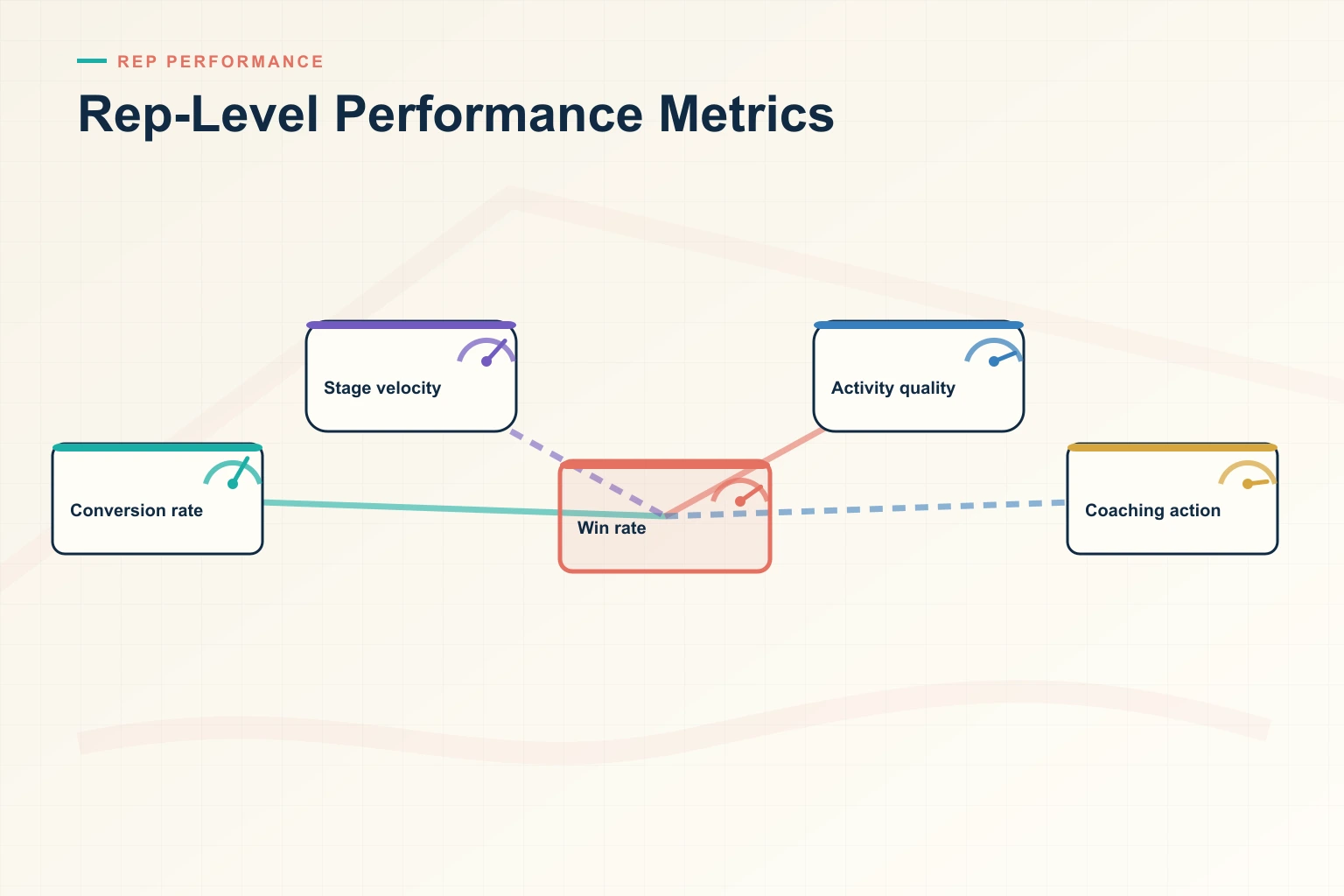
Rep-level performance reviews can address ownership, process, indicators, deal execution, and learning from losses. The framework below combines practical guidance for reviewing these areas without relying on unsupported performance benchmarks.
Teams evaluating technology options can learn about Revspire Revenue Analytics.
Five mistakes to review
1. Treating measurement as a one-time initiative
A measurement project may lose attention when routine pipeline work takes priority. Manage rep-level performance measurement as an ongoing operating discipline instead.
Correction: Assign a permanent owner to Rep-Level Performance Metrics outcomes. Add defined metrics and standing reviews to the operating cadence.
2. Relying on intuition alone
Review the full portfolio rather than forming conclusions from only the most recent or memorable deals.
Correction: When the data disagrees with the intuition, trust the data first and investigate the discrepancy.
3. Depending on one stakeholder
A deal centred on one contact may lack another route into the account if that contact disengages or changes roles.
Correction: Map every stakeholder in the buying committee, assign coverage, and track engagement with each one.
4. Confusing activity with progress
Calls, emails, and tasks should be reviewed alongside buyer engagement, stakeholder coverage, and deal progression.
Correction: Measure outcomes, not activities. Track stage progression velocity, buyer engagement quality, and stakeholder coverage breadth.
5. Moving on without reviewing losses
A loss review gives the team a place to document execution problems and identify relevant changes to coaching or playbooks.
Correction: Implement a structured loss review process. Document the findings and update playbooks accordingly.
Three-part explainer: Recognize the leak, Correct the behavior, and Prevent repeat failure.
Audit the current state
Before you can improve Rep-Level Performance Metrics, you need an honest baseline. Review opportunities by rep, segment, deal size, and pipeline stage, then identify where deals are falling out and why.
Check for unsuitable opportunities entering the pipeline, qualified deals stall mid-cycle, and late-stage process failures. Use the audit to answer three questions: Where is Rep-Level Performance Metrics working well today? Where is it breaking down? What does the data say versus what the narrative says?
An audit can establish a baseline before standards and measures are revised.
Define the operating model
An operating model for Rep-Level Performance Metrics answers three questions: what actions should happen, at what stage, and who is accountable. Document milestones, progression criteria, and ownership so managers and reps can review deals against the same standard.
The process that governs rep performance metrics sales KPIs must be documented, taught, and enforced. Technology should support that process rather than determine it. The technology layer for Rep-Level Performance Metrics should reduce friction, not add it.
When selecting measures, focus instead on conversion rates at each stage, time-in-stage benchmarks, and the correlation between specific behaviours and win rates.
The operating model covers ownership, process, technology, and data.
Combine leading and lagging indicators
For Rep-Level Performance Metrics, leading indicators might include stakeholder engagement rates, content consumption, mutual action plan progression, or deal velocity at each stage.
Lagging indicators can include win rates, cycle times, average deal sizes, conversion rates, and quota attainment. Review both types of measures in coaching, pipeline, and territory discussions.
Build a dashboard that shows both. Review it weekly.
Shared standards, indicators, coaching, and feedback can be incorporated into the operating cadence.
Operationalise the review process
- Define the standard: Document exactly what excellent execution looks like at each stage of the deal.
- Select indicators: Include measures that can be reviewed before an outcome and measures that record completed outcomes.
- Review current deals: Use live opportunities to identify specific execution gaps.
- Capture findings: Feed relevant win-loss findings into playbooks, training, and strategy.
- Align technology: Technology should serve the process, not define it.
- Maintain feedback loops: Compare measures with goals and update playbooks when the review identifies new information.
Begin with the current state, identify breakdowns, and assign ownership for selected changes.
Turn findings into a plan
Start with an honest audit. Select a limited set of changes, assign an owner to each one, define how each change will be reviewed, and incorporate the resulting standards into pipeline reviews and coaching.
The purpose is to maintain a repeatable review and learning process, not to collect activity data without a defined use.
Explore Revspire
Use any of the following options to continue: