CPQ for Complex Products: Rules, Pricing and Guided Selling
A practical perspective for connecting this idea to your revenue team’s next move.
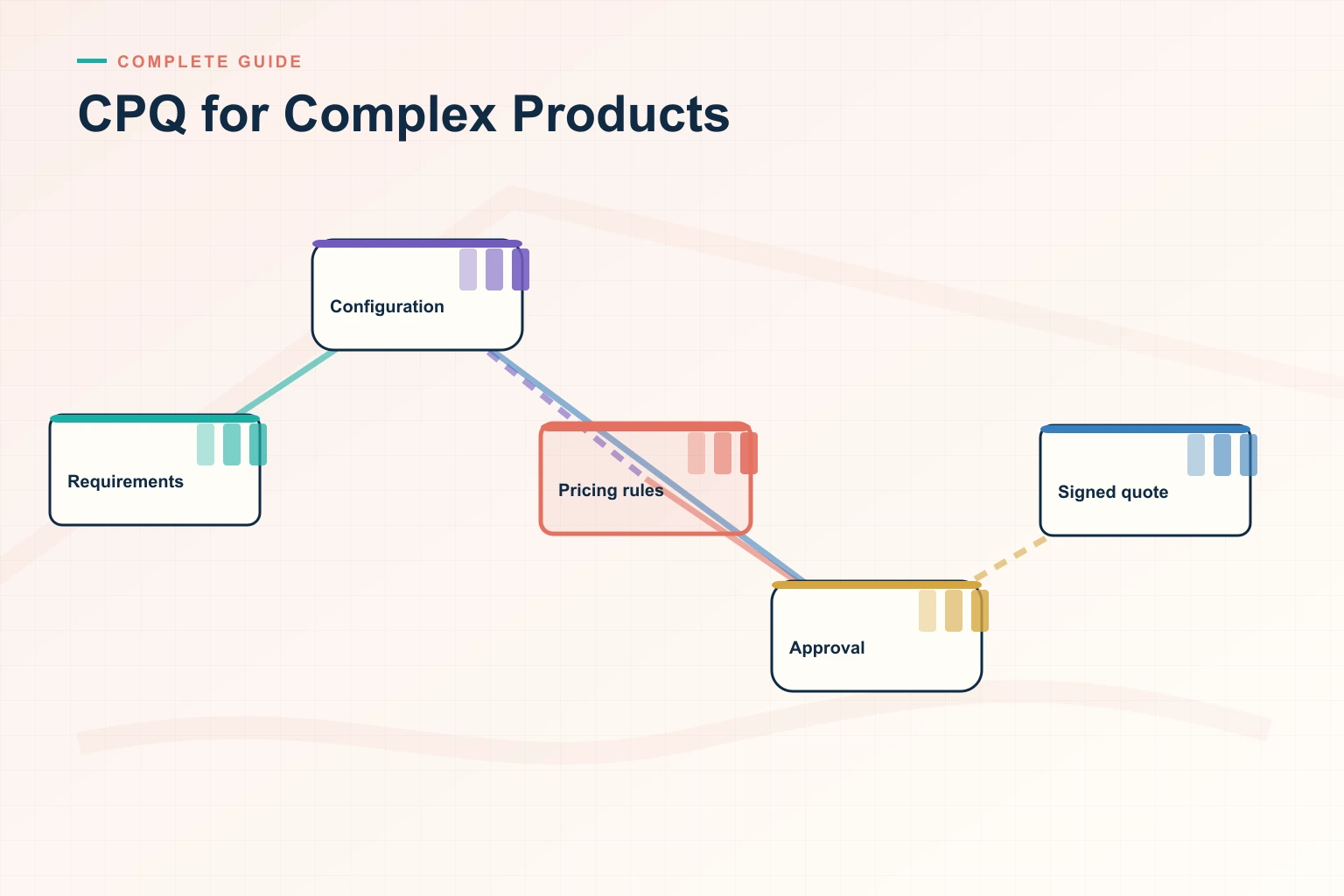
CPQ for complex products is configure, price, quote software that turns a catalog of interdependent options into valid, priced quotes. It works in three layers: configuration rules that allow only combinations that work, pricing logic that applies price books and discount guardrails, and guided selling questions that lead sellers from buyer needs to a starting configuration.
This guide explains what makes a product complex to quote, how configuration rules, pricing and approvals work, how guided selling questions drive those rules (with two worked examples), how to tell whether you need CPQ, what to test when you evaluate it and how to roll it out. It reflects vendor documentation checked in October 2026.
Last updated: 17 October 2026
What makes a product complex to quote?
A product is complex to quote when a seller cannot price it correctly from a list. The usual signs:
- Dependencies between options. One option requires another, excludes another, or only works with certain models.
- Bundles and sub-assemblies. Products are sold as sets, sometimes nested several levels deep.
- Quantities that depend on other quantities. Licences per user, consumables per machine, support hours per site.
- Pricing that varies. By region, currency, customer tier, volume, contract term or ramp schedule.
- Services attached to products. Implementation, installation, training or integration work sized by what was configured.
- Approvals. Discounts, margins, contract values or non-standard terms that need someone else’s sign-off.
- Technical validation. Some configurations need an engineer or solutions consultant to confirm they will work.
Simple product quoting
Complex product quoting
Catalog
Tens of products, few options
Hundreds or thousands of options, bundles and sub-assemblies
Valid combinations
Almost any combination works
Rules decide what can be sold together
Pricing
List price, occasional discount
Price books by region and currency, volume and term discounts, margin floors
Approvals
Rare
Routed by discount depth, margin or contract value
Who can quote
Any seller
Without CPQ, a few experts; with CPQ, any trained seller
Typical tool
The CRM’s built-in quotes
A CPQ system with a rules engine and guided selling
How does CPQ handle complex products?
The product model: bundles, features and options
CPQ represents a complex product as a bundle: a parent product with features (groups of choices) and options (the choices). Salesforce’s CPQ Basics module on Trailhead describes a bundle as a set of products sold together because the components depend on each other, with rules an admin sets so the set is complete and accurate. Many CPQ systems let an option be a bundle in its own right, which is how nested sub-assemblies are modelled.
Configuration rules
Configuration rules are what make a quote valid. Salesforce’s Trailhead unit on product rules describes four types, a useful vocabulary even if you use another CPQ:
- Validation rules block a configuration or quote from being saved until a problem is fixed, such as the wrong toner for a printer.
- Alert rules show a message the seller may ignore, such as a reminder of an upsell when a product is added.
- Selection rules add, remove or hide options automatically, such as pre-selecting options by the account’s industry and hiding incompatible ones.
- Filter rules limit which products appear in a selection list.
Each rule has conditions (when it fires) and actions (what it changes). Lookup queries link a rule to a data table, so one rule can cover many cases: you maintain a table of compatible combinations instead of writing a rule for each. The same unit describes configuration attributes: fields the seller sets while configuring, which rules then read. In the design described in the next section, guided selling answers are stored in configuration attributes or quote fields that rules read.
Pricing logic
Once the configuration is valid, CPQ prices it: the list price from the right price book (by region, currency or segment), then volume, term and tier discounts, bundle pricing, cost-based margin calculations and any ramp schedule for multi-year deals. Floor prices stop a quote from going below the lowest price the business will accept, whatever discount the seller enters.
Approvals and guardrails
Approvals are routed by the reason they exist: discount depth, margin, total contract value or non-standard terms. Guardrails show the seller in real time when a quote will need approval, before they send it, so most quotes stay inside policy and only exceptions wait for a decision. Our guide to CPQ best practices includes an example discount approval matrix.
The quote document and hand-off
CPQ generates the quote or proposal document, sends it for signature and writes products, amounts and status back to the CRM opportunity (see CPQ integration with CRM). For complex products, the document deserves as much care as the configuration, because it is what the buying committee reads at the end. In the Revspire digital sales room benchmark (aggregated customer data, October 2025 to September 2026), 80% of buyer views in the 14 days before a won deal closed went to the proposal and the implementation plan.
What is guided selling in CPQ?
Guided selling in CPQ is a question-led flow that asks about the customer’s needs and uses each answer to filter the catalog, pre-select options or set configuration attributes, so the seller starts from a valid configuration instead of an empty product list. It is the way most sellers configure complex products without knowing every product code and rule.
Vendors implement it in similar ways. In Salesforce CPQ, according to the same Trailhead module, the seller answers a series of questions when adding products, CPQ suggests products that fit, and some answers trigger follow-up questions. Zoho CRM’s guided selling documentation shows the mechanics plainly: each question is linked to a product field that represents a deciding factor, such as a budget range, and each answer filters the product records, so a catalog of about 100 watches in its example narrows to about 20. Zoho caps a flow at 10 questions, a useful discipline for any design.
How guided selling questions drive configuration rules
Guided selling and configuration rules are two halves of one system. The questions collect the facts; the rules turn facts into a configuration. The chain runs:
- Question: asked in the buyer’s language (“How many sites?”).
- Answer: stored as a configuration attribute or quote field.
- Rules: filter, selection, validation and alert rules read that field.
- Configuration: options are added, hidden or blocked.
- Pricing and approval: price rules apply, and guardrails show whether approval is needed.
Example 1: a software platform with editions, modules and services
An illustrative flow for a data platform sold in Standard and Enterprise editions, with add-on modules, connectors and implementation services. The thresholds are examples, not recommendations.
Question
Answer
What it sets
Rule it triggers
Effect on the quote
How many people need access in year one?
450
User count
Selection: above 250 users adds Enterprise edition; filter hides Standard
Enterprise edition, 450 users
Do you need single sign-on and automated user provisioning?
Yes
Identity requirement
Selection adds the identity module; validation confirms it requires Enterprise
Identity module added
Where must your data be stored?
European Union
Hosting region
Filter shows only EU-hosted plans; the euro price book applies
EU hosting, priced in euros
Which systems must it connect to?
CRM and ERP
Integration count: 2
Selection adds two connectors and sizes the implementation package
Two connectors, services package for two integrations
How long a contract do you want?
Three years
Term: 36 months
Price rule applies the multi-year discount; guardrail checks total discount against policy
Term discount; approval flagged only if over policy
When do you need to go live?
In 45 days
Target go-live date
Alert: under 60 days needs a services capacity check
Seller and services team alerted
Example 2: configured industrial equipment
The same pattern works for physical products, here an illustrative conveyor system:
- “What will it carry, and how much per hour?” filters to models rated for that load and throughput.
- “What power supply is on site?” selects the matching motor; a validation rule blocks motors not certified for the destination country.
- “Is it a washdown or food-contact area?” excludes painted steel frames and requires stainless steel and food-grade belts.
- “Who will install it?” adds installation and a site survey; an alert fires if no survey date is set.
- “What uptime do you need?” sets the maintenance plan tier and adds a spare-parts kit.
How to design guided selling questions
- Ask about the buyer’s situation, not product codes. “How many sites?” works for a new seller; “Which SKU?” does not.
- Keep only questions that change the output. If no answer to a question changes the configuration, price or approval, remove it.
- Go from broad to narrow, and use follow-up questions so sellers only see what applies.
- Prefill from the CRM. Industry, region and company size are usually known; do not ask for them again.
- Reuse your discovery questions. If the guided selling flow mirrors the discovery call, the configuration reflects what the buyer said.
- Allow “not sure”. Give it a safe default and an alert, rather than forcing a guess.
- Store the answers on the quote. Implementation, renewal and expansion teams need to know why the configuration looks the way it does.
- Test with won deals. Run recent closed-won deals through the flow; if it cannot reproduce what was sold, the questions or rules are wrong.
Can buyers use guided selling themselves?
Yes: the same questions can drive a buyer-facing configurator or a pre-filled quote the seller reviews. Demand for that is real. In a Gartner survey of 646 B2B buyers published on 9 March 2026 (fielded August to September 2025), 67% said they prefer a rep-free experience. For complex products, keep the same rules and approvals behind a buyer-facing flow, and hand off to a seller when the configuration needs validation or the discount needs approval.
Do you need CPQ for complex products?
You probably need CPQ when several of these are true:
- Configuration errors are found after the quote has gone to the customer.
- Only a few people can build a correct quote, and sellers wait for them.
- Discounts for similar deals vary widely, and approvals happen in email or chat.
- Product or price changes take weeks to reach every seller’s spreadsheet.
- Implementation teams re-scope deals after signature because the quote missed services.
The CRM’s built-in quotes are usually enough when the catalog is small, options rarely depend on each other and most deals sell at list price. Time is part of the case: in Salesforce’s sixth State of Sales report (25 July 2024, 5,500 sales professionals), reps spend 70% of their time on non-selling tasks; building quotes by hand is exactly the kind of work CPQ is meant to take off that list.
How do you choose CPQ software for complex products?
Test with your own hardest real deals, not the vendor’s demo catalog.
Capability
What to test
Product model
Nested bundles, option quantities that depend on other quantities, products that are both standalone and bundle options
Rules
Requires, excludes, auto-select, filter, validation and alert rules; lookup tables; who can maintain them without a developer
Guided selling
Branching questions, prefill from CRM fields, answers stored on the quote, a buyer-facing option if you need one
Pricing
Price books by region and currency, volume and term discounts, floor prices, ramp and multi-year schedules
Approvals
Routing by discount, margin, value and terms; serial and parallel approvers; delegates; re-approval when a quote changes
Documents and signature
Quote and proposal templates that hide internal detail, e-signature, version history
CRM integration
Which objects and fields sync, in which direction, and what happens on amendments and renewals
Performance
Time to configure your largest real deal and to recalculate after a change
Platform changes matter too. Salesforce describes its original CPQ product as “end of sale, not end of life”: it is no longer sold to new customers, existing customers can keep using, renewing and getting support for it, it will not get new features, and Salesforce points customers to Revenue Cloud Advanced. Our article on Salesforce CPQ’s end of sale covers the options for existing users.
Revspire CPQ
Revspire CPQ builds complex bundles, applies discounts with approval workflows and generates proposals. It provides guided configuration with product rules and nested dependencies, global price books with currency rules and floor-price protection, automated approval routing by margin, discount depth or contract value, and real-time discount and margin guardrails.
How do you roll out CPQ for complex products?
- Clean the catalog first. Retire dead products, agree one name per product and fix price books before anything is loaded.
- Write the rules in plain language. Keep a rule register (“industrial frames in food areas must be stainless”) reviewed by product, sales and finance before anyone builds it.
- Build guided selling from discovery. Start with the five to ten questions that change the configuration most.
- Replay real deals. Run a sample of last year’s quotes through the new configuration and compare the results.
- Pilot with one team, then expand. Track configuration errors, quote revisions per deal, time to first quote, approval turnaround and the share of quotes started from guided selling.
- Review quarterly. Options sellers always remove, questions they skip and approvals that are always granted are signals to change a rule.
Frequently asked questions
What is CPQ for complex products?
It is configure, price, quote software built for products with many interdependent options, bundles and pricing variables. It uses configuration rules to allow only valid combinations, pricing logic and approvals to keep quotes within policy, and guided selling to help sellers configure from the buyer’s needs.
What is guided selling in CPQ?
Guided selling is a question-led flow inside CPQ. The seller, or sometimes the buyer, answers questions about the customer’s needs, and each answer filters products, pre-selects options or sets fields that configuration rules use, producing a valid starting configuration.
What is the difference between guided selling and configuration rules?
Guided selling collects the facts about what the buyer needs; configuration rules decide what those facts mean for the product. A guided selling answer such as “450 users” sets a field, and a selection rule reading that field adds the right edition. You need both: questions without rules only filter a list, and rules without questions depend on sellers knowing what to pick.
What are the types of product rules in CPQ?
Salesforce CPQ uses four: validation rules that block invalid configurations, alert rules that warn without blocking, selection rules that add, remove or hide options, and filter rules that limit which products appear. Other CPQ products use different names for the same ideas, often requires, excludes and recommends.
Is Salesforce CPQ being discontinued?
Salesforce says its CPQ product is at end of sale, not end of life. It is no longer sold to new customers, existing customers can keep using and renewing it with support, it will not receive new features, and Salesforce recommends Revenue Cloud Advanced as its successor. Salesforce says it has not announced an end-of-life date for CPQ.
To see how guided configuration, price books and approval guardrails would work for your product catalog, request a Revspire demo.
Sources
- Get Started with Product Rules (Product Rules in Salesforce CPQ), Salesforce Trailhead, undated (accessed 17 October 2026)
- Streamlined Product Selection with Salesforce CPQ (Salesforce CPQ Basics), Salesforce Trailhead, undated (accessed 17 October 2026)
- Guided selling in CPQ, Zoho CRM Help, undated (accessed 17 October 2026)
- Gartner Sales Survey Finds 67% of B2B Buyers Prefer a Rep-Free Experience, Gartner, 9 March 2026 (accessed 17 October 2026)
- Salesforce Report: Sales Teams Using AI 1.3x More Likely to See Revenue Increase, Salesforce (sixth State of Sales report), 25 July 2024 (accessed 17 October 2026)
- Navigating the Future of Salesforce CPQ: Product End of Sale (Not End of Life), Salesforce, undated (accessed 17 October 2026)
- Digital Sales Room Benchmark, Revspire, 2026; aggregated customer data, October 2025 to September 2026 (accessed 17 October 2026)