Trust Signals in B2B Buying: What Buyers Check Before They Commit
A practical perspective for connecting this idea to your revenue team’s next move.
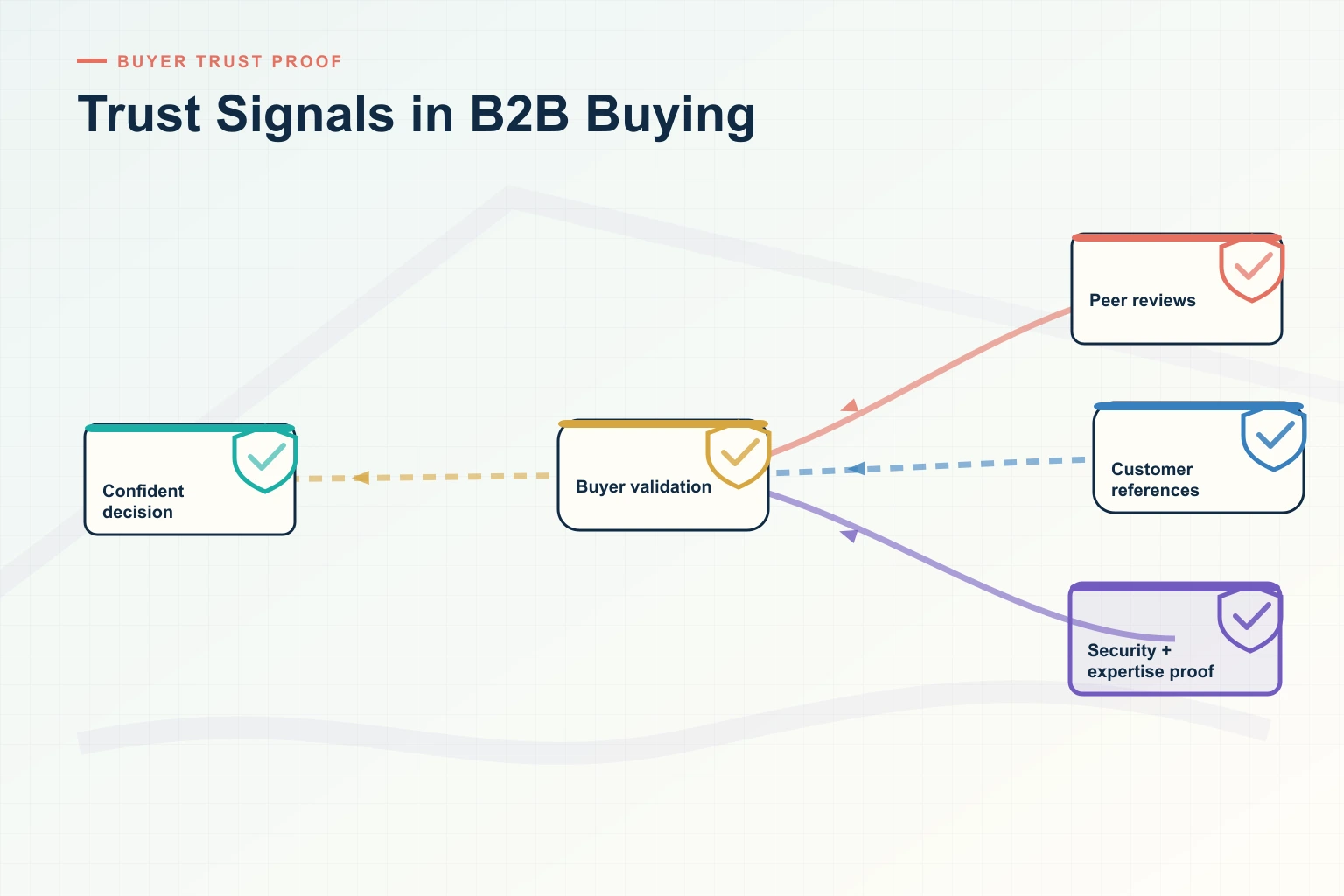
Trust signals in B2B buying are the pieces of evidence a buying group uses to decide whether a vendor is a safe choice: peer reviews and references, proof from similar customers, security documentation, consistent information, clear terms, a realistic implementation plan and a seller who keeps commitments. Each one answers a risk someone in the group is worried about.
They carry a lot of weight because many B2B buyers decide defensively. In Forrester’s 2023 Business Trust Survey, 43% of B2B buyers said they make defensive purchase decisions more than 70% of the time (Forrester, “Are B2B Buyers Cowards?”, undated). LinkedIn’s Buyability research, a survey of 750 senior B2B buyers reported by The Drum on 18 June 2025, found that being able to justify a choice that later failed mattered to slightly more buyers than whether the product worked. Below: the signals buyers check, how to find the risk blocking a deal, a six-step workflow to answer it, and a pipeline-review checklist, drawing on research from 2013 to 2026.
Last updated: 16 October 2026
What are trust signals in B2B buying?
A trust signal is anything a buyer can observe that makes a vendor’s claims easier to believe. Marketers usually mean website elements such as logos, review badges and case studies. In a B2B deal the list is longer, because the buying group is deciding whether to stake a budget, a project and several reputations on one supplier.
Forrester identifies seven levers of trust and says three of them, competence, consistency and dependability, are almost always the primary drivers of B2B buyer trust. It also says buyers who trust a company are almost twice as likely to recommend it externally or pay a premium to work with it (Forrester, undated blog). These three levers are a practical way to sort the signals a seller controls:
- Competence: can this vendor solve a problem like ours? Signals: customer stories from a comparable company, peer reference calls, a demo or trial on the buyer’s own scenario, and an accurate read of their situation in discovery.
- Consistency: does the story hold up wherever we check it? Signals: the website, seller, proposal, security documents and review sites all say the same thing. In a Gartner survey of 632 B2B buyers, 69% reported inconsistencies between information on a supplier’s website and what sellers told them, and Gartner’s Robert Blaisdell warned that the gap can create mistrust and put the deal at risk (Gartner, 25 June 2025).
- Dependability: will they do what they say? Signals: follow-through on small commitments during the sale, a mutual action plan whose dates hold, a realistic implementation plan, and candour about what the product does not do.
Trust signals are answers to risk
Buyers look for these signals because a B2B purchase carries personal risk as well as business risk. CEB (now part of Gartner) and Google surveyed 3,000 B2B buyers for From Promotion to Emotion (2013). The paper names the personal risks buyers run if a purchase goes wrong (losing time, credibility and even their jobs) and found personal value had twice the impact of business value on the outcomes measured; in a separate CEB buyer survey cited in the paper, 48% said they had once wanted to buy a new solution but had not spoken up about it. The study is old, but recent research points the same way: the signal that matters is the one that lets a buyer defend the decision.
Why are B2B buyers so risk-averse?
Risk aversion in B2B buying is the tendency of a buying group to prefer the option it can defend over the option with the most upside, and doing nothing is often the easiest option to defend. Four forces drive it.
Fear of messing up outweighs fear of missing out
Matt Dixon and Ted McKenna’s research behind The JOLT Effect analysed 2.5 million recorded sales conversations. Challenger reports medium to high indecision in 87% of deals, attributes 40-60% of lost deals to indecision, and found win rates dropped to 6% when high indecision was present (Challenger Inc., 22 February 2024). It concludes that fear of messing up (FOMU) drives indecision more than fear of missing out. Raising the pain of the status quo helps a buyer who doubts the problem; it does nothing for one who is afraid of choosing wrong.
CRM data tends to hide this. In Revspire’s win rate and sales cycle benchmark (about 40 B2B companies, October 2025 to September 2026), only 10% of closed-lost deals carried a no-decision or status-quo loss reason. The benchmark treats that as a floor, not the true rate, because sellers tend to record a competitor or price instead of “the buyer did nothing”.
More people can say no
Forrester reports that a typical buying decision now involves 13 internal stakeholders and nine external influencers, and that procurement has a decision-making role in 53% of business buying cycles. Its analyst Barbara Winters describes buyers as “under immense pressure to justify investments and minimize risk” (Forrester, 21 January 2026). Each extra person brings a different worry: finance about cost, IT about data, operations about adoption, the champion about their own credibility.
Buyers verify everything
TrustRadius’s 2026 B2B Buying Disconnect survey of 1,862 buyers found that 94% fact-check AI-generated information, 47% trust online resources less than they did a year earlier, 74% consulted customer reviews and 53% spoke to a peer during the purchase (HG Insights, 15 July 2026). Forrester describes the same habit: buyers compensate for unreliable AI answers by seeking validation from trusted sources such as peers, product experts and analysts (Forrester, “Risk-Averse Buyers Demand Proof, Not Promises”, undated).
Too much information makes buyers shrink the decision
More proof is not always better. In a Gartner survey of more than 1,000 B2B customers, those who met too much high-quality but contradictory information were 153% more likely to settle for a smaller, less disruptive course of action than planned, while Gartner linked high confidence in the information and low skepticism of the seller to high-quality, low-regret deals (Gartner, 29 July 2019). Gartner’s Brent Adamson called “customers’ confidence” the single biggest sales challenge (Gartner, 17 September 2019). A signal that adds noise can backfire, which is why the JOLT research tells sellers to limit exploration once more references stop adding certainty.
Which trust signals answer which buyer risk?
A concern voiced as price is often about something else: whether the project can be delivered, whether the timing is right, whether the buyer can get approval, or whether the value will materialise. Match the signal to the risk, not to the words the buyer used.
Risk the buyer feels
What it often sounds like
Who usually raises it
Trust signal that answers it
Outcome risk
“Will this work for a company like ours?”
Economic buyer, champion
A customer story from a comparable industry, size or use case; a peer reference call; results labelled as verified or estimated
Execution risk
“We tried something like this and nobody used it.”
Operations, project owner, team leads
An implementation plan with named owners on both sides, a phased rollout, an onboarding schedule, an introduction to the post-sale team
Technical and security risk
“Security has to sign off.” “Where does our data go?”
IT, security, legal
Security and privacy documentation sent early, written data-handling answers, a technical specialist on the call
Financial and approval risk
“It’s too expensive.” “I need to get this past finance.”
Finance, procurement, CFO
A business case in the buyer’s own numbers, clear pricing and terms, options on scope or term length
Personal and career risk
“I need to be sure before I put my name on this.”
Champion, executive sponsor
A peer who made the same decision, an honest list of what the product does not do, material the champion can present internally
Timing risk
“Now isn’t the right time.”
Sponsor, leadership team
The cost of waiting worked out with the buyer, a smaller first phase, a dated decision plan
Vendor dependability risk
“Will you still be responsive after we sign?”
Procurement, IT, end users
Review-site track record, follow-through during the sale, written support and exit terms
Classify each concern recorded on the opportunity against one or more rows before choosing a response. Many concerns combine two risks.
Signals buyers read before they talk to you
Many signals are read before a seller is involved. TrustRadius found that 79% of buyers had already heard of the product before they started researching, and 67% bought their first-choice product (HG Insights, 15 July 2026). In G2’s survey of 1,169 B2B decision-makers, nearly two out of three said they prefer to engage vendor salespeople only in the later stages of the journey (G2, 14 May 2025). Review profiles, public documentation and pricing pages are part of the trust picture, and the seller’s story has to match them.
Security scrutiny arrives earlier too. About 8 in 10 buyers in the same G2 survey reported stricter IT security, legal and compliance requirements when evaluating AI software, and SecurityPal, a security-questionnaire vendor, wrote that questionnaires increasingly arrive at the start of the buying journey, often before vendors are shortlisted (SecurityPal, 24 March 2026). A security pack that only appears at contract stage answers a risk the buyer raised much earlier.
How do you diagnose buyer risk before answering it?
The most common mistake is answering the concern you expected instead of the one the buyer has. A rebuttal delivered before the buyer finishes usually addresses the wrong objection.
- Let the buyer finish, and acknowledge the concern without arguing with it.
- Ask open questions: “What would have to be true for this to feel safe?” “Who else is worried about this?” “What happened the last time you bought something like this?”
- Restate the concern in the buyer’s words and check that you have it right.
- Classify it against the risk table above. Decide who on your side owns the answer: the seller, a solutions engineer, security, customer success or an executive.
- Record it on the opportunity: the buyer’s words, the risk type, who raised it and the evidence that would resolve it.
- If you still cannot name the risk, the next step is more discovery, not more proof.
Writing the concern down turns a feeling into something a manager can inspect. “Buyer nervous about price” cannot be inspected. “CFO worried adoption will stall because the last tool failed; needs an onboarding plan and a reference from a similar rollout” can.
How to build trust with B2B buyers: a six-step workflow
Once the risk has a name, work it through six steps. They apply to any concern, from a security sign-off to a champion who is afraid of being wrong.
1. Surface the risk early
Ask about risk before it turns into silence. “What would make this look like a bad decision a year from now?” invites concerns a buyer would otherwise keep to themselves.
2. Confirm what you heard
Restate the concern, get agreement, and ask who else shares it. A concern held by the CFO and voiced by the champion needs a different answer from one the champion holds alone.
3. Classify it
Map it to one or more risk types and assign an owner on your side: security questions to someone who can answer in writing, adoption questions often to customer success.
4. Prove it with comparable evidence
Choose evidence that fits the risk and the buyer’s context: customer stories for outcome questions, an implementation plan for execution risk, a specialist for technical fit, a business case for approval. Say which results are verified and which are estimates, and never imply a guaranteed outcome. Peer proof carries unusual weight: in LinkedIn’s Buyability research, peer recommendations were three times more influential than a cheaper price or claims of better performance (The Drum, 18 June 2025).
5. Reduce the exposure, not the price
Where the concern is legitimate, reduce what the buyer stands to lose while keeping a sound agreement: a phased implementation, a smaller first scope, a shorter initial term, or a pilot with written success criteria and a decision date. Offer only what your business can deliver, and never hide conditions or invent guarantees. Forrester reports that more than 60% of business buyers use a trial, and 78% of buyers making purchases of $10 million or more run one first (Forrester, 21 January 2026). Yet only a little over a third of buyers said they intended to move to a paid version with the same vendor (Forrester, undated blog). Many trials do not become a purchase from the trial vendor, so agree the success criteria and the decision date before a pilot starts.
Pushing harder does not work. Challenger found that when buyers got cold feet at contract stage, 73% of reps went back to the start of their status-quo pitch, and in 84% of those interactions the pattern made a loss more likely (Challenger Inc., 22 February 2024). Its alternative is realistic expectations and, in some cases, a safety net.
6. Commit to a mutual plan
Put the agreed path into a mutual action plan with success criteria, owners on both sides, dates and a review point. Check who owns what: in Revspire’s mutual action plan benchmark (October 2025 to September 2026), buyers owned only 20% of plan milestones, and deals with a plan were won 35% of the time against 28% without one. That is an observed pattern, not proof that a plan causes the win, but a plan in which the buyer owns nothing is a seller’s to-do list.
Why does trust have to reach the whole buying group?
Trust built with one stakeholder does not transfer automatically to the people who sign. Map the buying committee, assign coverage for each role that can block the deal, and flag any opportunity with only one active contact. Judge confidence by stage movement, engagement quality, stakeholder coverage, mutual action plan progress and deal velocity, not by how many emails the champion answers. The stakeholder mapping guide covers the mapping itself, and consensus selling covers getting the group to agree.
Revspire’s digital sales room benchmark (October 2025 to September 2026) shows how far trust has to travel. Deals with an active room engaged 15 unique buyer stakeholders, against 1 to 5 on deals without one, and 80% of rooms were forwarded beyond the first recipient. In the 14 days before a won deal closed, 80% of buyer views went to the proposal and the implementation plan, which suggests buyers near signature are checking cost and execution risk. After 20 days without a buyer view, the win rate fell below half the overall rate. These are observed patterns in Revspire customer data, not proof that a room causes a result.
Worked example: when “it’s too expensive” is not about price
This is an illustrative scenario, not a customer case. A 700-person software company is evaluating a sales enablement platform. Late in the evaluation, the VP of Sales says the price is too high.
- Diagnose. Open questions reveal that the CFO approved a similar tool two years ago that reps stopped using within a few months. The VP is worried about being blamed a second time, and IT security has not yet seen the vendor’s documentation.
- Classify. Execution risk (primary), personal risk for the champion, and an unopened technical and security risk.
- Prove. The seller shares an implementation plan with named owners and adoption milestones, arranges a reference call with an enablement leader at a similar-sized company that rolled out in phases, and sends the security documentation to IT that week.
- Reduce. The seller proposes a first phase for one region, with success criteria the buyer sets (for example, onboarding completion and content usage by that region’s reps) and a review at day 60. List price stays the same.
- Commit. A mutual action plan adds a CFO review meeting, a security review date and a legal date, and the buyer owns three of the milestones.
Nothing here guarantees the deal closes. But the objection is now specific, owned and dated, and the CFO has something to defend internally, which a discount would not have given them.
How to inspect trust signals in pipeline reviews
Add trust to the weekly deal review as evidence, not opinion. For each late-stage opportunity, ask:
- Is the buyer’s main concern recorded in their own words, with a risk type?
- Does the proof shared match that risk and come from a comparable customer?
- Has every role that can block the deal engaged directly, not only through the champion?
- Has security and legal review started, and does it have a date?
- Does the mutual action plan include buyer-owned milestones, and are the dates holding?
- When did a buyer last view, reply or attend? Is the silence getting longer?
- Is a reduced-risk option documented, and has delivery confirmed it can be delivered?
- Has the seller said anything that contradicts the website, the proposal or the security documents?
The answers are leading indicators. Track them separately from lagging ones (win rate, no-decision rate, cycle time, deal size), and use them to choose coaching questions and next actions, not as a forecast.
Learn which proof changed the decision
After significant wins and losses, record the concern, when it surfaced, who raised it, the evidence used, whether a reduced-risk path was offered, and what the buyer says made the difference. Keep the seller’s interpretation separate from the buyer’s account, and look for patterns across deals, not lessons from one. Because CRM loss reasons under-record indecision, interview a sample of lost buyers. Feed the patterns into discovery questions, the proof library and the scenarios reps practise.
Where sales technology helps
Software does not create trust, but it can make the signals consistent and visible across a team. Three jobs matter most:
- One governed source of proof. Approved customer stories, security documentation, pricing and implementation materials in one place, so every seller sends the current version.
- A shared buyer space. A digital sales room with a mutual action plan, stakeholder mapping and engagement analytics shows coverage gaps and silence while there is time to act. Revspire Digital Sales Rooms combine these in one branded space; other deal-room tools offer similar building blocks.
- Practice for risk conversations. In Revspire’s sales skills gap benchmark (2,000+ scored AI role-plays across 20 B2B companies, October 2025 to September 2026), the status quo objection was the hardest, at 2.9 out of 5, while security concerns scored highest at 4.1, probably because most companies give reps a prepared answer and documents. Rehearse the risk conversations that have no ready-made answer, and build a value-based business case for approval risk.
To put the reduced-risk path in writing with the buyer, start from the free mutual action plan template.
Frequently asked questions
What are examples of trust signals in B2B?
Public signals include customer reviews, analyst coverage, customer stories, security documentation and published pricing. In the deal, buyers read peer reference calls, a demo or trial on their own scenario, consistency between the seller and the website, an implementation plan with named owners, and whether the seller keeps small commitments. The strongest signal answers the specific risk a stakeholder has raised.
Why are B2B buyers risk-averse?
Because a failed purchase can cost them credibility, time and sometimes their job, and because many people can block the decision. Forrester’s 2023 Business Trust Survey found 43% of B2B buyers make defensive purchase decisions more than 70% of the time.
What is FOMU in sales?
FOMU stands for fear of messing up. Matt Dixon and Ted McKenna’s JOLT Effect research found it is a bigger driver of customer indecision than fear of missing out (FOMO). It means a hesitant buyer usually needs less risk, through a clear recommendation, realistic expectations and a safety net, rather than more urgency.
How do you handle a trust objection in sales?
Do not rebut it. Ask what has made the buyer doubtful, restate the concern, and classify it: outcome, execution, security, approval, personal or timing risk. Then answer with evidence that fits that risk, such as a comparable customer, an implementation plan or security documentation, and offer a smaller first step if the concern is legitimate.
What should you do when a prospect asks for more customer references?
Ask what the next reference needs to prove that the last one did not. If there is a specific gap, such as a similar industry or a phased rollout, find a reference that fills it. If requests keep coming without a clear gap, the buyer is probably stuck in indecision; the JOLT research advises limiting further exploration and making a clear recommendation.
Sources
- Are B2B Buyers Cowards?, Forrester, undated blog citing Forrester’s Business Trust Survey, 2023. Accessed 16 October 2026.
- The State Of Business Buying: Risk-Averse Buyers Demand Proof, Not Promises, Forrester, undated blog on The State Of Business Buying, 2026. Accessed 16 October 2026.
- Forrester’s 2026 Buyer Insights: GenAI Is Upending B2B Buying As Leaders Face Mounting Pressure To Justify Every Dollar Spent, Forrester, 21 January 2026. Accessed 16 October 2026.
- LinkedIn’s new B2B playbook shows ability to defend bad decisions drives B2B buying decisions, Richard Draycott, The Drum, 18 June 2025 (reporting LinkedIn’s Buyability research). Accessed 16 October 2026.
- How to Overcome Customer Indecision Using the JOLT Effect Approach, Challenger Inc. (research by Matt Dixon and Ted McKenna), 22 February 2024. Accessed 16 October 2026.
- Gartner Sales Survey Finds 61% of B2B Buyers Prefer a Rep-Free Buying Experience, Gartner, 25 June 2025. Accessed 16 October 2026.
- Gartner Reveals New B2B Sales Approach to Win in Today’s Information Age, Gartner, 29 July 2019. Accessed 16 October 2026.
- Gartner Says the Biggest Challenge in B2B Sales Today Is a Lack of Customer Confidence, Gartner, 17 September 2019. Accessed 16 October 2026.
- Trust More, Verify Everything: What the 2026 B2B Buying Disconnect Report Says About Where Buying Is Actually Heading, Grace Wells, HG Insights (TrustRadius), 15 July 2026. Accessed 16 October 2026.
- New G2 Research: How AI is Redefining the Buyer Journey in 2025 and How Sellers Can Adapt, Tim Sanders, G2, 14 May 2025. Accessed 16 October 2026.
- From Promotion to Emotion: Connecting B2B Customers to Brands, CEB Marketing Leadership Council and Google, 2013 (PDF copy hosted by a third party). Accessed 16 October 2026.
- Security Questionnaires Are Now Pre-Sales: What This Means for Revenue Teams, Sarah Rearick, SecurityPal, 24 March 2026. Accessed 16 October 2026.
- Revspire research (aggregated Revspire customer data, October 2025 to September 2026; observed patterns, not proof of cause): B2B SaaS win rate and sales cycle benchmark, Digital sales room benchmark, Mutual action plan benchmark and Sales skills gap benchmark, Revspire, 2026. Accessed 16 October 2026.