One-on-One Sales Coaching: An AI-Assisted Agenda, Questions, and Follow-Up Plan
A practical perspective for connecting this idea to your revenue team’s next move.
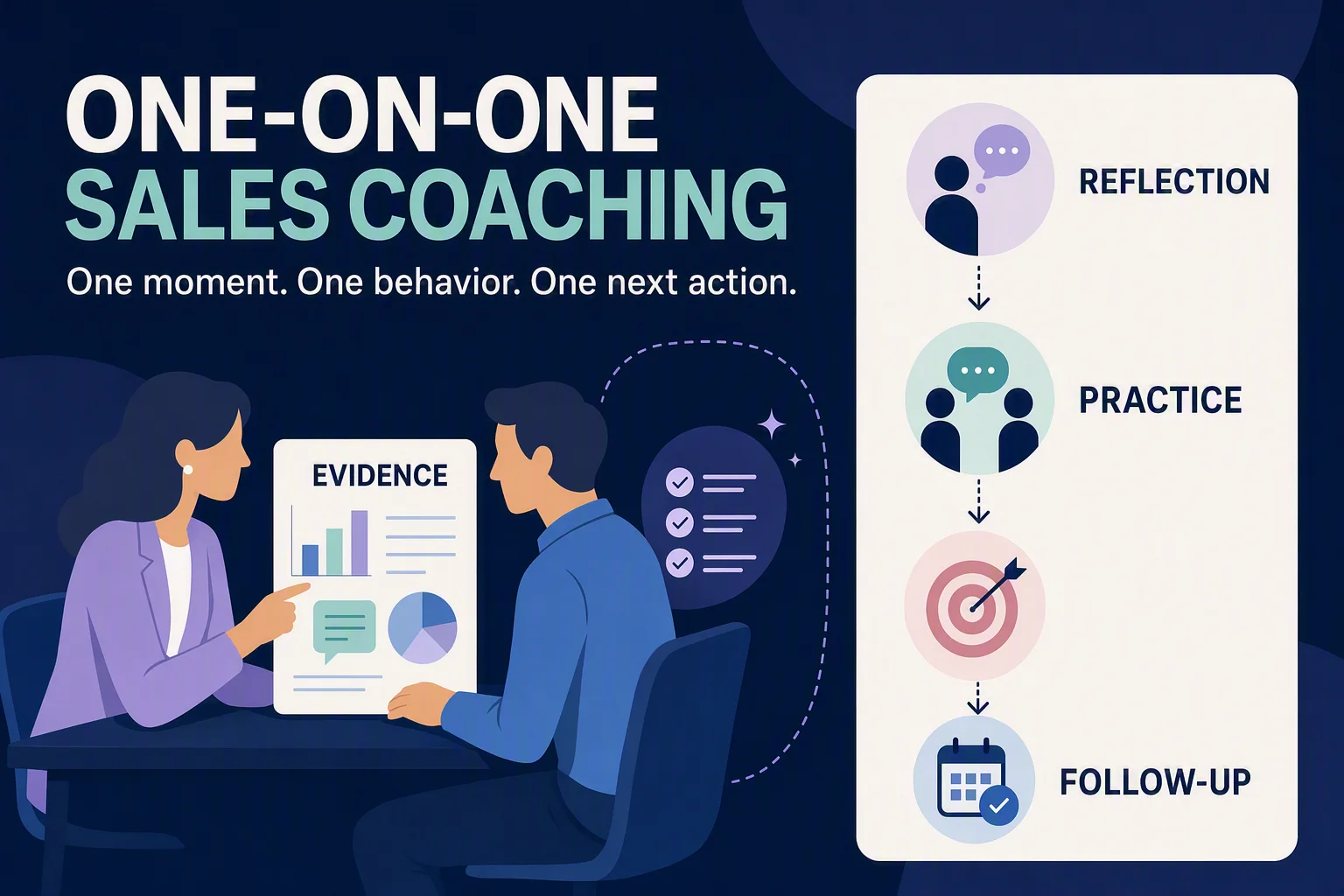
One-on-one sales coaching should produce one observable change
A one-on-one sales coaching meeting earns its place on the calendar when the seller leaves with a clearer decision, one behavior to practice, and evidence both people can review later. It is not a compressed pipeline inspection, a list of manager instructions, or a transcript summary delivered aloud. The meeting should help the rep examine a consequential moment, form a better response, and agree where to apply it next.
Before the session, define the intended change precisely. Revspire’s guide to behavior-based sales training objectives and evidence standards helps managers replace vague goals with an observable decision, conditions, and reviewable proof.
AI can reduce preparation time by organizing permitted evidence, locating a relevant call moment, or drafting neutral questions. It should not decide what a person intended, diagnose personality, or silently turn developmental coaching into performance management. NIST’s AI Risk Management Framework emphasizes validity, transparency, accountability, privacy, and continuous risk management. [1] Those principles translate directly into a useful coaching rule: every AI-assisted observation must remain traceable, contestable, and subordinate to human judgment.
This guide provides an agenda for the meeting itself. Revspire’s sales coaching cadence guide addresses how often coaching should happen across a team; this article focuses on what a manager and seller do during one session. When capacity is limited, use a sales manager coaching triage model to decide which evidence-backed need should receive protected time first.
Keep coaching separate from status, inspection, and evaluation
Managers often combine every recurring conversation into one meeting. That may appear efficient, but it changes what the seller is willing to examine. A pipeline review asks whether opportunities have sufficient evidence. A performance discussion evaluates expectations. A coaching conversation develops judgment or behavior. They can inform one another, but the purpose and authority should be visible.
Conversation
Primary question
Appropriate output
Do not disguise as coaching
Coaching
What behavior or decision should improve?
One practice action and a later observation.
A manager verdict with no seller reflection.
Pipeline inspection
What buyer-backed evidence supports the current deal state?
Updated evidence, owner, next step, or forecast judgment.
A personality critique prompted by deal risk.
Operational status
What work, dependency, or decision needs attention?
Priorities, owners, dates, and escalation.
A task list presented as development.
Performance management
How does performance compare with stated expectations?
Documented expectations and the organization’s formal process.
An undocumented consequence inferred from an AI score.
If one meeting must cover multiple purposes, label the transition. For example: “We have ten minutes for pipeline decisions, then twenty minutes for coaching on discovery.” That small boundary helps the rep know when exploration is safe and when an accountable business decision is being made. The deal-level coaching guide provides a complementary structure when the development topic is anchored to a live opportunity.
Use a 30-minute evidence-to-action agenda
The agenda below is deliberately narrow. A manager can extend it for a complex practice session, but adding more topics usually reduces the depth of reflection. The seller should help choose the moment and leave owning the action.
Time
Purpose
Manager contribution
Seller contribution
0 to 3 minutes
Set the coaching contract.
Confirm purpose, confidentiality boundary, and available evidence.
Name the outcome that would make the session useful.
3 to 8 minutes
Select one moment.
Offer neutral observations and ask which deserves attention.
Add context, correct the record, and choose the focus.
8 to 17 minutes
Examine judgment.
Ask questions before offering advice; separate fact from inference.
Explain the decision, alternatives considered, and buyer response.
17 to 24 minutes
Rehearse an alternative.
Create a realistic constraint and observe the retry.
Try a different question, response, or next-step agreement.
24 to 28 minutes
Commit to application.
Clarify evidence, support, and review date.
Choose where and when the behavior will be applied.
28 to 30 minutes
Close the loop.
Summarize the agreement and ask what was missed.
Restate the action in their own words and request support.
Google’s manager research describes effective managers as good coaches and recommends regular one-on-one conversations, useful feedback, active listening, and questions that help employees develop their own solutions. [2] The agenda operationalizes those behaviors without treating one company’s research as a universal formula.
Prepare evidence without pre-writing the judgment
The coaching record should connect one observed moment to reflection, rehearsal, application, and later verification.
Preparation should make the conversation more specific, not make the conclusion inevitable. Choose a small evidence packet: one short call segment, a practice response, a customer email that can be handled appropriately, an opportunity change, or a seller-selected moment. Provide enough context to understand the decision while respecting access, confidentiality, and retention rules.
Use Revspire’s 30-day sales training reinforcement plan when the agreed behavior needs spaced retrieval, varied practice, and a small manager check-in beyond the next meeting.
- Source: where the evidence came from, when it was captured, and who may use it.
- Observation: what was said, asked, omitted, changed, or agreed.
- Context: the sales motion, buyer role, stage, constraints, and information available at the time.
- Uncertainty: what the recording, CRM, or manager cannot establish.
- Choice: why this moment matters and who selected it for coaching.
Do not ask AI to rank a week’s conversations and present the “worst” one without a reviewed definition of relevance. A system may overvalue what is easiest to transcribe or score. Use the evidence practices in Revspire’s call coaching and review guide, and treat data-quality gaps as visible limitations rather than seller failures.
Ask questions that move from evidence to ownership
A strong coaching question is answerable from the seller’s experience, connected to the selected moment, and open enough to reveal reasoning. It should not smuggle the manager’s preferred answer into the wording. In an experimental study, participants who received active-listening responses reported a better impression of their experience, alongside activity in reward-related brain regions. [3] That does not prove a sales outcome, but it reinforces a practical coaching behavior: show that the seller was heard before preparing a rebuttal or prescribing an answer.
Stage
Questions
Avoid
Contract
What would make this conversation useful? Which moment should we examine?
“You know why we are here, right?”
Observation
What do you notice first? Which part of the evidence feels most consequential?
“Why did you fail to ask the obvious question?”
Context
What did you know then? What constraint shaped your choice?
Assuming the transcript contains the complete situation.
Alternatives
What else could you have tried? What might the buyer have done next?
Offering the manager’s script before the seller thinks.
Practice
Which alternative is worth rehearsing? What realistic resistance should I add?
Practicing an idealized buyer who accepts every answer.
Commitment
Where will you apply this? What evidence would show the behavior changed?
Ending with “do better next time.”
Support
What do you need from me? What obstacle could prevent the attempt?
Assigning an action without removing a known blocker.
The purpose is not to avoid manager expertise. Advice becomes more useful after the manager understands the rep’s reasoning and asks permission to add a perspective. CIPD’s coaching and mentoring overview distinguishes developmental support from simply directing work and emphasizes the importance of skilled, ethical practice. [4] Managers should know when a conversation requires instruction, escalation, or formal support rather than coaching questions.
Give AI a bounded role before, during, and after the meeting
AI assistance should be designed around specific jobs. “AI coach” is too broad to govern. Before the meeting, it might retrieve an entitled artifact or identify a candidate moment. During the meeting, it might capture agreed notes with consent. Afterward, it might remind both people of an action. Each use needs a source, a user, a review path, and a clear limit.
Stage
Useful AI assistance
Human decision that remains
Required safeguard
Preparation
Locate permitted evidence, summarize changes, and propose neutral questions.
Select the coaching moment and verify context.
Source citations, access control, and visible uncertainty.
Reflection
Replay a time-coded excerpt or compare it with approved guidance.
Interpret intent, context, and developmental priority.
No unsupported personality or emotion inference.
Rehearsal
Provide a consistent buyer prompt or variation for a retry.
Judge whether the practice represents the real job.
Scenario boundaries and a reviewed evaluation standard.
Documentation
Draft a concise evidence-and-action note.
Edit, approve, classify, and decide who may access it.
Consent, retention, and separation from formal records.
Follow-up
Surface the agreed action when the relevant moment arrives.
Assess later evidence and choose the next coaching step.
No automatic consequence or hidden employee ranking.
The ICO’s guidance on explaining AI-assisted decisions stresses context-appropriate explanations and meaningful routes to understand or challenge an outcome. [5] Even when coaching output is not a formal automated decision, the same design discipline helps: show what evidence informed the suggestion, distinguish observation from inference, and allow correction.
For broader program design, use Revspire’s AI sales coaching guide. When structured practice is appropriate, connect the meeting to a governed sales readiness scorecard rather than inventing a new scoring standard for each manager.
Turn the conversation into a small behavioral experiment
“Improve discovery” is not an action plan. A useful commitment names the situation, observable behavior, support, and next review. Frame it as a small experiment because the seller still needs to adapt to the buyer rather than obey a script.
- Situation: identify the next realistic moment, such as a first discovery call with an operational buyer.
- Behavior: define one observable action, such as restating the business impact before proposing a capability.
- Boundary: state what judgment remains with the seller and what claims or data must not be improvised.
- Support: provide the approved playbook section, practice opportunity, manager help, or example required.
- Evidence: agree what can show whether the action occurred, such as a reviewed call moment, seller reflection, or manager observation.
- Review: choose a date and decide what happens if the expected opportunity never occurs.
Use an approved playbook-to-practice workflow when the behavior depends on current messaging. Use Revspire’s AI sales role-play scenarios when the rep needs a safe rehearsal before applying the behavior with a buyer. After the attempt, run a manager-led role-play debrief with evidence and a focused retry.
Document only what the coaching loop needs
A coaching record should help both people remember the evidence, action, and follow-up. It should not become a speculative profile of the employee. Record the smallest useful set of fields:
- meeting date, participants, and stated coaching purpose;
- source reference and access classification rather than unnecessary copied data;
- observable moment, including any correction made by the seller;
- selected behavior, practice performed, and agreed application;
- support owner, review date, and later evidence;
- AI assistance used, output corrected, and final human owner.
Define retention and visibility with HR, privacy, legal, security, and employee-relations owners where appropriate. A developmental note should not quietly become a permanent assessment. Remote teams also need an accessible alternative when recordings, time zones, or local rules affect participation; Revspire’s remote sales coaching guide covers those operating risks.
Measure whether the meeting changed behavior
Do not judge one-on-one coaching by calendar completion alone. Start with process quality: did the session use relevant evidence, did the seller participate in diagnosis, was the action specific, and did follow-up occur? Then inspect a representative later moment. Business outcomes matter, but one meeting rarely causes a win-rate movement by itself.
Layer
Useful measure
Misleading substitute
Session quality
Evidence used, seller reflection, practice completed, and clear agreement.
Meeting held.
Follow-through
Action attempted in the agreed context and reviewed on time.
Reminder delivered.
Behavior
Target action appears appropriately in a comparable later moment.
A self-reported confidence increase alone.
Operating quality
Manager consistency, useful challenges, source errors, and time required.
Volume of AI-generated feedback.
Outcome connection
Behavior is plausibly linked to stage progress, buyer commitment, quality, or efficiency.
Claiming one coaching meeting caused revenue.
Aggregate cautiously. A score that helps one seller prioritize practice may not be valid for ranking people. Revspire’s sales coaching ROI framework explains how to connect operational evidence with outcomes without making unsupported attribution claims.
Calibrate the method across managers without scripting every conversation
Consistency should apply to evidence standards, safeguards, and follow-through. It should not require every manager to use the same words. Review a small sample of de-identified or appropriately handled coaching records. Ask whether managers separated observation from inference, allowed correction, selected one behavior, and closed the loop. Discuss disagreements and improve examples.
Manager development should include listening, asking neutral questions, giving direct instruction when needed, handling sensitive issues, and recognizing when to involve another function. Revspire’s frontline manager coaching guide covers capacity and operating support, while the coaching frameworks guide helps leaders choose a repeatable conversation model.
Test the method over four meeting cycles with a small manager group. Keep the agenda stable, collect friction, and change one component at a time. That is enough to learn whether preparation is feasible and follow-up happens; it is not a substitute for a broader enablement rollout.
Adapt the agenda to the evidence, not the seller’s seniority
The same evidence-to-action sequence can support a new rep, an experienced account executive, or a manager, but the coaching problem changes. A new rep may need direct instruction after reflection reveals a knowledge gap. An experienced seller may need a challenging question that exposes an assumption. A manager may need calibration on how they interpreted the evidence. Do not mistake seniority for either competence or resistance.
- When knowledge is missing: stop the inquiry, teach the approved answer, confirm understanding, and create a safe practice opportunity. Asking more questions cannot recover information the seller was never given.
- When judgment is the issue: compare the available signals, alternatives, tradeoffs, and likely buyer consequences. Let the seller choose and rehearse a different decision.
- When execution breaks down: reduce the behavior to an observable moment, practice it under realistic pressure, and remove a workflow or content obstacle if one exists.
- When the evidence is disputed: inspect the source and context before continuing. If the system or manager is wrong, correct the record and treat the challenge as useful quality feedback.
This distinction keeps coaching from becoming an automatic response to every performance signal. Sometimes the right intervention is clearer content, a process correction, additional authority, workload relief, or an escalation. Record that diagnosis so the organization does not repeatedly ask a seller to practice around a structural problem. Recurring patterns across several coaching records may indicate a team-level need; use a skill-gap analysis and prioritization matrix before converting those patterns into a training program.
One-on-one sales coaching FAQ
How often should one-on-one sales coaching happen?
Choose a frequency that matches the skill, opportunity to apply it, and manager capacity. Weekly may suit new or rapidly changing work; biweekly may suit established sellers. The important requirement is enough time between meetings to attempt the behavior and review evidence.
Should a manager review calls before every coaching meeting?
No. Use the smallest evidence source relevant to the topic. A short call segment may help, but a practice response, deal change, seller reflection, or observed meeting can be sufficient. Always apply access, consent, and retention rules.
Can AI run a sales coaching one-on-one without a manager?
AI can support preparation, structured practice, and reminders. It should not replace accountable human judgment for sensitive feedback, employment consequences, ambiguous context, or decisions that require empathy, authority, and organizational knowledge.
What should be written in a sales coaching note?
Record the purpose, source reference, observable moment, agreed behavior, application context, support, review date, and later evidence. Avoid speculative personality labels and unnecessary copies of sensitive customer or employee data.
How is one-on-one coaching different from a pipeline review?
Pipeline review determines the state and next decision for opportunities. Coaching develops a seller’s judgment or behavior. A live deal can supply evidence for coaching, but label the purpose and keep forecast authority separate from developmental exploration.
Sources
- National Institute of Standards and Technology, AI Risk Management Framework.
- Google re:Work, Coach managers to coach.
- Kawamichi et al., “Perceiving active listening activates the reward system and improves the impression of relevant experiences”.
- Chartered Institute of Personnel and Development, Coaching and mentoring factsheet.
- UK Information Commissioner’s Office, Explaining decisions made with AI.
Make the next coaching conversation observable
Begin with one real moment, ask before advising, rehearse one alternative, and agree where the seller will apply it. Use AI to reduce preparation and preserve evidence, while keeping the manager and seller responsible for context, judgment, and action. To explore a governed workflow connecting sales training, evidence, playbooks, and manager follow-up, request a Revspire demo.