Best Buyer Engagement Platforms in 2026: 10 Compared
A practical perspective for connecting this idea to your revenue team’s next move.
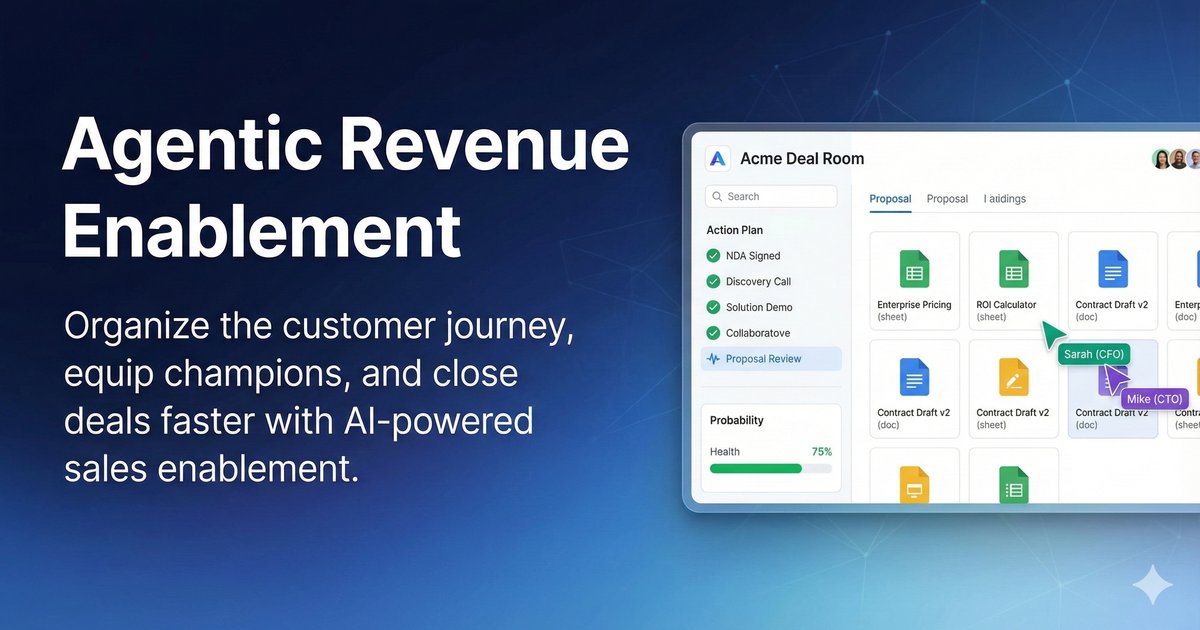
The best buyer engagement platforms in 2026 are Aligned, Dock, GetAccept, Revspire and Trumpet for digital sales rooms, DocSend and Highspot for content tracking, Navattic and Storylane for interactive demos, and Qwilr for proposals. They differ on whether they name each viewer, how finely they track, how they alert you and what they write back to the CRM.
This guide is for sales, enablement and RevOps leaders at B2B companies with 300 or more employees who want to see what the buying group does after the call.
Last updated: 30 October 2026
Disclosure: Revspire publishes this list and sells one of the tools on it. Revspire has one entry. Tools are grouped by category and listed alphabetically within each group. Capabilities and prices were checked on each vendor’s own website on 30 October 2026 unless another date is given. We do not compare security certifications for any vendor; ask each one for its own documents during your security review.
Buyer engagement platforms compared
“Not named” means we did not find it on the vendor’s pages, not that the product lacks it. Engagement data is only useful if buyers have a shared plan to act on, so the free mutual action plan template below the table gives you one to put inside whichever tool you choose.
| Tool | Category | Engagement tracking named on its pages | Alerts and CRM write-back named | Published pricing |
|---|---|---|---|---|
| Aligned | Digital sales room | Room analytics, visitor heatmap, per-asset analytics; stakeholder map; new-stakeholder alerts | Slack and Teams notifications; room analytics inside the CRM on Enterprise | Free; Basic $35, Pro $60 per seat a month ($29 and $49 billed annually) |
| Dock | Digital sales room | Visitors, views, time spent and actions by person, page or asset | Alerts on returning buyers and new stakeholders; Salesforce Tasks; HubSpot | Free; Standard $350 a month for 5 users; Premium $1,000 a month billed annually for 10 |
| GetAccept | Digital sales room | Which stakeholders view content, time per section; machine-learning deal score per send-out | Automated reminders; engagement synced to Salesforce or HubSpot from Professional | eSign $25, Professional $49 per user a month (minimum 5); Enterprise by quote |
| Revspire | Digital sales room | Real-time buyer engagement analytics; AI stakeholder mapping that flags deal risks | Connects to Salesforce, HubSpot, Dynamics 365, Zoho CRM, Pipedrive; Slack and Teams | priced by module with unlimited user licenses; about $25,000 USD a year on average |
| Trumpet | Digital sales room | Stakeholder-level views and downloads; engagement score; org chart | Slack, Teams or email alerts; two-way Salesforce and HubSpot sync on every plan | Free; Pro $45, Scale $100, Elite $160 per user a month |
| DocSend | Document tracking | Per-page analytics; individual and aggregate visit dashboard; visitor export | Real-time engagement notifications; Salesforce as a paid add-on | Personal $10, Standard $45 per user a month; Advanced $150 a month for 3 users |
| Highspot by Seismic | Content and enablement suite | Views, time spent and shares in digital sales rooms | Engagement metrics linked to CRM records | By quote; Vendr median $60,005 a year |
| Navattic | Interactive demos | Account identification, interest areas, buyer circle discovery | Email and Slack alerts on Growth; Salesforce sync to opportunities | Free Starter; paid plans unpriced; Vendr median $8,500 a year |
| Storylane | Interactive demos | Account Reveal (250 to 10,000 visitors a month by plan); Hubs | Email, Slack and Teams alerts; HubSpot from Starter, Salesforce on Premium | Free; Starter $40 or $50 a month; Growth $500 or $625; Premium $1,200 or $1,500 |
| Qwilr | Proposals | Page analytics and identity analytics (who views) | Alerts when pages are viewed, accepted or stalled; Salesforce on Scale | $35, $55 or $75 per user a month, billed annually |
From each vendor’s own pages, checked 30 October 2026. Vendr medians are from Vendr’s pages, last updated February 2026; purchase counts are in each tool section.
What should a buyer engagement platform track?
Buyer engagement analytics measure how members of the buying group interact with what you share after the meeting ends. Our buyer engagement analytics glossary entry defines the metrics. Six questions separate a view counter from something a forecast call can use.
- Who is the viewer? A named stakeholder, a company identified from traffic, or an anonymous visit. Ask what happens when a link is forwarded.
- How fine is the tracking? Whole asset, page by page, or section by section, with time spent and actions such as downloads and clicks.
- Does it see the whole buying group? New stakeholders joining, people who have gone quiet, and roles nobody has reached yet.
- How does it tell you? Email, Slack or Teams alerts when a buyer returns, a new person joins or a deal stalls.
- Is a score explained? If the tool rolls signals into one engagement score or deal score, ask which events feed it and how it is weighted.
- What reaches the CRM? Where activity lands (a Task, a field, an opportunity timeline), whether it is automatic, and which plan it needs.
This list is about tracking and analytics. If you are choosing the content and experiences buyers use to make their decision, such as demos, business cases and proposals, see our guide to the best buyer enablement tools instead.
Digital sales rooms
A digital sales room puts the plan, content and conversation for one deal behind one link, so it sees most of what the buying group does. For rooms compared on more than tracking, see the best digital sales room software for 2026.
Aligned
- What it does: Aligned’s Revenue Intelligence page names visitor and timeline analysis, a visitors heatmap, per-asset content analytics, alerts on buying intent, risks and any new stakeholder who enters the room, and a count of how multi-threaded each deal is. Its integrations page lists Slack notifications when rooms are opened, shared or commented on, Microsoft Teams engagement signals, bi-directional Salesforce sync, and HubSpot, Close CRM and Dynamics 365 connections.
- Pricing: the pricing page shows Starter at 0 with unlimited seats, Basic at $35 ($29 billed annually) and Pro at $60 ($49 billed annually) per seat a month, and Enterprise by quote. Basic adds Engagement Analysis and Analytics Triggers and Flags.
- Limitation: room analytics inside your CRM and bi-directional CRM integration are listed on Enterprise only.
- Choose it when: you want stakeholder alerts and multi-threading counts in a room you can start free.
Dock
- What it does: Dock’s sales rooms page says it shows visitors, views, time spent and actions across the workspace, reviewable by person, page or asset, and notifies you when buyers return or a new stakeholder joins. Its Salesforce page says workspace views, downloads, link and embed clicks and action plan events each land as a Task on the account or opportunity, and that HubSpot has the same core capabilities.
- Pricing: Free at $0; Standard at $350 a month with 5 users; Premium at $1,000 a month billed annually with 10 users; Enterprise on a custom annual contract for 25+ users. Extra seats are $50 a month (Dock pricing).
- Limitation: Salesforce and HubSpot integrations are not on the Free plan, and views of library assets outside a workspace sync only if the viewer is already a Salesforce contact.
- Choose it when: you want room activity logged to Salesforce opportunities without building it yourself, at a published price.
GetAccept
- What it does: GetAccept’s digital sales room page describes tracking which stakeholders view content, time spent per section and when buyers are most active, and says it syncs all buyer engagement activity back to the CRM in real time, mirroring the room in Salesforce or HubSpot. Its pricing page adds a document timeline and a deal score: machine learning scores each send-out on its likelihood of being signed.
- Pricing: eSign at $25 per user a month, Professional at $49 per user a month with a minimum of 5 users, and Enterprise by quote, all on 12-month agreements.
- Limitation: CRM integrations are listed from Professional, premium CRM integrations are add-ons there and included only on Enterprise, and the pricing page does not say which integrations count as premium.
- Choose it when: the proposal and signature are where your deals stall, and you want engagement, a deal score and e-signature in the same room.
Revspire
- What it does: Revspire is an AI sales enablement platform for B2B revenue teams that connects governed sales content, AI playbooks, AI sales training and coaching, and digital sales rooms in one revenue workflow. Its Digital Sales Rooms module lists branded buyer and seller rooms, mutual action plans with owners and due dates, AI content recommendations by deal stage and stakeholder role, AI buying-committee stakeholder mapping that flags deal risks, and real-time buyer engagement analytics. It connects to Salesforce, HubSpot, Microsoft Dynamics 365, Zoho CRM and Pipedrive, and to Slack and Microsoft Teams.
- Pricing: priced by module with unlimited user licenses; about $25,000 USD a year on average. Deal Room is added to Content Hub, the base module.
- Limitation: Deal Room is not sold on its own, so a team that wants only a room still buys Content Hub, and Revspire’s published capabilities do not say which engagement events are written to the CRM record. Ask to see it in a demo.
- Choose it when: you want room engagement next to content usage and coaching data, and do not want cost to rise as more sellers join.
Trumpet
- What it does: Trumpet’s revenue intelligence page says it tracks views, clicks and downloads inside each Pod down to stakeholder level, weighs depth of interaction, time spent, widget use and shares into an engagement score, and sends Slack, Teams or email notifications when a buyer acts. An account-wide org chart flags a missing stakeholder or a quiet champion, and Nerve Centre suggests actions when deals slip.
- Pricing: the pricing page shows Free (10 Pods per account, unlimited users), Pro at $45 per user a month (up to 5 users), Scale at $100 and Elite at $160, or $450, $1,000 and $1,600 per user a year, and its FAQ says two-way Salesforce and HubSpot sync is included on every plan, including Free. Trumpet’s AI information page showed different figures in pounds on 30 October 2026, so get the current price in writing.
- Limitation: the management dashboard starts on Scale, and Pro stops at 5 users.
- Choose it when: you want stakeholder-level scoring and an account-wide org chart that shows who has not engaged yet.
Document and content tracking
DocSend
- What it does: DocSend, part of Dropbox, shares files as tracked links. Its pricing page lists per-page analytics for PDF, Word, PowerPoint, Google Docs, Google Slides and Keynote files, real-time engagement notifications, an aggregate and individual visit dashboard and visitor export. When checked on 20 October 2026, its Salesforce add-on logged document visits and link creations as Salesforce Tasks with visit length and percentage viewed (Dropbox Help, modified 6 March 2026).
- Pricing: Personal at $10 and Standard at $45 per user a month (one user each), Advanced at $150 a month and Advanced Data Rooms at $180 a month, each with 3 users.
- Limitation: Salesforce is an extra-cost add-on with no published price, and HubSpot was not on its integrations page when checked on 20 October 2026.
- Choose it when: you mainly need page-by-page tracking of decks and documents, without a full room.
Highspot by Seismic
- What it does: Highspot’s buyer engagement page promises real-time visibility into views, time spent and shares, and says engagement metrics link directly to CRM records. Digital sales rooms are in its Good tier (Highspot pricing). Seismic completed its merger with Highspot on 18 August 2026 (Highspot blog).
- Pricing: contact sales on every tier. Vendr reports a median of $60,005 a year, ranging from $16,163 to $177,366, across 351 purchases (Vendr, last updated February 2026).
- Limitation: the buyer engagement page describes views, time and shares without naming per-viewer alerts or saying where on the CRM record the data lands.
- Choose it when: you already run Highspot for content and training and want buyer engagement in the same suite.
Interactive demo analytics
Interactive demos show which product areas a buyer explored alone, and who they shared the demo with.
Navattic
- What it does: Navattic’s homepage says engagement alerts show when a prospect views a demo and what they explore, that shared demos help you find new stakeholders, that a Sales Impact Dashboard lists visitors, and that Salesforce sync connects demo activity to opportunities. Its pricing page puts account identification, interest areas and pipeline impact on Base, and email and Slack alerts, interest-level demos and buyer circle discovery on Growth.
- Pricing: Starter is free; Base and Growth are billed annually with no amounts shown on 30 October 2026. Vendr reports a median of $8,500 a year, ranging from $5,000 to $18,000, across 99 purchases (Vendr, last updated February 2026).
- Limitation: it tracks engagement with demos only, and the rep alerts sit on Growth, not Base.
- Choose it when: buyers try your product between calls and you want to know which features they explored.
Storylane
- What it does: Storylane’s pricing page lists real-time alerts across email, Slack and Microsoft Teams from Starter, Account Reveal for 250, 2,500 or 10,000 demo visitors a month on Starter, Growth and Premium, Deal Intelligence for pipeline influence on Growth, and Hubs, buyer deal rooms of demos, PDFs, videos and embeds, on Premium.
- Pricing: Free at $0 with 1 seat; Starter at $40 or $50 a month (1 seat), Growth at $500 or $625 (5 seats) and Premium at $1,200 or $1,500 (10 seats), the lower figure with the 20% yearly discount the page shows; Enterprise is custom.
- Limitation: HubSpot is on Starter but Salesforce only on Premium, and the comparison table shows an add-on label near Hubs, so confirm what Premium includes.
- Choose it when: you run HubSpot and want demo engagement and company identification at a published price.
Proposal tracking
Qwilr
- What it does: Qwilr’s pricing page describes page analytics (where prospects spend time and click), identity analytics (who views) and alerts when pages are viewed, accepted or stalled. Analytics history is 60 days on Starter, 120 on Growth and unlimited on Scale.
- Pricing: Starter at $35 per user a month billed annually ($49 monthly), Growth at $55 with a minimum of 5 users and Scale at $75 with a minimum of 10, both billed annually.
- Limitation: Salesforce is listed on Scale only (Starter names HubSpot, Zoho and Pipedrive; Growth adds Dynamics), and Starter keeps 60 days of analytics.
- Choose it when: the proposal is the asset buyers pass around, and you want to see who opened it and whether it stalled.
Which tools track buyer engagement across a whole buying committee?
Every tool here records views. Fewer show the buying group as a group: who is engaged, who has gone quiet and who you have not reached.
- Named in a stakeholder view: Trumpet’s master org chart flags missing stakeholders and quiet champions; Revspire lists AI buying-committee stakeholder mapping that flags deal risks; Aligned lists a stakeholder map and multi-threading counts.
- Alerts when someone new appears: Dock (new stakeholder joins), Aligned (any new stakeholder in the room), GetAccept (new stakeholders added) and Navattic (new stakeholders found through demo sharing).
Illustrative example (ours, not a customer’s data): a room has six invited stakeholders. In week three the champion and finance lead are active, finance has lingered on pricing, the security lead has not opened the room, and an uninvited VP of operations has viewed the business case twice. The rep sends finance the pricing detail, asks the champion to introduce the VP, and dates the security review in the mutual action plan. A view counter would only have shown a busy room.
Treat these signals as questions to ask the buyer, not proof of intent.
How much do buyer engagement platforms cost?
Seven of the ten publish prices, and they use three models.
- Per user or per seat: GetAccept, Qwilr, Trumpet, Aligned and DocSend’s Personal and Standard plans.
- Per team bundle: Dock, Storylane and DocSend Advanced, each including a set number of seats.
- By quote: Highspot and Navattic’s paid plans (Vendr medians of $60,005 and $8,500 a year), and Revspire, priced by module with unlimited user licenses; about $25,000 USD a year on average.
Watch for three costs the headline price hides: the plan that unlocks the CRM link you need (Enterprise for Aligned’s bi-directional sync, Scale for Qwilr’s Salesforce, Premium for Storylane’s Salesforce, an add-on at DocSend), how much analytics history you keep, and whether buyers count as users. Our digital sales room pricing comparison sets the room vendors’ prices side by side with their check dates.
How we evaluated these tools
We picked tools whose own pages describe tracking what buyers do with shared rooms, documents, demos or proposals after a sales conversation, and that publish enough about tracking, alerts and CRM sync to compare. On 30 October 2026 we opened each vendor’s pricing and engagement or analytics pages and recorded what they name for the six questions above. Vendr medians appear only where Vendr shows a purchase count. Revspire’s facts come from its own website.
We did not run trials, use review scores or compare security certifications. DocSend’s Salesforce detail comes from our 20 October 2026 check. Confirm every capability in a demo and every price in writing.
To see stakeholder mapping, engagement analytics and mutual action plans in one room on your own deals, you can book a Revspire demo.
Frequently asked questions
What is a buyer engagement platform?
A buyer engagement platform shares content, rooms, demos or proposals with a buying group and records how each person interacts with them. The output is engagement data: who viewed what, for how long, who joined and who went quiet. Most also alert the seller and log activity to the CRM.
Which digital sales room has the best buyer engagement analytics?
It depends on the question you need answered. Trumpet and Revspire describe stakeholder-level views of the buying group, Dock logs room events to Salesforce opportunities as Tasks, and GetAccept adds a machine-learning deal score to each send-out. Test each one with a real deal and ask exactly which events feed any score.
Is buyer engagement tracking the same as intent data?
No. Engagement tracking records what known buyers do with content you shared with them. Intent data comes from third parties and infers interest from research activity across the web, usually at the account level. Engagement data is narrower but tied to a named deal and person.
Can buyer engagement data sync to Salesforce or HubSpot?
Yes, but plan rules vary. Trumpet’s FAQ includes two-way Salesforce and HubSpot sync on every plan, Dock logs activity as Salesforce Tasks from Standard, DocSend’s Salesforce link is a paid add-on, and Qwilr lists Salesforce only on Scale. Ask where each event lands on the record.
Sources
Accessed 30 October 2026 unless stated.
- Aligned pricing, Aligned Revenue Intelligence and Aligned integrations, Aligned, undated
- Dock pricing, Dock for sales and Dock Salesforce integration, Dock, undated
- GetAccept pricing and GetAccept digital sales room, GetAccept, undated
- Revspire Digital Sales Rooms and Revspire pricing, Revspire, undated
- Trumpet revenue intelligence, Trumpet Nerve Centre and Official information about Trumpet, Trumpet, undated
- Trumpet pricing, Trumpet, undated
- DocSend pricing, Dropbox DocSend, undated
- DocSend Salesforce integration, Dropbox Help Center, modified 6 March 2026, accessed 20 October 2026
- Highspot buyer engagement and Highspot pricing, Highspot (Seismic), undated
- Seismic completes Highspot merger, Highspot, 18 August 2026
- Navattic homepage and Navattic pricing, Navattic, undated
- Storylane pricing, Storylane, undated
- Qwilr pricing, Qwilr, undated
- Vendr software pricing pages for Highspot and Navattic, Vendr, each last updated February 2026