14 Best Partner Portal Software & PRM Tools (2026)
A practical perspective for connecting this idea to your revenue team’s next move.
The best partner portal software for most B2B channel programmes is a partner relationship management (PRM) platform that pairs a branded portal with deal registration, lead distribution and market development funds (MDF). Impartner, Channelscaler, Unifyr and Salesforce Partner Cloud suit large programmes; Kiflo, Magentrix and PartnerStack suit smaller or SaaS-led ones. Revspire suits teams that want partner onboarding, content and training inside their sales enablement platform.
Short answer
The 14 best partner portal software and PRM tools in 2026 are Channelscaler, Channeltivity, Impartner, Journeybee, Kiflo, Magentrix, Mindmatrix, PartnerPortal.io, PartnerStack, Revspire, Salesforce Partner Cloud, Softr, Unifyr and ZINFI. Which one fits depends on whether you need a full PRM for deal registration, tiers and payouts, or a portal whose main job is making partners ready to sell.
- Revspire : best for programmes whose main gap is partner readiness and getting partners the same approved content and plays as the direct team; priced by module with unlimited user licenses (about $25,000 USD a year on average).
- Channelscaler : best for large programmes with distributors, rebates and several partner tiers.
- Magentrix : best for mid-market programmes that want a published price and a short path to a working portal.
- Unifyr : best for enterprise vendors that fund partner marketing and run several tier programmes.
Revspire publishes this guide and has one entry. The full list below is grouped by type, not ranked.
Which one fits depends on how your partners sell, which CRM holds the pipeline, and whether your gap is commercial plumbing or partner readiness. This guide compares fourteen tools on those points, with each vendor’s published price or “quote-based”.
Last updated: 9 November 2026
What changed on 9 November 2026: we added Journeybee, PartnerPortal.io, Softr and ZINFI, and a section on when you need a partner portal and when you need a full PRM.
Disclosure: Revspire publishes this list and sells one of the tools on it (Revspire Partner Portal). Revspire has one entry. Vendors are listed alphabetically, and every capability and price below was checked on the vendor’s own website, or a credible source where noted, on 29 October 2026.
Partner portal software compared
If you are building a shortlist, the free evaluation scorecard below the table turns the criteria in this guide into a weighted sheet you can score each demo against.
| Vendor | Best for | Standout capability | Pricing (as publicly stated, 29 Oct 2026) |
|---|---|---|---|
| Channelscaler (formerly Allbound) | Large, multi-tier and distributor programmes | Modular PRM with rebates, MDF and distributor back-end credits | From $50k per module a year (stated for large or complex programmes); otherwise quote-based |
| Channeltivity | Reseller and dealer networks of 100 to thousands of partners | Deal registration, lead distribution and MDF in one focused PRM | Quote-based (Growth, Mid-Market, Enterprise) |
| Impartner | Enterprise programmes with many partner types | Tiering and compliance automation plus Aimi AI guidance for partner managers | Quote-based (Emerge, Ignite, Pro, Enterprise) |
| Journeybee | HubSpot teams that want PRM inside their CRM | Branded partner portals with deal registration, managed from HubSpot | Standard and Premium, quote-based; 14-day free trial |
| Kiflo | SaaS reseller and referral programmes | Account mapping, co-sell and commission calculation | Core $399 a month, scaling with active partners up to 50; Plus and Premier quote-based |
| Magentrix | Mid-market programmes that want published prices | Deal management, LMS and co-branding from the entry plan | Essentials $1,500 a month; Advanced $3,000 a month; Unlimited quote-based |
| Mindmatrix | Partners who run their own co-branded marketing | PRM plus partner marketing automation on one platform (Bridge) | Quote-based |
| PartnerPortal.io | Small programmes that want to launch in a day | Every feature on every plan, priced on partners and leads only | Free (5 partners); Professional $249 a month (100 partners); Enterprise $399 a month (unlimited) |
| PartnerStack | SaaS affiliate, referral and co-sell programmes | Automated partner payouts and a partner marketplace | Quote-based (Launch, Growth, Enterprise) |
| Revspire Partner Portal | Programmes whose gap is partner readiness and governed content | Co-branded partner microsites with governed content, playbooks, deal rooms and certifications | priced by module with unlimited user licenses; about $25,000 USD a year on average |
| Salesforce Partner Cloud | Companies running Salesforce as their CRM | Experience Cloud portal with deal management and channel analytics | PRM $25 per member a month, billed annually; Partner Ecosystem Management $50 per member a month |
| Softr | Teams building their own portal on Airtable or a database | No-code portal builder with logged-in external users | Free; Basic $19, Pro $99, Business $329 a month billed annually |
| Unifyr (formerly Zift Solutions) | Enterprise programmes with funded partner marketing | Campaigns partners can run, plus MDF and tiering in the top edition | Quote-based (Activate, Grow, Scale) |
| ZINFI | Enterprise channel programmes across regions | Unified Partner Management: PRM, marketing automation and incentives in one platform | Enterprise licence, quote-based |
For every vendor’s published price or dated contract data in one table, see our partner portal pricing guide.
Prices and capabilities from each vendor’s own pages, checked 29 October 2026; links are in each vendor section and under Sources. “Best for” is our editorial judgment.
What does partner portal software do?
A partner portal is the logged-in website where resellers, referral partners, agencies and system integrators do business with you. Partner portal software runs that site, usually on top of a PRM system that tracks every partner, their deals and what they are owed. Vendors use “partner portal”, “PRM” and “partner ecosystem platform” almost interchangeably, so it helps to list the jobs instead.
- Recruit and onboard partners. Application forms, agreements, onboarding checklists and segmentation by partner type, region or tier.
- Give partners content. A resource library, co-branded collateral and, in some tools, campaigns partners can send under their own brand.
- Train and certify. Courses, quizzes and certifications, often tied to tier status or the right to sell a product.
- Register deals and route leads. Partners claim opportunities so two partners do not fight over one customer, and the vendor sends leads to the right partner. Both should sync with your CRM.
- Fund and reward. MDF requests and approvals, rebates, incentives, commissions and payouts.
- Measure. Partner engagement, training completion, partner-sourced pipeline and revenue.
Partner enablement, the training and readiness side, is one part of that list. Our partner enablement software guide goes deep on courses, certifications and practice for partners; this page is about the portal and PRM layer around it. For a definition of the discipline itself, see the partner enablement glossary entry.
One quick test helps before you shortlist: if the people logging in sell your product to someone else, you need a partner portal. If they are buying from you, you need a buyer or customer portal instead, which our sales portal software guide covers.
Partner portal or PRM: which do you need?
Search results mix two kinds of product under “partner portal software”. A partner portal is the front end partners log into for content, training and deal registration. A PRM (partner relationship management) system is the back end that records partners, tiers, registered deals, MDF and payouts and syncs them with your CRM. Most vendors on this list sell both; the question is which half your programme is missing.
| Your situation | What you need | Tools on this list that fit |
|---|---|---|
| Fewer than 20 partners, mostly referrals, tracked in a spreadsheet | A light portal with lead registration and commission tracking | PartnerPortal.io, Kiflo, Journeybee (HubSpot) |
| Resellers who run the whole sale and need deal protection | Full PRM: deal registration with conflict rules, tiers, MDF, payouts | Impartner, Magentrix, Channeltivity, Unifyr, ZINFI, Salesforce Partner Cloud |
| Partners sign up but do not sell, or sell badly | An enablement portal: training tracks, role-plays, certification, approved content | Revspire Partner Portal, Mindmatrix |
| Affiliate or referral programme paid on links and conversions | A partner marketplace and payouts platform | PartnerStack |
| Simple programme, in-house builder, data already in Airtable | A no-code portal builder | Softr |
If you are still deciding what each partner tier should get, write that down first: our free partner enablement plan template sets out tiers, a 90-day onboarding plan, certification and the metrics to track, and makes the shortlist much shorter.
How to choose partner portal software
These criteria most often separate the tools. Write each as a requirement and ask every vendor to show it live in the demo.
- Partner motion. Resale, referral, co-sell and affiliate programmes need different mechanics. Affiliate programmes need link tracking and payouts; resale needs deal registration, price books and often distributor support. Check that the tool names your partner types on its own pages.
- Deal registration and conflict rules. Ask how a registration is approved, how duplicates are caught, and how a registered deal appears in the CRM.
- CRM sync. Two-way sync with your CRM is the difference between a portal and a second database. Confirm which CRMs are named, whether custom objects sync, and which plan includes it; several vendors reserve deeper CRM sync for higher tiers.
- Money flows. If you run MDF, rebates or commissions, check which plan includes them. In this list, MDF starts above the entry plan at PartnerStack (Growth) and Unifyr (Scale), and Magentrix’s pricing page is inconsistent about it, so the entry price can mislead.
- Partner readiness. Decide whether training and certification must live in the portal, and whether certifications should gate tier status or deal registration.
- Branding and access. Co-branded or white-label portals, per-partner content visibility, single sign-on and company-level roles so a reseller’s admin can manage its own staff.
- Pricing model. Per member, per partner count, per plan tier or per module. The model matters more than the headline price, as the worked example below shows.
- Analytics. At minimum, partner-sourced pipeline by partner and tier, training completion and content use. Ask whether partners see their own dashboards.
If you are running a formal selection, our sales enablement RFP template and requirements scorecard shows how to weight requirements and score vendors consistently; the same method works for a PRM shortlist.
Worked example: how the pricing model changes the bill
Illustrative example (ours, list prices only): a software vendor with 40 reseller companies and 200 partner users who need a login.
- Per member (Salesforce Partner Cloud, PRM edition): if each of the 200 partner users counts as a member, $25 x 200 x 12 = $60,000 a year before your own Salesforce licences.
- Partner and user caps (Magentrix): Essentials includes 100 partner users or 10 partner accounts, and Advanced 150 users or 20 accounts, so 40 resellers would push this programme towards extra licences or the quote-based Unlimited plan.
- Active partners (Kiflo): Core starts at $399 a month and rises with active partners up to a 50-partner cap; the page does not show the price at 40 partners.
- Per module (Channelscaler, Revspire): user count does not change the price. Channelscaler states from $50k per module a year for large or complex programmes; Revspire is priced by module with unlimited user licenses; about $25,000 USD a year on average.
Which is cheapest depends on your mix. The lesson is that a small per-member price can outgrow a flat module price as a programme scales, and a low entry tier can exclude the feature you need.
The 14 best partner portal software tools, A to Z
Channelscaler (formerly Allbound)
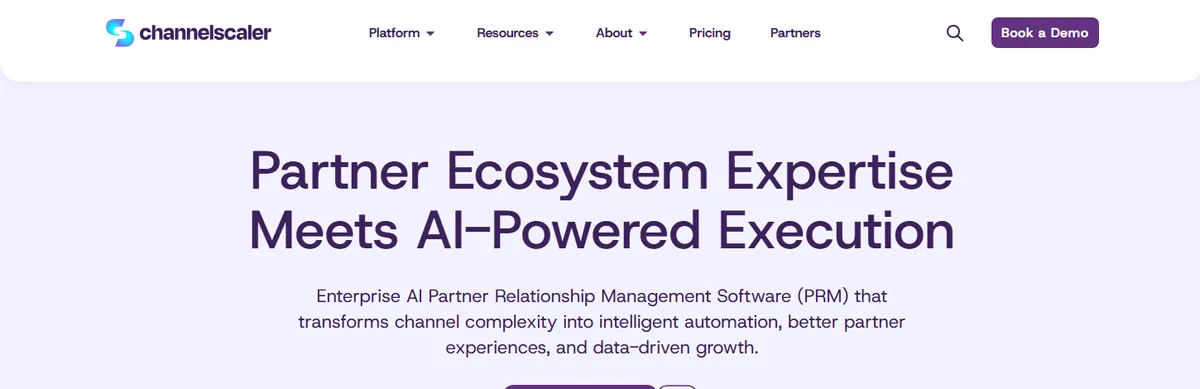
- What it does: PRM and partner programme automation in one modular product. The Channelscaler homepage says it is the new name for Allbound and Channel Mechanics, and lists modules for deal registration, lead distribution, co-selling, MDF, rebates, SPIFFs, commissions, distributor back-end credits, tiering, business planning, a partner portal, content management and an LMS, with integrations linking CRM, ERP, CPQ and payment systems.
- Best for: large programmes with distributors, rebates and several partner tiers.
- Pricing: priced per programme with a modular structure; the pricing page (modified 21 July 2026) states pricing from $50k per module annually for large or complex ecosystems, with setup, onboarding and training included and no user limits.
- What it does not do: it is not a low-cost starting point. At its stated entry price, a programme that needs several modules pays a multiple of $50k a year.
Channeltivity
- What it does: a focused PRM. Its PRM page describes deal registration with approvals, lead distribution with status tracking, MDF management, co-branded collateral, training and certification tracking, and partner recruitment with segmentation, plus integrations with HubSpot, Salesforce and Microsoft Dynamics, Zapier, SAML single sign-on and APIs.
- Best for: reseller and dealer networks, from a first programme of about 100 partners up to programmes with thousands.
- Pricing: quote-based. The pricing page defines Growth, Mid-Market and Enterprise plans by programme size and says partner programmes “don’t fit seat-based pricing”.
- What it does not do: the PRM page does not describe partner tiering or AI features; ask to see both if they matter to you.
Impartner
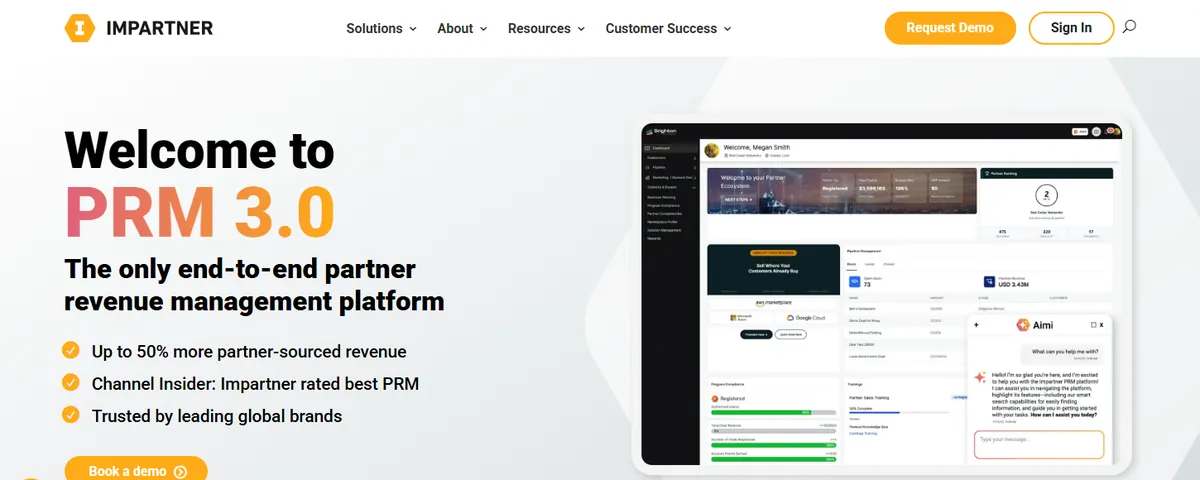
- What it does: an enterprise PRM it calls PRM 3.0. The Impartner PRM page (modified 21 September 2026) covers partner lifecycle management from recruitment and onboarding to training, deal registrations synced with the CRM, MDF requests and ROI analysis, tiering and compliance, referral automation, cloud marketplace co-selling (HyperscalerGTM) and an AI layer, Aimi, that flags partners with untapped potential and prioritises partner-manager actions. It names two-way sync with Salesforce, Microsoft Dynamics and HubSpot.
- Best for: enterprise programmes with many partner types, tiers and compliance rules.
- Pricing: quote-based. The pricing page (modified 28 September 2026) lists Emerge, Ignite, Pro and Enterprise plans with no prices.
- What it does not do: the entry plan is limited. The plan table caps Emerge at one version and one language, and marks some features as add-ons, so a multilingual programme should price a higher plan.
Journeybee
- What it does: a partner relationship management app that runs inside HubSpot. Its HubSpot Marketplace listing says partners register deals and work opportunities through branded portals while your team manages everything in HubSpot, with two-way data sync, automated commission payments and round-robin assignment of HubSpot users (HubSpot Marketplace: Journeybee, checked 9 November 2026).
- Best for: HubSpot-centred SaaS teams that want PRM without a second system.
- Pricing: Standard (for small teams, with a 14-day free trial) and Premium (for larger programmes), both through “Contact Us”; no figures are listed.
- What it does not do: it is built around HubSpot, so Salesforce-first teams should check sync depth before shortlisting.
Kiflo
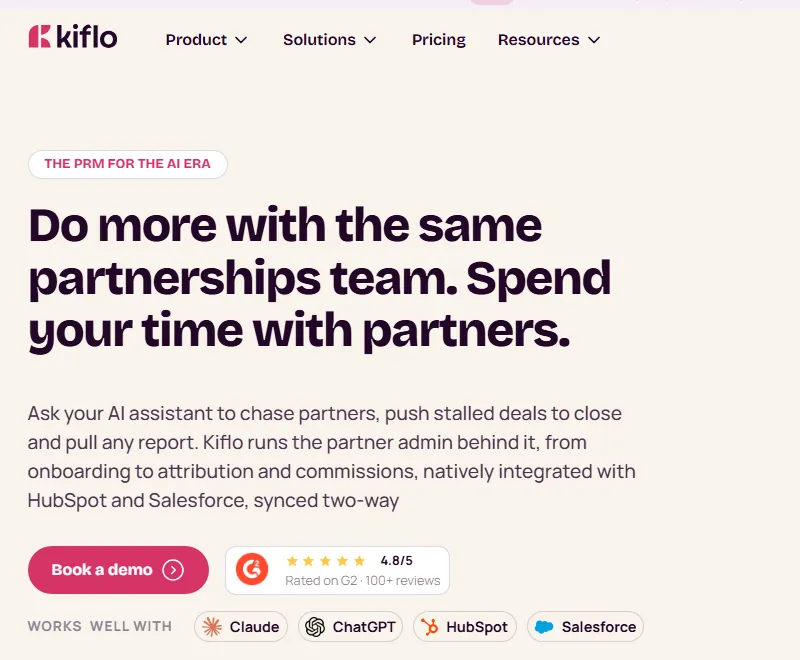
- What it does: PRM for growing SaaS partner programmes. The Kiflo pricing page lists, from the Core plan, a partner portal with lead registration, account mapping and co-sell, HubSpot and Salesforce sync, automatic commission calculation and Kiflo access from Claude and ChatGPT. Plus adds channel conflict detection, partner business plans and tier qualification; Premier adds enterprise SSO and co-branded collateral.
- Best for: SaaS reseller and referral programmes that want to start small and see a price first.
- Pricing: Core $399 a month, scaling with active partners, up to 50 partners and 3 partner managers with unlimited users; Plus and Premier through sales. Plans are 12-month contracts billed once a year. An active partner is one with portal access.
- What it does not do: Core stops at 50 partners and 3 partner managers, and co-branded collateral and SSO sit only in Premier.
Magentrix
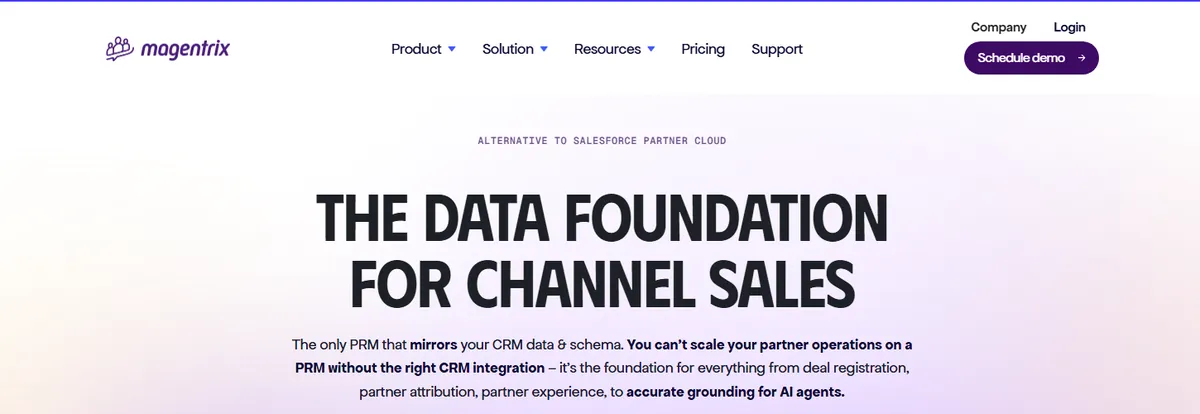
- What it does: partner portal and PRM with deal management. The Magentrix pricing page lists deal registration, pipeline and lead distribution, AI deal registration, LMS training, referral-link attribution, co-branding, programme tiers and partner payouts on the entry plan; Advanced adds gamification, business planning, microsites and advanced CRM integration with custom objects and a REST API.
- Best for: mid-market programmes that want a published price and a short path to a working portal.
- Pricing: Essentials $1,500 a month (100 partner users or 10 partner accounts with unlimited users each); Advanced $3,000 a month (150 partner users or 20 accounts); Unlimited on request. The page says there are no setup or onboarding fees, and monthly billing carries a 10% surcharge.
- What it does not do: the entry plans are capped, and extra user licences cost more. The page is also inconsistent about whether MDF and payouts start in Essentials or Advanced, so get it in writing.
Mindmatrix
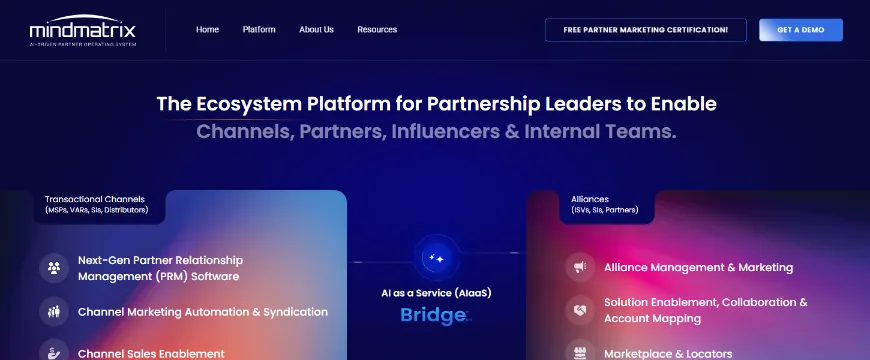
- What it does: Mindmatrix calls its platform Bridge and combines PRM, partner marketing automation, channel sales enablement and ecosystem orchestration (Mindmatrix homepage). Its PRM page covers deal and lead registration, lead routing by round-robin or priority, MDF requests and approvals, co-branded email, landing page and ad campaigns, an LMS, partner and product locators, incentives and a portal with SSO and custom branding. Named integrations include Salesforce, Autotask and ConnectWise.
- Best for: vendors whose partners need to run local, co-branded marketing as well as register deals.
- Pricing: quote-based.
- What it does not do: it publishes no prices or plan names, so you cannot estimate cost or compare packaging before a demo.
PartnerPortal.io
- What it does: a PRM and partner portal where every plan includes every feature, from partner and lead registration, commission tracking and payouts to resources, courses, quizzes and partner certifications, with HubSpot, Salesforce, Pipedrive and Zoho integrations (PartnerPortal.io pricing, checked 9 November 2026).
- Best for: small and mid-sized programmes that want a published price and a portal live the same day.
- Pricing: Free with 5 partners, 10 leads and 1 team member; Professional $249 a month with 100 partners and 1,000 leads; Enterprise $399 a month with unlimited partners and leads. The page says there is no per-seat pricing and no feature tiers.
- What it does not do: pricing scales on partners and leads, so a large referral programme moves to Enterprise quickly; MDF management is not listed among the features.
PartnerStack
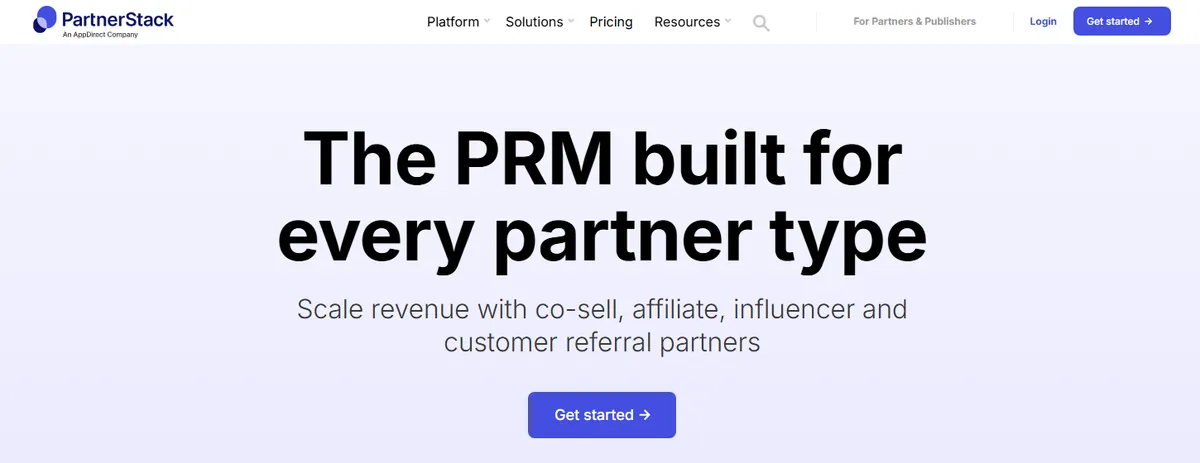
- What it does: a PRM and partner network for SaaS companies. The PartnerStack homepage names affiliate, referral, co-sell and influencer partners, automated commission payouts on a single monthly invoice, and a marketplace partners use to find B2B programmes. AppDirect announced on 14 April 2026 that it had acquired PartnerStack.
- Best for: SaaS affiliate and referral programmes that want partner recruitment and payouts handled for them.
- Pricing: quote-based. The pricing page lists Launch, Growth and Enterprise, priced by programme size, features and support, with no cap on partners or internal users.
- What it does not do: Launch makes you choose affiliate link tracking or lead and deal registration, not both; the learning management system and MDF start at Growth. Reseller partners are not among the partner types named in the homepage body.
Revspire Partner Portal
- What it does: Revspire is an AI sales enablement platform, and its Partner Portal gives partners one branded destination to learn, find approved resources and collaborate on opportunities. It covers CRM-connected partner company onboarding, company-level roles and member access, no-code co-branded partner microsites, governed access to content, playbooks, deal rooms, training and certifications, and analytics on partner engagement, training completion and certification. Revspire connects with Salesforce, HubSpot, Microsoft Dynamics 365, Zoho CRM and Pipedrive.
- Best for: programmes whose main gap is partner readiness and getting partners the same approved content and plays as the direct team.
- Pricing: priced by module with unlimited user licenses; about $25,000 USD a year on average (Revspire pricing). Partner Portal is a module added to the Content Hub base platform.
- What it does not do: deal registration, MDF, rebates and partner payouts are not among its listed capabilities, so programmes that need them pair it with a PRM or run them in the CRM.
Salesforce Partner Cloud
- What it does: Salesforce’s partner offering, built on Experience Cloud. The Partner Cloud pricing page lists a Partner Relationship Management (PRM) edition with Experience Cloud, Deal Management and Channel Analytics, and a Partner Ecosystem Management edition that adds partner enablement, loyalty management and account plans. Channel Revenue Management, with rebate tools, is sold separately. G2 now lists the product as Salesforce Partner Cloud, formerly Salesforce PRM.
- Best for: companies whose sales team already runs on Salesforce and wants partner deals in the same pipeline.
- Pricing: PRM $25 per member a month, billed annually; Partner Ecosystem Management $50 per member a month.
- What it does not do: the price is per member, so cost grows with every partner user you add. The page text also does not show which edition includes deal registration, lead distribution and MDF, so confirm the edition for each.
Softr
- What it does: a no-code builder for client and partner portals on top of a database such as Airtable or Google Sheets, with logged-in external users counted as “Client users” separately from your team (Softr pricing and plans, checked 9 November 2026).
- Best for: teams with a simple programme and someone who can build and maintain the portal themselves.
- Pricing: Free; Basic $19 a month (5 team and 5 client users); Pro $99 a month (10 team and 50 client users included, up to 250 clients at $1 each); Business $329 a month (30 team and 100 client users included, up to 500 clients at $2 each); all billed annually, monthly billing costs more; Enterprise custom.
- What it does not do: it is a builder, not a PRM: deal registration rules, tiers, MDF and payouts have to be designed and maintained by you.
Unifyr (formerly Zift Solutions)
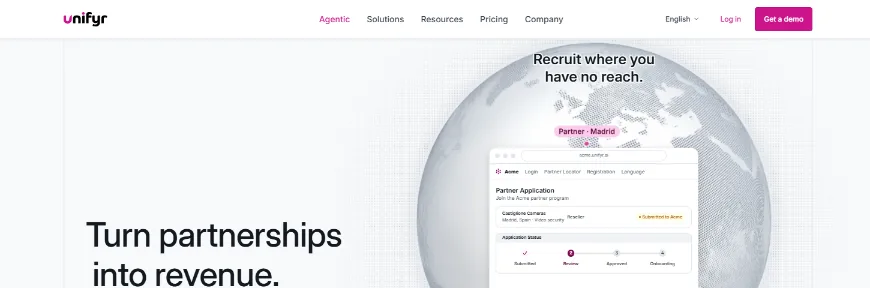
- What it does: partner ecosystem management for enterprise programmes. A Business Wire release from December 2025 says Unifyr completed its rebrand from Zift Solutions. The Unifyr pricing page lists deal and lead registration, a content library, co-branding, onboarding, playbooks, an LMS with SCORM, partner analytics and a branded portal from Activate; Grow adds certification management, campaign management, lead distribution and price books; Scale adds MDF, partner tiering, a partner locator, a deal workflow builder and partner CRM sync with Salesforce, Dynamics, SugarCRM and Zoho.
- Best for: enterprise vendors that fund partner marketing and run several tier programmes.
- Pricing: quote-based. Activate, Grow and Scale are sized to partner count, with no prices shown.
- What it does not do: MDF and partner tiering appear only in Scale, the top edition, and Activate includes a single CRM connector.
ZINFI
- What it does: a Unified Partner Management (UPM) platform covering partner relationship management, partner marketing automation and incentives. ZINFI’s own glossary describes “enterprise licensing models that provide comprehensive platform access across the six UPM pillars” (ZINFI: PRM pricing, checked 9 November 2026).
- Best for: large channel organisations running programmes across several regions and partner types.
- Pricing: enterprise licence quoted after a scoping conversation; no prices are published.
- What it does not do: no published prices or entry tier, so it is a long evaluation for a small programme.
How we evaluated these tools
We started from vendors that appear when B2B buyers search for partner portal and PRM software and that publish pages we could check, excluding affiliate-only tools and community platforms. For each, we opened its product and pricing pages on 29 October 2026 and recorded what they say about deal registration, lead distribution, MDF, training, branding, CRM integrations and price. Ownership changes were checked against a press release or the vendor’s own site.
We did not run hands-on trials or use review scores. Where a page was ambiguous, such as Magentrix’s MDF placement, we say so rather than guess. Treat every figure as the vendor’s list price on the date checked, and confirm it in writing.
If your shortlist includes a portal that should share governed content, playbooks and deal rooms with your direct sales team, you can book a Revspire demo to see the Partner Portal against your criteria.
Free template: the partner enablement plan template covers partner tiers, a 90-day onboarding plan to the first registered deal, content and training by tier, certification and quarterly metrics, in Word, Excel and PDF.
Training distributors and dealers? See our guide to sales training software for distributors, which compares partner LMSs, PRMs with training and enablement platforms with partner portals.
Frequently asked questions
What is partner portal software?
Partner portal software builds the secure website where resellers, referral partners and integrators work with a vendor. It usually covers partner onboarding, content and co-branded assets, training, deal registration and partner analytics, and in PRM products it also handles lead distribution, MDF and payouts.
What is the difference between a partner portal and PRM?
The portal is the front end partners log into. PRM is the system behind it that records partners, tiers, registered deals, funds and payouts, and syncs them with your CRM. Most products on this list sell both together; Revspire Partner Portal focuses on the portal and enablement side.
How much does partner portal software cost?
Published entry prices on this list run from free plans at PartnerPortal.io and Softr, and PartnerPortal.io Professional at $249 a month, to Channelscaler at $50k per module a year, with Salesforce Partner Cloud at $25 per member a month. Seven of the fourteen publish no price figure at all and quote on request. The pricing model, per member, per partner or per module, usually matters more than the entry price.
Does Salesforce have a partner portal?
Yes. Salesforce Partner Cloud’s PRM edition includes Experience Cloud for the portal, plus deal management and channel analytics, at $25 per member a month billed annually. It suits companies already on Salesforce CRM.
Can a sales enablement platform work as a partner portal?
For content, training and certification, yes: several enablement platforms extend access to partners. For deal registration, MDF and payouts you generally need a PRM alongside it or in its place.
Sources
All accessed 29 October 2026.
- Channelscaler: homepage (undated)
- Channelscaler: Pricing (modified 21 Jul 2026)
- Channeltivity: Partner Relationship Management Software (undated)
- Channeltivity: Pricing (undated)
- Impartner: Partner Relationship Management (modified 21 Sep 2026)
- Impartner: Request PRM pricing (modified 28 Sep 2026)
- Kiflo: Pricing (undated)
- Magentrix: Partner Management Platform pricing (undated)
- Mindmatrix: homepage (undated)
- Mindmatrix: Partner Relationship Management Software (undated)
- PartnerStack: homepage (undated)
- PartnerStack: Pricing (undated)
- AppDirect: AppDirect Acquires PartnerStack (14 Apr 2026)
- Salesforce: Partner Cloud Pricing (undated)
- G2: Impartner PRM vs Mindmatrix PRM vs Salesforce Partner Cloud (undated)
- Unifyr: PRM Software Pricing and Plans (undated)
- Business Wire: Unifyr Appoints Michael Kugler as CEO (2 Dec 2025)