Revspire blog
Objection Handling in Sales: Frameworks, Examples, and AI Practice
A practical guide to objection handling in sales with a six-move live-response framework, buyer-specific examples, and a four-week AI practice plan.
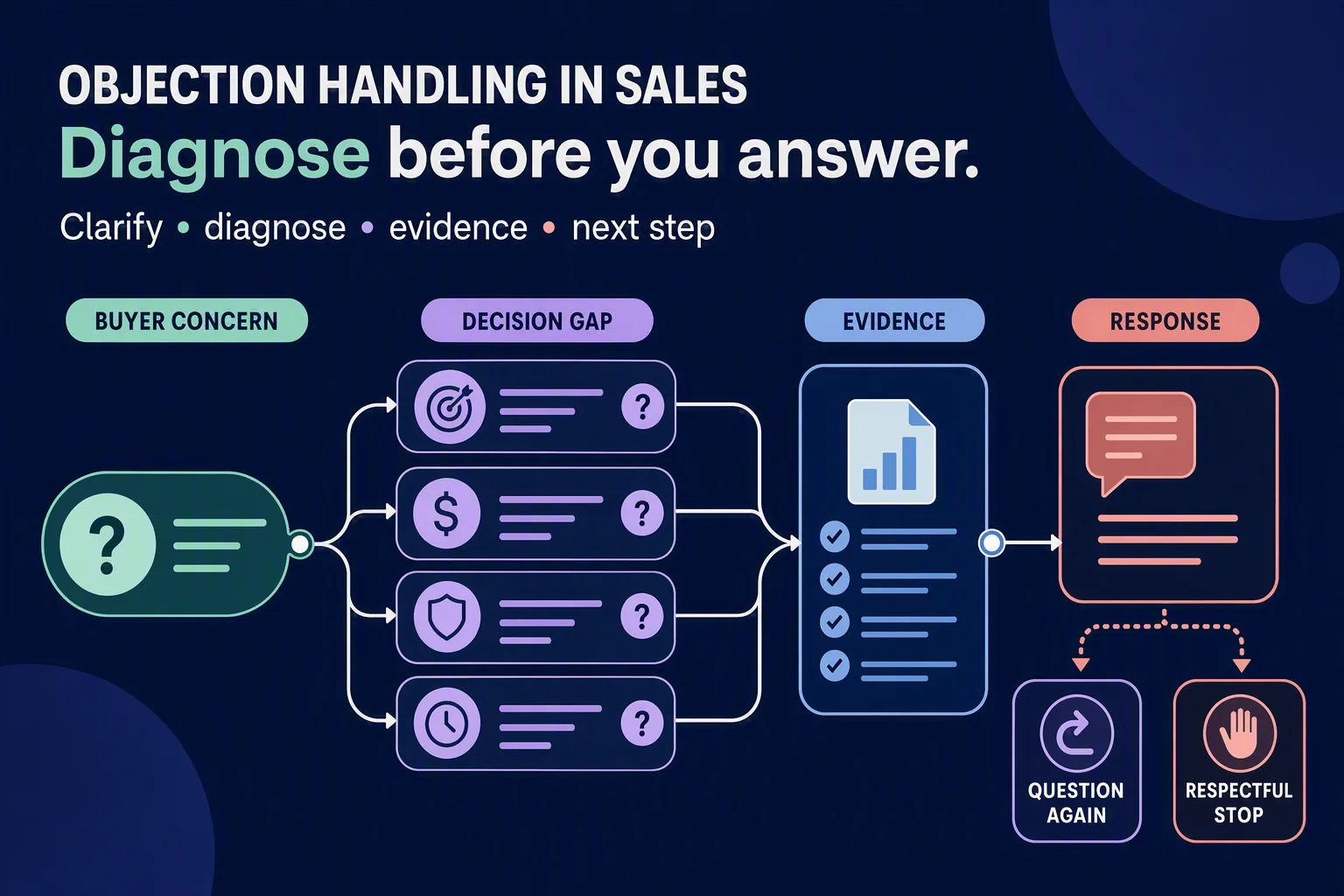
Objection handling in sales should resolve a decision gap, not defeat the buyer
Objection handling in sales works when the seller treats resistance as information about a decision. “It is too expensive,” “not now,” and “we already have a solution” sound conclusive, but each can conceal a different gap: unproven value, competing priorities, implementation risk, missing authority, or a genuine reason not to proceed. A memorized rebuttal answers the sentence. A useful response discovers the concern underneath it and helps the buyer evaluate that concern with relevant evidence.
The goal is not to make every objection disappear. Some concerns reveal a poor fit, a missing capability, or a decision that should wait. Good handling produces clarity: the buyer can state what would change the decision, the seller can answer within approved facts, and both can choose a proportionate next step. That makes the skill observable and practiceable without turning it into verbal combat.
This guide provides a live-response framework, examples for common B2B objections, and a four-week AI practice plan. It complements Revspire’s broader guide to sales coaching frameworks; it does not replace discovery, commercial negotiation, or a manager’s judgment about deal fit.
Classify the resistance before choosing a response
An objection is a stated reason for hesitation or rejection. It is not automatically a request for persuasion. First determine what kind of resistance you heard and whether the buyer has supplied enough context to answer. Research across three studies of live conversations found that people who asked more questions, particularly follow-up questions, were perceived as more responsive and were better liked. [1] Those studies were not sales experiments, but they support a practical principle: a relevant follow-up question often serves the conversation better than an immediate speech.
What you hear
What it may represent
Immediate job
Do not assume
Concern
A risk or unanswered question about value, fit, trust, or change.
Clarify the feared consequence and answer with relevant evidence.
That reassurance alone will resolve it.
Condition
A requirement outside the buyer’s control, such as policy, timing, or an integration dependency.
Test whether it is fixed, conditional, or owned by another stakeholder.
That persistence can remove a real constraint.
Brush-off
A polite way to end an irrelevant or poorly timed conversation.
Ask one low-pressure question, then respect the answer.
That every dismissal hides an opportunity.
Unknown
An ambiguous phrase such as “too much” or “not ready.”
Define the comparison, impact, and decision criterion.
That your preferred interpretation is correct.
Commercial term
A request about price, scope, risk allocation, or contractual terms after fit is established.
Record the term and move it into the authorized commercial process.
That an objection script is a substitute for negotiation authority.
Several types can appear in one sentence. “We cannot justify this this quarter” could mean the outcome is not valuable, the evidence is weak, budget is allocated elsewhere, or approval cannot occur before a fixed date. The value selling and value realization guide is useful when the gap is the business case. The deal-level coaching guide helps when the concern exposes missing stakeholders or process evidence.
A six-move framework keeps the live response brief and diagnostic
The response earns the right answer by locating the decision gap before introducing evidence.
Use six moves as a conversational sequence, not six lines that must be spoken every time. In a simple case, several moves may fit into two sentences. In a consequential or ambiguous case, the sequence may span multiple turns.
- Pause. Leave enough space to avoid interrupting or answering defensively. Do not fill the pause with “but,” a discount, or a feature list.
- Mirror. Reflect the concern in neutral language: “Implementation effort is the part you are questioning.” This shows what you heard without pretending to agree with an inference you have not examined.
- Clarify. Ask for the missing comparison or consequence: “When you say the rollout looks heavy, which team or dependency worries you most?” Use one question at a time.
- Diagnose. Locate the decision gap: value, priority, trust, fit, change risk, authority, or process. Test it explicitly: “If the identity work were covered, would another implementation concern remain?”
- Answer. Give the smallest response that addresses the diagnosed concern. Use an approved fact, a relevant example, a demonstration, or a candid limitation. Label what still requires confirmation.
- Confirm and advance. Ask whether the response addressed the original concern, then agree on the next evidence or decision. If it did not, return to clarification rather than stacking more claims.
Language matters at the opening. Research on conversational receptiveness found that language showing thoughtful engagement with opposing views can reduce conflict escalation and improve perceived persuasiveness and willingness to collaborate. [2] A practical opener is: “I can see why that would be a concern given the rollout you just described. Which part feels least workable?” It acknowledges the buyer’s reasoning without conceding an unverified conclusion.
Keep approved answers close to their evidence. Revspire’s guide to turning sales playbooks into practice and coaching explains how source ownership and updates should flow into rehearsal. An objection response copied into a private note will eventually drift from the product, policy, or proof it is meant to represent.
The first response should narrow the objection, not solve every possible problem
Common phrases are labels, not diagnoses. The examples below show an opening response and the evidence that should follow if the buyer confirms the concern. They are patterns to adapt to the buyer’s words, not universal scripts.
Buyer says
Seller’s first response
What to locate
Useful evidence or outcome
“This is too expensive.”
“Which comparison is driving that: the approved budget, another approach, or the result you expect?”
Affordability, value, scope, or procurement posture.
A buyer-owned cost baseline and an agreed value assumption; commercial terms stay in the authorized process.
“This is not a priority right now.”
“What took priority, and what happens to this problem while the team focuses there?”
A real sequencing choice, weak impact, or no urgency.
A consequence the buyer recognizes, a later trigger, or a respectful stop.
“We already have a solution.”
“What is working well enough that you would not change it, and what prompted this conversation?”
Satisfaction with the status quo versus a specific unresolved gap.
A clear reason to evaluate or confirmation that there is none.
“Security will never approve this.”
“Which requirement do you expect to block approval: data access, retention, hosting, identity, or something else?”
A named control, prior experience, or generalized risk.
Current approved documentation and the right specialist; never an improvised assurance.
“It will not integrate with our stack.”
“Which workflow and data direction are mandatory for the use case?”
A documented dependency versus a broad assumption.
Verified technical behavior, a bounded test, or a transparent product gap.
“I need to talk to my team.”
“Of course. What will they need to decide, and which concerns should we help you represent accurately?”
Legitimate collaboration, missing authority, or unresolved personal concern.
A buyer-led internal step, relevant material, or a joint session if useful.
Notice that none of the opening responses claims the objection is false. Each requests information that changes the next move. For additional deal signals that may sit behind stated resistance, use the AI deal-coaching risk signals guide; do not treat a model’s inferred risk as the buyer’s stated reason.
Strong answers are short, conditional, and bounded by proof
Once the concern is clear, answer that concern and stop. A useful answer usually has three parts: the conclusion, the evidence, and the boundary. For example: “Yes, the approved integration supports that read path. Here is the current technical specification. The write-back behavior you described is not confirmed, so I will bring our solutions engineer into the next review.” That response is more credible than a broad compatibility claim.
The same discipline applies to value. Suppose the buyer says, “I cannot defend this cost.” After clarifying, the seller learns that finance doubts the expected manager-time savings. A bounded response is: “Then the decision depends on that assumption. Let us use your current review volume and time per review, show the calculation, and let finance replace any estimate they do not accept.” The seller has not promised ROI; the buyer owns the inputs.
The US Federal Trade Commission’s advertising-substantiation policy states that objective product claims should have a reasonable basis before they are disseminated. [3] Exact legal duties depend on context and jurisdiction, but the operating rule is straightforward: do not invent a roadmap date, customer result, security assurance, integration behavior, or legal conclusion to keep a conversation moving. Say what is known, cite the current source, and assign unanswered questions to an accountable owner.
Call evidence can reveal whether sellers diagnose or merely recite. The call coaching and review guide describes the manager workflow, while the conversation intelligence guide covers the adjacent recording and transcript context.
Confirmation tests understanding without forcing agreement
“Does that make sense?” usually tests politeness, not resolution. Ask the buyer to evaluate the answer against the concern: “Does that address the data-retention issue you raised?” “What remains uncertain?” or “How would you explain this to security?” The last question adapts the closed-loop logic of the Institute for Healthcare Improvement’s teach-back method, which asks a person to explain information in their own words so the communicator can check whether it was explained clearly. [4] Teach-back was designed for healthcare, so apply the communication principle without adopting clinical language or a quiz-like tone.
Then choose the smallest honest next step. It may be a technical review, evidence the buyer will verify, another stakeholder’s input, a time-based trigger, or a mutual decision to stop. If the buyer says the concern remains, record why. An unresolved objection is useful deal evidence; a forced verbal “yes” is not.
AI practice is useful when resistance persists and the buyer can say no
AI practice should make the six moves easier to use under pressure. It should not guarantee that a polished phrase wins. Give the simulated buyer a coherent role, business context, decision criteria, known facts, hidden facts, and one objection with a real basis. The objection should persist when the seller answers the wrong concern, makes an unsupported claim, asks several questions at once, or pressures for agreement.
Use the existing AI sales role-play scenarios as the companion scenario library rather than rebuilding scenarios here. Start with one relevant situation and vary only one dimension per attempt: buyer role, root concern, available evidence, or ambiguity. Revspire’s AI sales coaching guide supplies the wider operating context.
For each attempt, retain the exact buyer objection, seller turns, facts available at that moment, unsupported statements, point of clarification, answer, and buyer reaction. The NIST Generative AI Profile identifies risks including confident false output, data privacy, harmful bias, and inappropriate human reliance. [5] Use synthetic or approved information, let managers challenge AI interpretations, and prevent generated feedback from becoming an employment decision by default.
A four-week practice plan turns the framework into a live habit
Practice two or three short sessions each week. Keep each attempt focused enough to repeat immediately, and use the seller’s second attempt as the learning event. Managers should listen for decisions in the conversation, not delivery polish alone.
Week
Practice focus
Attempt design
Evidence to review
1: Hear and clarify
Pause, mirror neutrally, and ask one relevant follow-up.
Use the same ambiguous objection in three runs with a different hidden cause each time.
Whether the seller avoided assumptions and found the actual concern.
2: Diagnose
Distinguish value, priority, trust, fit, change risk, authority, and process.
Keep the buyer’s opening words constant, but change the facts that a good question reveals.
The evidence that supports the seller’s diagnosis, or the point where the diagnosis goes off course.
3: Answer and bound
Respond with the smallest approved proof and state what remains unknown.
Include one answerable concern, one partial capability, and one issue requiring an expert.
Evidence used, unsupported claims avoided, and escalation chosen.
4: Confirm and transfer
Check resolution and agree on a buyer-relevant next step.
Mix earlier cases, then review one real call or meeting with appropriate access and consent.
Whether the same behavior appears in work and whether the buyer’s concern changes.
After each attempt, ask the seller three questions: What did you think the objection meant? Which buyer words supported that view? What would you change in the next turn? Compare the explanation with the transcript before offering advice. This prevents the debrief from becoming a list of preferred phrases. Revspire’s review of rep-performance coaching mistakes explains why vague feedback and weak follow-through undermine practice.
Measure transfer by the quality of the next decision
Track a small set of behaviors: the seller paused, represented the concern accurately, asked a relevant question, located the decision gap, used supported evidence, named a boundary, checked resolution, and accepted a legitimate “no.” Review a sample of practice and real conversations to see whether those behaviors transfer. Do not collapse them into a single number that hides a fabricated claim or a missed disqualification.
Connect improvement to a relevant operational result, such as fewer avoidable technical escalations, clearer next-step ownership, or less manager rework, while documenting other causes. The guide to sales coaching ROI provides the broader measurement chain. The aim here is narrower: verify that the seller makes a better conversational decision when real resistance appears.
The best objection response can be clarity, evidence, or a respectful stop
Effective objection handling is not a contest of confidence. It is a disciplined way to turn an ambiguous statement into a defined decision issue, answer with proportionate proof, and check what remains. Sellers who can do that protect buyer trust, expose poor fit sooner, and make valid opportunities easier to evaluate.
Sources
- Huang, Yeomans, Brooks, Minson, and Gino, “It Doesn’t Hurt to Ask: Question-Asking Increases Liking”. This peer-reviewed primary research examines question-asking, follow-up questions, perceived responsiveness, and liking across live conversations.
- Yeomans, Minson, Collins, Chen, and Gino, “Conversational Receptiveness: Improving Engagement With Opposing Views”. This primary research develops and tests language associated with receptiveness across contentious conversations.
- US Federal Trade Commission, “FTC Policy Statement Regarding Advertising Substantiation”. The statement addresses the evidentiary basis required for objective advertising claims.
- Institute for Healthcare Improvement, “Always Use Teach-back!”. The toolkit explains a closed-loop method for checking whether information was communicated clearly.
- National Institute of Standards and Technology, “Artificial Intelligence Risk Management Framework: Generative Artificial Intelligence Profile”. The profile identifies generative-AI risks and actions for governing, measuring, and managing them.
Frequently asked questions
What is objection handling in sales?
It is the process of clarifying a buyer’s stated resistance, identifying the underlying decision gap, responding with relevant evidence, and checking whether the concern is resolved. It can also reveal a real constraint or poor fit that should not be pushed aside.
What is a simple framework for handling sales objections?
Pause, mirror the concern, clarify ambiguous language, diagnose the decision gap, answer with the smallest sufficient evidence, then confirm and advance. If the answer misses the concern, return to clarification instead of adding more claims.
How should a seller respond to “your price is too high”?
Ask what “high” is being compared with: available budget, another approach, current cost, expected value, or negotiating posture. Address the confirmed issue with buyer-owned assumptions and approved evidence. Do not offer an unauthorized concession or promise a return.
Can AI help sales representatives practice objections?
Yes. AI can present consistent resistance, vary the hidden cause, preserve transcripts, and support immediate retries. The exercise still needs approved facts, realistic persistence, privacy controls, and human review because an AI buyer or coach can misread context or generate unsupported feedback.
How do managers know objection practice transferred to real calls?
Review comparable call moments for the same observable decisions: accurate reflection, relevant clarification, supported diagnosis, bounded evidence, a resolution check, and an appropriate next step. Pair that sample with operational outcomes and manager correction effort rather than relying on completion alone.
Ready to make real buyer resistance easier to practice? Request a Revspire demo and bring one recurring objection, the approved evidence behind the answer, and the behavior your team needs to repeat.