Sales Enablement Platform Buyer’s Guide 2026
A practical perspective for connecting this idea to your revenue team’s next move.
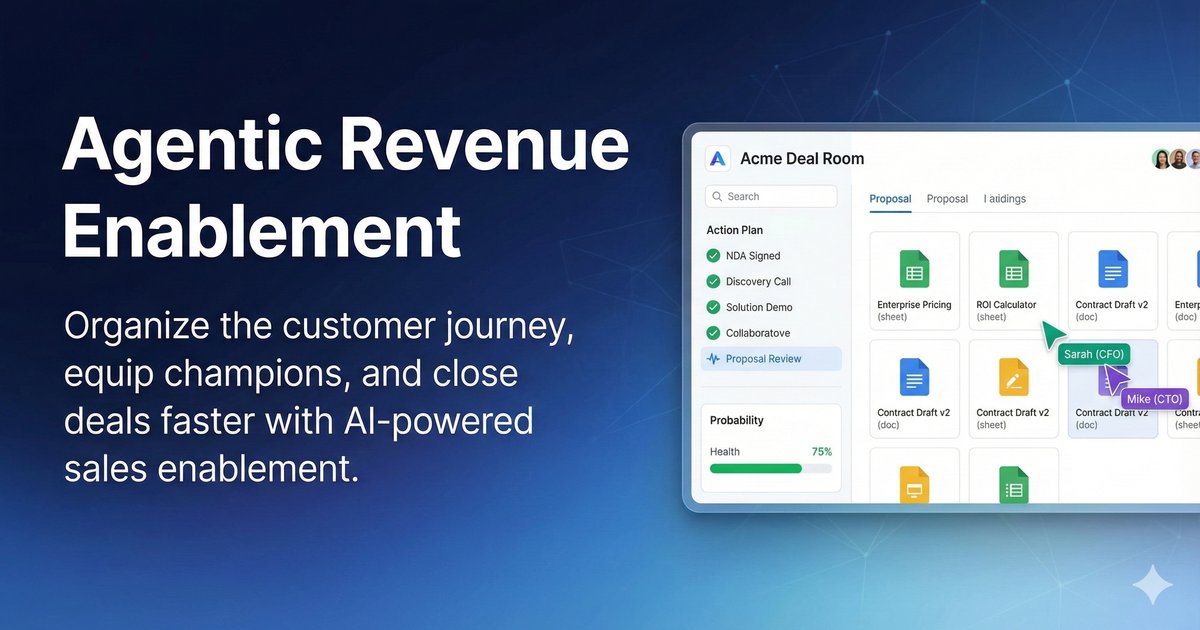
To choose a sales enablement platform in 2026, score every vendor against the same ten criteria, from content management and training to pricing model and implementation, then test the top two or three in scripted demos and a short pilot. Base the decision on what each tool does with your own content and CRM.
This buyer’s guide sets out those ten criteria, a scorecard you can copy, what vendors publish about price, a shortlist by company size, the demo red flags we see most often, and a 90-day evaluation plan.
Last updated: 31 October 2026
Disclosure: Revspire publishes this guide and sells a sales enablement platform. Revspire has one entry, in the shortlist below. Vendor capabilities and prices come from each vendor’s own pages, and contract benchmarks from Vendr, all opened on 31 October 2026. We do not compare security certifications for any vendor; ask each one for its own documents during your security review.
Who this guide is for
It is written for the people who run the evaluation: a VP Sales or CRO who owns the budget, an enablement or sales readiness lead who will run the platform, and a RevOps lead who will own the CRM connection. It fits best at companies of roughly 100 to 5,000 employees that have outgrown a shared drive, or are replacing an enablement tool at renewal.
If you are still deciding whether you need a platform at all, start with our signs you need sales enablement software. If you already know you need one and want a formal tender, our sales enablement RFP template and requirements scorecard has the full requirement list, pass/fail gates and a free downloadable scorecard. This guide is the step before it: how to think about each criterion and how to read what vendors tell you.
The 10 criteria for evaluating sales enablement software
Most platforms now sell content, training and buyer-facing rooms in some combination, so the differences lie in depth, packaging and cost. For each criterion below we say what to test and give an example from a vendor’s own pages.
1. Content management
Can a seller find the approved, current version of an asset in seconds, and can a content owner update it once so every shared link changes? Test search with your own messy file names, and ask how the tool flags stale and unused content. Allego’s content management page, for example, says it can spot unused and outdated assets worth retiring or refreshing. Our sales content management software comparison goes deeper on this criterion alone.
2. Training and readiness
Check whether onboarding courses, learning paths and certifications live in the platform or need a separate LMS. Packaging varies: on Highspot’s pricing page, training (learning paths, adaptive learning, AI-assisted course authoring) starts at the Better package, not the entry package. Ask who builds the first courses and how long that takes. Our sales training platforms comparison lists dedicated options.
3. Coaching and AI role play
AI role play is now common, but limits differ. SalesHood’s pricing page caps AI role-play submissions at 40 per seat on Essential and 80 on Pro, with no cap on Unlimited, and Spekit lists AI Role Play as an add-on. Ask how scenarios are built from your own deals, how scoring works and what managers see. See our AI sales role-play software comparison if coaching is your main gap.
4. Digital sales rooms
A digital sales room is a shared page where the buyer finds content, a mutual action plan and next steps, and where the seller sees who engaged. Some suites include rooms only at higher tiers: Spekit lists AI Deal Rooms in its GTM Acceleration package, and SalesHood puts Digital Sales Rooms in Pro and Unlimited. Ask whether buyers need a login and whether room activity writes back to the opportunity. Our digital sales room software comparison covers specialists.
5. Analytics and attribution
Leaders want to know which content and training show up in won deals. Ask exactly how the vendor joins content activity to CRM opportunities, and whether you can export the raw data. Allego says it tracks engagement, pipeline influence and win rates by asset; ask any vendor making that kind of claim to show it on a sample of your own closed deals.
6. CRM and tool integrations
One CRM integration that works well is worth more than a long logo wall. Check where content appears on the opportunity record and whether buyer views flow back. Note which tier includes it: Dock includes Salesforce and HubSpot from its Standard plan, while Showell lists Salesforce, HubSpot and Microsoft Dynamics as add-ons. Highspot’s pricing form asks which learning, conversation intelligence and sales engagement tools you use, which tells you integrations shape the quote.
7. AI search and generation
Ask what the AI is grounded on, whether answers cite the source asset, and whether admins can exclude draft or expired content. Highspot’s entry package lists AI-powered search and answers and content autogeneration, and its Best package adds an MCP server for connecting AI assistants. Run the same ten seller questions through every shortlisted tool and compare the answers side by side. Our AI sales enablement platforms comparison covers this in depth.
8. Admin and governance
Someone has to run the platform after launch. Check approval workflows, expiry dates, permissions by team or region, single sign-on and automated user provisioning, and how many admin hours a week the vendor expects. Tier matters here too: Dock offers Google and Microsoft sign-on on every plan but lists SCIM provisioning and Okta or Azure sign-on only on Enterprise.
9. Pricing model and total cost
The model decides what happens to the bill as you hire. Per-seat pricing grows with every seat; workspace and module pricing changes when you cross a user band or add a module. Price the whole term, including services, add-ons and renewal increases. The pricing section below gives the published figures.
10. Implementation and adoption
Ask for a dated plan with named owners on both sides, and what it assumes of your team. Vendors state different timelines: Allego says most deployments can launch within 4 weeks with full participation from your project team, and SalesHood’s page says go live in days. Then ask how the vendor measures adoption at 90 days, and what happens if you miss it.
A scorecard for comparing sales enablement vendors
Score each vendor 0 to 4 on every criterion (0 = absent, 2 = works with workarounds, 4 = shown working on your own data), multiply by the weight and divide by 4. The weights below are a balanced starting point and our editorial judgement, not an industry benchmark; move points toward the criteria that match your main gap. For pass/fail gates, a demo script and a downloadable Word, Excel and PDF version, use the free sales enablement RFP template and scorecard.
| Criterion | Weight | Ask the vendor to show | Score (0 to 4) |
|---|---|---|---|
| Content management | 15 | Search across 20 of your own files; one update reaching every shared link | |
| Training and readiness | 10 | A real onboarding path with a certification at the end | |
| Coaching and AI role play | 10 | A role play built from one of your live deals, scored, with the manager view | |
| Digital sales rooms | 10 | A room sent to a test buyer, with activity on the opportunity | |
| Analytics and attribution | 10 | Content use joined to closed deals, plus a raw data export | |
| CRM and tool integrations | 15 | The integration in your CRM sandbox, both directions | |
| AI search and generation | 10 | Ten seller questions answered with cited sources | |
| Admin and governance | 5 | Approval, expiry and permission setup by an admin, live | |
| Pricing model and total cost | 10 | An itemised quote for every year of the term at today’s and next year’s headcount | |
| Implementation and adoption | 5 | A dated plan with named owners and an adoption measure at 90 days |
Balanced weights total 100. Editorial starting point from Revspire, 31 October 2026; adjust before you score.
What does a sales enablement platform cost? Pricing models and published figures
Most enablement software is sold by quote. Of the 18 vendors in our sales enablement software pricing guide, five publish any prices. The figures below are the published ones from that guide; we re-opened every source on 31 October 2026 and each matched.
Per seat
Trumpet lists $45 per user a month on Pro (up to 5 users), $100 on Scale and $160 on Elite, or $450, $1,000 and $1,600 per user a year. Confirm lists its Learn:Up LMS (formerly WorkRamp) from $9 and Practice, its AI role-play product, from $4 per user a month, billed annually and based on a 200-person company. Allego and Spekit also price per seat but publish no rates; Allego says its typical contract is three years, paid annually.
Plan fee plus seats
Dock lists Standard at $350 a month with 5 users and Premium at $1,000 a month billed annually with 10 users, with extra seats at $50 a month and a custom Enterprise contract from 25 users. Dock says it charges only for internal team members, so buyers and partners join free.
Per workspace
Showell lists Professional from $715 per workspace a month, users included, for 10 to 200 users, with Enterprise quoted above 200. All plans need a 12-month commitment that renews automatically, with 90 days’ notice to cancel.
Quote only, with dated benchmarks
For quote-only vendors, Vendr publishes median annual contracts from its own transactions. On pages last updated February 2026 and opened 31 October 2026: Highspot $60,005 (351 purchases, range $16,163 to $177,366), Mindtickle $44,356 (65 purchases), Showpad $34,875 (50 purchases), Seismic $31,950 (415 purchases) and Spekit $16,308 (36 purchases). A median blends every seat count, module mix and term, so treat it as a range check. Vendr’s figures are not independently verified, and several of its pages show a different “deals handled” count from the purchase count.
Costs that sit outside the licence quote
Services can be large. Vendr’s Seismic page puts professional services at $10,000 to $30,000 for 10 to 50 users, $30,000 to $75,000 for 50 to 200 users and $75,000 to $150,000 or more above 200 users. Vendr’s Highspot page puts enterprise onboarding at $10,000 to $50,000 or more, with training separate, and says 3 to 7% annual renewal increases are common. Ask for services as a fixed fee or a cap, and a renewal cap in writing.
A worked example at list price shows why the model matters. A team of 20 on Trumpet Scale, billed annually, costs $20,000 a year; at 100 users it costs $100,000. Dock Premium costs $12,000 a year for 10 users and $18,000 for 20. The per-vendor detail is on our Highspot, Seismic, Mindtickle and Dock pricing pages.
Sales enablement platform shortlist by segment
Start with three to five vendors. These groupings follow each vendor’s own packaging and published terms and are unranked; within each segment vendors are listed alphabetically.
Small teams (under about 25 users)
- Dock: published prices from a free plan to Premium; its homepage lists deal rooms, content management, learning management and role play.
- Hyperbound: a free plan with 45 prebuilt AI role plays, if practice is the first need. Paid plans are quoted.
- Trumpet: a free plan with 10 Pods and unlimited users, then per-user plans, built around its buyer-facing Pods.
Small teams should favour published prices and monthly terms. The digital sales room pricing guide compares room vendors on cost.
Mid-market (about 100 to 1,000 employees)
- Allego: four packages covering learning with conversation intelligence, AI role play, content and digital rooms, with implementation and training services included in every deployment. The three-year typical term is a long commitment.
- Revspire: Content Hub is the base platform, with Deal Room, Academy (training and certification), Partner Portal and CPQ added as modules. It connects to Salesforce, HubSpot, Microsoft Dynamics 365, Zoho CRM and Pipedrive, and has two-way sync with SharePoint and OneDrive. Revspire is priced by module with unlimited user licenses; about $25,000 USD a year on average. The first team is typically live 2 weeks after signature, with full rollout in about 6 weeks. Limitation: prices are not published, and its Conversation Intelligence module is listed as coming soon, so teams that need call recording today will pair it with a separate tool. See Revspire pricing.
- SalesHood: Essential, Pro and Unlimited editions with AI practice caps on the first two and rooms from Pro; Salesforce is the CRM it names.
- Spekit: per-seat pricing quoted on package and team size, with AI Deal Rooms in GTM Acceleration. Vendr’s median is $16,308 a year (36 purchases, February 2026).
Our mid-market sales enablement platforms comparison reviews nine tools for this segment.
Enterprise (1,000+ employees)
- Highspot by Seismic: Good, Better and Best packages, quoted by go-to-market team size. Seismic completed its merger with Highspot on 18 August 2026 and keeps Highspot as a product brand, so ask about the product roadmap and price protection for the full term.
- Mindtickle: its homepage lists AI role play, sales training, coaching, content management, digital sales rooms, conversation intelligence and analytics.
- Seismic: broad content automation and governance; budget for services, which Vendr puts at $75,000 or more above 200 users.
- Showpad: Professional, Advanced and Expert plans, licensed per user and quoted on its pricing page; Vendr’s median is $34,875 a year (50 purchases, February 2026).
See our enterprise sales enablement platforms comparison, and if you are reviewing an incumbent, the Highspot alternatives and Seismic alternatives pages.
Regulated industries
In financial services, life sciences and insurance, the deciding questions are usually approval workflows, expiry, distribution control and whether reviewed content reaches sellers unchanged.
- Allego: its content page says version control, approvals and expiration are controlled in one place, and that compliance and branding travel with every document.
- Seismic: its compliance page describes content governance at scale, approval workflows and governed distribution to internal and external audiences.
- Showpad: the Vodori connector sends approved, regulated content from Vodori’s review system into Showpad for life sciences teams.
Ask every vendor to walk through an expired asset: what the seller sees, what a buyer who holds an old link sees, and what the audit record shows.
For the full field, our best sales enablement tools for 2026 compares 18 tools.
Red flags in sales enablement demos
- Only the vendor’s sample content. If they will not load 20 of your files before the second demo, you cannot judge search or AI answers.
- Integration shown in slides. Ask to see it working in a CRM sandbox, including data written back to the opportunity.
- AI answers with no source. If an answer does not show which asset it came from, a seller cannot check it and an admin cannot fix it.
- Attribution you cannot audit. A win-rate chart with no way to export the underlying records tells you nothing you can check; ask for the records.
- Features that sit in another tier. Ask for each demoed feature’s package name in writing; rooms, training and provisioning often sit above the entry tier.
- No admin in the room. Ask the person who will run it to set up an approval and an expiry date live.
- A timeline with no conditions. Ask what the go-live date assumes from your team, and who on their side owns it.
- Pressure to sign before a pilot. End-of-quarter discounts are real, but a scoped pilot with a pre-agreed full price protects you better.
A 30/60/90-day sales enablement evaluation timeline
Days 1 to 30: define and shortlist
- Write a one-page decision brief: the problem, who uses the tool, budget range and decision date.
- Agree pass/fail gates (for example sign-on, data export, CRM) and set the scorecard weights.
- Price your current setup, then use the pricing guide to set a budget range before any quote.
- Cut a longlist of eight to ten to a shortlist of three to five, and send each the same requirements.
Days 31 to 60: demo and verify
- Run scripted demos on your own content and CRM sandbox, with every evaluator scoring independently.
- Hold reference calls with customers of your size and CRM, chosen by you where possible.
- Start the security and legal review in parallel, and request itemised quotes for the full term.
- Cut to two finalists.
Days 61 to 90: pilot and decide
- Run a two- to four-week pilot with one team and a written success measure.
- Negotiate the services scope, renewal cap and full-rollout price before the pilot ends.
- Score the pilot, present the business case and sign.
Once you have signed, our 90-day sales enablement implementation plan covers the rollout.
Frequently asked questions
How do I evaluate sales enablement vendors?
Score each vendor on the same weighted criteria, with gates for anything that is non-negotiable. Run scripted demos on your own content and CRM, check references, and pilot the top one or two with one team before you sign. Compare itemised quotes for every year of the term.
What are the most important sales enablement software evaluation criteria?
Content management and CRM integration carry the most weight for most teams, followed by training, coaching, digital sales rooms, analytics, AI search, governance, pricing model and implementation. Move weight toward your main gap: a team with weak onboarding should weight training and coaching higher.
What is the best sales enablement platform for a 500 or 1,000 person company?
There is no single best platform at that size; the right one depends on your main gap, your CRM and how many people need a seat. For around 500 employees, start from the mid-market shortlist above, such as Allego, SalesHood and Spekit; nearer 1,000 employees with several teams or regions, add enterprise suites such as Highspot by Seismic, Mindtickle, Seismic and Showpad. Model the cost at your real seat count, because per-seat pricing scales with every hire.
How much should I budget for a sales enablement platform?
Vendr’s February 2026 medians for quote-only vendors run from $16,308 a year (Spekit) to $60,005 (Highspot), before services. Published prices start lower: Dock’s Standard plan is $350 a month for 5 users and Trumpet’s Pro plan is $45 per user a month. Add implementation and renewal increases to the licence figure.
How long should a sales enablement platform evaluation take?
About 90 days is typical for a mid-market or enterprise team: a month to define requirements and shortlist, a month of demos and references, and a month for a pilot and negotiation. Smaller teams buying on published prices can move faster.
Should I run a pilot before buying sales enablement software?
Yes, if the contract is a year or longer. Keep it short, two to four weeks with one team, define the success measure in writing, and agree the full-rollout price before the pilot starts so a good result does not reopen the negotiation.
Sources
All accessed 31 October 2026.
- Allego pricing and Allego sales content management, Allego, undated
- Confirm pricing (Learn:Up, Practice), Confirm, undated
- Dock homepage and Dock pricing, Dock, undated
- Highspot pricing, Highspot (Seismic), undated
- Seismic completes Highspot merger, Highspot, 18 August 2026
- Hyperbound pricing, Hyperbound, undated
- Mindtickle homepage, Mindtickle, undated
- SalesHood pricing, SalesHood, undated
- Seismic compliance, Seismic, undated
- Vodori connector for Showpad, Showpad, undated
- Showpad pricing, Showpad, undated
- Showell pricing, Showell, undated
- Spekit pricing, Spekit, undated
- Trumpet pricing, Trumpet, undated
- Vendr software pricing pages for Highspot, Seismic, Mindtickle, Showpad and Spekit, Vendr, each last updated February 2026