Revspire blog
The Complete 2026 Guide to Competitive Battle Cards for Revenue Leaders
A practical guide for revenue leaders to create, use, distribute, measure, and maintain competitor-specific battle cards for B2B sales teams.
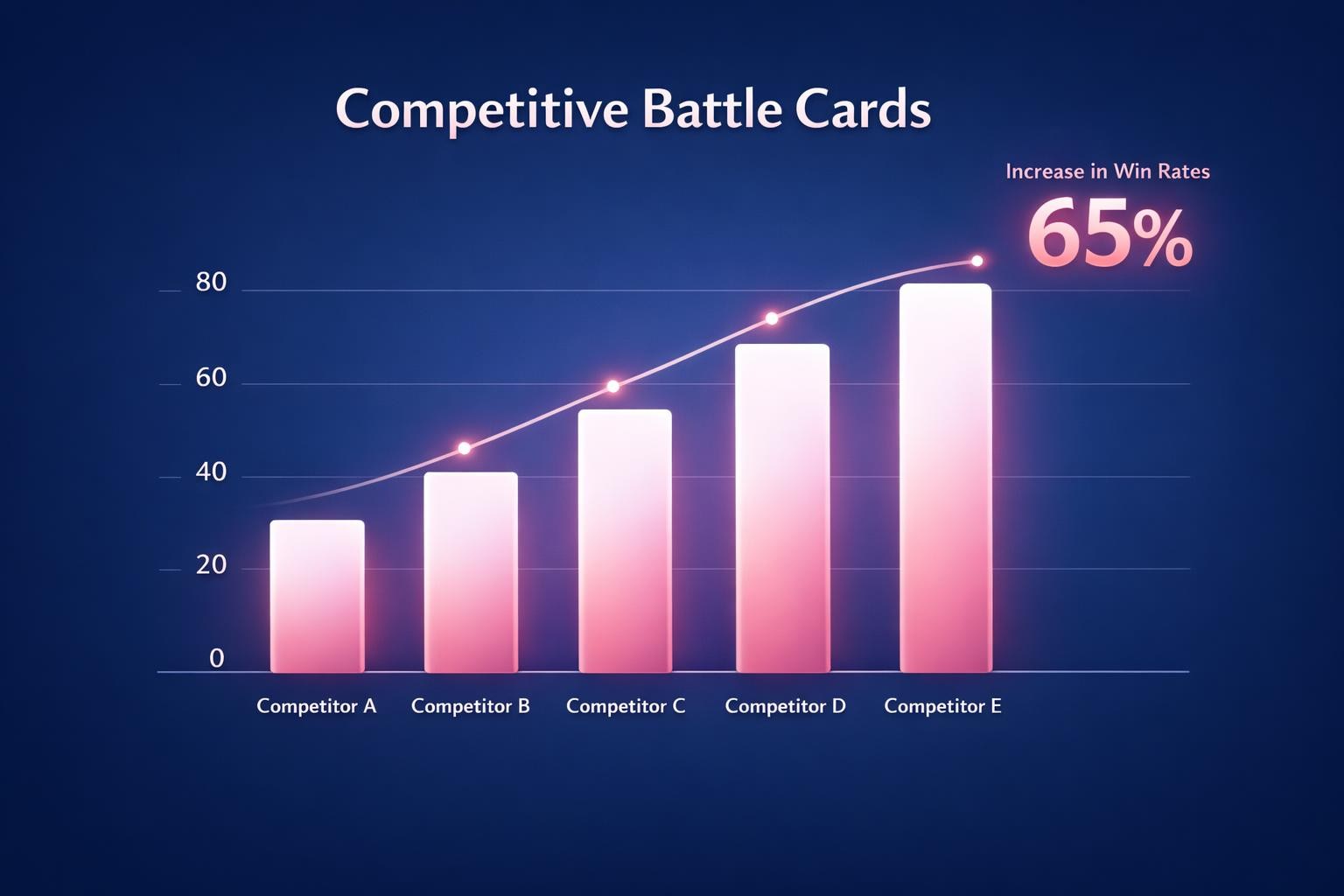
For revenue leaders who want to build a durable competitive advantage in 2026, mastering Competitive Battle Cards is not optional — it is the foundation everything else builds on. This guide gives you the complete playbook.
What a competitive battle card means in this guide
In this guide, a competitive battle card is a concise, rep-facing playbook organized around a specific competitive situation. It gives a seller documented guidance to use during a live opportunity. It is not a synonym for pipeline management, forecasting, stakeholder coverage, or general sales execution. Those disciplines can supply signals and feedback, but the battle card remains the artifact that turns those inputs into usable guidance.
The core problem is that Competitive Battle Cards is treated as a one-time event rather than an ongoing system. A card should therefore be treated as a living playbook with an owner, a defined workflow, and a recurring update process.
What to include in a competitive battle card
Use a consistent template so every card is easy to scan and coach against. A practical card can include:
- Competitive situation: Name the competitor or sales situation covered by the card and state when the card applies.
- Deal context: Record the relevant stage, milestone, buyer signals, and stakeholder activity.
- Discovery prompts: List the questions a rep should ask before choosing a response.
- Talk tracks and objection handling: Record the objection, the approved response, supporting proof, and the next question the rep should ask.
- Next action: Make the recommended action and accountable owner explicit.
- Evidence and learning: Capture what won and lost deals reveal, then feed those findings back into the card.
- Governance: Identify the card owner, review cadence, and the conditions that trigger an update.
How to research and create a battle card
1. Audit the current state
Start with an honest audit. Where is Competitive Battle Cards working well today? Where is it breaking down? What does the data say versus what the narrative says?
Review recent opportunities and identify the competitive situations that recur. Use deal data, post-deal interviews, CRM analysis, and structured win-loss reviews to separate repeated patterns from isolated anecdotes.
2. Define the intended use
For each card, specify what action should happen, at what stage, and who is accountable. An operating model for Competitive Battle Cards answers three questions: what actions should happen, at what stage, and who is accountable.
Keep each card focused on one competitive situation. Pipeline status, stakeholder coverage, and forecast data should appear only when they help the rep recognize that situation or select the next action.
3. Draft the response guidance
Turn the research into a short sequence a rep can use: recognize the situation, ask the relevant discovery questions, choose the approved talk track, address the objection, present the supporting proof, and confirm the next step.
The process that governs competitive battle cards B2B sales must be documented, taught, and enforced. Define what excellent use looks like so managers can coach against the same standard.
4. Assign ownership and review
Someone on the leadership team is accountable for the outcomes, not just the activities. They set the goals, define the metrics, and ensure the approach evolves as market conditions change.
Assign a permanent owner to Competitive Battle Cards outcomes. Build it into your operating cadence with standing review meetings, defined metrics, and quarterly improvement goals.
Three-part explainer: Audit the current state, Build the operating model, and Measure and improve.
A reusable battle-card template
Use the following blank structure for each competitor or recurring competitive situation:
- Card name and scope: Which competitive situation does this card cover?
- When to use it: Which signal, objection, stage, or milestone activates the card?
- What to learn: Which discovery questions should the rep ask?
- What to say: What is the approved talk track?
- How to handle objections: What response, proof, and follow-up question should the rep use?
- What to do next: Which action should happen, and who owns it?
- What changed: Which win-loss finding or buyer signal prompted the latest revision?
- Governance: Who owns the card, and when will it be reviewed?
This template is a practical editorial framework for applying the documented-process, clear-ownership, deal-signal, coaching, and feedback-loop guidance in the source articles. It does not introduce performance guarantees.
How reps and managers should use battle cards
Use the card during live opportunities
What works is deal-specific coaching — reviewing live opportunities with each rep, identifying exactly where their competitive battle cards B2B sales execution breaks down, and working through the fix in real time.
Managers can review whether the rep recognized the competitive situation, asked the documented questions, used the approved response guidance, and completed the next action. This keeps coaching centered on the card rather than turning the card into a label for the entire sales process.
Distribute guidance in the existing workflow
A battle card is useful only when the team can find it at the relevant moment. The source guidance calls for embedded workflows, manager reinforcement, and technology that surfaces the right action at the right moment.
Technology should serve the competitive battle cards B2B sales process, not define it. The Revspire Playbook Engine is retained here as the platform resource referenced by the source articles.
Use deal signals as inputs, not as the definition
Leading indicators might include stakeholder engagement rates, content consumption, mutual action plan progression, or deal velocity at each stage. These indicators can help a team decide when a card is relevant or whether its guidance is being used; they are not themselves battle cards.
How to maintain and improve battle cards
Capture win-loss intelligence
Every won and lost deal contains insights about what works and what does not in your approach to Competitive Battle Cards. The best teams capture them deliberately — through post-deal interviews, CRM data analysis, and structured win-loss reviews — and feed them back into playbooks, training, and strategy.
Implement a structured loss review process. Document the findings and update playbooks accordingly. Apply each finding to the relevant card instead of making an unsupported change across every card.
Review on a defined cadence
Review Competitive Battle Cards metrics quarterly against targets and update playbooks when you learn something new. A review should confirm that the card still covers the intended competitive situation, that its talk track and objection guidance remain approved, and that ownership is current.
Measure use and outcomes separately
The right metrics for Competitive Battle Cards sit at the intersection of leading and lagging indicators. Leading indicators — behaviors that predict future outcomes — give you the ability to intervene before a quarter is lost. Lagging indicators — win rates, cycle times, average deal sizes — confirm whether your approach is working.
Build a dashboard that shows both. Review it weekly. Tie it directly to coaching conversations and territory reviews. Do not attribute a revenue result to a battle card without evidence that separates the card from the broader sales process.
Three-part explainer: Expose the hidden cost, Build the business case, and Start where it matters.
Common battle-card mistakes
Treating the card as a one-time deliverable
The fix: Assign a permanent owner and a recurring review cadence. Update the relevant card when win-loss analysis produces a supported change.
Using broad sales language instead of competitor-specific guidance
The fix: Keep pipeline management, forecasting, stakeholder coverage, and general coaching outside the card unless a specific signal changes the recommended competitive response.
Relying on intuition instead of evidence
The fix: Define three to five leading indicators for Competitive Battle Cards and track them weekly. When the data disagrees with the intuition, trust the data first and investigate the discrepancy.
Measuring activity without checking outcomes
The fix: Measure outcomes, not activities. Track stage progression velocity, buyer engagement quality, and stakeholder coverage breadth.
Failing to learn from losses
The fix: Implement a structured loss review process. Document the findings and update playbooks accordingly.
Put the framework into practice
Begin with one recurring competitive situation. Create one focused card, assign an owner, coach with it during live deals, and revise it through documented win-loss feedback. Expand the library only after the first card has a clear use case and governance process.