The Complete 2026 Guide to Sales Tech Consolidation for Revenue Leaders
A practical perspective for connecting this idea to your revenue team’s next move.
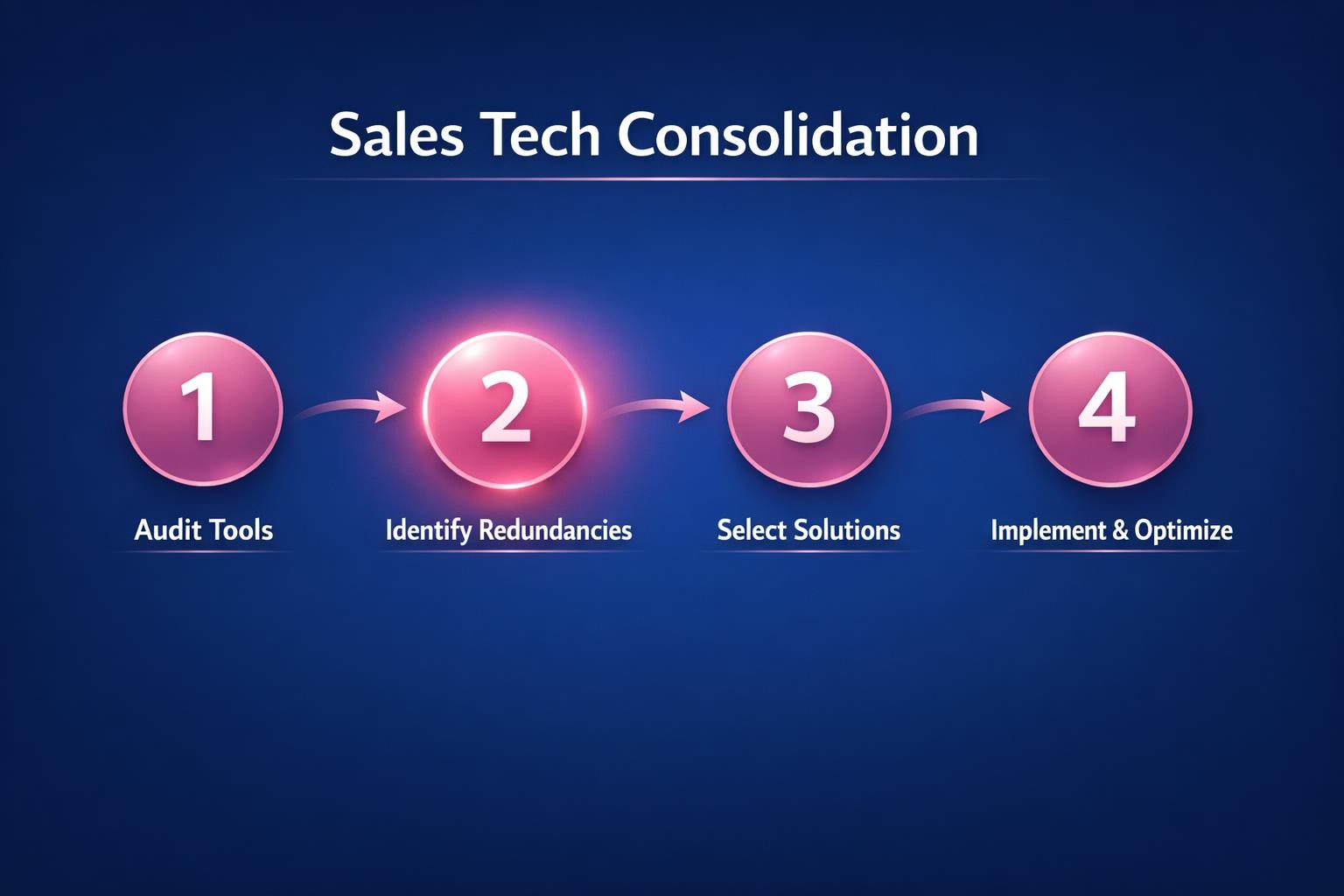
Sales tech consolidation is the deliberate reduction of the number of tools a revenue team runs, by retiring what nobody uses, merging tools that do the same job, and absorbing point solutions into a platform the team already pays for. The goal is not a smaller invoice. It is fewer places where the same record lives, fewer integrations to keep alive, and fewer tabs between a seller and the thing they were trying to do.
Last updated: 23 October 2026
This guide covers why stacks sprawl, how to build an inventory that supports a decision, where overlap sits, the four choices available for each tool, how pricing models change the arithmetic, a 90-day plan and how to tell whether it worked.
What sales tech consolidation is, and what it is not
Consolidation is a portfolio decision, not a procurement exercise. Cutting licence spend is the easiest part to measure and usually the smallest part of the benefit. The expensive costs of a sprawling stack are the ones that do not appear on a renewal notice:
- Integration upkeep. Every pair of tools that must share data is a mapping someone maintains, and it breaks when either side changes.
- Duplicate records. When two systems can both edit the same account, price or stage, they will disagree, and then nobody trusts either.
- Administration and attention. Each tool needs an owner, an access review and a place in onboarding, and every extra surface is a context switch for the people whose time is most expensive to waste.
Consolidation is also not the same as standardising on one vendor. A stack of one is rarely the right answer: CRM, conversation intelligence and enablement are genuinely different jobs. The target is the smallest set of tools that each own a distinct job well.
Why revenue stacks sprawl
Sprawl is almost never a single bad decision. It accumulates: point solutions bought for one quarter’s problem and never cancelled, team-level purchases whose overlap is only visible from above, suites that keep adding modules you already pay someone else for, pilots that became renewals nobody reviewed, and reorganisations that merge two teams and their two stacks. Because it accumulates quietly, the first job is not cutting. It is looking.
Signs it is time to consolidate
| Signal | What it usually means |
|---|---|
| Nobody can list the stack from memory | There is no owner for the portfolio, only owners for individual tools |
| Two teams report different numbers for the same metric | Two systems both claim to be the source of truth |
| Licences are bought in blocks and never reclaimed | Seat counts reflect past headcount, not current usage |
| Sellers keep a personal workaround, usually a spreadsheet | The official path is slower than the unofficial one |
| Renewals are approved because cancelling looks risky | No one has measured what the tool actually contributes |
Build the inventory before you cut anything
A consolidation decision needs one row per tool, and the hard columns are the ones people skip. Fill these in before any conversation about cutting:
| Column | Why it decides the outcome |
|---|---|
| Job it does, in one sentence | Two tools with the same sentence are candidates to merge |
| Internal owner | A tool with no owner is usually a tool with no case |
| Licences bought vs licences active in the last 30 days | The gap is the cheapest saving available, and needs no change to how anyone works |
| Annual cost, renewal date and exit terms | Consolidation happens on renewal dates, and notice periods decide whether a decision is even available this year |
| Data it owns that nothing else holds | This is the real switching cost, and the thing most often discovered too late |
| Systems it reads from and writes to | Tells you what breaks downstream when it goes |
| Who would complain, and what they would lose | Names the conversation to have before, not after |
Pull usage from the tools themselves rather than asking. Self-reported usage of a tool someone championed is not evidence. For how to think about the stack you want rather than the one you have, see our guide to B2B sales tech stack design.
Where overlap usually sits in a revenue stack
Overlap is rarely tool-for-tool. It is usually one feature in four places.
| Capability | Tools that often claim it | What to decide |
|---|---|---|
| Content library | Enablement platform, CRM, shared drive, intranet, training tool | One library of record; everything else links rather than holding copies |
| Buyer-facing sharing and tracking | Deal room, document tracking, proposal tool, email tracking | Which surface the buyer sees, and where engagement data lands |
| Quoting and approvals | CPQ, CRM quoting, proposal tool, spreadsheets | One quote of record per opportunity, approvals in one place |
| Forecasting and pipeline analytics | CRM, revenue intelligence, BI, spreadsheets | One committed number, from one definition |
| Training and practice | LMS, enablement platform, conversation intelligence | Where training and practice records live for the whole team |
Four decisions, one per tool
| Decision | When it applies | What it costs you |
|---|---|---|
| Retire | Low active usage, no unique data, no downstream dependency | Almost nothing beyond an export and a comms note |
| Merge | Two tools do the same job for different teams | A migration, and a real conversation with whichever team loses its tool |
| Absorb | A platform you already pay for covers the job adequately | Configuration and retraining; the feature is usually good enough, not better |
| Keep deliberately | The tool does one job better than any platform, and that job matters | Nothing, if the decision is written down and revisited at renewal |
“Keep deliberately” is the decision most often missing. A written reason to keep a tool stops the same argument being had every year, and it is what makes the exercise credible to the teams who did lose something.
What the content data says about sprawl
Tool counts are hard to benchmark, because every team draws the boundary of its stack differently. The effects of sprawl inside a single library are easier to measure, and Revspire’s own customer data shows what accumulation looks like once it is visible:
- A third of active content is not in use. 35% of active sales assets had no shares and no opens in the last 90 days (Revspire sales content benchmark, about 40 B2B companies).
- Some of it is out of date. 18% of active assets were past their review or expiry date, and 7% were flagged as duplicates (Revspire sales content governance benchmark).
- Curation does not fix it on its own. 32% of playbook assets, the content an enablement team specifically chose for a stage, were never opened by a seller in 90 days.
- Search pays the price. 28% of seller searches ended without the seller opening any result (Revspire seller search benchmark).
These are observed patterns in Revspire customer data, not a random sample of all B2B companies. The point is the shape rather than the figure: things accumulate faster than anyone retires them, and the cost shows up as noise rather than as a line item. The same is true of tools.
How pricing models change the arithmetic
Two stacks with the same tool count can have very different cost curves, because the unit of pricing differs.
| Model | What drives the bill | What to watch |
|---|---|---|
| Per user, per month | Headcount | Cost rises with hiring whether or not usage does; unreclaimed seats are pure waste |
| Per module or platform fee | Scope of capability | Cost is stable as the team grows, but you pay for a module whether two teams use it or ten |
| Usage or consumption | Volume of activity | Cheap to start, hard to forecast; set alerts before the quarter ends |
| Tiered packages | Which edition unlocks the feature you need | One required feature can force an upgrade for everyone |
This matters because absorbing a point solution into a per-seat platform can cost more than keeping it, while the same move into a platform priced by module usually costs nothing extra. Work out the marginal cost of each absorption before assuming it is a saving. Published list prices for the category are collected on our sales enablement software pricing comparison.
A 90-day consolidation plan
- Weeks 1–2: name an owner for the portfolio. One person, usually in RevOps, who owns the inventory and the renewal calendar. Without this, the exercise is a one-off audit that decays.
- Weeks 2–4: build the inventory. Every tool, with the columns above. Pull usage from the tools, not from a survey.
- Week 4: reclaim inactive licences. This needs no decision from anyone and changes nothing about how people work, so do it first and bank the result.
- Weeks 5–8: map the overlap, then decide tool by tool. Group tools by the job they do, not by the vendor, and mark each group’s system of record. Then retire, merge, absorb or keep deliberately, writing the reason next to each, including for the keeps.
- Weeks 8–10: sequence by renewal date and switching cost. Start with retirements, then absorptions where the platform already covers the job, then merges. Leave anything that owns unique data until you have exported and verified it.
- Weeks 10–12: communicate and migrate. Tell the teams losing a tool what replaces it and who trains them, before access is switched off. A migration nobody was warned about is how shadow tools start.
- Ongoing: review at every renewal. A consolidation done once is sprawl deferred by about eighteen months.
How to measure whether consolidation worked
| Measure | What it tells you |
|---|---|
| Tools in the inventory, and the share with a named owner | Whether the portfolio is governed or just counted |
| Licences bought vs licences active | The simplest waste measure, and the one that drifts back fastest |
| Annual run rate, and the marginal cost of each absorption | Whether the savings are real or just moved to another invoice |
| Integrations maintained in-house | The maintenance load that licence savings are supposed to buy down |
| Systems a seller touches to run one deal end to end | The seller-experience measure; count it by walking a real deal |
| Shadow tools found at the next audit | Whether consolidation removed a need or just removed a tool |
Take a baseline on every one of these before you cut anything. Consolidation projects are judged afterwards on whichever number somebody can find, and that number is usually licence spend.
Common sales tech consolidation mistakes
- Cutting on cost alone. The cheapest tool to cancel is often the one quietly holding a workflow together.
- Counting tools instead of jobs. Going from twelve tools to eight means nothing if the same four capabilities still live in three places each.
- Assuming the platform feature matches the point solution. It usually does not. Decide whether adequate is enough for that job, and say so out loud.
- Forgetting the data. Engagement history, call recordings, training records and quote history are easy to lose and impossible to reconstruct.
- Skipping the teams who lose something. A team that was not consulted buys its own replacement, and the stack grows again outside the inventory.
- Consolidating during a quota crunch. Changing how sellers quote or share in the closing weeks of a quarter buys a revenue problem to solve a cost problem.
Frequently asked questions
What is sales tech consolidation?
It is the deliberate reduction of the number of tools a revenue team runs: retiring unused tools, merging tools that do the same job, and absorbing point solutions into a platform the team already pays for, so that each capability has one system of record.
How many tools should a sales team have?
There is no credible benchmark, because teams draw the boundary of the stack differently and sales, marketing and customer success tools overlap. A more useful test is whether each capability has one system of record and each tool has a named owner and a written reason to exist. For the post-sale side, compare the best customer success software.
Where should you start when consolidating a sales tech stack?
With an inventory that includes licences bought against licences active in the last 30 days, the renewal date, and the data each tool uniquely holds. Then reclaim inactive licences, which needs no decision from anyone, before you discuss cutting any tool.
Does consolidating tools always save money?
No. Absorbing a point solution into a platform priced per user can cost more than keeping it, while the same move into a platform priced by module may cost nothing extra. Work out the marginal cost of each absorption rather than assuming consolidation is a saving.
What is the biggest risk in sales tech consolidation?
Losing data that only the retired tool held, such as buyer engagement history, certification records or quote history. Export it and verify the export before access is switched off, not after.
Revspire covers governed content, AI playbooks, role-play coaching, CPQ and digital sales rooms in one workflow, and prices by module with unlimited user licences, so cost does not grow with headcount; the average customer pays about $25,000 USD a year, quoted by sales. See Revspire pricing.
Sources
- Sales content benchmark, Revspire, aggregated customer data, October 2025 to September 2026 (accessed 23 October 2026)
- Sales content governance benchmark, Revspire, aggregated customer data, 12 months to October 2026 (accessed 23 October 2026)
- Seller search and AI assistant benchmark, Revspire, aggregated customer data (accessed 23 October 2026)
- Sales enablement software pricing comparison, Revspire (accessed 23 October 2026)