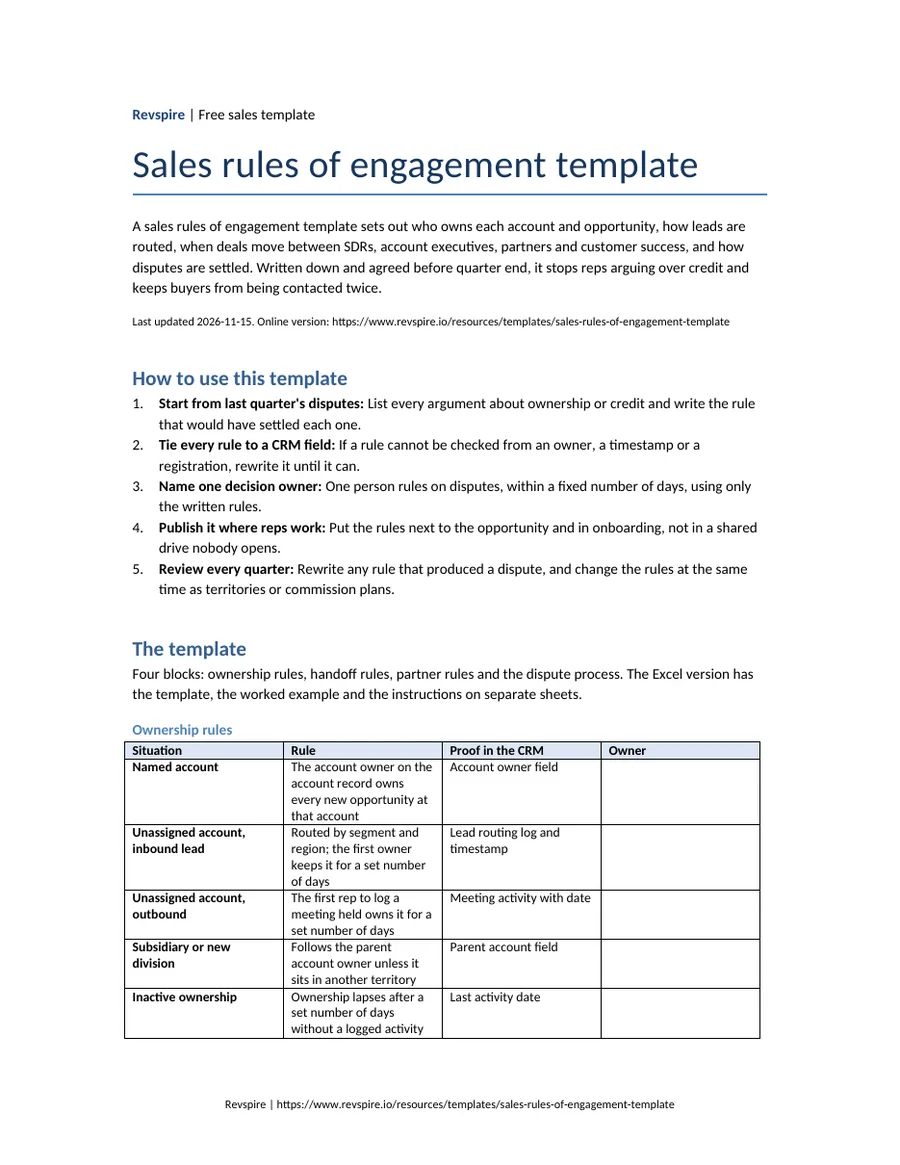
What rules of engagement cover
Rules of engagement are the operating agreement of a sales team. They answer the questions that otherwise get settled in a heated thread at the end of a quarter: who owns this account, who gets credit for this deal, and what happens when two people were talking to the same buyer.
The template has four parts: the ownership rules, the handoff rules between roles, the partner and channel rules, and the dispute process with its decision owner and deadline. Each rule has a trigger, an owner and the system of record that proves it.
Good rules are short, testable against the CRM and reviewed every quarter. If a rule cannot be checked from a field or a timestamp, it will be argued about.
When to write or rewrite your rules of engagement
- You are adding SDRs, a second sales team or a partner channel.
- Territories, segments or account lists change at the start of a year.
- Two reps claimed the same deal last quarter and nobody knew who decided.
- Customer success starts selling expansion and needs clear lines with account executives.
- Commission plans change and credit rules must change with them.
Rules of engagement, territory plan or commission plan
Three documents that are often confused. Rules of engagement sit between the other two and refer to both.
| Document | What it decides | Who owns it | How often it changes |
|---|---|---|---|
| Territory plan | Which accounts and segments each rep or team covers | Sales leadership with RevOps | Yearly, with mid-year fixes |
| Rules of engagement | How work and credit move between roles inside and across territories | RevOps, approved by sales leadership | Reviewed each quarter |
| Commission plan | What each role is paid for closed business | Finance and sales leadership | Yearly |
The template
Four blocks: ownership rules, handoff rules, partner rules and the dispute process. The Excel version has the template, the worked example and the instructions on separate sheets.
Ownership rules
| Situation | Rule | Proof in the CRM | Owner |
|---|---|---|---|
| Named account | The account owner on the account record owns every new opportunity at that account | Account owner field | |
| Unassigned account, inbound lead | Routed by segment and region; the first owner keeps it for a set number of days | Lead routing log and timestamp | |
| Unassigned account, outbound | The first rep to log a meeting held owns it for a set number of days | Meeting activity with date | |
| Subsidiary or new division | Follows the parent account owner unless it sits in another territory | Parent account field | |
| Inactive ownership | Ownership lapses after a set number of days without a logged activity | Last activity date |
Handoff rules
| From | To | Trigger | What must be handed over |
|---|---|---|---|
| SDR | Account executive | Meeting held and qualification criteria met | Notes, pains, stakeholders and next step |
| Account executive | Customer success | Contract signed | Success criteria, stakeholders, commitments made in the sale |
| Customer success | Account executive | Expansion opportunity above an agreed size | Use case, sponsor and timeline |
| Any role | Leadership | Ownership dispute raised | The facts from the CRM, not opinions |
Partner and channel rules
| Question | Your rule |
|---|---|
| When does a partner registration take precedence over a direct opportunity? | |
| How long does an approved deal registration protect the partner? | |
| Can direct reps work a partner-registered deal, and how is credit split? | |
| Who approves conflicts between two partners? |
Dispute process
| Step | What happens |
|---|---|
| 1 | The rep raises the dispute in writing within a set number of days of the opportunity being created. |
| 2 | RevOps pulls the CRM facts: owners, activity dates, routing log, registrations. |
| 3 | The named decision owner rules within a set number of working days, using only the written rules. |
| 4 | The decision is logged, and any rule that proved unclear is rewritten at the next quarterly review. |
Prefer a file? We email the Word, Excel and PDF versions to your work address, free.
Email me the filesA worked example
Example: fictional company
One dispute settled from the rules and the CRM, without a meeting.
At Marlow & Finch Logistics, an SDR booked a meeting with a prospect that an account executive had emailed two months earlier. Both claimed the opportunity. The rules gave outbound ownership to the first meeting held and let ownership lapse after 45 days without activity.
Marlow & Finch Logistics: the ruling
| Fact from the CRM | Rule applied | Result |
|---|---|---|
| Account executive: two emails, no meeting, last activity 60 days ago | Ownership lapses after 45 days without activity | No standing ownership |
| SDR: meeting held last week, qualification notes logged | First meeting held owns an unassigned outbound account | SDR-sourced opportunity |
| Territory: the account sits in the account executive's region | SDR hands over to the territory account executive | Account executive works the deal; SDR gets sourcing credit |
Example: fictional company. Ferncastle Analytics, Harborview Metrics, Marlow & Finch Logistics and every person named in this example are invented for illustration. Any resemblance to real companies or people is coincidental.
How to roll out rules of engagement
Start from last quarter's disputes
List every argument about ownership or credit and write the rule that would have settled each one.
Tie every rule to a CRM field
If a rule cannot be checked from an owner, a timestamp or a registration, rewrite it until it can.
Name one decision owner
One person rules on disputes, within a fixed number of days, using only the written rules.
Publish it where reps work
Put the rules next to the opportunity and in onboarding, not in a shared drive nobody opens.
Review every quarter
Rewrite any rule that produced a dispute, and change the rules at the same time as territories or commission plans.
Where rules of engagement go wrong
Rules nobody can check
"Whoever built the relationship" cannot be proved; a logged meeting can.
No expiry on ownership
Accounts sit with reps who stopped working them, and nobody else may touch them.
Partners left out
Direct and partner teams chase the same buyer because registration rules were never written down.
Decided by seniority
If the loudest voice wins disputes, reps stop logging activity honestly.
Rules separate from pay
If the commission plan credits differently from the rules, the plan wins every time.
Where Revspire fits
Rules only work if reps can find them at the moment they need them. Revspire's AI Playbook Engine publishes approved plays and process guidance into the places sellers already work, so the rules sit beside the deal rather than in a forgotten document.
For deals that cross roles, a Revspire digital sales room keeps the buyer, the mutual action plan and every shared asset in one place, so a handoff from SDR to account executive or from sales to customer success carries the full history with it.
Sales rules of engagement template FAQs
What should sales rules of engagement include?
Account and opportunity ownership, lead routing, how long ownership lasts without activity, handoffs between SDRs, account executives and customer success, partner and deal registration rules, and a dispute process with one decision owner and a deadline.
Who owns the rules of engagement?
Usually revenue operations writes and maintains them, sales leadership approves them, and finance checks that commission credit follows the same rules.
How do you settle a dispute over who owns a deal?
Use only the written rules and the CRM facts: owners, activity dates, routing logs and registrations. One named person decides within a fixed number of days, and any unclear rule is rewritten at the next review.
How often should rules of engagement change?
Review them every quarter and change them when territories, segments or commission plans change, so the three documents never contradict each other.
Related templates and reading
- Free templateMutual action plan templateA shared, dated plan from discovery to go-live, with a buyer owner and a seller owner on every milestone.
- Free templateStakeholder map templateEvery person in the buying group on one page, with buying role, influence, stance, priorities and a next action.
- Free templateSales enablement business case templateA one-page sales enablement business case: the problem, what ramp, rep time and turnover cost today, the options, the numbers and a dated decision ask.
- Free templateSales close plan templateEvery remaining step between verbal intent and signature, with owners on both sides, the approval chain and the risks the buyer never sees.
- Template: what moves with a signed dealSales to customer success handoff template
- Template: how presales requests are scoped and prioritisedPresales deal support template
- Template: where the rules of engagement usually liveSales playbook template
- Blog: tools that put process guidance next to the dealBest sales playbook software